The Seven Sleepers In Islamicate Textuality: Complex Crossings

MCRGenPDF.pdf_page_6

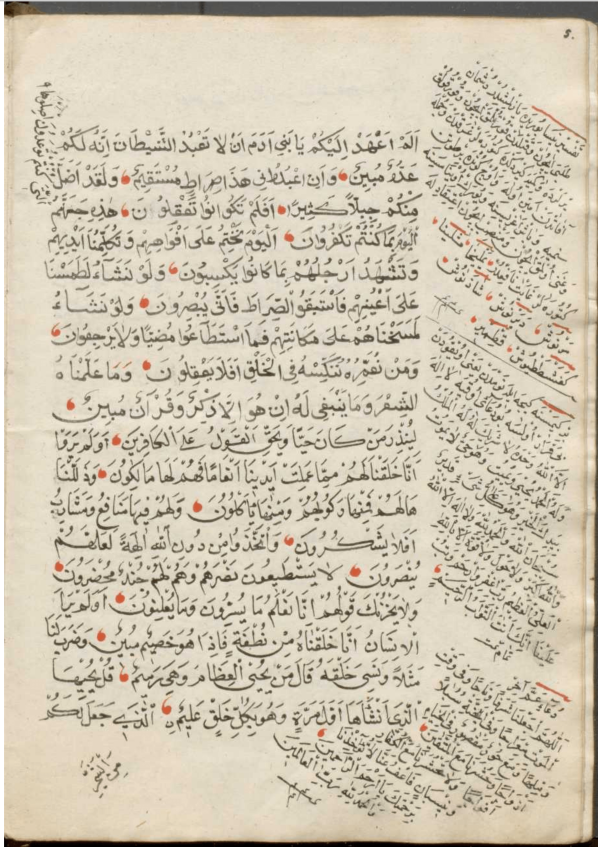
During an Islamicate manuscripts reading group I am coordinating this semester, I was looking around in my archive of digitized manuscripts for some nice examples of marginal texts and came across the manuscript from which the above image comes, a majmū’a (a collective volume of many discrete texts between two covers) of various sorts of material, produced somewhere in the Turkish-speaking part of the Ottoman Empire in the eighteenth century or so. As we read through some of the marginal comments surrounding this particular main text (a compilation of awrād, devotional litanies for use throughout the day), we came to the one in the top right corner of this page. Written in Ottoman Turkish, the note claims to relay information from the tafsīr of al-Nīsābūrī concerning the effaciousness of writing out the names of the Aṣhāb al-kahf, generally known as the Seven Sleepers of Ephesus in Christian tradition, which will ward off all manner of evil and bring much good. Briefly for those not familiar with the story, the ‘Companions of the Cave’/’Seven Sleepers of Ephesus’ were seven (though the number varies in pre-Islamic traditions, variance which is referenced- and not resolved- in the Qur’an) young men who fled from Roman persecution into a cave and were granted divine sleep for three hundred and nine years, awoke to find a totally transformed world in which Christianity was now dominant, disclosed themselves to the wondering population, then died. While the exact origin of the story and devotion to the Sleepers is now obscure, their hagiography circulated in numerous languages, from Sogdian to Old Irish, ending up in the Qur’an as a sizeable portion of Surat al-Kahf (‘the Cave’), alongside other material (including renderings of the names of the Sleepers, which are not given in the Qur’an).

In the marginal notation above only six of the human Sleepers’ names are given out of the usual Islamic seven (a number not however fixed by the Qur’an), plus that of their dog, Qiṭmīr, himself a de facto saint in Islamic tradition (his name has sometimes been treated as prophylactic aid on its own in fact). The notation is brief, but it got me thinking about the textual traces of the Seven Sleepers in the Islamicate world, which I’d like to explore a bit here. The use of names of the Seven Sleepers/Aṣhāb al-kahf provide a good view into the ways in which elements of ‘manuscript culture,’ of the textual materia of the book, crossed over into other media and spheres of life, parallel to the boundary-crossing nature of devotion to and the semantic traces of the Seven Sleepers themselves. As I discuss in a parallel but more philosophical and speculative essay on my Substack, there is a lot that we can continue to glean from this strange story and its incredible historical afterlives.

In Islamic contexts, devotion to the Seven Sleepers was expressed in multiple ways, but two stand out: one, the ‘finding’ and veneration of caves associated with them, to the point that caves reputed to have held the Sleepers in their several centuries of sacred slumber proliferated across the Islamicate world, from Turkestan to the Maghrib (with a similar proliferation present in Christian lands). But even more widespread were the names of the Sleepers: as with several other sites of Islamic devotion, in the general absence of pictorial icons, names and verbal descriptions served as de facto ‘icons’ reproducing the presence and the sacred power of holy figures. In the early modern Ottoman context, beyond Muhammad and his house, verbal ‘icons’ of the Four Rightly Guided Caliphs, of the Ahl al-Badr (fighters and martyrs in the Battle of Badr), and the Aṣhāb al-kahf were frequently reproduced within manuscripts and across other media, in some cases also embedded in other texts. There are no doubt many reasons for this focusing on names; in the case of the Companions/Sleepers, it is partially an inheritance of the late antique heritage, as visible in lines from the sixth century Syriac poet St. Jacob of Serug (translated here by Sebastian Brock):

There were there two wise men, sons of the leading men,
and they reckoned that the Lord would resurrect them,
so they made tablets of lead and placed them beside them,
on them they wrote down the names of the children of light…

Already there is a sense of their names having an important function, if not quite the prophylactic one they would gain in early modern Islam. By whatever routes however, those names- which as we will discuss below, were inherently distinctive just in their spelling- would be the locus of devotion and power for Islamic audiences, and traces of that devotion and power are readily visible in the manuscript tradition.

In the example below, a short poem (for those who do not read Arabic, it is the section marked with what look like red commas) off gives their names in succession and then details the particular potencies of each name when written down, either for a certain thing or upon certain media. The names of the Sleepers are written in red (fifth through seventh lines), the virtues of each then adumbrated in a series from ‘the first’ to ‘the seventh,’ the numbering also rubricated:

25_00b96_default

Early modern Islamic audiences took such messages to heart: the names of the Companions do indeed appear in many, many contexts outside of manuscripts. Here are two of them: first, a prophylactic seal made in the eighteenth century Ottoman world (Met. 1983.135.11), the text consisting primarily of the Sleepers’ names intertwined; the stamp produced by this seal could have been applied to manuscripts, or perhaps for the production of stand-alone amulets, upon documents, and so forth (perhaps even on walls, one wonders). As with many such calligraphic amuletic devices, human legibility is not primary in terms of the effectiveness of the writing; and in this case, even a cursory look at the writing suggests whose names are given here:

DP299947

At the other end of portability (well, almost- obviously it was disassembled and moved at some point!) is this fireplace of Iznik tile (V&A 703-1891), built in 1731 for the home of someone quite well off indeed; the names of the Sleepers run across the very middle of the installation, the only instance of text in the entirety of the piece: Continue reading “The Seven Sleepers In Islamicate Textuality: Complex Crossings”
The Funduq Saint of Fez: ‘Abd al-Majīd and His Exceptional Acts of Devotion

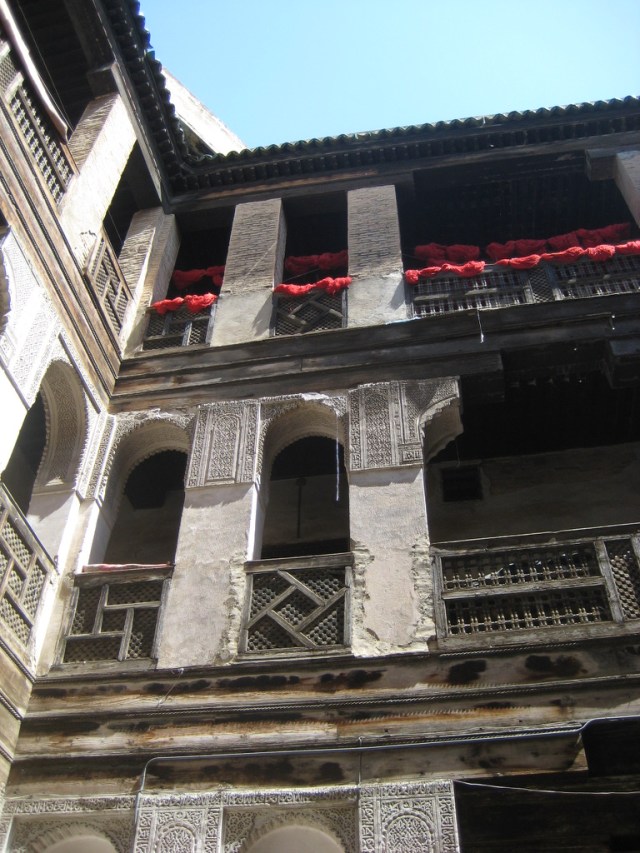
As far as I can tell, the ‘Abd al-Majīd Funduq is no longer extant; however, it may have resembled in general plan and ornamentation this early 18th century example, Funduq Ṣāgha, pictured here from my visit in the spring of 2008.

Early modern Islamic religious life across Afro-Eurasia was marked by many trends and developments with roots in the medieval period but which took on new and often surprising forms in the following centuries. One of the most important trends was the explosive growth of devotion to Muḥammad, growth both in terms of apparent overall popularity but also, and more objectively measurable, growth in the number of textual instruments, ritual practices, and social settings oriented towards Muḥammad-centered devotion. Alongside this growth in devotion was another trend that does not at first glance seem related, namely, the continued flourishing and adaptive transformations of ‘deviant’ mendicant piety, the sort exemplified in the late medieval period by the Qalandar and other types of ‘radical’ dervishes, and in the early modern particularly by the majdhūb. Such forms of ascetic practice and aspiration to sainthood often eschewed compliance with the sharī’a, or at the very least transgressed many social norms in a deliberate fashion.

The following saint’s life, preserved in a seventeenth compilation of outstanding holy or learned (or both) lives, comes from Morocco, Fez to be precise, and embraces both of the above trends in early modern Islamic religious life. The saint, Sīdī ‘Abd al-Majīd, was acclaimed a saint, at least according to our author al-Ifrānī, because of his incredible, indeed super-human, devotion to the Prophet of Islam. The first few paragraphs of his life, the entirety of which I have translated here, lay out his acts of devotion and his saintly inner states, including the curious detail that his ecstatic remembrance of Muḥammad took place even in the latrine- a detail which hints at a somewhat non-normative manner of life. It is in the following paragraphs that we are given further indications that ‘Abd al-Majīd was not universally admired and that his mode of life had many parallels with that of the ‘deviant’ dervishes better known from the Islamic East. But before we consider just what kind of a saint he was, it would be better to read his life as al-Ifrānī has described it:

Among them, the well-known saint and great gnostic Sīdī ‘Abd al-Majīd ibn Abī al-Qāsim al-Bādisī: he was originally from the Rif [1], from the region of the Banū Yaṭifat; he was of the Malāmatiyya, and dwelled in the funduq [2] associated with him north of the Qarawiyyīn Mosque, which is now known as the Funduq of Sīdī ‘Abd al-Majīd. He practiced numerous prayers upon the Prophet, God bless him and give him peace, constantly devoted to him and to prayers upon him, of immense affection towards him, enraptured in love of him, and of great love towards the Folk of the House [3]. And whenever he commenced with invocation of blessings upon the Prophet, God bless him and give him peace, he would begin with saying: ‘I take refuge in God from Shayṭān the accursed. In the name of God the Merciful, the Compassionate: verily, God and His angels pronounce blessings upon the Prophet—O you who believe, pronounce blessings upon him and ask for him peace!’ He would complete this arrangement in good order, letter by letter, then say: ‘O God, bless Muḥammad!’ then ecstasy would overwhelm him and he would simply cry out, ‘Muḥammad! Muḥammad!’ He did not cease remembrance of him standing or sitting, in whatever condition he was in, even in the latrine (bayt al-khalā’). It was said to him, ‘Do you mention him in the latrine?’ He replied, ‘It dwells, O brother,’ meaning, perhaps, love [of Muḥammad], but God knows best. Continue reading “The Funduq Saint of Fez: ‘Abd al-Majīd and His Exceptional Acts of Devotion”

Safavid Devotional Art in Steel, Script, and Scroll

1987.14
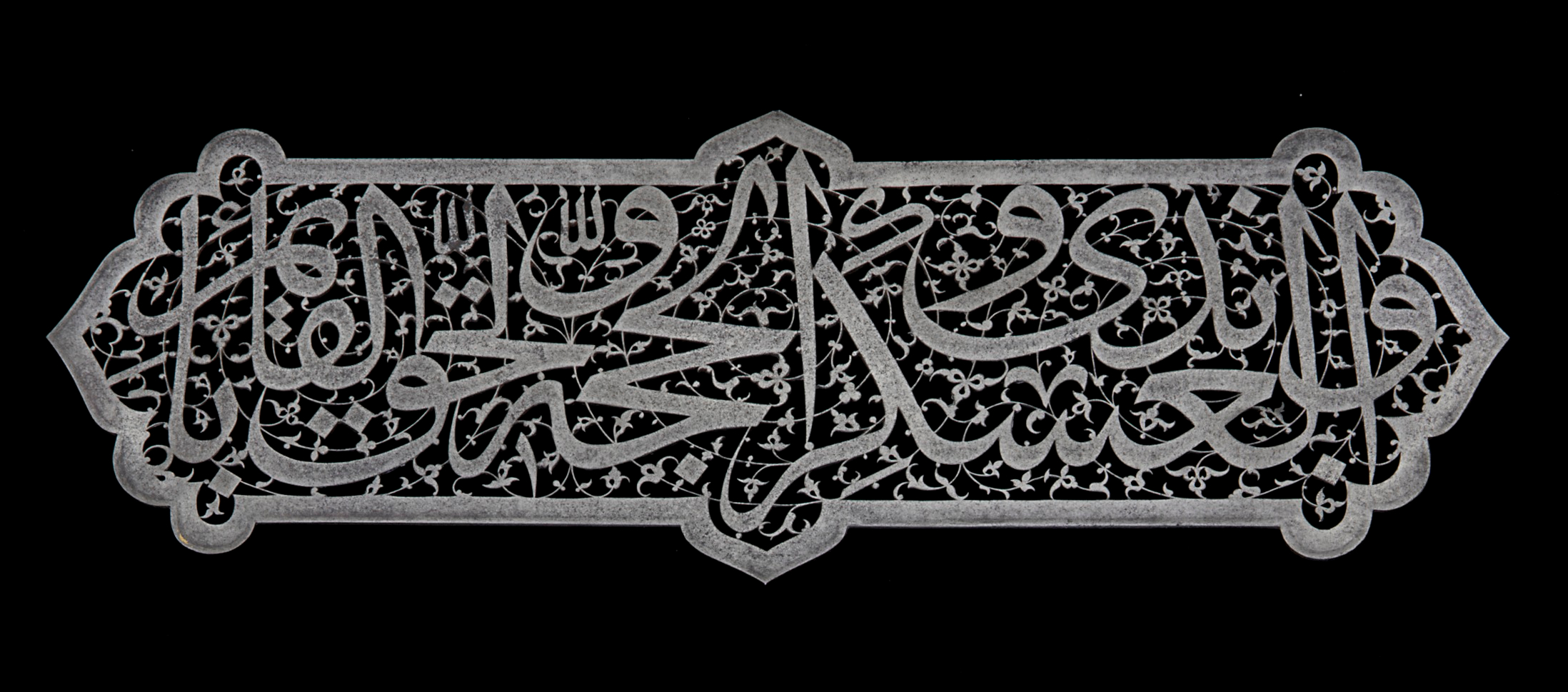
A Safavid pierced steel plaque, probably late 17th century, featuring a calligraphic rendering of part of a poem in praise of Muḥammad, Fāṭima, and the Twelve Imams, formerly part of a larger set distributed in a shrine or similar structure. Metropolitan Museum of Art 1987.14

Pierced metal plaques such as the one above must surely count among the most spectacular instances of Safavid art to modern eyes, with their stark contrasts, incredible fineness of detail, bold clean lines surrounding delicate ornament, and obvious evidence of extremely skilled craft. Plaques such as this one- see below for another, quite similar example- once formed part of the interior of Safavid shrines, either to one of the Twelve Imāms or to the far more frequent imāmzādehs, the descendents  of the Imāms, who were also more likely to be found in Safavid controlled territory (there were also cases of saints’ shrines of various sorts being ‘converted’ to an imāmzādeh after the rise of the Safavids). Others were found on the tombs of Safavid shahs and in the massive shrine complex of Ṣafī al-Dīn, the Safavid eponym, in Ardabil. In 1550 large number of such plaques were ordered and installed by Shah Tahmāsp I in the shrine of Imām Riḍā in Mashhad, with further production through the rest of the Safavid dynasty.

Copyright_David-Collection_Copenhagen_28-1997_web.jpg
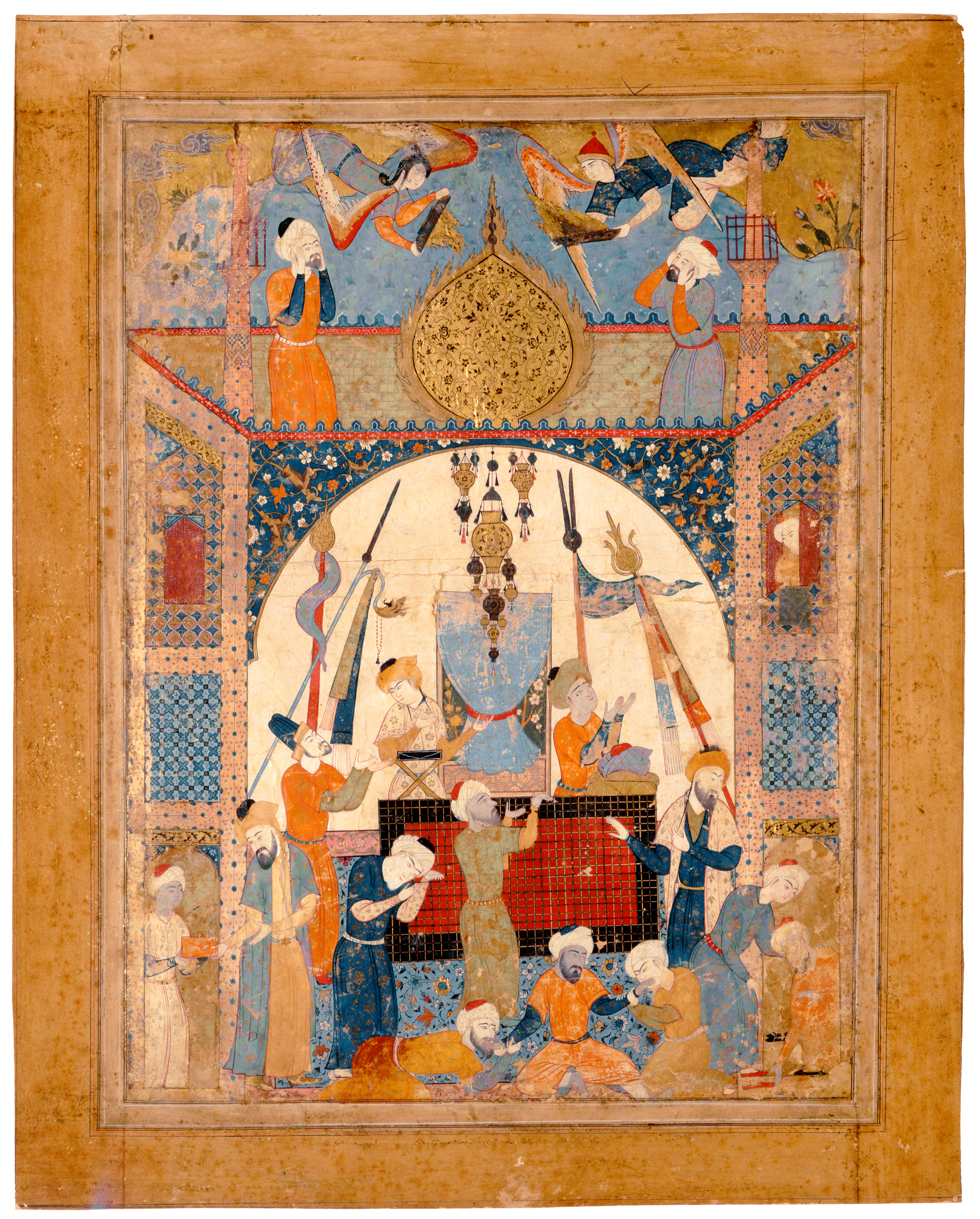
The interior of the shrine of an Imām or an imāmzādeh, from a circa 1550 Safavid Fālnāmeh (‘book of divination’). Besides showing the internal architectural layout of a Safavid shrine, it provides a nice view of the activity that might go on there. (David Collection Inv. no. 28/1997)

So far as I know none remain in situ, a consequence of their likely original location- probably upon the grill-like structure surrounding the location of the tomb itself (see the 16th century illustration above for an idea of what such a space would have looked like). Such structures, as well as the built fabric of shrines in general, tend to be subject to great use, wear-and-tear, and continual renovation; as a result these plaques were dispersed and now reside in various museums and collections. Originally, however, they would have been visible to those making pious visitation (ziyāra) to the holy people whose tombs they adorned.

Decorative Plaque Plaque
Another Safavid pierced plaque, here extolling the last of the Twelve Imāms, also from the late 17th century. (Freer & Sackler F1997.21)

In terms of content, these plaques extoll and in some cases supplicate the prayers of the Twelve Imāms, as well as Muḥammad and Fāṭima, acting both to channel the intercessory power of these figures while linking the entombed person to the ‘People of the House.’ While devotion to the Twelve Imāms was not limited to Shi’i Muslims historically- contemporaneous Ottomans who would have regarded themselves as good Sunnis venerated the Twelve Imāms as well- such devotion was especially central to Shi’i Islam and to Safavid religious identity. These plaques signaled, to those who could read them (or have them read to them), that centrality, while also acting as inscribed requests for intercession, connecting the People of the House and their baraka to whatever shrine their names were place within. The sheer skill, time, and resources that were involved in producing such works were in themselves acts of devotion (along with the patronage of such work).

CBL Is 1623
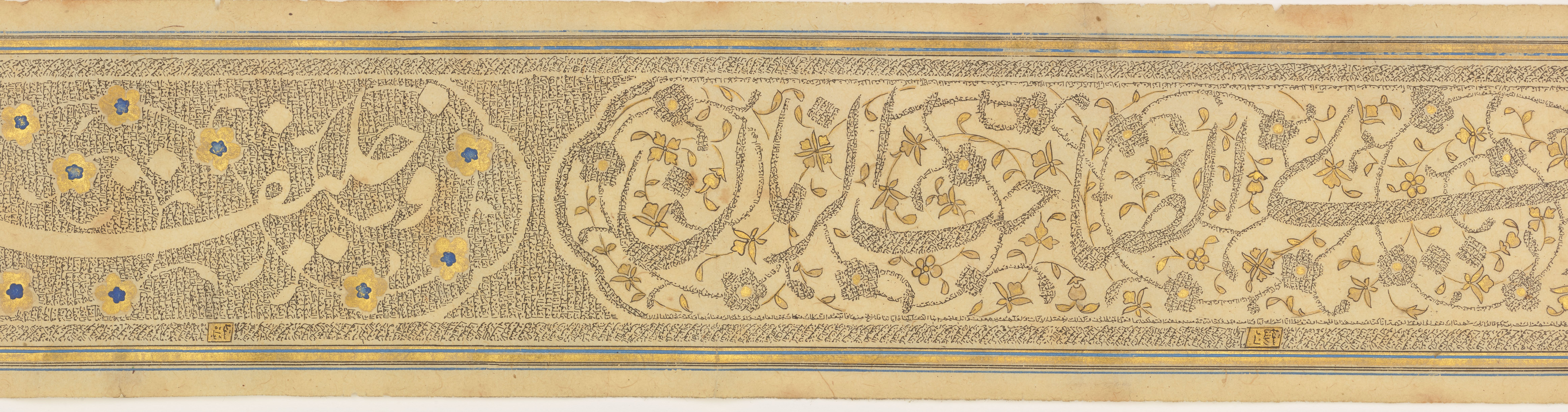
Above and below: sections from a Safavid Qur’an scroll written in ghubār (‘dust’) script with extensive illumination (Chester Beatty Library Is 1623)

default.jpg

Continue reading “Safavid Devotional Art in Steel, Script, and Scroll”

Explicating Devotion to Muhammad, Part i.

image
Opening page to Kara Davutzâde Mehmed Efendî, Tevfik muvaffikü’l-hayrât li-neyli’l-berekât fi hizmet menbai’s-saâdât, University of Michigan, Special Collections Library, Isl. Ms. 672

Late medieval and early modern devotion to Muhammad in Islam was first and foremost a matter of personal and communal practice, embodied in devotional regimes, public rituals, habitual expressions, and material objects, among other practices and techniques. But it also unfolded at a discursive, textual, and homiletical level, with scholarly and semi-scholarly productions explicating, extolling, and critiquing various aspects of devotion to the Prophet appearing from the late medieval period forward in multiple languages of Islam. The genre of commentary (Ar. sharḥ/Ott. Trk. şerh) was an important vehicle for delivering explication of devotional practices and their intersection with theology and other Islamic disciplines. Numerous commentaries on ṣalawāt– the litanies of blessing upon Muhammad- and related sorts of texts appeared across the Ottoman world and beyond, in both Arabic and Ottoman Turkish (and in other languages further east). Like much early modern commentary production in Islamic societies, these texts have received little engage scholarly attention, though the neglect of commentaries is starting to change. In the following weeks I’d like to give some samples of commentary on devotional texts, starting with excerpts from commentary on what was perhaps the most important text of devotion to Muhammad, al-Jāzūlī’s Dalā’il al-khayrāt.

But before presenting translated texts and analysis of them, I’d like to start with the above image. It comes from the opening page of a beautifully executed manuscript copy of an Ottoman Turkish translation and expansion of an Arabic commentary on al-Jāzūlī’s prayerbook. Titled Tevfik muvaffikü’l-hayrât li-neyli’l-berekât fi hizmet menbai’s-saâdât, this work, which goes through, line by line, the text of Dalā’il al-khayrāt, was composed by an eighteenth century author, Kara Davutzâde Mehmed Efendî, about whom I know no more than can be gleaned from the text. The commentary was aimed at many audiences, especially, it seems, pious women, and may have been meant to furnish material for preachers.

The charming miniature that is framed at the top of the page, a depiction of Medina, centered on the Prophet’s Mosque, is a good example of the devotional iconography that grew up around devotion to Muhammad, in many contexts, featuring images of Mecca and Medina, the tomb of Muhammad and the tombs of the Four Rightly Guided Caliphs, the footprint of Muhammad (and other physical traces), and so on. Such images had many functions: they presented the physical presence of Muhammad and his close associates in an iconographic manner but without actually depicting Muhammad directly. Instead they summoned his presence by pointing the viewer at the material traces of his life and memory, a sort of icon at remove. They had an educational value, giving the reader or viewer a sense of what the holiest places of Islam and the artefacts of the Prophet looked like. And finally they had a prophylactic purpose- that is, early modern Muslims might display or otherwise have on hand these images as a way of warding off evil and misfortune, based on their icon-at-a-remove connection to Muhammad and his powerful intercession. The above image- which is also just simply beautiful and delicately rendered- participates in all of the above.

O Monarch of the Heart

In yesterday’s post I introduced the theme of late medieval and early modern devotion to Muhammad, a ‘movement’ within Islam that became dominant and widespread by the end of the middle ages, especially flourishing in the early modern period. The texts of this devotion were not only written in Arabic: rather, devotion to Muhammad was often expressed in vernaculars. The following translated poem, by an Ottoman sufi şeyh and saint, Muhammed Nasûhî Üsküdarî (d. 1718), is a part of a larger collection of poetry of praise and supplication directed towards Muhammad, written in Ottoman Turkish. It is a good example of this genre of poetic composition, which was common across the Ottoman world and beyond, expressing theological concepts as well as emotional bonding between the poet and his object, Muhammad. I have included footnotes at points to clarify certain references that would have been relatively obvious to a contemporary reader or listener but might not be to my readers here.

Iznik Flower Panel

You are the cure of my sickness, yâ Muhammed Mustafa!
You are the sovereign of my heart, yâ Muhammed Mustafa!

Who am I that I dare to praise you, o monarch of the heart?
You are the light of the moon of Yâ-sin [1] yâ Muhammed Mustafa!

You hold sway over the inner secret of this habitation below, o mirror of the True!
You are the monarch of the throne of If you had not been [2], yâ Muhammed Mustafa!

Without sign, without place, in your inner secret I beheld your essence.
You are the spirits of the passionate lovers, yâ Muhammed Mustafa!

To the crooked-statured, sin-bearing Nasûhî [3] give
Help—you are a remedy, yâ Muhammed Mustafa!

Üsküdarlı Muhammed Nasûhî, [‘Poem 6’], in Üsküdarlı Muhammed Nasûhî ve Dîvânçe-i İlâhiyat’ı, ed. Mustafa Tatcı (Üsküdar, İstanbul: Kaknüs Yayınları, 2004), 166-167.

[1] A reference to the 36th surāh of the Qur’an, Surāh Yā’-Sīn, sometimes referred to as ‘the heart of the Qur’an.’

[2] An allusion to a hadith qudsi– a hadith said to convey God’s speech, though not as part of the Qu’ran- in which God says to Muhammad words to the effect of ‘If you not been I would not have created the universe.’

[3] Including one’s name in the penultimate line is an Ottoman convention, carried over from Persian poetic convention.

Devotion to Muhammad in Medieval and Early Modern Islam: An Introduction

Hilye triptych
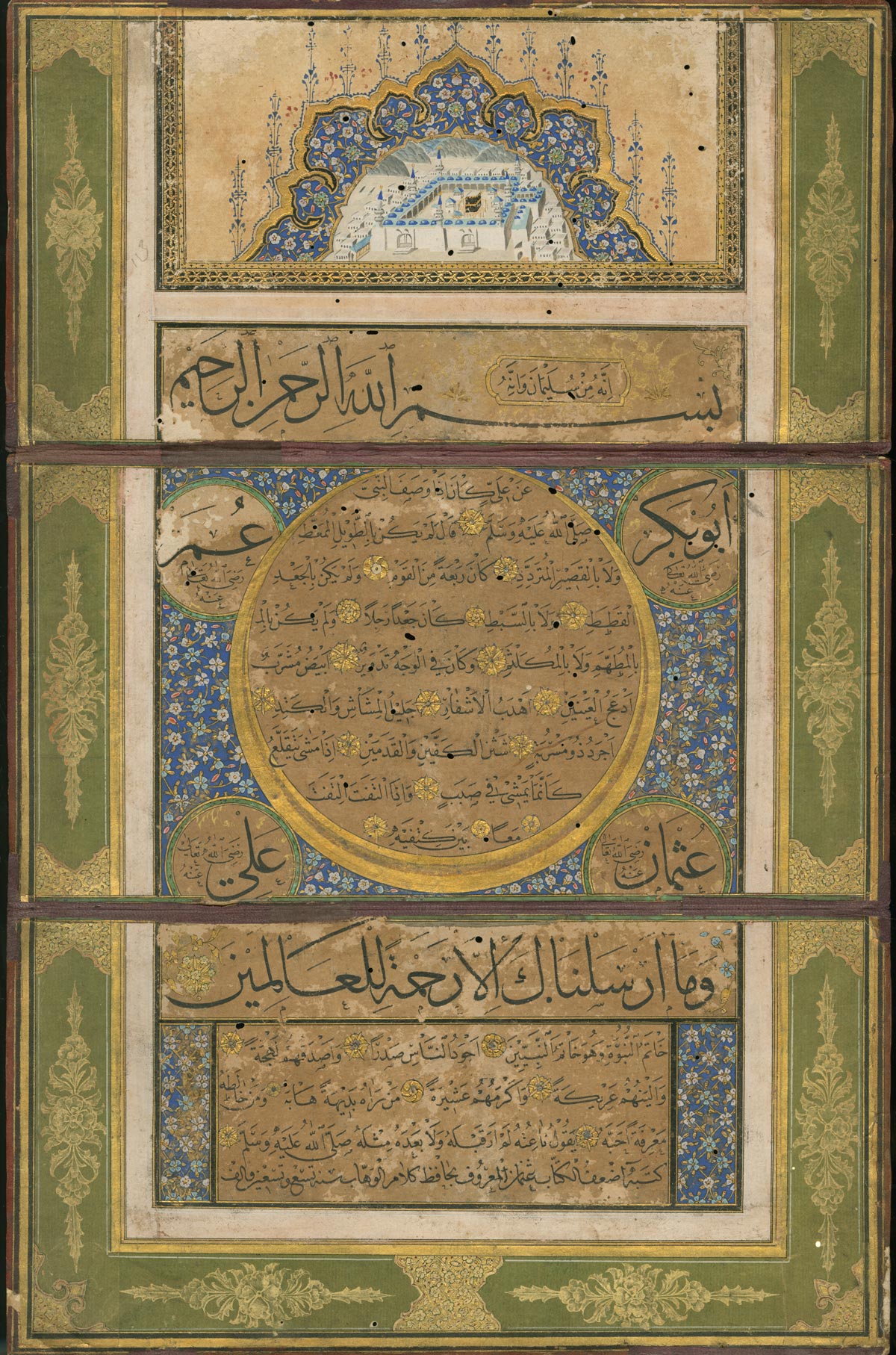
A three-panel Ottoman ḥilye-i şerîf-  a description of Muhammad’s physical attributes, or ‘verbal icon’- by Ḥafîẓ Osmân Efendî (d. 1698). Note the miniature depiction of Mecca in the top panel. Special Collections Library, University of Michigan, Ann Arbor, Isl. Ms. 238.

There are a number of aspects of medieval and early modern Islam (and contemporary living Islam too, for that matter) that tend to surprise, even shock, many modern-day observers, especially non-Muslims who nonetheless have some degree of knowledge about the ‘basics’ of Islam. Because of the wide-spread and often quite profound changes that have transformed Islam in many places throughout the world over the last century and a half or so, there is a great deal in pre-modern ‘mainstream’ Islam that many contemporary Muslims might find odd, unexpected, or even heretical. One such source of surprise and even shock is the history of the image and meaning of Muhammad in Islamic theologies and devotional practices. If, like me, in your initial exposure to Islam you learned that Muslims—throughout time, perhaps?—viewed Muhammad as ‘only’ a prophet, and no more, then Islamic theology that talks about the Muhammadan light, the cosmic role of Muhammad within God’s creative plan, and the intercessory power of the Prophet, and so on, must all sound quite strange and even ‘un-Islamic.’ Indeed, I remember thinking, as I delved into the vastness of ‘Muhammadology,’ that much of the theology I was discovering bore a marked resemblance to Christology, in particular to Logos theology, in Christianity.

Yet far from being aberrant or peripheral, the theological ‘elevation’ of Muhammad that took place in the course of the Islamic medieval period was a transformation that occurred and impacted Islam across the board. It was not just a ‘Sufi’ thing or a matter of ‘popular’ religion. Devotion to Muhammad, alongside theological renderings of the ‘cosmic Muhammad,’ coursed through the very veins of Islam from the middle ages into early modernity and beyond. The person and role of the Prophet Continue reading “Devotion to Muhammad in Medieval and Early Modern Islam: An Introduction”

Turn Toward a Sacred Precinct Filled With Acceptance

‘Ā’isha al-Bā’ūnīyah (d. 1517) was a female Sufi master from Damascus, living in the twilight years of Mamluk rule and the very beginning of Ottoman control of the region. She is one of the most prolific, if not the most prolific, female Muslim writer in the pre-modern era, writing treatises, poetry, devotional literature, and the like, including a mawlid-text (a text in celebration of Muhammad’s birth) that would prove to be of enduring popularity. The following is a poem from her diwan that is representative of her deeply emotional and affective piety and poetic style.

2006BK4224_jpg_l
Mamluk-era polychrome tile (c. 1420-1459), Damascus.

When I sought union from the one I love,
His majesty replied that there was no path to Him.

So, I closed my eyes that had tried so hard to see Him,
while in my heart, desire burned with separation’s fire.

I was about to meet my death, when He was kind,
and sweetly spoke to my heart, saying:

‘If you want union from Us, be true to Us,
set aside all else, strive for Us, and be humble.

Leave yourself and come to Us with Our true love and grace.
Make that your means to Me.

Draw near to Us, be devoted to Us; don’t fear rejection.
Turn toward a sacred precinct filled with acceptance.

There, you will find providence draws you to Us,
bringing sweet union,

And you will leave there all but Us
and appear in a station where true men alight.

You will behold lights of power, and in their intensity,
the shadow of difference will go and disappear.

You will pass away, nothing to preserve you save Our splendor,
as you behold, truly, the climax of desire.

Then you will abide with Us, Our servant,
pure, chosen by Us for Our secrets forever!’

_______________________________

‘Ā’isha al-Bā’ūnīyah, Fayḍ al-Faḍl wa-Jam’ al-Shaml, translated by Th. Emil Homerin, in Emanations of Grace: Mystical Poems by ‘Ā’isha al-Bā’ūnīyah (Louisville: Fons Vitae, 2011), 64.