No More Notebooks for Shaykh ‘Alwān

Preacher with Ink instead of Rosewater
An illustration of the interior of a 17th century Ottoman mosque, which wouldn’t be too far off from the setting of the below story- the preacher on the minbar (with hands in his deep sleeves), the candles at the mihrab, the men seated to listen to the preaching, and the neatly lined up shoes, all would have been seen, albeit in somewhat different forms (the floral decoration on the side of the minbar, for instance, is a clear indication that this is a 17th or 18th century setting). (Walters M.666)

Shaykh ‘Alwān (d. 1530) was one of the major Muslim saints of late Mamluk into early Ottoman Damascus. While possessed of the multifaceted education typical of a member of the ‘ulama of his time, Shaykh ‘Alwān’s most important formation came at the hands of an itinerant holy man from the Maghrib (modern day Morocco, ‘Ali al-Maymūn. The following story, related by Najm al-Dīn al-Ghazzī, an important source for saints’ lives from early Ottoman Syria, describes Shaykh ‘Alwān’s first encounter with the man who would become his spiritual preceptor. Besides illustrating a saintly miracle of sorts, it incidentally provides a look at how an early modern Muslim preacher would conduct his sermons, namely, with a handbook of useful material tucked up his sleeve (literally!).

DP230667

Shaykh ‘Alwān related to [Shaykh Yunūs) in 924: He was preaching in Hama, in accordance with the custom of preachers—using a notebook with pleasing stories, wise anecdotes, and edifying reports and accounts, when al-Sayyīd ‘Ali ibn Maymūn—who was also preaching in Hama—passed by him, stopped before him, and said: “O ‘Alwān, preach from your head, and not from a notebook!” But Shaykh ‘Alwān did not pay him any mind, so he said the same thing a second time, then a third. Then, Shaykh ‘Alwān reported, “That caused me to pay attention, and I knew that he was from among the Friends of God. So I said to him: ‘It’s no good for me to preach from my head—meaning by heart.’ He replied: ‘Nay, preach from your head!’ I replied: ‘Ya Sayyīdi, only if you help me!’ He said: ‘I do, and trust in God!’ So when I awoke the next morning I went to the preaching session, with my notebooks in my sleeve. When I sat down the Sayyīd was opposite me. I began speaking from the heart, and God inspired (fataḥa) me, and that inspiration has continued until now!”’

Najm al-Dīn al-Ghazzī, al-Kawākib al-sāʼirah bi-aʻyān al-miʼah al-ʻāshirah (Beirut: Dār al-Kuttub al-‘Ilmiyya, 1997), v. 2, 204-5).

Explicating Devotion to Muhammad, Part i.

image
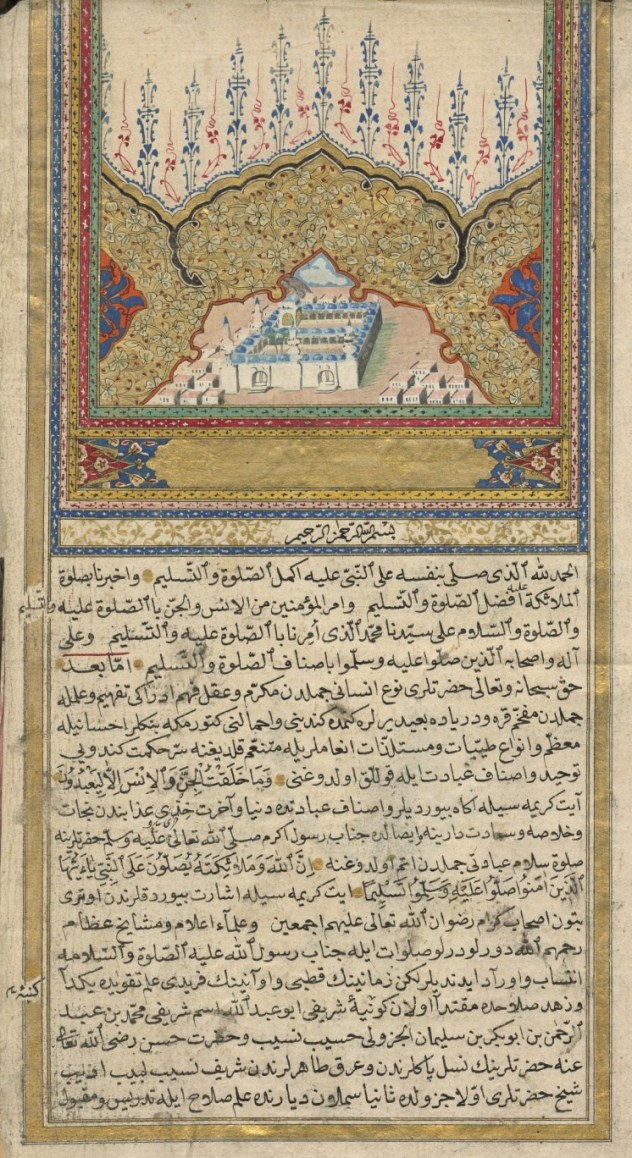
Opening page to Kara Davutzâde Mehmed Efendî, Tevfik muvaffikü’l-hayrât li-neyli’l-berekât fi hizmet menbai’s-saâdât, University of Michigan, Special Collections Library, Isl. Ms. 672

Late medieval and early modern devotion to Muhammad in Islam was first and foremost a matter of personal and communal practice, embodied in devotional regimes, public rituals, habitual expressions, and material objects, among other practices and techniques. But it also unfolded at a discursive, textual, and homiletical level, with scholarly and semi-scholarly productions explicating, extolling, and critiquing various aspects of devotion to the Prophet appearing from the late medieval period forward in multiple languages of Islam. The genre of commentary (Ar. sharḥ/Ott. Trk. şerh) was an important vehicle for delivering explication of devotional practices and their intersection with theology and other Islamic disciplines. Numerous commentaries on ṣalawāt– the litanies of blessing upon Muhammad- and related sorts of texts appeared across the Ottoman world and beyond, in both Arabic and Ottoman Turkish (and in other languages further east). Like much early modern commentary production in Islamic societies, these texts have received little engage scholarly attention, though the neglect of commentaries is starting to change. In the following weeks I’d like to give some samples of commentary on devotional texts, starting with excerpts from commentary on what was perhaps the most important text of devotion to Muhammad, al-Jāzūlī’s Dalā’il al-khayrāt.

But before presenting translated texts and analysis of them, I’d like to start with the above image. It comes from the opening page of a beautifully executed manuscript copy of an Ottoman Turkish translation and expansion of an Arabic commentary on al-Jāzūlī’s prayerbook. Titled Tevfik muvaffikü’l-hayrât li-neyli’l-berekât fi hizmet menbai’s-saâdât, this work, which goes through, line by line, the text of Dalā’il al-khayrāt, was composed by an eighteenth century author, Kara Davutzâde Mehmed Efendî, about whom I know no more than can be gleaned from the text. The commentary was aimed at many audiences, especially, it seems, pious women, and may have been meant to furnish material for preachers.

The charming miniature that is framed at the top of the page, a depiction of Medina, centered on the Prophet’s Mosque, is a good example of the devotional iconography that grew up around devotion to Muhammad, in many contexts, featuring images of Mecca and Medina, the tomb of Muhammad and the tombs of the Four Rightly Guided Caliphs, the footprint of Muhammad (and other physical traces), and so on. Such images had many functions: they presented the physical presence of Muhammad and his close associates in an iconographic manner but without actually depicting Muhammad directly. Instead they summoned his presence by pointing the viewer at the material traces of his life and memory, a sort of icon at remove. They had an educational value, giving the reader or viewer a sense of what the holiest places of Islam and the artefacts of the Prophet looked like. And finally they had a prophylactic purpose- that is, early modern Muslims might display or otherwise have on hand these images as a way of warding off evil and misfortune, based on their icon-at-a-remove connection to Muhammad and his powerful intercession. The above image- which is also just simply beautiful and delicately rendered- participates in all of the above.

O Monarch of the Heart

In yesterday’s post I introduced the theme of late medieval and early modern devotion to Muhammad, a ‘movement’ within Islam that became dominant and widespread by the end of the middle ages, especially flourishing in the early modern period. The texts of this devotion were not only written in Arabic: rather, devotion to Muhammad was often expressed in vernaculars. The following translated poem, by an Ottoman sufi şeyh and saint, Muhammed Nasûhî Üsküdarî (d. 1718), is a part of a larger collection of poetry of praise and supplication directed towards Muhammad, written in Ottoman Turkish. It is a good example of this genre of poetic composition, which was common across the Ottoman world and beyond, expressing theological concepts as well as emotional bonding between the poet and his object, Muhammad. I have included footnotes at points to clarify certain references that would have been relatively obvious to a contemporary reader or listener but might not be to my readers here.

Iznik Flower Panel

You are the cure of my sickness, yâ Muhammed Mustafa!
You are the sovereign of my heart, yâ Muhammed Mustafa!

Who am I that I dare to praise you, o monarch of the heart?
You are the light of the moon of Yâ-sin [1] yâ Muhammed Mustafa!

You hold sway over the inner secret of this habitation below, o mirror of the True!
You are the monarch of the throne of If you had not been [2], yâ Muhammed Mustafa!

Without sign, without place, in your inner secret I beheld your essence.
You are the spirits of the passionate lovers, yâ Muhammed Mustafa!

To the crooked-statured, sin-bearing Nasûhî [3] give
Help—you are a remedy, yâ Muhammed Mustafa!

Üsküdarlı Muhammed Nasûhî, [‘Poem 6’], in Üsküdarlı Muhammed Nasûhî ve Dîvânçe-i İlâhiyat’ı, ed. Mustafa Tatcı (Üsküdar, İstanbul: Kaknüs Yayınları, 2004), 166-167.

[1] A reference to the 36th surāh of the Qur’an, Surāh Yā’-Sīn, sometimes referred to as ‘the heart of the Qur’an.’

[2] An allusion to a hadith qudsi– a hadith said to convey God’s speech, though not as part of the Qu’ran- in which God says to Muhammad words to the effect of ‘If you not been I would not have created the universe.’

[3] Including one’s name in the penultimate line is an Ottoman convention, carried over from Persian poetic convention.

The Thought of Fishing

As noted in a previous post, the Ottoman majdhūb/meczûb (the first is the Arabic rendering, the second the same term but in Ottoman Turkish)- the divinely drawn saint or holy madman- was often involved in the details of everyday life, such as the smoking of tobacco. In the following story, which comes from a compilation of meczûb lives in a sprawling 17th work of hagiography by Mehmed Nazmî EfendiHediyyetü’l-ihvân, we see one of these holy madmen miraculously discern the wandering thoughts of the imam in the greatest mosque of Ottoman Istanbul.

IMG_2952
A view of the courtyard of the Süleymâniye Mosque, the setting of the following story

‘And there was one, Hızır Aşak, who was from among the great (ulular) of the meczûb. He was a powerful meczûp capable of unveiling inner secrets. It is related that the imam of the Süleymâniye Mosque, Süleymân Efendi—who was later dismissed and sent into retirement—was one day leading the noon prayers, when the thought came to him: “After completing the salât, I’ll go to Hisar [on the Bosporus] and go fishing.’ Just as this thought was occurring to him, Hızır Aşak came to the mosque, and, as was his custom, cried out “Hû!” [i.e. ‘He,’ meaning God, a common sufi form of zikr] and said, “Süleymân Çelebi! You are here, your mind ought not be off fishing in Hisar. There is no prayer without presence of heart. Lead these men in prayer a second time.” Having said this he left the mosque. Süleymân Çelebi related thus: “This unveiling of the mad one brought about divine fear and embarrassment before the people in me. For a little while I passed out! Coming to, I properly completed the prayers.”’

Mehmed Nazmî Efendi, Hediyyetü’l-ihvân

Ottoman Majdhūb/Meczûb: Two Stories

The following accounts treat an important, and well-nigh ubiquitous, type of Ottoman Muslim saint, the majdhūb (meczûb in Ottoman Turkish), the ‘divinely attracted or drawn one.’ For a longer explanation of this ‘mode’ of sainthood, see this post of mine from a while back. One of the chapters of my forthcoming dissertation will consist of a detailed history and analysis of majdhūb sainthood, as well. The two accounts below represent the different ways and environments in which this ‘immersive’ saintly identity could operate, across the diverse lands of the Ottoman Empire. The first, from an Arabic biographical compilation from the mid-17th century, treats the arguably most important and well known majdhūb saint in the Ottoman world, Abū Bakr ibn Abū al-Wafā’ al-Majdhūb (d. 991/1583), of Aleppo. The dervish complex and mazār (place of visitation or shrine) that grew up during his lifetime and especially after his death still stands, having gone from being on the outskirts of the city to well enveloped within it, a monument to the centrality this strange and powerful saint took on both during and after his life on earth (for more on this saint and his legacy, see Watenpaugh, Heghnar Zeitlian. “Deviant Dervishes: Space, Gender, and the Construction of Antinomian Piety in Ottoman Aleppo.” International Journal of Middle East Studies 37, no. 4 (2005): 535–65). In the story I have translated we see the saint’s intervention in one of most dangerous and pressing situations in any pre-modern society, the threat of drought- with the mere suggestion that drought might be imminent enough to send local markets into a price-raising frenzy, as noted in this story. The saint’s strange behavior- open to all manner of interpretation- is also displayed here, out of a long list of stories of strange and far more shocking action than manifested here. Continue reading “Ottoman Majdhūb/Meczûb: Two Stories”

A Mad Saint, a Dervish, and a Flash-Flood

The following is a pair of Muslim saints’ lives, included in a biographical compilation (Luṭf al-samar wa qaṭf al-thaman) by an early 17th century Ottoman author from Damascus, Najm al-Dīn al-Ghazzī, the scion of a prominent family of ‘ulama, and one of the more prolific Damascene authors of the first part of the 17th century. His biographical histories include many saints’ lives, with a special emphasis on holy men with whom he or his saintly brother Shihāb al-Dīn al-Ghazzī had contact. Perusing the pages of these collected lives, a veritable ecosystem of sainthood and sanctity comes to life, populated by individuals of striking piety and of often controversial actions and behavior. Sainthood was and is a deeply social phenomenon, particularly in the Ottoman world wherein no ecclesial or political authority offered canonical guidance in the question of who was and was not a ‘true’ friend of God. Rather, something of a consensus among devotees would emerge, often alongside challenges from other directions, concerning a given person’s sanctity and closeness to God.

In the first life which I have translated here, we meet an enigmatic majdhūb, or possessed saint, who displayed seemingly erratic and irrational behavior, interpreted by those around him as the manifestation of jadhb, or divine attraction. Like many such majadhīb, he seems to have come from a rural environment, and in lieu of complex doctrinal teachings, he manifested his sainthood through strange, even shocking actions. And like many such possessed saints, he deliberately transgressed social boundaries, in particular, strictures on gender segregation and contact. His companion, Dervish Ḥusayn, was also marked by his transgressing of social norms, in his case, through living for a time an extremely hermetical life, even refusing to speak directly to most pious visitors. Yet before we imagine a gulf between such ‘transgressive’ forms of sanctity and the scholarly ‘ulama class from which our author hailed, al-Ghazzī also describes the ties of members of the ‘ulama with these two saints. Dervish Ḥusayn, for instance, made an exception to his hermit’s life to discuss religious matters with al-Ghazzī and his shaykh.

Finally, these two lives, Continue reading “A Mad Saint, a Dervish, and a Flash-Flood”

A Picnic on Imam al-Shafi’i’s Dome

maqbara-of-imam-shafee
The dome of al-Shāfi’ī’s tomb in Cairo, Egypt, with its distinctive and somewhat mysterious boat perched atop. Source.

When once [‘Abd al-Wahhāb al-Sha’rānī, d. 1565] was hindered from making a visit to [the tomb of] Imām al-Shāfi’ī, God be pleased with him, he [al-Shāfi’ī] came to him in a dream-vision and said to him: ‘O ‘Abd al-Wahhab, I am censuring you for your paucity in visiting me!’ ‘Abd al-Wahhāb replied, ‘Tomorrow I’ll come and visit you.’ But the Imām said to him: ‘I won’t release you until I go with you to my place.’ So he took him by the hand, until he ascended with him upon the back of his dome (qubba), underneath the boat (markab) that is upon it. He spread out for him a new mat and place before him a dining-cloth upon which was tender bread, cheese rounds, and split open for him an ‘abdallāwī melon. He said to him: ‘Eat, O ‘Abd al-Wahhāb, in this place which kings of the earth now departed desired to eat!’

Muḥammad Muḥyī al-Dīn al-Malījī, Tadhkirat ūlī al-albāb fī manāqib al-Shaʻrānī Sayyidī ʻAbd al-Wahhāb

The Beauty and the Sublimity, Winter and Summer

The following is a single discourse from a collection of discourses by the seventeenth century Ottoman Sufi mystic and scholar Ismāʿīl Ḥaḳḳī, featured previously on this blog here: Sufi Concision. It is a rather dense little piece, despite only being a couple paragraphs. I will keep my explication short, in part because I am reluctant to put words in the author’s mouth, and do not fully understand the lineaments and depths of his particularly cosmology and symbolic apparatus.

The central motif of this discourse is the contrast between manifestations of God’s beauty (al-jamāl) and His sublimity (aljalāl), a word that might also be translated as ‘majesty’ or ‘magnificence.’ The concept of a sort of dualism in God’s nature or manifestation of Himself had existed for some time in Sufi thought before Ibn ‘Arabi developed the idea into the form upon which our author here is drawing. The most explicit development of Ibn ‘Arabi’s thought on the beauty and the sublimity can be found in, not surprisingly, a short treatise titled Kitāb alJalāl wal-Jamāl, available in an English translation from the Ibn ‘Arabi Society. Therein Ibn ‘Arabi complicates previous ideas of God’s manifestations of beauty and majesty, arguing against a rather simplistic interpretation of those attributes and the ways in which they might be experienced by humans. Ismāʿīl Ḥaḳḳī picks up this ‘complication’ of the attributes, and extends Ibn ‘Arabi’s original conception into the cosmological interactions of humans, nature, revelation, and God.

There appeared to me regarding [Muhammad’s] words, Winter is the spoils of the believer, that the most important of affairs for the perfect among the believers is the matter of religion, not the matter of this world. And winter aids in the realization of the latter matter, in that days are shorter and nights longer. For the shortening of nights makes fasting easier, while the lengthening of nights makes standing [in prayer] easier—in variance with summer, as the days are longer and the heat stronger, forbidding the aforementioned benefits. Sleep has the ascendency during summer nights due to their shortness and the languor of bodies [due to summer heat].

So know that summer is the site of the manifestation of God’s Beauty (al-jamāl) in deed in regards to outward form (min ḥaythu al-ṣūrah), however, in it is God’s Sublimity (jalāl) in potency in regards to inner meaning (alma’inā). But when earthquakes, violent storms, lightning strikes, and their like, occur in the summer, and as for winter in general, then it is the opposite: the Sublimity is manifest exteriorly, while the Beauty is manifest interiorly. Therefore, there does not occur in it what occurs in the summer as aforementioned. And in the nature of winter is a advantageous benefit which points to the fact that the perfect believer, whenever trial or trouble befalls him in regards to himself, to his possessions, or to his family, he takes advantage of that situation and recoups benefit. For if under every misfortune is another misfortune, on the contrary, the perfect one is he who finds sweetness in the Sublimity like that which he finds in the Beauty. And if not, then he is incomplete [in his mystical realization], because all that occurs is from God, and what is from God is not bitter to the true enraptured lover of God. It is the custom (sunnah) of God to first instruct someone through the Beauty, and if the person does not thus become aware of Him, He instructs him through the Sublimity. And if he does then become aware of Him, He uproots him—we take refuge in God from that and from all which is merely exterior.

The one who seeks ascension finds it in repentance and in the manifestation of his incapacity, not elsewhere. God possesses people who serve Him in hardship and ease equally—so look into what leads to Him: their perfect knowledge and complete tranquility of soul.

Ismāʿīl Ḥaḳḳī (1063/1652-1137/1725)