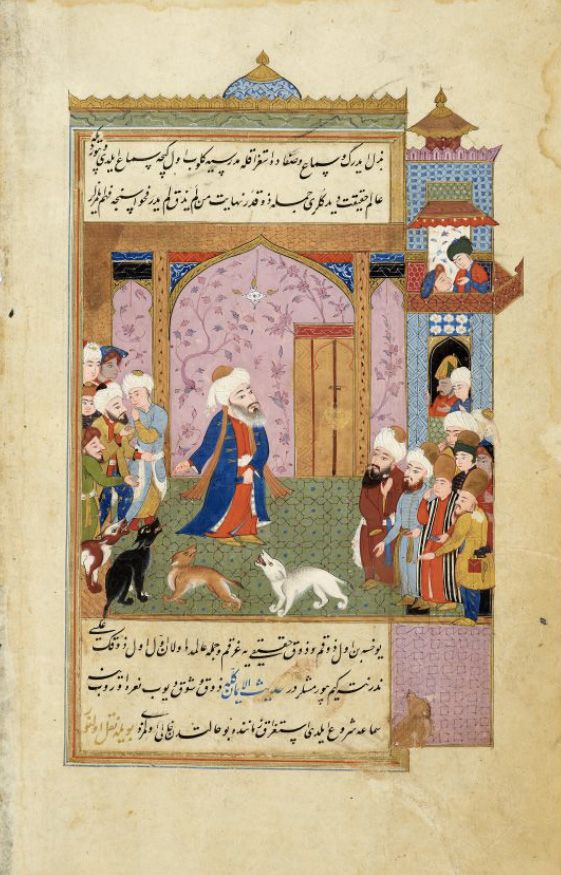
Mevlana Rumi addresses dogs in the marketplace, from a c. 1590 copy of the Ottoman Turkish translation of Aflākī’s menāqib of Rumi (Morgan Library MS M.466, fol. 66v)
The following story hails from a massive hagiographic compilation in Ottoman Turkish, Hediyyetü’l-ihvân,written by one Mehmed Nazmî Efendi (d. 1669) and dealing with the lives of a series of saints leading up to his own şeyh (Ar. shaykh) in the seventeenth century. This story comes from the life of Şemseddîn Ahmed Sivâsî (1519-1597), who was born in the little town of Zile in Anatolia and eventually settled in Sivas, becoming in time quite well known, to the point of Sultan Süleyman the Great inviting him to go on campaign with him to Hungary. The charming tale that I have translated here points to his fame among the towns and villages of this part of Anatolia. It also reminds us of the complicated relationship between people and dogs that has historically been the case in Islamic lands: we see both an outbreak of ‘anti-dog’ measures in the person of the (unnamed and castigated) kadi, the studied ambiguity of a hadith, and the robust support of the saint, simultaneously. That a saint would intervene on behalf of unjustly treated dogs is not particularly surprising- accounts of Mevlana Rumi’s interactions, and those of his followers, with dogs circulated in the Ottoman world, as witnessed by the above illustration, contemporary in fact to this story.
From among his miracles was the following: the people of Karahisâr-ı Şarkî [modern Şebinkarahisar] sent messengers to Şems asking him that he honor them with his preaching, counsel, [performance of] zikr [1], and his blessed noble beauty. In answer to their supplication he came, and was honored immensely, being given a fine place to stay as well as much feasting and amiable conversation. For some time he preached, gave counsel, and led zikr, then announced that he was returning to Sîvâs. When the scholars, şeyhs, merchants, notables, and ordinary people of the town all came together to give him a farewell with honor and respect, numerous dogs also came before the saint, and, as if presenting complaints, began barking! When Şems asked why they were barking so, the people replied, “Because there has been plague and pestilence in our town, the kadi [2] of our town ordered the killing or banishing of the dogs, so that we killed some and we banished some. These are dogs that we banished.”
The saint cried out, “Your kadi was heedless of the hadith which says, If dogs were not a community (umma) from among the communities, then I would order them killed.” [3] Saying that, he addressed the dogs: “Go safely and soundly back to dwell and to be at rest in your former places!” As the townspeople returned from bidding the saint farewell, they saw these words fulfilled as the dogs, understanding the command, followed after the people back into town to their usual places—and having done so, by the command of God, the plague was lifted on that very day!
[1] That is, the practice of ‘remembrance (Ar. dhikr) of God’ in a ritualized manner.
[2] The kadi- literally, ‘judge,’ from Ar. qāḍī- was not just an arbitrator of legal cases but, in the Ottoman context, a multi-task administrator.
[3] The meaning of this hadith, attributed to Muhammad, seems to be that dogs have a special status as an umma, which normally means a religious community (such as the umma of all Muslims); this special status outweighs any negative aspects dogs may have.
Şeyh Mehmet Nazmi, Osmanlılarda tasavvufî hayat: Halvetîlik örneği : Hediyyetü’l-ihvân, edited by Osman Türer (İstanbul: İnsan Yayınları, 2005), 359-360. Translation by Jonathan Parkes Allen, 2018.
This final installment- for now at least- in this series of texts dealing with Ottoman women’s lives in the context of sainthood comes from the life of ‘Abd al-Ghanī al-Nābulusī (1621-1731), arguably the most important early modern saint of the Arab provinces, who combined the practice of sanctity with a vast scope of scholarship and literary endeavors (for more on him see this post and this one). The following account comes from a massive hagio-biography treating his life, Wird al-unsī wa-al-warid al-qudsiī fī tarjamat al-ʻārif ʻAbd al-Ghanī al-Nābulusī, which was compiled by the saint’s great-grandson, Muḥammad ibn Muḥammad al-Ghazzī (1760-1799). Al-Ghazzī’s account covers almost every aspect of his great-grandfather’s life, including ‘Abd al-Ghanī’s mother’s ‘foretokens’ of her unborn son’s future saintly greatness. In introducing the section from which the below accounts are taken, al-Ghazzī says: ‘Just as there are foretokens for the prophets before [the manifestation of their] prophethood, so the saints of God have miracles occur for them even before the coming to light of their manifestation [as saints], and before they even have capacity for that.’
While, then, these stories are ultimately meant to be understood as signs of ‘Abd al-Ghanī’s sainthood- which was at work, as it were, and evident even while he was in his mother’s womb- they also reveal quite a bit about ‘Abd al-Ghanī’s mother and the relationship between holy men in early modern Damascus and women in general, reinforcing what we saw in a previous post. Here the holy man in question is a majdhūb, a ‘divinely drawn one’ akin to a ‘holy fool,’ a ‘mode’ of saint that I have dealt withrepeatedly on this site (and which will feature prominently in my forthcoming dissertation and, God willing, eventual book project). The majādhīb (the plural of majdhūb) had a central presence in ‘Abd al-Ghanī’s life, from before birth and even after his death (one of his daughters would become a majdhūba), a relationship that his mother clearly contributed towards forging. The practices and the sacred presence of the majdhūb saint tended to result in the temporary breakdown of social expectations and protocol, both in terms of gendered relations but also in more fundamental ways (such as the strictures against throwing rocks at guests!). That women in Damascus would particularly numbered among Shaykh Maḥmūd’s devotees is not surprising- but neither is ‘Abd al-Ghanī’s ongoing devotion to the saint, an example of which I have also included in this translated excerpt.
Besides the accounts of ‘Abd al-Ghanī’s mother’s relationship with the saint Maḥmūd translated here, we are also learn from ‘Abd al-Ghanī’s own writings that his mother’s death and burial saw the miraculous intervention of another majdhūb, ‘Alī al-Nabkī, who walked from his village to the city just as ‘Abd al-Ghanī’s mother’s body was being washed. We are meant to understand by all of this, I think, that ‘Abd al-Ghanī’s own sanctity was not entirely unique to him- his mother, in her own way, was a holy woman, numbered in the ranks of the friends of God, male and female.
17th century tile from Ottoman Damascus (Met. 1993.315)
As for the good tidings his mother received about him, they were many. Among them is that which she herself related, saying, “The saints and majādhīb used to give me good tidings concerning him, and about his elevated status, and the majesty of his power, before his birth.” From among that was that the pious Shaykh Maḥmūd the Majdhūb—who is buried by the tomb of Shaykh Yusuf al-Qamīnī atop Jabal Qāsiyūn [1]—gave her good tidings of him while she was pregnant with him. He gave her a silver coin and said to her: “Name him ‘Abd al-Ghanī for he will be victorious.” He said to her another time, “Give good tidings to ‘Abd al-Ghanī concerning the divine abundance (al-fayḍ)!” Shaykh Maḥmūd died one day before the master was born. He had said to her: “When you give birth to him, bring him to my tomb, and rub him with dust from it before you bestow his name upon him [2].” Whenever he saw her he would honor her greatly, and say to her, “I venerate the one whom you bear, for by God he will possess greatness and immense power!” Continue reading “Ottoman Women and the Lives of Saints, iii.: The Majdhūb and the Pregnant Lady”→
This post begins a three-part series of accounts of women’s lives that I have discovered ’embedded’ in hagiographical literature from the early modern Ottoman world, lives which I’ve selected for the variety they show, both in the social and economic profiles of the women they feature, and in the ways that the interact with the holy men in the stories. I’ve featured women in Ottoman hagiography before (such as in this recent post), and I could have easily extended this series many times over: for as it turns out, women tend to be quite visible in these sorts of sources, often doing and saying things that might come as a surprise for those who tend to imagine Islamic and Middle Eastern women of this period living highly secluded, strictly gender-segregated existences. While not always true, women tend to be sympathetic or virtuous (or both) characters in these accounts, often being singled out for their devotion and trust in the saint in question, not infrequently in contrast to higher-status men who do not show such trust and suffer the consequences. And across accounts we see women from a range of backgrounds and stations in life freely associating with male saints and crossing into the physical space of the saint- living and departed- in ways that might not have been countenanced so readily by Ottoman men in other spaces.
In the following brief account, taken from a major 17th century compilation of lives of notable people- including numerous saints- of Damascus and beyond by the scholar Najm al-Dīn al-Ghazzī, we encounter an unnamed woman (a frequent feature in this stories, reflecting gender norms that did not break down even in the textual presence of a saint) who is close to the saint featured here, one Muhammad Abū Muslim al-Ṣamādī (911/1505-994/1585), a charismatic and popular saint of Damascus whom al-Ghazzī considered one of the greatest and most important holy men of the 10th Islamic century. The woman and her husband in this story seem to be of originally nomadic origin- hence the appellation ‘son of an Arab,’ which suggest Bedouin background- but spent at least part of their time in Damascus, going out to the steppes (which lie quite close to the city) at certain times of the year. Note also in this story both the identity of the woman- she herself is described as being a saint, though we are given no further details, unfortunately- and the apparent freedom with which she associated with not just al-Ṣamādī but al-Ghazzī’s father and al-Ghazzī himself.
It also reached me that a man called Muhammad ibn ‘Arab [that is, the son of an ‘Arab] went out eastward [into the steppes] in order to bring in some cattle, and on his way back he spent the night in fearful place. The night was extremely windy and had heavy rain. He related: “It was the middle of the night, when a movement spooked the animals and they bolted. I despaired of regathering them, so I cried out: ‘Yā Abī Muslim, this is your time!’ Then scarcely the blink of an eye later and the animals had come together to me from every direction until they were all assembled.”
The wife of this “ibn ‘Arab” was a holy woman from among the saints of God, who believed in Shaykh Muhammad al-Ṣamādī and who used to believe in my father as well, frequently visiting him and then me after him. She said: “I went to [Shaykh Muhammad al-Ṣamādī] Abū Muslim one day, and my husband was absent on that journey. He said to me: ‘Ya Umm So-and-So I am going to tell you something you must not relate until after I have died. Last night your husband’s animals fled from him so he cried out to me, seeking my aid. So I picked up a stone and threw it towards him, and his animals came back together. He will come to you soundly nothing having happened to him.’”
The Ottoman army enters a city, from an illuminated copy (Met. 45.174.5) of the Divan of the poet Bâkî (1526–1600). Note the banner held aloft by the soldiers in the top right corner, similar to what we might imagine the saint in the tanner’s story below carrying; also note the diversity of soldiers and other support personnel visible.
Like early modern militaries the world over- and in fact like any organized and sizeable military, right up into the present- the Ottoman military relied on a vast body of ‘support staff’ to travel on campaign and wage warfare. Many of these support staff were recruited from the guildsmen of Istanbul and other major cities in the empire, the craftsmen and artisans and merchants being required to essentially pick up shop and go on campaign, agreeing to offer their services at a set price. In the following short story, taken from an Arabic biographical and hagiographical compendium by the scholar Balī ibn ‘Alī, also known as Alî Mınık (d. 1584), the miracle story is related by a tanner from Edirne who had recently returned from campaign. As is often the case in these sorts of stories, the details are thin, but we are probably meant to imagine a battle involving a fortress on the frontier with the Hapsburg lands. The story is pretty self-explanatory: besides being narrated by a member of the army’s ‘support staff,’ the story is interesting for what it reveals about the perceived role of seemingly unassuming saints in Ottoman military successes, and the imaginative travel, if you will, of otherwise sedentary saints out to the contested frontier.
A close-up from the above of the army’s banner.
‘Among the miracles (karamāt) of [Şeyh Alâüddînd Cerrâḥzâde/‘Alā al-Dīn al-Jarrārzada, 1495-1575]’: the story that our shaykh Muṣlaḥ al-Dīn [the son of ‘Alā al-Dīn], God be merciful to him, related, saying: “We were sitting outside of the aforementioned zawīya [the Dergâh of Şeyh Şücaeddin, in Edirne] with some of the disciples. Tanners in the city had previously been drafted to go on campaign. A tanner came up and kissed my father’s hand, then kissed his feet, and said, ‘If it hadn’t been for you we wouldn’t have taken the fortress!’ My father said, ‘What is this fortress? I don’t know anything at all about it.’ The man persisted in his entreaty and humble supplication, but [my father] persisted in his denial.
So we asked the man about the story, and he said: ‘I went out to war for the Sultan with a detachment of tanners. When we had invested Such-and-Such Fortress, and aimed to seize it, the fighting wore on, and the flame of piercing and striking flared up, so that the fortress was refractory and refused to be conquered. The army was bewildered and despaired of seizing it, until suddenly a shaykh with a banner in his hand appeared, charging at the infidels, scattering them like dust struck by a powerful cold wind. He scaled the fortress and planted the banner upon it. The soldiers of the Islamic army followed after him, entering the fortress through this spot, its conquest becoming easy because of that man. My companions and I got a close look at the man—it was Shaykh ‘Alā al-Dīn, there being no doubt that he came on military campaign with us, and was present for the conquest of the fortress, yet we marveled that we had never once seen him while on the way there!’”
“Later, when I was alone with my father I asked him about the reality of this matter, so as to receive confirmation from him about this secret matter. He would not say anymore than that he did indeed know the one who had obtained to this degree, and that ‘You will obtain, God willing, to this degree of spiritual power when you reach maturity—God cause us and you to obtain to high degrees of spiritual power, and pour out upon us from the streams of His hidden and manifest kindness!’”
Balī ibn ‘Alī, al-ʻIqd al-manẓūm fī dhikr afāḍil al-Rūm (Dār al-Kitāb al-ʻArabī, 1975), 467-468. Translated by Jonathan Parkes Allen, 2018.
I’ll wrap up, for the moment, what has turned into a mini-series of accounts from the menakıb (saint’s life) of the Ottoman Istanbul saint Hasan Ünsî: previous installments can be found here and here. In the two previous translated stories, we saw different snap-shots of daily life- and conflict- in late 17th century Istanbul and its suburbs, coupled with saintly miracles and practices. In the fairly lengthy story I’ve translated below, the action takes place in two very different locations within the early 18th century Ottoman Empire. At this point in Hasan Ünsî’s life he had moved into a tekke (often translated as a ‘sufi lodge’) down the hill from the palace of the sultans themselves. In addition to his extended family and household, various dervishes lived here with him, and he was visited by devotees of all stations of life.
One of these devotees of the saintly şeyh was a za’îm, a tîmâr-holder– that is, someone given grants of productive land in exchange for military service- named Mehmed Aǧa. He ‘believed in’ (or, we might also translate, owed allegiance and had trust in) Hasan Ünsî as being a Friend of God. One day he was sent on campaign, or some other form of military service, to the Balkans, in keeping with his obligations as a tîmâr-holder, but even far from Istanbul, our hagiographer tells us, he kept his faith and allegiance in his şeyh. And so the stage is set for the following miracle-story, one which emphasizes the power of the saintly şeyh at a distance, but which also gives us a good look at the hazards of travel in rural, often largely uncontrolled, parts of the empire, especially in its mountainous regions.
An Ottoman levend, or irregular soldier, from the Ralamb Book of Costumes. Such soldiers, while recruited by Ottoman military commanders for ‘official’ warfare, often ended up taking up a life of brigandage when demobilized.
‘One day it was heard that Mehmed Aǧa had been killed by bandits (haydûdlar). The sufis having heard this news related it to the Şeyh. The Şeyh smiled and said that Mehmed was fine. Later, the dervishes found out that Mehmed Aǧa was in fact still alive. After some time had passed, Mehmed Aǧa abruptly appeared [in the tekke], and the dervishes gathered around him. He said, ‘I’d like to go in to see the Şeyh,’ but they replied, ‘The Şeyh is in his harem [inner private area of the household], he’ll come out soon.’ In the meantime, he waited in the room of Uyûnî Derviş Seyyid Mehmed’s room. Because of his belief in the Şeyh the dervishes had great love for Mehmed Aǧa. During their conversation with Mehmed Aǧa, they asked, ‘Bandits attacked you suddenly in the road, and we heard many people say you had been killed. But when we reported this to the Şeyh, he said you were fine! That is how we knew that you were still alive.’ Mehmed Aǧa went silent and gave no answer.
Then the Şeyh came forth from his harem, and having given him the news, Mehmed Aǧa and the dervishes went up to the Şeyh’s presence, and, after greeting him, the Şeyh asked, ‘Mehmed, did you see the camel?’ Then, having heard this word from the Şeyh, the dervishes knew that some secret matter, a hidden deed, had taken place between the saint and Mehmed Aǧa. Mehmed and all the dervishes sat down in the presence of the Şeyh, and for a while he [the şeyh] spoke with Mehmed Aǧa. Afterwards, the Şeyh prayed, and the dervishes and Mehmed Aǧa went out of the Şeyh’s presence, and went back to sit in Uyûnî Derviş Seyyid Mehmed’s room. Therein the elder dervishes and halifes asked Mehmed Aǧa, ‘What did the Şeyh mean by asking you “Did you see the camel?”’ Mehmed Aǧa replied, ‘Do not ask about it,’ and fell silent.
Some time later, after the Şeyh had died, the halife A’rec Mustafa Efendi, Ser-tarîk Mehmed Efendi, Enişte Mustafa Efendi, and others, once again asked Mehmed Aǧa about the Şeyh’s having said ‘Did you see the camel?’ They added, ‘The Şeyh has gone to the Other World, so there is now no longer any harm in talking of it! Rather, it is appropriate and praiseworthy to make this miracle (kerâmet) public so that we may know and the name of the Şeyh be better remembered!’ And so Mehmed Aǧa said, ‘It was when I had gone to Rumili [the Balkans] in military service. After completing my service, in the company of a caravan we headed back to Istanbul when while on our way we came to a forest. The others in the caravan said that this forest did not have any bandits, still, they said, let us go through it quickly. We entered in good order, but there were in fact bandits in the forest. Unable to take us all on in one fell swoop, they instead began killing us off. Killing many men they set to pillaging our goods, while those of my retinue were killed. I too despaired of my life, saying to myself, I wonder which one will kill me? In fear, as I dropped disordered and shaken to the skirts of a mountain, the Şeyh came to my mind. And at that moment I saw him coming up in front of me—he looked at me and motioned to me to go up the side of the mountain. We ran and went up right in front of the bandits, but they did not see us.
‘The Şeyh headed up the mountain, and I followed behind. The Şeyh said to me, “Keep on going over the side of this mountain,” motioning with his blessed hand, then disappeared. Looking in all four directions, I saw no trace of the Şeyh. Then I ran over the other side of the mountain, eventually reaching a level place. I saw a number of tents set up there, and many people. When they saw me come down from the mountain, some of them came to my side—I was disoriented out of fear of being killed and had no capacity to speak. These people later asked about my condition, and I told them about how on the other side of the mountain bandits had emerged from the woods and fallen upon the caravan, turning us aside, pillaging, and killing, taking my goods and killing my retinue.
They replied, “What time did this happen? We heard nothing!” I said, “Just now, not a quarter hour ago!” They said, “There’s no such woods on the other side of this mountain, nor any bandits, just a village!” But I said, “Come now! There were bandits there! Pillaging and looting!” One of them asked me, “Where were you coming from?” I replied, “We were coming from such and such place. On the road from there are woods, on the other side of this mountain!” But they replied, “The woods you speak of are three hours from here, but you say you were just there?” Then I knew that this was an instance of the saint’s divine disposal and miracle-working. I replied, “I’m all confused—I don’t know what I’m saying!”
I took as companions some people there who went with me to Istanbul, and upon arrival I came straight to the Şeyh. As you and I approached the saint together as he came out the door, his saying “Mehmed, did you see the camel [that is, the camel that presumably bore him the three hours from the mountain to the level place]?” was in reference to this.’ And so he related in this manner the story. The dervishes that were there in hearing it greatly increased their faith in the şeyh and as a result sought assistance from his spiritual powers.
İbrahim Hâs, Hasan Ünsî Halvetî ve Menâkıbnâmesi, edited by Mustafâ Tatcı (Bağcılar, İstanbul: Kırkambar Kitaplığı, 2013, 2013), 234-240. Translated by Jonathan Parkes Allen, 2018.
*
Dear reader: while you’re here, consider supporting me on Patreon, so that I can keep content like this coming along at a regular pace. Thanks!
Previously I discussed the ‘conversion’ narrative of a major late seventeenth into early eighteenth century Muslim saint of Istanbul, Şeyh Hasan Ünsî Halvetî (1643-1723), whose life was chronicled in great detail in a menâkıb (saint’s life) by Ibrahim Hâs. The story I’ve translated below comes from a slightly later period in the saint’s life, after his şeyh, Karabaş-i Velî (also known as Karabaş ‘Alî: he wore a black turban, hence his being called ‘Black-Head’) had died in the Sinai while making the ḥajj, in 1685. Hasan Ünsî had excelled in ascetic discipline and spiritual insight, his hagiographer tells us, such that Karabaş ‘Alî elevated him over all of his other halifes (Ar. khalīfa, delegates sent from a şeyh/shaykh), and sent him back to Istanbul to establish a center for worship and instruction in the sufi path. Hasan Ünsî settled in a space near the Hagia Sophia, the Acem Aǧa Mosque, built upon parts of the ruins of a pre-Ottoman Byzantine church, St. Mary Chalkoprateia (today the church has sunk deeper into ruin, and only parts of the mosque remain standing- see this excellent blog post for more details on the ‘deep history’ of the site). There he continued his ascetic practices, led zikr (a sufi ritual of ‘remembrance’ of God), and instructed disciples.
But his residency here was not to be entirely peaceful: since the early decades of the 17th century, the Ottoman lands had seen the rise of various ‘puritanical’ Islamic movements and tendencies, often looking back to the writings and life of a 16th century pietistic preacher, Mehmed Birgivî, for inspiration. Many groups and individuals inspired by the puritanical texts, movements, and leaders that arose over the course of the century were opposed to such things as the veneration of the saints, sufi rituals like zikr/dhikr, and widespread practices such as tobacco-smoking and coffee-drinking (though opposition to the former was for a long time widespread beyond so-called ‘puritan’ circles). Unusually- for theological movements of this nature had developed before in various places in the Islamic world- many advocates of a purified Ottoman Islam believed it appropriate to use force to achieve their moral and theological goals. Hasan Ünsî evidently had to deal with Ottoman puritans in his mosque (which, not unusually, also functioned as a living space for dervishes, students, and others), in the form of students of jurisprudence (suhtelar). We are told that, having adopted the beliefs of the ‘people of denial’ (ehl-i inkâr), these students (some of whom Hasan, who himself had an ‘exoteric’ education in the Islamic sciences, had previously instructed) began trying to drive the saintly şeyh from the mosque, in order to ‘purify’ the space of ritual uses they opposed, and to claim the space exclusively for themselves.
To make a long story short, the struggle between Hasan Ünsî and the puritanical legal students grew hotter and hotter and increasingly physical, to the point that, our hagiographer claims, the students contemplated murdering the şeyh! It culminated in a show-down in which, after trying to argue his case using verse from the Qur’an, Şeyh Hasan manifested his ‘celâl,’ or divinely-given wrathful majesty- and the students began dying of mysterious accidents or suddenly falling ill, to the point that in a week’s time none remained in the mosque! During the course of these incidents, one of Şeyh Hasan’s dervishes, Kebâbî Ahmed Dede, asked whether the şeyh ought to moderate the outflow of divine celâl, to which the şeyh replied, ‘Occupy yourself with your own matters!’ At this the dervish, we are told, went pale witnessing the şeyh’s fierce celâl, and reported later that ‘all my being went shaky and my mind was thrown into disorder’ when the şeyh said these words to him. This leads us to the following extended story, in which a cross-section of Istanbul society bears witness to the divine wrath and majesty at work in the şeyh: with the obvious moral throughout that opposing God’s Friends was dangerous, even if it was the ostensibly pious who were doing so.
Woman and child on the way to the hamam, from the Rålamb Book of Costumes, depictions of residents of Istanbul in the 1650s, a couple of decades before our story.
‘One day, at mid-morning, a lady and her child passed by the Acem Aǧa Mosque, which was locked up. The child peeked into the mosque through a window, but crying out he tumbled into his mother’s arms. His mother said, ‘What was it that frightened you so?’ The child said, ‘There is a lion sitting atop the şeyh’s post [an animal skin rug that symbolized the şeyh/shaykh’s authority]! And now he is rising up!’ The lady herself then looked through the window and saw that a magnificent lion was sitting upon the post. Having seen him the lady became afraid and out of her fear began exclaiming loudly and rapidly.
Some of the dervishes there heard her and came up to her, saying, ‘Lady, what’s the matter?’ She related what had happened to them, and so they took looked through the window and saw upon the Şeyh’s post a lordly lion sitting. He opened his eyes and looked at them such that the gall-bladder of the one upon whose gaze he fell burst from fear! Being filled with great fear they were gripped with confusion. They said, ‘If this lion rises up and comes at us, the door will prove no barrier and there will be trouble!’ As they were trying to figure out a solution, one of the Şeyh’s old dervishes, Pîr Osman Dede Efendi came and forbade them from doing anything, instead sending them to their rooms. After an hour had passed he said to them, ‘Come and see—where is the lion now?’ With fear the dervishes came and peered inside the mosque through a window, but saw no lion! Instead the Şeyh [Hasan Ünsî] was upon his post. Osman Dede Efendi said to them, ‘Keep silence! Tell no one of this! For it is not permitted [to talk of it to others]!’ So saying he strongly admonished them.
Nonetheless, the story became widely known. A while later, some of the dervishes asked Osman Dede Efendi about the secret and divine wisdom of this lion. Drawing them aside, in secret he said to them: ‘This is the form that the Şeyh takes when his celâl is overwhelmingly strong in his innermost secret. Did you not see how in the course of a week the jurisprudence students came to their ends, and have you not heard what Kebâbî Ahmed Efendi said?’
İbrahim Hâs, Hasan Ünsî Halvetî ve Menâkıbnâmesi, edited by Mustafâ Tatcı (Bağcılar, İstanbul: Kırkambar Kitaplığı, 2013, 2013), 222-224. Translated by Jonathan Parkes Allen, 2018.
*
Dear reader: while you’re here, consider supporting me on Patreon, so that I can keep content like this coming along at a regular pace. Thanks!
View of the dome of Eski/Atik Vâlide Mosque (the tekye mentioned in the story was a part of the larger complex, with the mosque in the center). Photo by the author, 2015.
As I noted in an earlier post, stories of conversion- to a new faith or to an intensified version of one’s faith- were common across early modern Eurasia, in diverse Christian, Islamic, and Buddhist environments. The following story is another example of a ‘conversion story,’ embedded within a hagiography (in this instance, a menâkıb (Ar. manāqib) the Islamic functional equivalent of the saint’s vitae in the Latinate world). Unlike the others, this one is told, not from the perspective of the individual doing the converting, but is instead described by someone who was there. Hasan Ünsî Halvetî (1643-1723), whose türbe (tomb-shrine) is near Istanbul’s Topkapı Palace and is today passed by a constant stream of tourists walking and riding the street-level tram (the Gülhane stop is a couple blocks from the saint’s tomb), was one of the foremost Islamic saints in early 18th century Istanbul. Born in the village of Taşköprü outside of the provincial center of Kastamonu, Hasan, like many academically-minded young men in Ottoman Anatolia, made his way to the big city, where he soon found a niche as an instructor in the (no longer extant) medrese attached to the Ayasofya (that is, the Hagia Sophia, converted to a mosque complex after the Ottoman conquest of Constantinople). The rooms mentioned here are small residential cells for teachers and students.
Several things of interest can be picked up on in this story: one, the role of Üsküdar- here conceptualized as a distinctly separate town or geographical entity from Istanbul- across the Bosporus as a sort of loci of sanctity that is close enough to be accessible yet far enough to be distinct and to have a certain aura about it (and in fact several other major early modern Islamic saints are buried in Üsküdar). Also in terms of place, note the importance that Alî Efendi places on the common regional original of everyone in the story- he learns about Karabaş Alî from another man from Kastamonu (which here means not just the town by the rural areas around the town), for instance. This alone tells us that regional identities continued to matter for Ottoman subjects who had settled in the imperial center.
It is also noteworthy that Şeyh Hasan is depicted as having not followed the usual protocol of venerating a saintly şeyh (the Turkish rendering of the Arabic shaykh), until his encounter with Karabaş Alî. We are not told why this was the case- perhaps Hasan had aligned himself with critics of such practices. Or perhaps it was merely a personal tic. Regardless, the hagiographic intent is clear: this encounter was divinely ordained, and it would set Hasan Ünsî on a trajectory for sainthood himself.
In terms of style and language, I have tried in my translation from the Ottoman Turkish to preserve the fairly colloquial feel of the original. Like many instances of the genre, there is little of the florid prose, heavy with Persian and Arabic genitive constructions, that was popular in many other genres during the period.
Inscription above the main entrance to the Eski Vâlide Mosque. MIT Libraries, Aga Khan Visual Archive (IMG40234)
The cause of the holy şeyh’s coming under divine grace was that there was in a neighboring resident room [of the medrese in which Şeyh Hasan Ünsî lived] a member of the ‘ulemâ named Alî Efendi, who was from the same town as Hasan [that is, Kastamonu], and to whom this poor one [that is, the author, Ibrahim Hâs] also knew quite well. This Alî Efendi frequently came to visit the holy şeyh, and told the following story about him: ‘One day I was in Üsküdar, where I met with someone from my town [Kastamonu]. That person said to me, “There is a şeyh from our town, Şeyh Karabaş Alî Efendi, living in Üsküdar’s Eski Vâlide Tekye,” and he went on to describe his greatness. But when I went I did not get to see him. When I returned to Istanbul, I went to Şeyh Ünsî Hasan’s room, I told him, “A şeyh has come from Kastamonu to Üsküdar, one who is learned, virtuous, abstinent, and his ascetic exercise and struggles are without equal; he is a master of spiritual states (hâl) and of divinely-granted disposal (tasarruf), whom they call Karabaş Alî Efendi. His written works are many. Let’s go—I’d like to go and see him with you,” I said. “Sounds good!” said Hasan Efendi, so together we went to Üsküdar.
When we came to the Eski Vâlide Tekye we sought out Şeyh Karabaş Alî Efendi’s presence, and when he saw us the first thing he said was, “Hasan Efendi, I have often wished for you! Thanks be to the Guide [ie God] who has facilitated this meeting!” He then said, “Attendant, summon Osman Efendi!” One of his dervishes went and called, and when Osman Efendi came, [Şeyh Alî] said to him, “Osman, here is the one I talked to you about!” So saying, he pointed at Hasan Efendi and smiled broadly. Osman Efendi, having kissed the holy şeyh’s blessed knees, sat down. Then for a while we talked with the holy şeyh. Hasan Efendi remained silent. In such manner we sat in the presence of the şeyh for half an hour.’
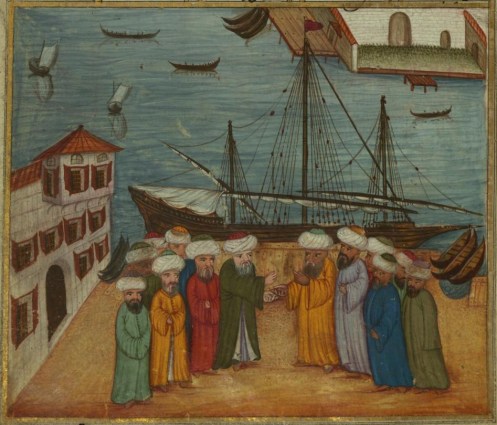
Şeyh Gülşenî (at center on the left), a 15th into 16th century Ottoman saint, bids some of his disciples and khalīfas farewell at a dock, illustrating the relationship between a saintly shaykh and his disciples also on display in the below story from another Ottoman context. From an 18th century illustrated copy of Ata’is Hamse (Walters 666.41A)
Shaykh Abū al-Wafā’ ibn Ma’rūf al-Ḥamawī—who was from among the pious ‘ulāmā and whose biography will come later—related to me that he had become a khalīfa to Shaykh [Aḥmad ibn ‘Abd al-Raḥman, (d. 1571), a Kurdish saint in the countryside north of Aleppo] after serving him for some time. He went to Cairo in order to study exoteric knowledge. He met with Shaykh Abū al-Ḥasan al-Bakrī, God sanctify his secret [1]. He treated him hospitably, but then Abū al-Ḥasan tried to get Abū al-Wafā’ to take the pledge of his ṭarīqa from him [2]. Abū al-Wafā’ refused out of regard for his shaykh [Aḥmad]. Abū al-Ḥasan kept asking, and Abū al-Wafā’ continued to refuse, until one night [Abū al-Ḥasan] entered his room and said: ‘Put your hand in mine!’ Suddenly a crack appeared in the wall, and Shaykh Aḥmad emerged and cried out, ‘Leave my disciple alone!’ [Abū al-Ḥasan] said, ‘Not possible!’ In that very moment, a fire came forth from Shaykh Aḥmad’s eye, and at that Shaykh Abū al-Ḥasan left Abū al-Wafā’ alone. Then al-Khiḍr emerged, and made peace between the two shaykhs [3]. The next morning Abū al-Wafā’s visit to Cairo was concluded so he returned home, and when he reached the village of al-Quṣayr, he entered the presence of Shaykh Aḥmad and kissed his hand, at which the shaykh smiled and said, ‘The chain of our ṭarīqa is unbroken!’
This poor one [ie the author al-‘Urḍī] had heard this story and had denied its truth, saying that people were making up lies about Shaykh al-Wafā’. But when I was young he came to Aleppo and I said to him, ‘This story, did it take place in waking life or dreaming?’ [4] He replied, ‘Waking life!’
_______________
[1] The Bakrī family was by the mid-16th century a well-established scholarly and saintly house, which would continue to be prominent all through the Ottoman period.
[2] Receiving a ṭarīqa- that is, initiation into a particular sufi lineage or path- from a shaykh could be a very personal matter of loyalty and prestige, particularly in this period, and especially in a Kurdish context- while receiving multiple affiliations was not uncommon in some contexts, and posed no problem for some shaykhs, this obviously was not universally true.
[3] Al-Khiḍr is an immortal, mysterious figure within Islam, and is often depicted appearing at opportune moments to convey knowledge or to solve a particular problem.
[4] In other words, did the ‘action’ take place in a dream-vision (which would be ‘real,’ just in a different way), or did the two shaykhs and al-Khiḍr bodily appear in poor Abū al-Wafā’s room? The former option would be rather unexceptional; the latter is a rather different and more spectacular scenario.
Muḥammad ibn ʻUmar al-ʻUrḍī, Maʻādin al-dhahab fī al-aʻyān al-musharrafa bi-him Ḥalab ʻAmman : Markaz al-Wathaʼiq wa-al-Makhtutat, 1992), 282.
One of the great transformations that Ottoman society- and many other societies across the world- underwent in the course of the early modern period was the introduction of new (to most markets at least) ‘social’ commodities such as coffee, tobacco, tea, and sugar. Driven by new technologies of transportation, by the European discovery and colonization of the Americas, and by changing dynamics of personal wealth and consumption patterns, across the world people’s lives began to be shaped by the use of coffee and tobacco, both substances with addictive properties, and which lend themselves to use in social, often public, contexts (I am writing this from a coffeehouse, for instance- a direct descendant of these early modern transformations!). In the Ottoman world, as in many other places, both tobacco and coffee stirred up controversy, tobacco most of all.
Yet despite strenuous objections, including sultanic attempts to prohibit smoking, tobacco use flourished in the Ottoman lands, and soon permeated society and culture at many levels. The following anecdote, which dates from the early part of the 18th century and is set in Damascus, illustrates this permeation, which reached even to the karamāt (miracles or signs of sanctity) of Muslim saints, in particular, it seems, the majādhīb, the divinely drawn ones, whom I have introduced elsewhere and who will continue to appear in these digital pages. In this story we see both the continued ambiguity surrounding tobacco, as well as the possibility for its use by a saint, and even being miraculously transformed through the saint’s baraka (divine grace or power).
Shaykh Muṣtafā related to me [Muṣtafī al-Bakrī], saying: ‘I came to visit you once but didn’t find you at home. [Aḥmad the majdhūb] was sitting in front of the iwān, so I greeted him. He said to me: “You only come to visit Ibn al-Bakrī, you never come to visit me, not even once!” I replied, “Your place is exalted and I am weak!” So he said to me, “Come out to my khalwa, I’ll host you!” I wasn’t able to oppose him in that, so I went with him, fearing that the smell of tobacco would harm me due to the closeness of his khalwa. He set to with his pipe, talking with it [in his mouth], but I did not smell the scent of the tobacco nor did anything of it come to my face—and I knew that this was a mark of sanctity (karāma) of his!’
The dome of al-Shāfi’ī’s tomb in Cairo, Egypt, with its distinctive and somewhat mysterious boat perched atop. Source.
When once [‘Abd al-Wahhāb al-Sha’rānī, d. 1565] was hindered from making a visit to [the tomb of] Imām al-Shāfi’ī, God be pleased with him, he [al-Shāfi’ī] came to him in a dream-vision and said to him: ‘O ‘Abd al-Wahhab, I am censuring you for your paucity in visiting me!’ ‘Abd al-Wahhāb replied, ‘Tomorrow I’ll come and visit you.’ But the Imām said to him: ‘I won’t release you until I go with you to my place.’ So he took him by the hand, until he ascended with him upon the back of his dome (qubba), underneath the boat (markab) that is upon it. He spread out for him a new mat and place before him a dining-cloth upon which was tender bread, cheese rounds, and split open for him an ‘abdallāwī melon. He said to him: ‘Eat, O ‘Abd al-Wahhāb, in this place which kings of the earth now departed desired to eat!’





 Thicket & Thorp