
Offer the light piercing and the springmorning clouds
Over the grey backboned ridgelines gathering into early bloom.
Offer the salttaste of the marsh receding under early summer’s
Thunderheads larger than our toilsome systems, looming.
Offer this stone rolled down from the mountains rising,
Worn to round in years and years of river rise and fall.
Offer the moments that are not contained, offer the wind wet and cold
Off the sprucetreed highlands. Savage and beautiful is closeness
To the sacred, what in the last decree cannot be controlled. In the end all
This worn anthropocene too must give way, sedimented back into the holy,
Soil and stone of the world, bright and becoming from the hand of the Father—
Eucharist rung out still from the trampled earth, so take up and sing in offering,
What is not yours is that for which you must most give thanks.
Category: Poetry
I Shall Treat Their Wounds
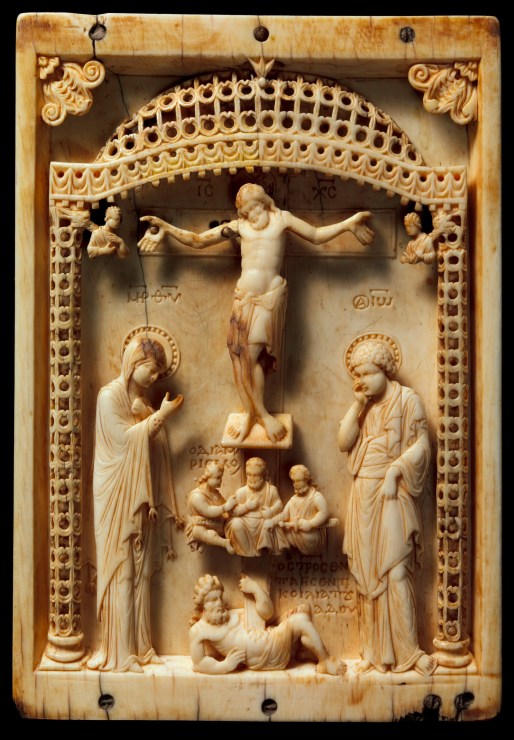
7. Mary said: ‘My Son, see how I wipe the tears from my eyes.
I chafe my heart even harder,
but my mind cannot keep its silence.
Why, my Beloved, do you say “Unless I die, Adam will not be cured?”
Certainly you cured many people without suffering yourself.
You cleansed a leper, yet felt no pain- it was not your plan.
You unbound a paralytic, yet were gripped by no spasm.
With a word, Merciful One, you gave sight to a blind man,
yet remained free from suffering,
my Son and my God.’
8. ‘You raised the dead, but did not become a corpse.
You were not placed in a tomb, my Son and my Life.
Why do you say that you must suffer for Adam to be cured?
Give the command, my Savior, and he will rise and carry his bier.
Even if Adam was buried in a tomb,
you will raise him too, like Lazarus, with one word.
The entire universe serves you, the Creator of all things.
So why do you hurry, my Son? Do not rush to your sacrifice.
Do not embrace your death,
my Son and my God.’
9. ‘You do not understand, my Mother, you do not understand what I say.
So, open the gates of your mind, welcome what you hear,
and ponder within yourself what I say.
That man I mentioned, miserable Adam, so helpless,
not only physically, but also spiritually,
wanted to be sick. He did not obey me and pays the penalty.
You grasp what I mean. So, do not grieve, Mother,
but cry out, “Have mercy on Adam,
show pity to Eve,
my Son and my God!”
10. ‘Adam, helpless because of his lack of control
and his gluttony, has been carried down into the depths of Hell
and there he sobs over the agony in his soul.
Eve, who once tutored him in irresponsibility,
groans at his side. She is as helpless as he,
so that both may learn to obey the physician’s instructions.
You understand now, don’t you? You do grasp what I have said?
Shout out once more, Mother, “If you forgive Adam,
also be forgiving to Eve,
my Son and my God!”‘
11. When she heard these explanations,
the Ewe without blemish answered her Lamb: ‘My Lord,
if I ask another question, do not become angry with me.
I shall say what I feel, so I can learn from you all I want to know.
If you suffer, if you die, will you ever come back to me?
If you set out to heal Adam and Eve, shall I see you again?
I fear that you will never return from the tomb, my Son.
I am afraid and, anxious to see you,
I shall weep and cry out, “Where is
my Son and my God?”‘
12. When he heard these questions, the Lord who knows everything
even before it happens, replied to Mary: ‘Mother, be certain
that you will be the first to see me when I come from the tomb.
I shall return to reveal to you the terrible agonies
from which I freed Adam, the terrible pains I endured for him.
I shall show my loyal comrades the marks of nails in my hands.
And then, Mother, you will behold Eve,
alive, as in Eden, and you will shout with joy,
“He has redeemed my primeval parents,
my Son and my God!”
13. Be strong for a little while, Mother, and you will see how,
just like a surgeon, I strip and rush to where my patients lie.
I shall treat their wounds:
I shall cut away solid tumors with the soldier’s spear.
I shall use gall and vinegar to staunch the incision;
nails, a lancet to probe the tumor; a seamless robe to wrap it.
The cross itself I shall use as a splint.
By this you will understand and sing,
“By suffering himself, he has destroyed suffering,
my Son and my God!”
14. ‘Cast your pain aside, Mother, cast it away,
and rush out with joy. Now I am eager to bring my mission
to its end and complete the plan of the one who sent me.
From the very first, this was agreed by me and by my Father,
with the full assent of the Holy Spirit:
I would become man and suffer to redeem that who had fallen.
So, my Mother, go and deliver this proclamation to everyone:
“By suffering he shatters the one who hates Adam-
and he returns triumphant,
my Son and my God!”‘
17. Son of the Virgin, God of the Virgin, Creator of the Universe,
you suffered and you revealed the depths of your wisdom.
You know what you were and what you became.
You wished to suffer, for you judged it glorious to save mankind.
As a Lamb, you took away our sins.
Your sacrifice, our Savior, redeemed all those who were dead.
You are the one who suffers and who cannot suffer.
You save by dying! You gave your holy Mother
the privilege of faith: to cry out to,
‘My Son and my God!’
St. Romanos the Melodist (d. after 555), ‘Mary at the Cross,’ translated by R. J. Schork, in Sacred Song from the Byzantine Pulpit: Romanos the Melodist (Gainesville: University Press of Florida, 1995), 110-113, 114
On Commentary and Its Uses in the Ottoman World

Commentary (Arabic sharḥ, Ott. Turk. şerh) was one of most widely used forms of textual production in the early modern Ottoman world, and indeed in the broader late medieval and early modern Islamic world (and beyond- commentaries were popular across pre-modern Eurasia in many scholarly and literary traditions). Islamic manuscript libraries are filled with commentary after commentary, as well as super-commentaries (commentaries on commentaries), both frequently featuring marginal comments added by authors, scribes, or later readers. Related to but distinct from the genre of Qur’an commentary (tafsīr), a sharḥ (pl. shurūḥ) could potentially be used to explicate, argue with, modify, interpret, allegorize, or otherwise engage with almost any sort of text in almost any field or genre, though ‘canonical’ texts from the distant and recent past were the most common objects. It was not uncommon, however, for an author to produce a commentary on an important work he himself had written, sometimes as a sort of ‘package deal.’ Commentary was so dominant that there are examples of parodic commentaries, such as the expansive, and deeply scatological one contained in the 18th century work of Yusuf al-Shirbīnī Brains Confounded by the Ode of Abū Shādhūf Expounded.
Commentary literature has often been overlooked or outright scorned in modern-day appraisals of medieval and early modern Islamic literature and knowledge systems, in part because the genre, while still in existence, is far less central to modern-day cultural and intellectual life and thus does not appear to us as especially interesting or significant. Reading through an example of this commentary literature is often not particularly easy, or interesting, and can be rather dry, sometimes excruciatingly so. The abundance of commentaries and super-commentaries on everything from philosophical treatises to poetry collections has often been used as an example of the ‘decay’ and ‘decadence’ of ‘post-classical’ Arabic intellectual and cultural life. However, on closer analysis- which some scholars of Islamic history are increasingly beginning to do, myself included– the genre (or rather, genres) of commentary writing are much richer than first glance would suggest, and beyond their immediate content, the social role of commentary was quite important. These texts were not just exercises in detached scholarship, but played roles akin in many ways to modern forms of electronic communication, especially social media.
The following story, which I’ve selected and translated from a hagiographic and polemical work by the eighteenth century scholar, Khalwatī sufi, and saint Muṣṭafá al-Bakrī (1688-1749), provides an excellent glimpse into the social role of commentary production, as well as some other particularities of early modern Ottoman life. In order to remain close to the topic at hand, I have interspersed my translation with commentary. We begin with al-Bakrī’s description of the usual way of life of the saint in question:
[Shaykh Aḥmad ibn Kasaba al-Ḥalabī al-Qādirī] loved retreat and solitude apart from people, being constantly turned instead towards God. I used to hear about him and greatly desired to meet him so as to derive benefit from him, but when he would come from his journeys back to Damascus he would not open his door to the flow of visitors. Continue reading “On Commentary and Its Uses in the Ottoman World”
Walking in Tel Aviv the Night Before Flying Home
My feet take me westwards through a soft white night of street
Lights low and gentle. Outlined high rises climb up behind the city asleep
In the shadow of Shabbat. Coming to the shore of the Great Sea I pass by
Arab families circled on the sand laughing as the smells of low little grills alight
Mingle with the sea’s salt scent drifting skywards. Girls in head scarves
Bob along the surf’s edge blurred in the darkness. Ah, this is where I end up,
My own limbs laced with certain rhythms, effortless.
How many tongues, how many cartographies and lays of land
Jumble in me, palimpsetting one on another and in arabesquing interlace? The sand
Is soft on my unshod feet. Around the shore’s curve
The lights of old Jaffa glow, soft, against the dark rising sea.
Relics
And so this: culture, to cultivate, cultus,
The smell and feel of soil and of holy dust, the sacred grit
That will break the fine tuned gears of the machine,
Rust out its parts and reveal the garden.
To grow, to guide, to shape the self that
Passes beyond the self, finds the Other and the Elsewhere,
Here and now, and finally then. Watered and broken down.
Unless the seed die…
Such is the labor, and the prayer, the labor in prayer. Bowing,
My lips touch the bit of bone, proximity in fragments. From these
Pieces scattered and gathered grows the universe.
Nanih Waiya
The bones we carried
Were more than the bones that bore.
The long dry plains, then the great fathering water.
The dead cities mounded and the forgotten fields, the forests filling back in.
We brought with us our ancestors’ souls and maize seeds,
The rumor of strange beasts and men behind us.
At the leaning hill we stopped and felt the tannin dark waters
Lapping the cypress knees. Sandhill and bottomland, we spread out
And spread names over the rivers and rises, felt
Our speech along the land’s low and gentle lines. We laid
Our mothers’ and our fathers’ bones to rest in the red clayed ground,
Made ourselves native to the place, spoke the voices out from under the earth.
O Monarch of the Heart
In yesterday’s post I introduced the theme of late medieval and early modern devotion to Muhammad, a ‘movement’ within Islam that became dominant and widespread by the end of the middle ages, especially flourishing in the early modern period. The texts of this devotion were not only written in Arabic: rather, devotion to Muhammad was often expressed in vernaculars. The following translated poem, by an Ottoman sufi şeyh and saint, Muhammed Nasûhî Üsküdarî (d. 1718), is a part of a larger collection of poetry of praise and supplication directed towards Muhammad, written in Ottoman Turkish. It is a good example of this genre of poetic composition, which was common across the Ottoman world and beyond, expressing theological concepts as well as emotional bonding between the poet and his object, Muhammad. I have included footnotes at points to clarify certain references that would have been relatively obvious to a contemporary reader or listener but might not be to my readers here.

You are the cure of my sickness, yâ Muhammed Mustafa!
You are the sovereign of my heart, yâ Muhammed Mustafa!
Who am I that I dare to praise you, o monarch of the heart?
You are the light of the moon of Yâ-sin [1] yâ Muhammed Mustafa!
You hold sway over the inner secret of this habitation below, o mirror of the True!
You are the monarch of the throne of If you had not been [2], yâ Muhammed Mustafa!
Without sign, without place, in your inner secret I beheld your essence.
You are the spirits of the passionate lovers, yâ Muhammed Mustafa!
To the crooked-statured, sin-bearing Nasûhî [3] give
Help—you are a remedy, yâ Muhammed Mustafa!
Üsküdarlı Muhammed Nasûhî, [‘Poem 6’], in Üsküdarlı Muhammed Nasûhî ve Dîvânçe-i İlâhiyat’ı, ed. Mustafa Tatcı (Üsküdar, İstanbul: Kaknüs Yayınları, 2004), 166-167.
[1] A reference to the 36th surāh of the Qur’an, Surāh Yā’-Sīn, sometimes referred to as ‘the heart of the Qur’an.’
[2] An allusion to a hadith qudsi– a hadith said to convey God’s speech, though not as part of the Qu’ran- in which God says to Muhammad words to the effect of ‘If you not been I would not have created the universe.’
[3] Including one’s name in the penultimate line is an Ottoman convention, carried over from Persian poetic convention.
Verses From Jerusalem
If I forget thee O Jerusalem—but how much do you, O Jerusalem, forget? Here
Is what you forget: all the lives lived and buried under your warm old stones, and
Stones that lie buried under newer stones, that give way to older cold stones,
Fenced and labeled, dead stones, an inner bark exposed to the air, the sap dried.
You forget too much, and not enough, O Jerusalem. If I forget thee—but how
Could I? You are lodged in me like the new old name of God lodged in the tongue
Of the mystic from Buffalo roaming your streets,
Like the crosses and the names sunk in the threshold of the holy Tomb.
Will you forget me after the dust of my feet has risen up into your air
And fallen east over the ridgetop settlements, over the bright waters of En Prat,
Over the high concrete walls, over dead forgotten cities in the desert,
Over Nabi Musa’s stark domes, over sad black tarps in the nomad camps?
What is the skill of your right hand, O Jerusalem? Gathering stones,
And in another time or in the same time, scattering them. Yet, in your left hand
Is remembering, rising up like scents in Suq al-‘Attarin, all your names
And the names within names in the many tongues
Pooling in your left palm, ephemeral, eternal,
But the right hand, it does not know what the left hand has.
September Beside the Potomac
Persimmon fruit hangs sweet and heavy in the air-
Bottomland forest along the Potomac,
First leaf falls whisp in and out, acorns, walnuts
Scatter and plop to the sandied floor, soundings.
Cool breeze washes the warm dense scent of the river
At end of summer up to us, promise of change. Memory’s scent,
Of my own late summer childhood nestling in
The sun-warmed receding pools, focusing the gentle force of drawn-
Down cascades in the Piney River, sniffing in the little river,
Shivering as the sun got low in afternoon
And we got out of the water. Now, my little son
Reaches out to feel the great round bole of a silver maple,
Smiling, two vigors, connecting. Together, we take in the
Touch, the forest and the river’s wafting multiplicities,
Such lines of continuity, untamed worlds, wild rivers,
Seasons in their turns and turns and turns.
Southern Monuments
There our monuments red gritstone grave markers on a low rise
South of the Sipsey River, river where amongst the cypress knees
Whispering trace of baptisms in the tannin water flow silent and slow.
Jesus behind every sacred tree and over every fireant hill.
These our monuments kudzu covered loess hills
Towering above where the River once ran
Some blood bled white there, and the blood of our others went free.
One day we’ll all go free, a hot wind in August says low.
The man who tells you anything is any other than tragedy and transcendence
Is a fool or a liar or both. That is all there is here, that is all there is anywhere.
Here, here it is sharp and bright, engraved.
These our monuments the lilting into earth house our greatgrandfather built,
Where for a few seasons buzzards roosted.
The floorboards splattered white, in spring, the face of the world there renews,
Snowdrops scattered under the oaks the tornado three years back just missed.
These our monuments the burial grounds of ancestors and ancestors’ slaves,
Hollowed bald cypress, an arrowhead cupped in hand,
Concaved thunderheads looming in July longleaf heat.
These our monuments my sharecropper granny’s fingers that
Picked cotton like nobody’s business, coaxed bloom and beauty for
Year and years from the tough soil and the takings of time.
These our monuments on red clay and muddy water, grave and ghost,
Sweat on brows, the thick air filling up our lungs,
Life and death, hate and love, pedestals untoppled and unwreathed.
Memory, we fear and pray, eternal.
 Thicket & Thorp