If I forget thee O Jerusalem—but how much do you, O Jerusalem, forget? Here
Is what you forget: all the lives lived and buried under your warm old stones, and
Stones that lie buried under newer stones, that give way to older cold stones,
Fenced and labeled, dead stones, an inner bark exposed to the air, the sap dried.
You forget too much, and not enough, O Jerusalem. If I forget thee—but how
Could I? You are lodged in me like the new old name of God lodged in the tongue
Of the mystic from Buffalo roaming your streets,
Like the crosses and the names sunk in the threshold of the holy Tomb.
Will you forget me after the dust of my feet has risen up into your air
And fallen east over the ridgetop settlements, over the bright waters of En Prat,
Over the high concrete walls, over dead forgotten cities in the desert,
Over Nabi Musa’s stark domes, over sad black tarps in the nomad camps?
What is the skill of your right hand, O Jerusalem? Gathering stones,
And in another time or in the same time, scattering them. Yet, in your left hand
Is remembering, rising up like scents in Suq al-‘Attarin, all your names
And the names within names in the many tongues
Pooling in your left palm, ephemeral, eternal,
But the right hand, it does not know what the left hand has.
The following accounts treat an important, and well-nigh ubiquitous, type of Ottoman Muslim saint, the majdhūb (meczûb in Ottoman Turkish), the ‘divinely attracted or drawn one.’ For a longer explanation of this ‘mode’ of sainthood, see this post of mine from a while back. One of the chapters of my forthcoming dissertation will consist of a detailed history and analysis of majdhūb sainthood, as well. The two accounts below represent the different ways and environments in which this ‘immersive’ saintly identity could operate, across the diverse lands of the Ottoman Empire. The first, from an Arabic biographical compilation from the mid-17th century, treats the arguably most important and well known majdhūb saint in the Ottoman world, Abū Bakr ibn Abū al-Wafā’ al-Majdhūb (d. 991/1583), of Aleppo. The dervish complex and mazār (place of visitation or shrine) that grew up during his lifetime and especially after his death still stands, having gone from being on the outskirts of the city to well enveloped within it, a monument to the centrality this strange and powerful saint took on both during and after his life on earth (for more on this saint and his legacy, see Watenpaugh, Heghnar Zeitlian. “Deviant Dervishes: Space, Gender, and the Construction of Antinomian Piety in Ottoman Aleppo.” International Journal of Middle East Studies 37, no. 4 (2005): 535–65). In the story I have translated we see the saint’s intervention in one of most dangerous and pressing situations in any pre-modern society, the threat of drought- with the mere suggestion that drought might be imminent enough to send local markets into a price-raising frenzy, as noted in this story. The saint’s strange behavior- open to all manner of interpretation- is also displayed here, out of a long list of stories of strange and far more shocking action than manifested here. Continue reading “Ottoman Majdhūb/Meczûb: Two Stories”→
The following is a pair of Muslim saints’ lives, included in a biographical compilation (Luṭf al-samar wa qaṭf al-thaman) by an early 17th century Ottoman author from Damascus, Najm al-Dīn al-Ghazzī, the scion of a prominent family of ‘ulama, and one of the more prolific Damascene authors of the first part of the 17th century. His biographical histories include many saints’ lives, with a special emphasis on holy men with whom he or his saintly brother Shihāb al-Dīn al-Ghazzī had contact. Perusing the pages of these collected lives, a veritable ecosystem of sainthood and sanctity comes to life, populated by individuals of striking piety and of often controversial actions and behavior. Sainthood was and is a deeply social phenomenon, particularly in the Ottoman world wherein no ecclesial or political authority offered canonical guidance in the question of who was and was not a ‘true’ friend of God. Rather, something of a consensus among devotees would emerge, often alongside challenges from other directions, concerning a given person’s sanctity and closeness to God.
In the first life which I have translated here, we meet an enigmatic majdhūb, or possessed saint, who displayed seemingly erratic and irrational behavior, interpreted by those around him as the manifestation of jadhb, or divine attraction. Like many such majadhīb, he seems to have come from a rural environment, and in lieu of complex doctrinal teachings, he manifested his sainthood through strange, even shocking actions. And like many such possessed saints, he deliberately transgressed social boundaries, in particular, strictures on gender segregation and contact. His companion, Dervish Ḥusayn, was also marked by his transgressing of social norms, in his case, through living for a time an extremely hermetical life, even refusing to speak directly to most pious visitors. Yet before we imagine a gulf between such ‘transgressive’ forms of sanctity and the scholarly ‘ulama class from which our author hailed, al-Ghazzī also describes the ties of members of the ‘ulama with these two saints. Dervish Ḥusayn, for instance, made an exception to his hermit’s life to discuss religious matters with al-Ghazzī and his shaykh.
The dome of al-Shāfi’ī’s tomb in Cairo, Egypt, with its distinctive and somewhat mysterious boat perched atop. Source.
When once [‘Abd al-Wahhāb al-Sha’rānī, d. 1565] was hindered from making a visit to [the tomb of] Imām al-Shāfi’ī, God be pleased with him, he [al-Shāfi’ī] came to him in a dream-vision and said to him: ‘O ‘Abd al-Wahhab, I am censuring you for your paucity in visiting me!’ ‘Abd al-Wahhāb replied, ‘Tomorrow I’ll come and visit you.’ But the Imām said to him: ‘I won’t release you until I go with you to my place.’ So he took him by the hand, until he ascended with him upon the back of his dome (qubba), underneath the boat (markab) that is upon it. He spread out for him a new mat and place before him a dining-cloth upon which was tender bread, cheese rounds, and split open for him an ‘abdallāwī melon. He said to him: ‘Eat, O ‘Abd al-Wahhāb, in this place which kings of the earth now departed desired to eat!’
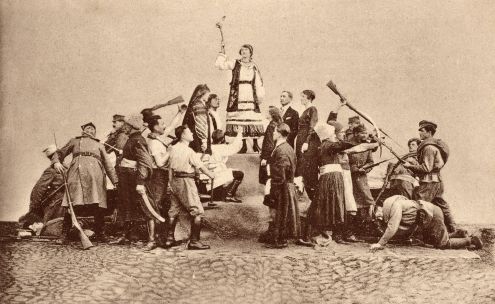
A symbolic depiction of Ukrainian nationalism, c. 1920
While the world probably doesn’t need any more commentary on the recent American election, I’d like to offer some anyway, though in a way that looks at happenings beyond the US to the rest of the world, where we see related patterns unfolding according to local particularities and conditions. While the US is its own case, it is also part of an interconnected world, the ties of global capitalism, human movement, globalized classes, elites, and political structures, and other things working to move American realities in directions broadly congruent with other, often quite different, parts of the world. My thoughts here—which are reflective of the halting directions my political thought have been taking as of late, but should not be interpreted as final or fully coherent—are springing off an article by Jonathan Haidt from back in the summer, but which is rather prescient and worth reading in its own right. What follows here, then, are three interlinking thoughts precipitated by, but in some cases sharply diverging from, Haidt’s article.
One, while right now the dominant options are either liberal ‘cosmopolitan’ globalism or some form of nationalism, within the framework of nation-states (whether more autonomous or more directed from supra-national entities being at question) and of some form of globalized (if not globalist) capitalism, those are not in fact the only options. To give but one example, Continue reading “Nationalisms, Globalisms, and Their Alternatives”→
Political ideologies are deeply toxic, psychologically destructive things. Their function is fairly simple: they allow people to navigate the contours of states and industrial economies, and they offer the surest routes into the ‘core’ of such entities. They map the terrain. But in so doing, they also preclude all other terrain. Modern ideologies, even when they incorporate ‘extraneous’ elements, reduce all other forms of identity and meaning and value into a homogenized, internally bound whole. When these ideologies encounter insurmountable incongruity, or outright collapse, the damage to individual psyches and emotional well being is enormous, as all the erasures of identity and personality come to light in the gaping wound left by epistemic collapse. The subject is left confused and troubled, anxious to rediscover the surety that was there before.
In the American context, liberalism—here understood in the American vernacular rendering, though the broader sense should be kept in mind—is the primary, or perhaps, strongest vehicle of this totalizing effect, of this subsumption of all else into one overriding, all-structuring political and ideological identity and generator of meaning and social value. Conservatism by its very nature lacks systematization, and requires the existence of other values, other traditions, other forms of life, to give it meaning—even if all those other things are themselves deeply deformed and distorted by the effects of modernity (and in the American case this is especially true). Over time, it is true, many of the identities and traditions and forms of life which flow into conservatism have themselves become artefacts of ideology, integrated into the logics of the state and its political, value, and linguistic systems, albeit in often erratic and unpredictable ways (the current political disruption being one such effect). But the multiplicity of identity and meaning among conservatives remains, if only in tatters—not necessarily healthier or less damaging psychologically, but perhaps with slightly more openings out. Perhaps.
The following are some thoughts and outlines of theory that aim at encapusalating some of my developing thought on human social order, the dynamics of historical change (particularly in the modern world, as we call it), and so on, which do not really ‘fit’ into my own academic work, but which lie behind how I think about the pre-modern world and my role as an observer and shaper of historical knowledge, which is always knowledge intimately tied up with the present. These are quickly assembled thoughts-out-loud, but I hope they prove of interest and use to the reader who takes the effort to navigate them.
1. On Discontinuities and Disorder: One of the problems that particularly marks our age—by which I mean the last half century or so, though with extensions backwards through the era of Western industrialization—is the problem (which is also a potent problématique) of radically discontinuous time scales within conjunctive social, political, economic, and ecological systems and processes. While technical advances and developments, be they in socio-political organization, economic systems, or actual technology, have moved many aspects of life on this earth into incredibly high-speed trajectories, they have been unable—and are most likely necessarily unable—to effect such transformations across the board. In fact, many of the most salient and vital processes, systems, and exigencies remain on time scales similar to or the same as during any period of post-agricultural revolution human history, and in some cases—particularly ecological and geological aspects—pre-human time scales. If our technics allow, for instance, for rapid, unpredictable socio-political disintegration, it is not clear that they encourage symmetrical forms of re-integration and re-formation, processes which are slow and unsteady, and which tend to require periods of relative stability and, crucially, extended time scales. One of the results of these discontinuities, I think, has been the rapid cyclical processing of global history, with periods of incredibly rapid formation and development along many metrics, followed by equally incredible periods of collapse and destruction. The succeeding periods of re-integration and re-building tend to automatically have the seeds of their dissolution built into them, accelerating the cycle. Of course, different societies have had very different responses to this process due to vastly differing historical circumstances and contingencies, but all societies have been subject to it, and it is possible that we are seeing, in this very historical moment, convergences towards a single unitary period of dissolution, with no clear route forward afterwards. Technics are growing more and more integrated and rapid, obliterating many quotidian time scales, yet proving incapable of shoring up or replacing many of the social systems, ecological processes, and interpersonal relationships that they are helping to either obliterate or destabilize. We are faced with a situation in which stable, resilient systems are necessary more than ever, but the tools and exigencies at our disposal increasingly trend in the very opposite direction.
Our heart’s a crepe myrtle in the earlysummer heat gleam
Bright pink and purpled bits, folded into themselves and drifting
One two three slow seconds down, ground graved of fire ants languid. Yes.
I ease off the shoulder back onto the sunrotting coarse blacktop narrowing down
Muscadine and pine easing in, time’s suddenness.
I drove through the town I grew up in today… well.
We are vessels of decay, and none of our
Works will last. That’s the resounding message in the lay of this land, let me tell you.
Even our memory, the memory of our bones and our blood and the broken banners
Of our fathers and our fathers’ fathers, it’s split to nothing and wasting away,
Its own weight and the weight of the sins of the world. With every hurricane
Another empty space. Ten years, twenty, even the shards of bricks will be swallowed.
I turn my heart to the sun burning off in the west. October comes, and the last bit of color
Is gone. The leaves turn brown, and cling to the weary limbs. Metaphor? It’s so much
Deeper than that, man. All our lives are ruins, return, and red with sword and speech.
Some of us have worse ruins than others. These innerscapes of history—God how
I wish I could escape that word—are the brown leaves clinging, the crepe myrtle heart,
The swathe of the storm, the hidden cotton rows secret,
Our forefathers’ and mothers’ sweat and sins, our birth and others’ scarred redemption.
The religious lives of the nomadic people of the Ottoman era are not easy to reconstruct. While some aspects of nomadic and semi-nomadic life are recoverable due to Ottoman administrators’ interest in the nomads and their often vital role in Ottoman military activities, other aspects are much murkier. Few to no nomads left written records of their own, leaving us dependent on the observations of others, observations that themselves are rather thin due to either lack of contact or, more likely, lack of sustain concern- a situation that holds with observations of rural life in general. But while there were certainly stereotypes operative about nomadic peoples, the attitudes of sedentary, learned people were in fact quite complex and capable of nuance. The following story, narrated by Muḥammad Abū al-Wafā’ ibn ʻUmar al-ʻUrḍī (d. 1661), a scholar from Aleppo whose biographical dictionary, Ma’ādin al-dhahab, is, no pun intended, a gold-mine for the cultural, social, and religious life of early modern Aleppo and its surrounding region, is an example of this nuance. It is not the only story in the biography that features Turkmen nomads- in the next story a group of nomads seek out, and gain, the intercession of the saint on behalf of the son of a tribal chief.
As for this story, it opens with rural people- who may be nomadic, semi-nomadic, or sedentary- engaging in a water dispute with a Shaykh Aḥmad, the subject of the biographical entry (and the author’s maternal great-grandfather), a detail by itself worthy of note. We next see a nomadic Turkmen family, though they are not really the center of the story as it turns out. At heart this anecdote is about the powers of insight of the saintly hero, and his ability in leading an adulterous disciple to repentance and restoration. Still, we get a glimpse of life among the Turkmen of Syria and their devotion to local saintly shaykhs (and the saintly shaykh’s respect for them), coupled with gender norms considerably laxer than those found in urban areas (gender segregation is not observed, and we get the sense that the wife is not veiled). Yet it is noteworthy that there is no explicit condemnation of these lax gender norms, or of the woman involved- rather, the responsibility for the sin that occurs is placed squarely on the errant urban male, who is made to confess his betrayal of hospitality by the saintly shaykh, then guided back to religious and social soundness through the shaykh’s tutelage.
Turkmen storage bag (chuval), c. 18th century. The Metropolitan Museum of Art, New York, 22.100.40a
My father the shaykh related to me that Ibn al-Qala’ī turned towards Antakiya due to a case against the shaykh [Aḥmad ibn ‘Abdū al-Raḥman al-Quṣayrī al-Kurdī, d. 1560] concerning water which the Banu al-Qala’ī were making claims on. He found along the way a khalīfa [1] of Shaykh Aḥmad, and he told the matter to him. The khalīfa said: ‘No, this is a futile matter; still, I will mediate between you and the shaykh.’ They agreed upon going to the village of the shaykh for reconciliation. Then night overtook them, so they stopped in a Turkmen tent [2], and the Turkmen received the khalīfa of Shaykh Aḥmad, in honor of the master, and showed him great hospitality. Then the Turkmen left after the evening prayers to tend to his flocks. He had a beautiful wife, and he left the two of them sleeping in the presence of his wife. When the cover of night fell, the khalīfa sought to seduce the wife, and she quickly responded and complied with his desire. Ibn al-Qala’ī perceived that, but the two supposed he was sleeping. When the khalīfa consummated his lust [lit. when he consummated what God had decreed for him], he settled down and went back to sleep.
Morning came, and Ibn al-Qala’ī and the khalīfa set out. Ibn al-Qala’ī said: ‘Let us perform the morning prayer.’ The khalīfa was silent, and payed Ibn al-Qala’ī no attention, so he stopped at a spring of water, did ablutions, and prayed the morning prayer. When the two reached the shaykh who is the subject of this biography, the khalīfa entered. It was the shaykh’s custom to rise to meet him, [which he did]. Then the shaykh looked at him wrathfully, and withdrew his hand from him when the khalīfa sought to kiss it, his face reddening. When the two sat down, the shaykh ordered the fetching of [the book] al-Targhīb wa al-tarhīb [by ‘Abd al-‘Aẓīm ibn ‘Abd al-Qawī al-Mundhirī, d. 1258]. He opened the book and began to read the chapter ‘Invocation of Fear towards Adultery,’ taking up the mention of the evil of adultery. The khalīfa remained silent, until he suddenly cried out, and began weeping and wailing openly. The shaykh shouted at him, then stripped him of his ceremonial apron (mi’zar), drove him out, and said: ‘O traitor! A man trusted you with his family and you betrayed him?’
Then he spent a long time weeping before the door of the shaykh, and was public with his repentance and returning to God, until the shaykh caused him to undergo a forty-day retreat [3]. He then dressed him the clothing of the fuqarā’, not of the khalīfas. After two years, when he verified the soundness of his repentance, he returned him to his previous position.
______________________
[1] A sort of deputy of a Sufi shaykh.
[2] Turkmen nomads and semi-nomads could be found all across the Ottoman Arab provinces, sometimes in competition with Arab Bedouin tribes who surged north into Palestine and Syria during this period.
[3] During a forty-day retreat (forty being a symbolic number in both Christianity and Islam) the disciple would remain in seclusion most of the period, praying, practicing remembrance of God, and struggling with his lower self. Aḥmad was an initiate of the Khalwatiyya Sufi ṭarīqa, an order known for spiritual retreats, hence their name, taken from khalwa, ‘solitary retreat.’
______________________
Muḥammad Abū al-Wafā’ ibn ʻUmar al-ʻUrḍī. Maʻādin al-dhahab fī al-aʻyān al-musharrafah bi-him Ḥalab. [Ḥalab]: Dār al-Mallāḥ 1987. 92-93. Translation by Jonathan P. Allen, 2015, no rights reserved.
‘Ā’isha al-Bā’ūnīyah (d. 1517) was a female Sufi master from Damascus, living in the twilight years of Mamluk rule and the very beginning of Ottoman control of the region. She is one of the most prolific, if not the most prolific, female Muslim writer in the pre-modern era, writing treatises, poetry, devotional literature, and the like, including a mawlid-text (a text in celebration of Muhammad’s birth) that would prove to be of enduring popularity. The following is a poem from her diwan that is representative of her deeply emotional and affective piety and poetic style.
When I sought union from the one I love,
His majesty replied that there was no path to Him.
So, I closed my eyes that had tried so hard to see Him,
while in my heart, desire burned with separation’s fire.
I was about to meet my death, when He was kind,
and sweetly spoke to my heart, saying:
‘If you want union from Us, be true to Us,
set aside all else, strive for Us, and be humble.
Leave yourself and come to Us with Our true love and grace.
Make that your means to Me.
Draw near to Us, be devoted to Us; don’t fear rejection.
Turn toward a sacred precinct filled with acceptance.
There, you will find providence draws you to Us,
bringing sweet union,
And you will leave there all but Us
and appear in a station where true men alight.
You will behold lights of power, and in their intensity,
the shadow of difference will go and disappear.
You will pass away, nothing to preserve you save Our splendor,
as you behold, truly, the climax of desire.
Then you will abide with Us, Our servant,
pure, chosen by Us for Our secrets forever!’
_______________________________
‘Ā’isha al-Bā’ūnīyah, Fayḍ al-Faḍl wa-Jam’ al-Shaml, translated by Th. Emil Homerin, in Emanations of Grace: Mystical Poems by ‘Ā’isha al-Bā’ūnīyah (Louisville: Fons Vitae, 2011), 64.




 Thicket & Thorp