Fire Poured Out From Heaven: Muslim Saints’ Shrines in Safavid Miniature Painting

Miniature from a copy of Jafar al-Sadiq_s Falnama. “Scene From a Mausoleum” Iran, Tabriz or Qasvin; c. 1550
Miniature from a copy of Jafar al-Sadiq’s Falnama. “Scene From a Mausoleum”
Iran, Tabriz or Qasvin; c. 1550 (David Collection, Inv. no. 28/1997)
“Prayers in a Mosque” Miniature from Kulliyat-i Mawlana Ahli Shirazi (Collected Works of Mawlana Ahli Shirazi) Shiraz, Iran; c. 1550
Miniature from Kulliyat-i Mawlana Ahli Shirazi (Collected Works of Mawlana Ahli Shirazi)
Shiraz, Iran; c. 1550, David Collection, Inv. no. Isl 161

As any long-time reader of this blog will know, one of my primary areas of scholarly interest is the history of saints and sainthood in the Islamic world, primarily within Islamic traditions but also in Christian and Jewish traditions practiced within or in contact with Islamicate cultures. The very fact that ‘Muslims have saints’ often comes as a surprise, with the usual follow up question being something along the lines of ‘Just what is a Muslim saint like?’ The answer, of course, varies from place to place and time to time, with the usual caveats that Muslims saints ‘look’ both like and unlike saints in other religious traditions, and that some forms of Islam, especially in the modern world, largely reject sainthood (similar to some forms of Christianity after the Protestant Reformation).

One difference between Muslim modes of understanding and depicting saints and sainthood and those found in many other traditions such as Christianity and Buddhism is the relatively low-key role of visual depictions in describing saints and in venerating them or inscribing their memory. While it is not true to say that Islam across the board lacks iconographic traditions, explicit uses of icon-like depictions for veneration has historically tended to be limited to either to depictions of non-human items and places, described in last week’s post, or in a rather supplemental manner (for private devotions or in the context of a shrine), such as has become common in contemporary Shi’i devotion (though certainly not only Shi’i- for instance, see this example from resolutely Sunni Morocco). The two miniatures above fall into another category altogether: in both we have something quite rare, namely, artistic renderings of practiced devotion to saints. These two images, both of which were produced in Safavid Iran while it was still in the long process of transitioning from a Sunni polity to a Shi’i one, give us a pretty good visual idea of what tomb veneration looked like in an early modern context- while they come from the Persian world, we know from literary evidence that the practices and architectural elements depicted in them would have been shared with other regions, including the neighboring Ottoman lands. The images are hence worth a closer look. Continue reading “Fire Poured Out From Heaven: Muslim Saints’ Shrines in Safavid Miniature Painting”
Explicating Devotion to Muhammad, Part i.

image
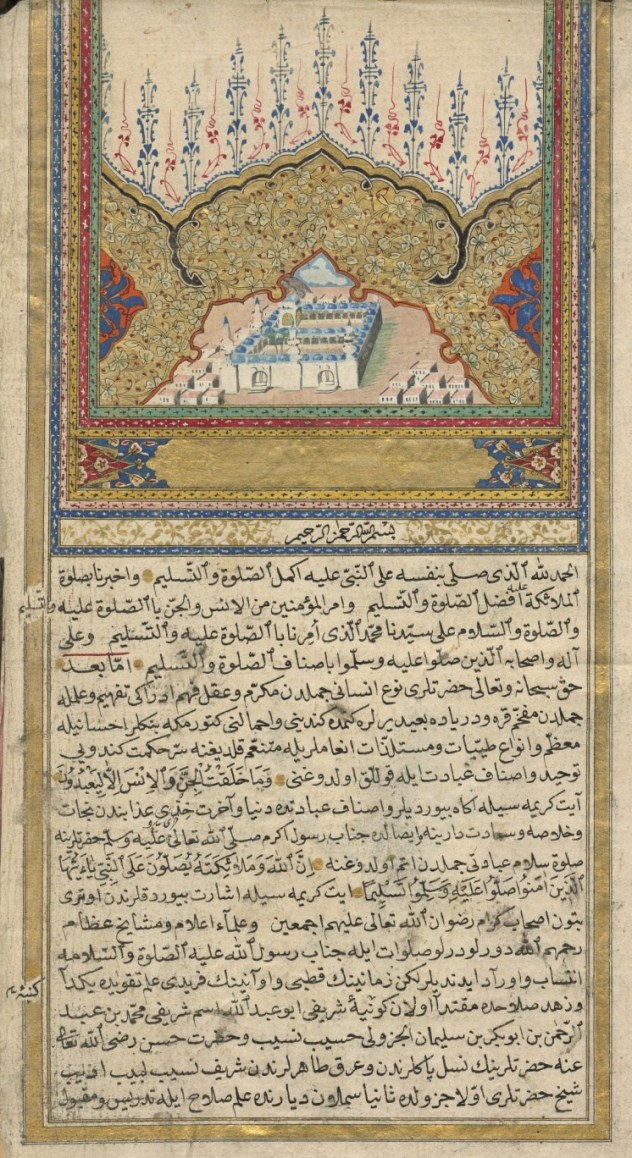
Opening page to Kara Davutzâde Mehmed Efendî, Tevfik muvaffikü’l-hayrât li-neyli’l-berekât fi hizmet menbai’s-saâdât, University of Michigan, Special Collections Library, Isl. Ms. 672

Late medieval and early modern devotion to Muhammad in Islam was first and foremost a matter of personal and communal practice, embodied in devotional regimes, public rituals, habitual expressions, and material objects, among other practices and techniques. But it also unfolded at a discursive, textual, and homiletical level, with scholarly and semi-scholarly productions explicating, extolling, and critiquing various aspects of devotion to the Prophet appearing from the late medieval period forward in multiple languages of Islam. The genre of commentary (Ar. sharḥ/Ott. Trk. şerh) was an important vehicle for delivering explication of devotional practices and their intersection with theology and other Islamic disciplines. Numerous commentaries on ṣalawāt– the litanies of blessing upon Muhammad- and related sorts of texts appeared across the Ottoman world and beyond, in both Arabic and Ottoman Turkish (and in other languages further east). Like much early modern commentary production in Islamic societies, these texts have received little engage scholarly attention, though the neglect of commentaries is starting to change. In the following weeks I’d like to give some samples of commentary on devotional texts, starting with excerpts from commentary on what was perhaps the most important text of devotion to Muhammad, al-Jāzūlī’s Dalā’il al-khayrāt.

But before presenting translated texts and analysis of them, I’d like to start with the above image. It comes from the opening page of a beautifully executed manuscript copy of an Ottoman Turkish translation and expansion of an Arabic commentary on al-Jāzūlī’s prayerbook. Titled Tevfik muvaffikü’l-hayrât li-neyli’l-berekât fi hizmet menbai’s-saâdât, this work, which goes through, line by line, the text of Dalā’il al-khayrāt, was composed by an eighteenth century author, Kara Davutzâde Mehmed Efendî, about whom I know no more than can be gleaned from the text. The commentary was aimed at many audiences, especially, it seems, pious women, and may have been meant to furnish material for preachers.

The charming miniature that is framed at the top of the page, a depiction of Medina, centered on the Prophet’s Mosque, is a good example of the devotional iconography that grew up around devotion to Muhammad, in many contexts, featuring images of Mecca and Medina, the tomb of Muhammad and the tombs of the Four Rightly Guided Caliphs, the footprint of Muhammad (and other physical traces), and so on. Such images had many functions: they presented the physical presence of Muhammad and his close associates in an iconographic manner but without actually depicting Muhammad directly. Instead they summoned his presence by pointing the viewer at the material traces of his life and memory, a sort of icon at remove. They had an educational value, giving the reader or viewer a sense of what the holiest places of Islam and the artefacts of the Prophet looked like. And finally they had a prophylactic purpose- that is, early modern Muslims might display or otherwise have on hand these images as a way of warding off evil and misfortune, based on their icon-at-a-remove connection to Muhammad and his powerful intercession. The above image- which is also just simply beautiful and delicately rendered- participates in all of the above.

From Above the Frozen Potomac

We are standing on a flood-scoured tongue of rock that juts down from the banks of the Potomac River, a mile or so below the mouth of the river’s great gorge, a gorge headed by the mighty Great Falls. The cries of geese settling down into an open basin of water within the ice-choked river overwhelm the distant hum of the interstate. That hum is the only indication of how close we are to ‘civilization,’ and to the very seat of the American imperium. The sprawling organs of that state are but a few miles downstream, but here—here the broad river is silent under sheets of ice, melt-water pooling here and there as the temperature has risen a bit above freezing the last couple of days. Beneath the ice the river is strong, is pure power and energy, surging towards the sea. It bubbles up from under the ice in the oval basin where the geese have found refuge, and here and there in riffles and surges. I scan the sprawling sheets of ice, multicoloured, sinuous, maps to other worlds that intertwine with ours but will always lie out of our grasping reach. Near the river’s right bank—the Maryland side, though this is a designation that lies so lightly on the land, and will one day pass away—my eyes fall upon a scuttling, flapping black mass. A circle of black vultures, gathered around some victim of the river’s ice, stark and brilliant against the pale grays, blues, and whites. Overhead, a grey sky hangs heavy and cold, reaching down into the ghostly limbs of the sycamores that rise above the river’s banks, seeps into the ancient stone.

I shift upon the river-scoured stone, witness to the last great age of ice, when the decaying continental ice sheets unleashed world-shaking floods on this stretch of river, and cut across and down into the incredibly ancient metamorphic rock that jaggedly breaks upon the earth’s surface here. The cold rises up from the frozen river’s surface. I check to make sure my little son—tomorrow is his tenth month birthday—is warm, his face turned inwards to my chest, snuggled and asleep for now. Later, by the lively river rapids further down he will wake back up and take in the mighty beauty, but at the moment he sleeps against me, warm and peaceful. There are no other humans in sight from here. At points along the river, outside of the Park Service domains, mansions of the rich leer down, but from where we are standing they are invisible, cloaked by hill and stone and tree.

For a moment I think of the halls of power downstream. The river’s waters will flow past them soon, but they will pay the halls and the mighty men and women and the monuments and the sprawling buildings and high-rises no heed. I think: one day, perhaps soon, perhaps in the far distant future if the Eschaton tarries, the monuments will crumble, the detritus of empire will accumulate out in the Potomac’s outflow into the Chesapeake. The river will still be here. The ice will spread across the river, the vultures will gather and enact their age-old somber and joyous dance, turning death back into life. Perhaps the ravens and bears will have come down from the mountains by then, adding their gronks to the cold air, their tracks over the snow. The works of men will perish, thank God. There is a strange comfort in the thought, and comfort in our sharing in this moment and space of the wild, the sublime and the beautiful, so close to so much that is not beautiful, that is destructive and terrible and which lays waste to the earth, to the soul, to the good. I cannot dislodge the systems and powers downstream, and I do not love to think that my son will inherit a world marked by the same or similar ones. I do not know what the ecologies and landscapes that I love and that I hope he will love, too, will be like in ten or twenty years. But while nothing is certain, I am hopeful that places like this, moments like this, will remain, that one day he can stand above a frozen river in the depths of January, perhaps with a germ of memory of this very day, and breath in the wild, feel the charge of—yes—holiness, of the grandeur of God, and the impermanence of the works of man, good and bad, and listen to the silence of the ice, the faint rustle of the river oats, the power of the river in motion, and to be present in it.

Nanih Waiya

The bones we carried
Were more than the bones that bore.
The long dry plains, then the great fathering water.
The dead cities mounded and the forgotten fields, the forests filling back in.
We brought with us our ancestors’ souls and maize seeds,
The rumor of strange beasts and men behind us.
At the leaning hill we stopped and felt the tannin dark waters
Lapping the cypress knees. Sandhill and bottomland, we spread out
And spread names over the rivers and rises, felt
Our speech along the land’s low and gentle lines. We laid
Our mothers’ and our fathers’ bones to rest in the red clayed ground,
Made ourselves native to the place, spoke the voices out from under the earth.

O Monarch of the Heart

In yesterday’s post I introduced the theme of late medieval and early modern devotion to Muhammad, a ‘movement’ within Islam that became dominant and widespread by the end of the middle ages, especially flourishing in the early modern period. The texts of this devotion were not only written in Arabic: rather, devotion to Muhammad was often expressed in vernaculars. The following translated poem, by an Ottoman sufi şeyh and saint, Muhammed Nasûhî Üsküdarî (d. 1718), is a part of a larger collection of poetry of praise and supplication directed towards Muhammad, written in Ottoman Turkish. It is a good example of this genre of poetic composition, which was common across the Ottoman world and beyond, expressing theological concepts as well as emotional bonding between the poet and his object, Muhammad. I have included footnotes at points to clarify certain references that would have been relatively obvious to a contemporary reader or listener but might not be to my readers here.

Iznik Flower Panel

You are the cure of my sickness, yâ Muhammed Mustafa!
You are the sovereign of my heart, yâ Muhammed Mustafa!

Who am I that I dare to praise you, o monarch of the heart?
You are the light of the moon of Yâ-sin [1] yâ Muhammed Mustafa!

You hold sway over the inner secret of this habitation below, o mirror of the True!
You are the monarch of the throne of If you had not been [2], yâ Muhammed Mustafa!

Without sign, without place, in your inner secret I beheld your essence.
You are the spirits of the passionate lovers, yâ Muhammed Mustafa!

To the crooked-statured, sin-bearing Nasûhî [3] give
Help—you are a remedy, yâ Muhammed Mustafa!

Üsküdarlı Muhammed Nasûhî, [‘Poem 6’], in Üsküdarlı Muhammed Nasûhî ve Dîvânçe-i İlâhiyat’ı, ed. Mustafa Tatcı (Üsküdar, İstanbul: Kaknüs Yayınları, 2004), 166-167.

[1] A reference to the 36th surāh of the Qur’an, Surāh Yā’-Sīn, sometimes referred to as ‘the heart of the Qur’an.’

[2] An allusion to a hadith qudsi– a hadith said to convey God’s speech, though not as part of the Qu’ran- in which God says to Muhammad words to the effect of ‘If you not been I would not have created the universe.’

[3] Including one’s name in the penultimate line is an Ottoman convention, carried over from Persian poetic convention.

Devotion to Muhammad in Medieval and Early Modern Islam: An Introduction

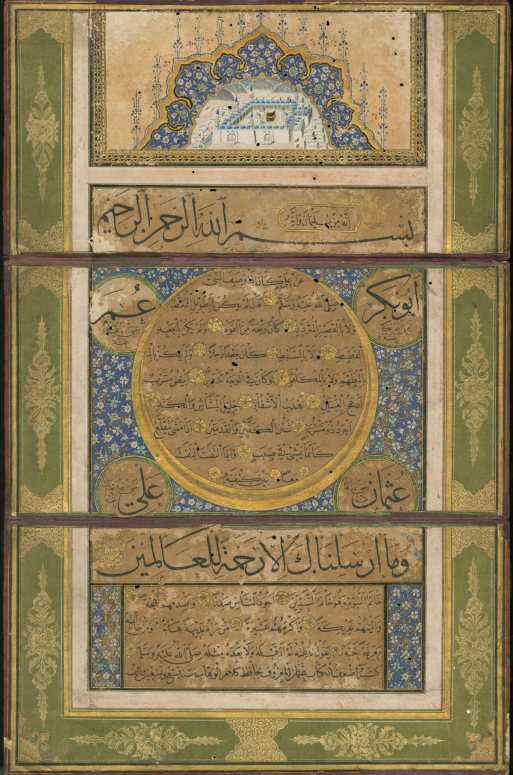
Hilye triptych
A three-panel Ottoman ḥilye-i şerîf-  a description of Muhammad’s physical attributes, or ‘verbal icon’- by Ḥafîẓ Osmân Efendî (d. 1698). Note the miniature depiction of Mecca in the top panel. Special Collections Library, University of Michigan, Ann Arbor, Isl. Ms. 238.

There are a number of aspects of medieval and early modern Islam (and contemporary living Islam too, for that matter) that tend to surprise, even shock, many modern-day observers, especially non-Muslims who nonetheless have some degree of knowledge about the ‘basics’ of Islam. Because of the wide-spread and often quite profound changes that have transformed Islam in many places throughout the world over the last century and a half or so, there is a great deal in pre-modern ‘mainstream’ Islam that many contemporary Muslims might find odd, unexpected, or even heretical. One such source of surprise and even shock is the history of the image and meaning of Muhammad in Islamic theologies and devotional practices. If, like me, in your initial exposure to Islam you learned that Muslims—throughout time, perhaps?—viewed Muhammad as ‘only’ a prophet, and no more, then Islamic theology that talks about the Muhammadan light, the cosmic role of Muhammad within God’s creative plan, and the intercessory power of the Prophet, and so on, must all sound quite strange and even ‘un-Islamic.’ Indeed, I remember thinking, as I delved into the vastness of ‘Muhammadology,’ that much of the theology I was discovering bore a marked resemblance to Christology, in particular to Logos theology, in Christianity.

Yet far from being aberrant or peripheral, the theological ‘elevation’ of Muhammad that took place in the course of the Islamic medieval period was a transformation that occurred and impacted Islam across the board. It was not just a ‘Sufi’ thing or a matter of ‘popular’ religion. Devotion to Muhammad, alongside theological renderings of the ‘cosmic Muhammad,’ coursed through the very veins of Islam from the middle ages into early modernity and beyond. The person and role of the Prophet Continue reading “Devotion to Muhammad in Medieval and Early Modern Islam: An Introduction”

An Ottoman Book Binding by Way of Tabriz

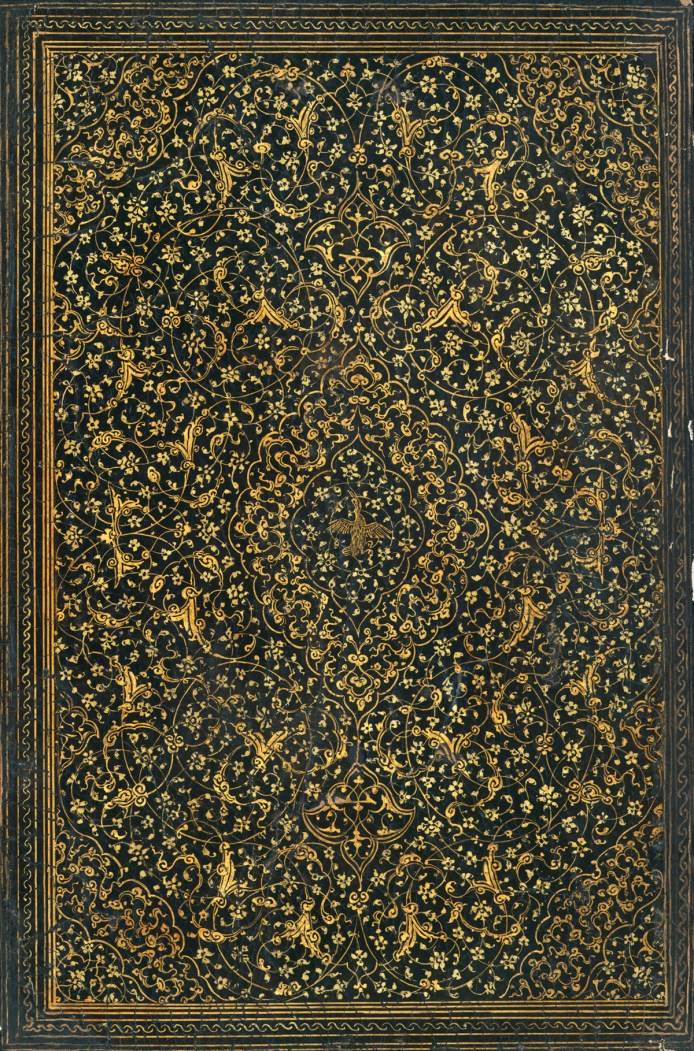
Binding of a copy of the Bustan of Sa‘di MSS 712
Binding of a copy of the Bustan of Sa‘di, Khalili Collections, MSS 712. Istanbul, Ottoman Empire (likely), 1530–1540. (Papier-mâché boards, painted and varnished; with paper doublures; 24.7 x 16.5cm (covers, each); 24.7 x 11cm (flap and fore-edge)

This spectacular example of book binding was probably produced in the workshops of the Topkapı Palace by artisans from Tabriz (modern-day Iran, at the time part of the Safavid Empire, though periodically contested by the Ottomans). As such it is a good demonstration of the interconnection between the Persianate world and that of the Ottomans, especially in the 16th century (Persian influence and connections would decline somewhat in the coming centuries). This cover protects a copy, executed in Tabriz in 1530, of one of the great works of Persian poetic literature, Sa’di’s Bustan (‘Garden’), which, along with other works of Persian poetry, would have a long-lasting influence on the production of Ottoman Turkish poetry. The artwork, with its intricate interlacing tendrils, delicately rendered foliage and single creature at the center, is redolent of the Persian world, and would have been immediately recognized as such by whatever connoisseurs of art would have had access to the finished product, probably in the Topkapı itself.


The Thought of Fishing

As noted in a previous post, the Ottoman majdhūb/meczûb (the first is the Arabic rendering, the second the same term but in Ottoman Turkish)- the divinely drawn saint or holy madman- was often involved in the details of everyday life, such as the smoking of tobacco. In the following story, which comes from a compilation of meczûb lives in a sprawling 17th work of hagiography by Mehmed Nazmî EfendiHediyyetü’l-ihvân, we see one of these holy madmen miraculously discern the wandering thoughts of the imam in the greatest mosque of Ottoman Istanbul.

IMG_2952
A view of the courtyard of the Süleymâniye Mosque, the setting of the following story

‘And there was one, Hızır Aşak, who was from among the great (ulular) of the meczûb. He was a powerful meczûp capable of unveiling inner secrets. It is related that the imam of the Süleymâniye Mosque, Süleymân Efendi—who was later dismissed and sent into retirement—was one day leading the noon prayers, when the thought came to him: “After completing the salât, I’ll go to Hisar [on the Bosporus] and go fishing.’ Just as this thought was occurring to him, Hızır Aşak came to the mosque, and, as was his custom, cried out “Hû!” [i.e. ‘He,’ meaning God, a common sufi form of zikr] and said, “Süleymân Çelebi! You are here, your mind ought not be off fishing in Hisar. There is no prayer without presence of heart. Lead these men in prayer a second time.” Having said this he left the mosque. Süleymân Çelebi related thus: “This unveiling of the mad one brought about divine fear and embarrassment before the people in me. For a little while I passed out! Coming to, I properly completed the prayers.”’

Mehmed Nazmî Efendi, Hediyyetü’l-ihvân

Sense Can Come Only From the Sacred

‘The omnipresent Nietzschean or Sartrean chimera which proclaims that man can liberate himself totally, from everything, can free himself of tradition and of all pre-existing sense, and that all sense can be decreed by arbitrary whim, far from unfurling before us the prospect of divine self-creation, leaves us suspended in darkness. And in this darkness, where all things are equally good, all things are also equally indifferent. Once I believe that I am the all-powerful creator of all possible sense, I also believe that I have no reason to create anything whatsoever. But this is a belief that cannot be accepted in good faith and can only give rise to a desperate flight from nothingness to nothingness.

‘To be totally free with respect to sense, free of all pressure from tradition, is to situate oneself in a void and thus, quite simply, to disintegrate. And sense can come only from the sacred; it cannot be produced by empirical research. The utopia of man’s autonomy and the hope of unlimited perfection may be the most efficient instruments of suicide ever to have been invented by human culture.’

/

« La chimère nietzschéenne ou sartrienne, tellement répandue parmi nous, selon laquelle l’homme peut se libérer totalement, se libérer de tout – de toute la tradition et de tout sens préexistant– et qui proclame que tout sens se laisse décréter selon une volonté ou un caprice arbitraires, cette chimère, loin d’ouvrir à l’homme la perspective de l’autoconstitution divine, le suspend dans la nuit. Or dans cette nuit où tout est également bon, tout est, aussi bien, également indifférent. Croire que je suis le créateur tout-puissant de tout sens possible, c’est croire que je n’ai aucune raison pour créer quoi que ce soit. Mais c’est une croyance qui ne se laisse pas admettre de bonne foi, et qui ne peut que produire une fuite enragée du néant vers le néant.

« Être totalement libre à l’égard du sens, être libre de toute pression de la tradition, c’est se situer dans le vide, donc éclater tout simplement. Et le sens ne vient que du sacré, parce qu’aucune recherche empirique ne peut le produire. L’utopie de l’autonomie parfaite de l’homme et l’espoir de la perfectibilité illimitée sont peut-être les outils de suicide les plus efficaces que la culture humaine ait inventés. »

Leszek Kolakowski, ‘La revanche du sacré dans la culture profane,’ translated by Agnieszka Kolakowska, in Le besoin religieux, 1973

Tobacco and the Syrian Majdhūb

One of the great transformations that Ottoman society- and many other societies across the world- underwent in the course of the early modern period was the introduction of new (to most markets at least) ‘social’ commodities such as coffee, tobacco, tea, and sugar. Driven by new technologies of transportation, by the European discovery and colonization of the Americas, and by changing dynamics of personal wealth and consumption patterns, across the world people’s lives began to be shaped by the use of coffee and tobacco, both substances with addictive properties, and which lend themselves to use in social, often public, contexts (I am writing this from a coffeehouse, for instance- a direct descendant of these early modern transformations!). In the Ottoman world, as in many other places, both tobacco and coffee stirred up controversy, tobacco most of all.

Yet despite strenuous objections, including sultanic attempts to prohibit smoking, tobacco use flourished in the Ottoman lands, and soon permeated society and culture at many levels. The following anecdote, which dates from the early part of the 18th century and is set in Damascus, illustrates this permeation, which reached even to the karamāt (miracles or signs of sanctity) of Muslim saints, in particular, it seems, the majādhīb, the divinely drawn ones, whom I have introduced elsewhere and who will continue to appear in these digital pages. In this story we see both the continued ambiguity surrounding tobacco, as well as the possibility for its use by a saint, and even being miraculously transformed through the saint’s baraka (divine grace or power).

2006BK4224_jpg_l

Shaykh Muṣtafā related to me [Muṣtafī al-Bakrī], saying: ‘I came to visit you once but didn’t find you at home. [Aḥmad the majdhūb] was sitting in front of the iwān, so I greeted him. He said to me: “You only come to visit Ibn al-Bakrī, you never come to visit me, not even once!” I replied, “Your place is exalted and I am weak!” So he said to me, “Come out to my khalwa, I’ll host you!” I wasn’t able to oppose him in that, so I went with him, fearing that the smell of tobacco would harm me due to the closeness of his khalwa. He set to with his pipe, talking with it [in his mouth], but I did not smell the scent of the tobacco nor did anything of it come to my face—and I knew that this was a mark of sanctity (karāma) of his!’

Muṣṭafā al-Bakrī, al-Bayān al-ghanī ʻan al-tahdhīb fī suná aḥwāl al-majādhīb (Cairo: Dārat al-Karaz, 2011), 75.