Many Worlds in One Manuscript: A Close Reading of Ms. Yah. Ar. 765, Part II

This post continues my three-part exploration of a short Ottoman manuscript text, Risāla fī ithbāt ruʾyat al-nabī yaqaẓatan li-man iṣtafāhu min ʿibādihi al-ṣāliḥīn, by the otherwise obscure scholar Muḥammad b. Aḥmad al-Kūmuljinawī; if you have not already read Part I much of the following will not make sense, so start there then proceed to the following.

In Part I we were introduced to the manuscript as a codicological unit, and reviewed some of the paratextual aspects that appear in this handful of folios. In the remaining pages the same elements continue, plus some additional ones, which we’ll examine before plunging into the main topic of this post, the theological content and the way in which al-Kūmuljinawī drew upon existing authorities, how he might have gone about locating sources, and what we can gather about ‘canonical’ theological authorities in the eighteenth century Ottoman world. Let’s have a look at the second page in the treatise and note the paratextual elements visible there:
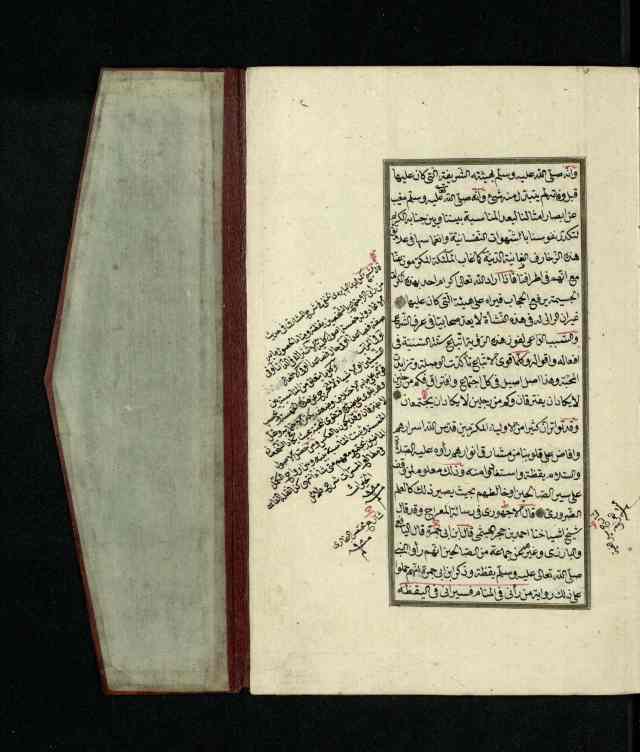
National_Library_of_Israel_Jerusalem_Israel_Ms._Yah._Ar._765.pdf_page_9

First, it’s important to pay attention to things that might otherwise fade into the background: for instance, this manuscript features a frame around the main text, a common feature but not a universal one, bespeaking the refined nature of the manuscript and its intended purpose as a presentation text. More mundanely, the frame neatly demarcates the main text from its marginal apparatus: in the case of this manuscript, primarily comments that are the functional equivalent of footnotes in modern book practice. In the example above, three annotations are visible, all examples of the minhu, ‘from him,’ type of note, placed there by the author of the text (at least in this case- in other cases the provenance of such notes can vary). The notes are linked to particular points in the main text via rubricated letters, very much akin to the footnote, although spatially they are placed more or less proximate to the linked section of main text, and hence in a variety of arrangements- an affordance of handwritten texts that is considerably more of a challenge for typography (though not insurmountable; not a few early Ottoman printed works featured sloping commentary text, though not at varying angles as here).

Nearly all of the minhu comments in this section, save a single (incorrect as it turns out!) translation of an obscure Arabic word into Ottoman Turkish, are in the same hand as the main text, which we’ve every reason to believe is the hand of the author (or, if not in his actual hand, the hand of a scribe to whom he dictated). For more on these notes and their relationship to authorship, manuscript transmission, and so forth, see A Tunç Şen’s ‘Authoring and Publishing in the Age of Manuscripts: the Columbia University Copy of an Ottoman Compendium of Sciences with Marginal Glossing.’

The other paratextual element to notice in this section of the text is the use of red overlining at various points: there is no single modern equivalent for this overlining, as at points it functions like italicizing or bolding, drawing attention to a particular point in the text; at other points it functions somewhat akin to quotation marks, or, at least, the first set of quotation marks. In the example above, the final line is largely overlined, marking out a particular ḥadīth visually from the rest of the text (in Persian texts from this period, switching from nasta’liq to naskh for ḥadīth and Qur’ān did similar visual denotation work). Taken together, all of these paratextual elements- dots, rubricated words and letters, and overlining- aid the reader in navigating and interpreting the text, knowing immediately where cited texts begin, or where important arguments or transitions are located. In my translation below I’ve largely ‘translated’ these elements into modern punctuation; on reflection I think it would be interesting to try and replicate them exactly, and will try to do in the final installment of this series.

I have aimed for a relatively literal translation, while trying to draw out some of the nuance in the usage of technical vocabulary, the most challenging aspect of this text to render in English. I initially tried a two-column display here, but found that it caused a serious error when displayed on the front page of the website, unfortunately, so I have had to drop the marginal notes down to the end of the translated section.

Know that it has been established by definite texts from among the sound and sunna-conforming aḥādith that our lord and master Muḥammad, God bless him and give him peace, is alive in his grave in body and soul, and that he has freedom of action and can go where he wills in the quarters of the earth and in the imaginal realm (al-malakūt). Verily, he—God bless him and give him peace—is [still] in his noble form in which he was before his death, nothing has been changed. And if he, God bless him and give him peace, is hidden from the sight of the likes of us, it is due to the relational distance between us and between his noble person, due to the turbidity of our lower selves due to the passions of the self and their immersion in the attachments to these trifling vain wordly babbles, just as the noble angels are hidden from us even as they are in our very midst.

Now, if God desires to honor anyone with this bodily miracle, He raises the veil and he is able to see him in his true form (this does not entail that the one who so sees him is in the ranks of the Companions in a sharī’a-accordant sense). The generative cause for the obtainment of this vision is his following the sunna in his deeds and words. The more that he strengthens his following [of the sunna] the more resilient will be his personal connection [with Muḥammad], and love [for him] will increase. This is the fundamental root of all union and separation—there are those people who are scarcely ever in a state of separation and those people who are scarcely ever in a state of union [marginal note a.].

It has been established by multiple avenues of transmission that many among the noble saints, God sanctify their inner secrets and pour out blessing upon our hearts from the orients of their lights, see him, upon him be peace and blessing, in waking life, and spiritually benefit from him—that is something that is known to the one who comes to the path of the saintly or who associates with them, such that it becomes akin to necessary knowledge.

Al-Ajhūrī (d. 1655) [marginal note b.] said, ‘The shaykh of our shaykhs, Aḥmad ibn Ḥajar al-Haythamī said that Ibn Abī Jamra [marginal note c.] said that al-Yāfi’ī and al-Bārazī and others from among the community of the saintly pious have said that they have seen the Prophet, God bless him and give him peace, in waking life. And Abū Jamra mentioned that they experienced that in accordance with the transmitted saying, “The one who has seen me in a dream-vision, he will see me in waking life.” Truly, they have seen him in dreams and they have seen him afterwards in waking life, and have asked about various things and he has reported to them concerning those things, and it has turned out as he has related to them.’

The one who denies that, if he is from among those who cast calumny upon the miracles (karāmāt) of the saints—then we have nothing to say to such a one. Otherwise, this [vision] is from among [their miracles], when in the rending of [the] customary [nature of things] there is unveiled to them things in the world above and below.

Al-Fāsī (d. 1698) says in Maṭāli’ al-massarāt [his commentary (sharḥ) on] Dalā’il al-khayrāt: ‘Shaykh Abū ‘Abd Allāh al-Suhaylī [also vocalized as al-Sahlī], God be pleased with him, has said: “In order to affix love of the Prophet in the soul, do not let his noble form be hidden from the eye of insight for a moment—it is the true vision because the vision of sight is due to his conveyance of the true essence of the one who sees to the eye [or essence] of insight, so that in the presence of insight there occurs comprehension regarding the true reality of what is conveyed to [sensory] sight from among the visible things. There is no doubt that ṣalāt upon the Prophet, God bless him and give him peace, if one’s innate disposition (mashrab) is purified, will shed forth its lights and the lower self (nafs) will become a mirror for [Muḥammad’s] form, God bless him and give him peace, and will not be hidden from it. This is true knowledge in which there is no doubt. Continue reading “Many Worlds in One Manuscript: A Close Reading of Ms. Yah. Ar. 765, Part II”

O Monarch of the Heart

In yesterday’s post I introduced the theme of late medieval and early modern devotion to Muhammad, a ‘movement’ within Islam that became dominant and widespread by the end of the middle ages, especially flourishing in the early modern period. The texts of this devotion were not only written in Arabic: rather, devotion to Muhammad was often expressed in vernaculars. The following translated poem, by an Ottoman sufi şeyh and saint, Muhammed Nasûhî Üsküdarî (d. 1718), is a part of a larger collection of poetry of praise and supplication directed towards Muhammad, written in Ottoman Turkish. It is a good example of this genre of poetic composition, which was common across the Ottoman world and beyond, expressing theological concepts as well as emotional bonding between the poet and his object, Muhammad. I have included footnotes at points to clarify certain references that would have been relatively obvious to a contemporary reader or listener but might not be to my readers here.

Iznik Flower Panel

You are the cure of my sickness, yâ Muhammed Mustafa!
You are the sovereign of my heart, yâ Muhammed Mustafa!

Who am I that I dare to praise you, o monarch of the heart?
You are the light of the moon of Yâ-sin [1] yâ Muhammed Mustafa!

You hold sway over the inner secret of this habitation below, o mirror of the True!
You are the monarch of the throne of If you had not been [2], yâ Muhammed Mustafa!

Without sign, without place, in your inner secret I beheld your essence.
You are the spirits of the passionate lovers, yâ Muhammed Mustafa!

To the crooked-statured, sin-bearing Nasûhî [3] give
Help—you are a remedy, yâ Muhammed Mustafa!

Üsküdarlı Muhammed Nasûhî, [‘Poem 6’], in Üsküdarlı Muhammed Nasûhî ve Dîvânçe-i İlâhiyat’ı, ed. Mustafa Tatcı (Üsküdar, İstanbul: Kaknüs Yayınları, 2004), 166-167.

[1] A reference to the 36th surāh of the Qur’an, Surāh Yā’-Sīn, sometimes referred to as ‘the heart of the Qur’an.’

[2] An allusion to a hadith qudsi– a hadith said to convey God’s speech, though not as part of the Qu’ran- in which God says to Muhammad words to the effect of ‘If you not been I would not have created the universe.’

[3] Including one’s name in the penultimate line is an Ottoman convention, carried over from Persian poetic convention.

The Thought of Fishing

As noted in a previous post, the Ottoman majdhūb/meczûb (the first is the Arabic rendering, the second the same term but in Ottoman Turkish)- the divinely drawn saint or holy madman- was often involved in the details of everyday life, such as the smoking of tobacco. In the following story, which comes from a compilation of meczûb lives in a sprawling 17th work of hagiography by Mehmed Nazmî EfendiHediyyetü’l-ihvân, we see one of these holy madmen miraculously discern the wandering thoughts of the imam in the greatest mosque of Ottoman Istanbul.

IMG_2952
A view of the courtyard of the Süleymâniye Mosque, the setting of the following story

‘And there was one, Hızır Aşak, who was from among the great (ulular) of the meczûb. He was a powerful meczûp capable of unveiling inner secrets. It is related that the imam of the Süleymâniye Mosque, Süleymân Efendi—who was later dismissed and sent into retirement—was one day leading the noon prayers, when the thought came to him: “After completing the salât, I’ll go to Hisar [on the Bosporus] and go fishing.’ Just as this thought was occurring to him, Hızır Aşak came to the mosque, and, as was his custom, cried out “Hû!” [i.e. ‘He,’ meaning God, a common sufi form of zikr] and said, “Süleymân Çelebi! You are here, your mind ought not be off fishing in Hisar. There is no prayer without presence of heart. Lead these men in prayer a second time.” Having said this he left the mosque. Süleymân Çelebi related thus: “This unveiling of the mad one brought about divine fear and embarrassment before the people in me. For a little while I passed out! Coming to, I properly completed the prayers.”’

Mehmed Nazmî Efendi, Hediyyetü’l-ihvân

The Good Tree of the Heart

The following is an excerpt from the Qur’an commentary of the important eleventh-century Sufi writer al-Sulami, who wrote a prodigious number of texts, the most significant- in terms of later use and emulation- where the tafsir excerpted here and his Tabaqat al-Sufiyya, a collection of biographies of Sufis of preceding generations. Much of his work- such as the example here- involves compiling and reworking material from previous Sufis (and other sources); some of it, including- perhaps- the final paragraph here, are al-Sulami’s own compositions. At any rate, al-Sulami represents a consolidation of the early stages of Sufi thought and practice, as well as the reconciliation- or attempt at it- of conflicting or divergent strands of Sufi teachings and other forms of mystical practice.

I thought this selection gives a quite readable and approachable example of how eleventh-century Sufis are doing Qu’ran commentary; instead of the specialized grammatical and syntactical vocabulary of ‘conventional’ commentaries, Sufi technical terms are worked into the exegesis, at once reinforcing Sufi concepts and practices with Qur’anic dicta, while also ‘Sufi-ising’ the Qur’anic text itself. Another significant difference in all early Sufi tafsir, and even most later ones, is the selective nature of Sufi commentaries. Rather than go verse by verse, they select certain verses as locii for interpretations and explanations, usually- though not always- forgoing more conventional explanations for an interpretation that ties the text into Sufi understanding and practice. The following is an lovely example that also reveals the relative freedom and resulting artistry this particular exegetical technique can unlock.

To make the translation a little clearer for those not familiar with Sufi terminology, I have placed expansions of certain terms in brackets. Some words are simply impossible to really get across; a couple- including the bit about the wind blowing upon (or blowing into place?) a ‘mark’ on the heart- I don’t exactly understand myself. That’s part of the fun: and quite possibly the intended experience.

*

His saying, mighty and glorious is He: ‘And the likeness of a good word is a good tree.’ (Q. 14.24)

Ibn ‘Ata’ said: The good word is ‘No god but God’ in regards to the assertation, and the good tree is the triumphing of the secrets (asrār) of the professors of God’s oneness over the filth of desires, through faith in God, and through the cutting off for His sake of whatever is other than Him.

Muhammad bin ‘Alī said: the good tree is faith, God establishing it in the hearts of those He loves, and He makes its earth congruity [with His commands], its leaves sainthood/governance, its sky assistance, its water soliciting guidance, and its branches sufficiency. Its leaves are sainthood, its fruit union [with God], its shade intimacy. Its branches (aghsānuhā) are rooted firmly in the heart/core of the friend/saint, and its twigs (farū’uhā) are firmly rooted in the sky, through the superabundance of the presence of the Omnipotent. The root tends to the branch through continuious compassion and watchfulness, and the branch guides the root through what is gathered from the state of witnessing and proximity [to God]; thus, the heart of the believer and his benefits is disclosed.

I heard Muhammad bin ‘Abd Allah al-Damashqī saying: I heard ibn al-Mawlad saying: Abū Sa’īd al-Khrāz said: the treasures of God in the sky are the unseen (al-ghayūb), and His treasures upon the earth are hearts. For God the Exalted created the heart of the believer as a house of His treasures, then sent a wind which blew upon it a spot of unbelief, associationism (shirk), hypocrisy, and deceit. Then He created praise, and it rained down in [the heart], then He firmly roots in it a tree. Then it bore fruit of good pleasure [with God], love, gratitude, purity, sincerity, obedience- so His saying ‘Like a good tree its root is firmly established and its brances are in the sky.’

Some say: Every tree in this world below, whenever it does not have its portion of water, it dries up. And the tree that is in your heart dries up whenever you do not water it with the water of repentance and the water of remorse, then with the water of sorrow, then with the water of holy desire. Then come clouds of grace, and they rain upon your heart the rain of [divine] mercy until there is the water of service [to God] beneath and the water of [divine] mercy above, so that it will be fresh and pleasant. Then three things come: the way of servanthood in the lower self (fī ‘l-nafs), the way of praise in the heart, and the way of remembrance (dhikr) in the secret (al-sirr). The service of the lower self is obedience, the service of the heart is intention, and the service of the secret is continual watchfulness. Then there rains upon it, rains upon the lower self the rain of guidance, upon the tongue the rain of subtletly, upon the heart the rain of sublimity, upon the secret the rain of grace, upon the spirit the rain of nobility. Then there sprouts from the rain of the tongue gratitude and trust; from the rain of the lower self obedience and piety; from the rain of the heart truthfulness and purity, and from the rain of the secret, holy desire and diffidence; and from the rain of the spirit, vision and encounter [with God].

Abū ‘Abd al-Rahman Mahmud bin al-Hussayn bin Mūsā al-Azdī al-Sulamī, Haqā’iq al-Tafsīr, Vol. 1 (Beirut: Dar al-Kitab al-‘Almīa, 2001), 344.