Neighbors, Strangers, and Travellers

Sufi exegesis of the Qur’an was often quite divergent with the broad consensus of ‘exoteric’ exegetes: Sufis ‘heard’ different things in the Qur’an, and looked for more ‘esoteric’ depths to the established meanings other exegetes worked within. Yet at the same time Sufi exegetes did not reject those meanings. In fact, they very much operated within the wider exegetical scheme. This exegetical scheme could manifest itself in quite subtle ways, ways that remind us that in late antique and medieval ‘scriptural communities’ scripture was never read in isolation from exegesis or from the wider religious and cultural life of the community. Rather, scripture and scriptural exegesis became deeply integrated in the thought-worlds of writers across the spectrum, almost to the level of an automatic ‘reflex’. This reflex shows up quite well in comparing two seemingly quite different exegetical approaches to the same verse.

In the first example, a citation in al-Sulami’s tafisr of the great formative Sufi teacher Sahl al-Tustari, what we would probably call ‘allegory’ is clearly being deployed. The second example is a much longer and much more ‘traditional’ passage from the voluminous al-Tabrisi, an eleventh century author who consolidated much previous material and recrafted it according to his particular literary scheme. At first glance the two passages seem to have little in common, save a shared reference. Al-Tabrisi does not point out any allegorical or mystical significance; al-Tustari gives no ‘literal’ meaning. However, informing al-Tustari’s interpretation, in fact making it understandable, is the ‘literal’ exegesis that lies in the background. The verse in and of itself is relatively unclear, especially the odd term ‘adjacent neighbor.’ It is only with an exegetical unpacking that the various terms can be differentiated and explained. It is this unpacking that al-Tustari’s exegesis takes advantage of. Knowledge of this ‘literal’ exegetical background also gives an unspoken, deeper significance to al-Tustari’s symbolic equivalences. To explain: if the heart is the nearby neighbor, we know from the ‘literal’ exegesis that it has the most ‘rights’ and is, according to some commentators, to be understood as a kinsmen: someone related by blood, and not merely physical proximity. The adjacent neighbor, understood by al-Tustari to be the ‘lower self’, retains rights as well, but is essentially foreign: either distant geographically or unrelated in terms of blood. The companion, understood by literal exegetes to be someone you are traveling with, is the intellect: a helper in the way, essentially. Finally, the bodily limbs, if equated with the traveller (who is by definition a foreigner to be treated with hospitality), are for the spiritual adept not truly essential, but still important and to be treated with care. All of these meanings depend upon two levels of background knowledge: knowledge of the wider exegetical apparatus for this verse, and knowledge of Sufi terminology. Once again we see the importance of approaching Sufism- especially early Sufism- as a movement very much embedded in and interacting with the wider Islamic tradition, and not as an exogenous thing grafted onto ‘orthodox’ Islam.

The Texts

His saying, exalted and glorious is He: [And show kindness to] to the neighbor who is close [to you], and to the adjacent neighbor [or: unrelated neighbor], and to the companion nearby, [and to the traveller].

Sahl [al-Tustari], God be merciful to him, said: the neighbor who is close is the heart, and the adjacent [or distant, see below] neighbor is the self (al-nafs), and the companion alongside is the intellect (al-‘aql), which comes to know the imitation of the Way and the Law. The traveller is the bodily limbs that are obedient to God, exalted and glorified is He.

Tafsir al-Sulami, Q. 4.36

The neighbor who is close and the adjacent neighbor: it is said: its meaning is the neignbor who is close through kinship, and the adjacent neighbor is one with whom you and he have no kinship, according to ibn ‘Abbas, Mujahid, Qatada, Dahak, and ibn Zayid. It is said that the intended meaning here is a neighbor close to you through Islam, while the adjacent neighbor is the non-believer distant in terms of religion. It is related that the Prophet, peace and prayers be upon him, said: ‘There are three sorts of neighbors: a neignbor who possess three rights (huquq)- the right of the neighborhood, the right of kinship, and the right of Islam; a neighbor who possess two rights- the right of the neighborhood, and the right of Islam; and a neighbor who possess the right of the neighborhood, [namely], unbelievers among the People of the Book.’ Al-Zajaj said: the neighbor related to you is he who is close to you and you are close to him, and who knows you and you know him. And the adjacent neighbor: the stranger [or simply the one who is more distant]. It is related that the limit of a neighborhood runs out to forty houses, and it is related that it is forty dhara’ [approx. eighty feet]. He said: it is not possible that the intented meaning is the neighbor who is close through kinship, because mention of kinship and the commanding of good deeds towards them came earlier, through His saying and to those nearby. It is possible to answer him that [this meaning] is possible. Mention of kinship had come before because a neighbor, if related by kinship, possesses the right of both kinship and neighborship. The relative who is not also a neighbor still has the right of kinship reckoned to him, while the singularities of the related neighbor are presented as preferable through this mentioning [?].

And the companion nearby: in its meaning are four intepretations: the first of them: that he is a comrade on a journey, according to ibn ‘Abbas, Sa’id ibn Jabir, and others. And good deeds towards him are by way of benifience and proper companionship. The second of the interpretations: that it is one’s spouse, according to ‘Abdallah ibn Sa’ud, ibn Abu Layla, and al-Nakha’i. The third of the interpretations: that he is one cut off from his journey, hoping for some benefit from you, according to ibn ‘Abbas in one of the reports [he relates], and according to ibn Zayd. And the fourth of the intepretations: that he is a servant who serves you. However, the first interepretation makes allowance for the other two [to be correct also].

And the traveller: its meaning is the traveler on the road, and there are two ideas contained therein: that he is the traveling stranger, according to Mujahid and al-Rabi’. And it is said: he is a guest, according to ibn ‘Abbas. He said: Showing hospitality to a guest for up to three days is a commonly acknowledged good deed (ma’ruf), and every such good deed is an act of almsgiving. And Jabar related that the Prophet said: ‘Every commonly acknowledged good deed is an act of almsgiving. It is concordant with the good deed that you meet your brother with a joyful face, and that you empty your bucket into the vessel of your brother.’

Tafsir al-Tabrisi, Q.4.36

Layering Meaning: Two Sufi Tafsir Excerpts

The following are two selections from the formative Sufi Qur’an commentary of al-Sulami (whom I have written about previously here and here). There are several interesting hermeneutical moves that al-Sulami makes in these two selections, moves that will be familiar to anyone conversant with Patristic and medieval Christian commentary. In the first selection, of Quran 2.158, al-Sulami has selected exegetical thoughts concerning the two hills al-Safa and al-Marwa, two small peaks that form part of the rituals of the Hajj (here is a decent overview of the two hills and their role in the Hajj)- pilgrims move around the two at one point in the pilgrimage’s rituals. It is this ritual significance that our exegetes here have in mind when addressing the verse in question. What, in fact, is the significance of these two hills, and how do they relate to the wider goals of the Sufi? Al-Sulami (and his sources) answer in two ways. First, they emphasize the importance of inner transformation and sight when carrying out the rituals of the Hajj- they do not negate the outward performance, but, as with formative Sufism generally, call for a carrying out of the outward acts alongside one’s inner acts.

Second, our exegetes look to the names of the hills themselves and mine them for significances that would resonate within Sufism. This is a type of exegesis that appears frequently in Christian Patristic commentary (East and West, Latin, Greek, Syriac, and others), enough so that by the early Middle Ages entire treatises devoted to etiologies and etymology could be found- with place names being particularly popular sites of examination. Keep in mind when reading this sort of commentary that for these writers, Christian or Islamic, names are not accidental occurrences, but have the capacity of representing deeper realities, of conveying multiple levels of meaning.

Finally, a note on the word I have translated godly manliness: al-muru’a is a tricky term, one that I have yet to find a good translation for. It has a whole web of meanings and connotations that develop around it through Sufi thought and a little later in futuwwa treatises and other genres. The Latin concept of virtus is perhaps the closest thing to muru’a, although the two ideas are not synonymous. Here it has a specifically religious sense, hence my tentative translation.

As for the second selection, it is fairly straightforward. The unstated question of our exegetes is: how is one to remain devotedly in mosques (or anywhere else)? The answer: this verse can be understood, with a little exegetical tweaking, to command not just devoted seclusion in a literal, physical place of prayer, but the transformation of one’s self into a continual site of prayer and devotion to God. Hence the command given in the scripture passage becomes broader and deeper, enjoining a state of secluded devotion not just at certain times or places, but at all time, and in all places.

*

Q. 2.158: His saying, exalted is He: ‘Verily, al-Safā and al-Marwa are among the rites [or symbols] of God.’

It is said: whoever climbs al-Safā and does not unite his secret to God, nothing of the rituals of the Hajj are clear to him; and whoever climbs al-Marwa and the realities of the Unseen are not clear to him, perceives nothing of the rituals of the Hajj.

And it is said: al-Safā is the place of concord (al-musāfāh) with the Truth, and whoever does not devote himself singularly to the concord of God, let him understand that he has squandered his days and the running of his course in his Hajj. I heard Mansur speak a tradition related back to Ja’afar, who said: ‘Al-Safā: the spirit, due to its being clean (safā’) of the filth of divergences [from God]. Al-Marwa: the self (al-nafs), due to its employment of godly manliness (murū’a) in standing to service of its Lord.’ And he said: ‘Al-Safā is the purification of spiritual knowledge, and al-Marwa is the godly manliness of the knower. Al-Safā is cleansing from the turbidity of this world and the passions of the self, while the running of the course [between the two hills] is fleeing to God, and when one unites his running of the course to fleeing to God, he is not rendered empty by looking to something other than God.’

Q. 2.187: His saying, exalted is He: ‘Remain devotedly in the mosques.’

Al-Wasitī said: the devoted remaining is the imprisoning of the self (al-nafs) and the binding of the limbs and attention to the time- then, wherever you are, you are remaining devotedly.

One of them said: The Sufis are remain devotedly through their inner secrets before God- nothing from temporal occurrences effects them due to their total immersion in divine witnessing.

Al-Sulami, Haqa’iq al-Tafsir

Breaking Down the Golden Calf

The following is a translated selection from the early Sufi commentary on the Qur’an authored/compiled by al-Sulami, a Sufi who lived a little after the great foundational figures of early Sufism. Al-Sulami, in this commentary and in other works of his, worked to draw the various strains of Sufism that had developed, sometimes in relative independence from each other, into a coherent body of doctrine and practice. This commentary was part of that process. In this excerpt, which deals with a verse  which retells the famous story of the children of Israel and the Golden Calf, our author has collated various interpretations which interpret the calf allegorically as the nafs of the human person. Nafs– variously translated as self, soul, ego- is one of those multivalenced words that Sufis delighted in coining and employing; they are words that have a history both in the milieu of Eastern Christianity monastic spirituality and practice and in the textual world of the Qur’an. But rather than try to explain further, I will leave you to the following explorations al-Sulami has collected here:

Surah al-Baqrah [Q. 2]. 54: His saying, exalted is He: ‘Verily, you have oppressed yourselves by your taking [as an object of worship] the calf [in the wilderness].

It is said: the ‘calf’ (‘ijl) of every person is his self (nafsuha), and whoever humbles it and turns away its desire and passion, he has been freed from its oppression.

His saying, exalted is He: ‘Turn (tawbū) to your Creator, slaying (fa-aqtalū) your selves.’

It is said: If the first step in spiritual conduct is repentance (altawbah)- and repentance is the destruction of the self (al-nafs) and slaying it through abandoning the passions and cutting it off from desire)- then how is attachment to a thing among the stations of the sincere believers? In its first step is the destroying of the life-blood [of the self].

And it is said: ‘Turn to your Creator’: return to Him through your inner secret self (asrārikum) and your hearts; ‘slay your selves’ through being rid of it [the self]- for it is not even worthy to be someone’s rug! And Abū Mansūr said: The Truth does not begin one upon a path otherwise [than in this manner], and its beginnings are destruction [of the self].

God, exalted is He, said: ‘Turn to your Creator, slaying your selves.’ As long as discrimination and reasoning keep you company, you are in the essence of ignorance, until your reason is misled, your notions go, your connections fail- then, perhaps, perhaps…

Al-Wāstī said: The repentance of the children of Israel was the annihilation (fanā’) of their selves, but for this community [Muslims] it is more intense: the annihilation of their selves and the annihilation of their desires alongside the remaining of their corporeal traces.

Fāris said: Repentance is the effacement of humanness and the rooting of divineness. God, exalted is He, said: ‘So turn to your Creator, slaying your selves.’

Surah al-Kawthar: Sufi Tafsir: ibn ‘Ajiba

The tafsīr of the Moroccan Sufi Ahmad ibn ‘Ajība (b. 1747/8) is the most recent of the commentaries I am examing in this series, and because of that it is a good summation of the many centuries of exegetical tradition that preceded it, both in ‘mainstream’ Sunni tafsir and in Sufi mystical intepretation. At first glance, there is little to distinguish ibn ‘Ajība from his predecesors. He seems to be drawing heavily upon al-Baydawī (or al-Baydawī’s source, al-Zamakhsharī), with some expansions. However, there are some rather significant changes. For instance, we see that al-Sulamī’s story about Muhammad’s discontent has been included as part of the ‘exoteric’ commentary, and has been modified slightly. Ibn ‘Ajība includes brief grammatical explanations, taking care not to overburden the reader; he also includes an occasion of revelation story that we have not come across before, as well as brief speculation on the liturgical proscriptions inherent in this surah. He thus draws upon the wide variety of exegesis that had developed, paring it down and presenting the various elements in rapid succession.

Finally, of most significance is the final paragraph of the commentary, the ‘spiritual allusions.’ Here we see another form of Sufi exegesis, but in a very different order from al-Sulamī’s. Instead of the usual process of dividing the surah into lemmas (individual lines or units) and presenting various exegetical authorities and opinions, line by line, our author interprets the surah through a process of interpolation, flowing from phrase to phrase. He expands the verse using Sufi doctrines and concepts, uniting the scriptural words seamlessly with mystical language and experience.

*

The Truth [God], His strength is mighty, said: ‘Verily, we gave to you al-kawthar.’ That is: abundance of goodness, the one [Muhammad] whom universal prophethood exalts possesses the good of both worlds, universal headship, and the happiness of this world and the next. [The word al-kawthar is of the form] faw’al from [the word] al-kathira. And it is said: it is a river in the Garden, sweeter than honey, whiter than milk, colder than snow, softer than foam. Its two brims are of pearls and chrysolite, and its [drinking] vessels are of silver, the number of the stars of heaven, and the one who drinks of it will never be thirsty, and the one coming to drink it returns. Two of the Immigrants recited, [they are of] dirty clothes, unkempt hair, those who are not wedded to the graces [of God?], and He does not open to them the gates of intensity [?]- that is: the gates of the kings- due to their weakness. One of them dies, and his necessity stammers inside his chest- if he swore by God, let him fulfill it. [These last couple of sentences remain opaque to me. There seems to be some reference to something which I am missing…]

And ibn ‘Abbās interpreted it as abundance of good, and it was said to him: verily people say: it is a river in Paradise. So he said: The river is part of that good. And it is said: it is abudance of his children and descendents, or the ‘ulamā’ of his community, or the Qur’ān providing the good of this world and the next.

And it is related: That the Prophet, peace and prayer be upon him, said: ‘O Lord, You took Ibrahim as a friend, and Musa as a spokesman- so how am I special?’ So [this verse] descended: ‘Did He not find you an orphan then give [you] shelter?’ But he was not satisfied with that, so there descended: ‘We gave you al-kawthar.’ But he was not satisfied with that, for it was due him lest he be satisfied, for contement from God is deprivation, and reliance upon [one spiritual] state cuts off the highest [spiritual state]. So Jibrīl descended, and said to the Prophet, peace and prayer be upon him: ‘God- blessed and exalted is He- greets you with peace, and says to you: “If I took Ibrahim as a friend, and Musa as spokesman, then I have taken you as a beloved one (habīban), and My counsel and my Strength are for the preference of My beloved over and beyond My friend and My spokesman.”’ So [Muhammad], peace and prayer be upon him, was content.

The [particle] fa’ in His saying ‘So pray (fa-sall) to your Lord and sacrifice’ is for the organization of what is after it in relation to what is before it, in that God, exalted is He, gave [Muhammad]- peace and prayer be upon him- what was mentioned of the gift which was not given to any one [else] in the world, deserving to the one commissioned by Him, that is, one deserving. That is: continue in prayer to your Lord- He who has poured out upon you this glorious grace, to which no [other] grace compares- purely devoted to His face, differing from the heedless hypocrites, so stand in the reality of gratitude for it, for verily the canonical prayer is a uniting of the various parts of gratitude. ‘And sacrifice’: the torso (al-badn), which is the choice part of the goods of the Bedouin, and give alms to the needy, differing from him who repells them [the needy] and forbids them, forbidding from them small kindnesses. And on the authority of ‘Attīa: it is the canonical prayer of dawn in a gathering, and the sacrifice is in Mina, and it is said: [it is] the prayer of the festival and of the sacrifical animal. It is said: it is the kind of prayer, and ‘the sacrifice’ is the placing of the right [hand] upon the left, under his sacrifice. It is said: it is that one raise his hands during the ‘God is great’, towards his sacrifice. And according to ibn ‘Abbās: face the qibla with your sacrifice, that is, during the ritual prayer. Al-Fara’ and al-Kalbī [also] say this.

‘Verily, he who hates you’: that is, the one who despises you, whoever he may be, ‘he is cut off’: he who has no descendent, when there does not subsist for him lineage, no glorification of remembrance- but as for you [Muhammad], your progeny remains, your fame is glorified, and your virtue praised, up to the day of the Resurrection. Because all who are begotten of the Muslims are your sons and your descendants, your remembrance is lifted up in the minbars, and is upon the tongue of every scholar and mystic, to the end of the age. One begins with the remembrance of God, and one gives praise through your remembrance. You possess in the next world what is not described in the Qur’an, and one cut off does not speak of even your likeness, rather, the one cut off, he who hates you, is forgotten in this world and the next.

It is said: [the verse] descended regarding al-‘As ibn Wā’al, who used to call the Prophet, peace and prayer be upon him, ‘cut off,’ after [Muhammad’s] son, ‘Abd Allāh, died. He stopped [to speak] with the Prophet, peace and prayer be upon him, and it was said to him: ‘With whom did you stop to speak?’ He said: ‘With that cut-off one.’ So Quraysh called him cut-off and one solitary without descendants. And when Ka’ab ibn al-Ashra- God curse him!- preceded to Mekka, and Quraysh agitated against [Muhammad], peace and prayer be upon him, saying to [Ka’ab]: ‘We are the people of al-Saqāya and al-Sadāna, and you are the master of the people of al-Medīna- so are we better, or is that cut-off solitary one without descendants of your people [better]?’ He answered: ‘You are better,’ so [the following verse] descended regarding Ka’ab: ‘Have you not looked to those to whom half of the Book was given, who believe in al-Jibat and al-Tāghūt…?’ (al-Nisa’, 51) And [the following verse] descended regarding them, ‘Verily, he who hates you, he is cut off.’

Spiritual allusions: it is said to the successor (khalīfa) of the Messenger, he who is molded after [Muhammad’s] innate characterstics and follows after him: ‘We gave you al-kawthar,’ abundance of good, because whoever obtains gnosis of God has gained the entire good. ‘He who has found You, what is he deprived of?’ [Ibn ‘Attā Allāh, Kitāb al-Hikam, Munājāt 26] ‘So pray to your Lord’ the prayer of the heart, ‘and sacrifice’ yourself and your passions. ‘Verily he who hates you’ and despises you, ‘he is cut off,’ and as for you, your remembrance continues, and your life is not cut off, because the death of the people of piety is life without annihilation afterwards. And Junayd said: ‘“He who hates you, he is cut off”: that is, cut off from attaining hope in You.’

May God pray for our master Muhammad and his house!

Surah al-Kawthar: Sufi Tafsir: al-Sulami

Now for something rather different. Here we have an early example of Sufi Qur’an exegesis, composed by the eleventh century Sufi al-Sulamī; it will be followed in a day or two with an excerpt from a much later Moroccan Sufi, ibn ‘Ajiba. Hermeneutically, al-Sulamī’s exegetical moves here are not terribly different from his more exoteric contemporaries. For instance, in interpreting the tricky term al-kawthar, where other exegetes expand upon the term using ‘standard’ Islamic concepts, al-Sulamī deploys Sufi ideas and terms as possible explanations. As with the non-Sufi commentaries, all of his possible explanations follow from the exegetical commonplace, well established by the eleventh century, that al-kawthar was either ‘abundance of good’ (which could encompass, as we have seen, virtually anything) or ‘a river in Paradise.’ Al-Sulamī follows from both, expanding upon them, but from a Sufi perspective.

Also similar hermeneutically to other commentators is the Sufi ‘occasion of revelation’ included here. Or at least its form reminds us of an occasion of revelation story- in fact, its inclusion of the occasion of revelation of the verse in question is only a secondary component of the story. The scripture references reinforce the story, which itself does relatively little to explain the verse at hand. Rather, this is perhaps less an occasion of revelation story as it is an instance of what Gerhard Bowering has described as a process in which particular ‘key-notes, words, or phrases set off’ a mystical commentator into a story or explanation or burst of poetry. While all tafsīr- Sufi and non-Sufi- tends to be rather free-flowing, Sufi tafsīr in particular tends to have a measure of freedom and sometimes seeming randomness that sets it apart from other forms of Islamic exegesis. Perhaps this is intentional: like mystical experience itself, the ‘inner’ appreciation of the text is harder to control, is more ‘random’ and organic. And also like mystical experience, perhaps the apparent dissonance of conflicting opinions, one after another, is the point: that all of these senses and interpretations can coexit, because of the ultimate inexpressibility of the inner experience, of the inner meaning.

His saying, exalted is He: ‘Verily, We have given you al-kawthar.’ Al-Sādiq said about His saying ‘I have given you al-kawthar’: [it is] a light in your [Muhammad’s] heart, that is on account of Me, and it cuts you off from what is other than Me. He [al-Sādiq] also said: intercession (al-shifā’a) for your community (ummatika).

One of them said: ‘We have given you’ miracles which increase in number the people of compliance (ahl al-ijāba) in accordance with your summoning. And ibn ‘Attā’ said: [al-kawthar is] the message and prophethood. And ibn ‘Attā’ said: [al-kawthar is] knowledge of My Lordship, and being singled out by My unicity, My power, and My will. And Sahl [al-Tustarī] said: [al-kawthar is] the basin [in Paradise], you give to drink whom you will by My permission, and you forbid [to drink from the basin] whom you will by My permission.

Al-Qāsim said about His saying, ‘Verily, the one who hates you, he is cut off (al-abtar),’ that is, out of commission, cut off from the good things of the two worlds together.

Abū Sa’īd al-Qarashī said: when there descended upon the Prophet, peace and prayers of God be upon him, [the verse] ‘O those who are summoned, desire from your Lord the means, closeness.’ The Prophet said: ‘O Lord, you took Ibrahīm as a friend (khalīlan), and Mūsā as a spokesman (kalīman), so with what do you distinguish me?’ Then God, exalted is He, sent down [the verse] ‘Have We not opened your chest?’ But he [Muhammad] was not content with that, so God sent down [the verse] ‘Did He not find you an orphan then give [you] shelter?’ But he was not content with that, and He changed him so as to not be content, because reliance upon one’s state (al-hāl) is the cause of the cutting off of the highest degree [i.e., being content with a lower spiritual state prevents the attainment of the highest spiritual state]. So God sent down [the verse] ‘Verily, We have given you al-kawthar,’ but he was not content with that until, as we report, Jibrīl, peace and prayers of God be upon him, said: ‘Verily, God, exalted is He, greets you with peace, saying: “If I have taken Ibrahīm as a friend, Mūsā as a spokesmen, then I have taken you as a beloved one (habīban) and as My power, for I have prefered My beloved over My friend and My spokesman.”’ So he [Muhammad] was content, and this is more glorious than [the state of] satisfaction because of this audacity of speech and argument, because satisfaction is for the beloved, while distraction and expansion are for the friend. Or have you not looked to the story of Ibrahīm, prayers of God be upon him, and his state was that of glad tidings; he argued with Us and he is [in the state of] expansion/joy.

The Genres of Tafsir

The following is an excerpt from the introduction to the 18th century Moroccan Sufi Ahmad ibn ‘Ajiba’s mystical commentary on the Qur’an. He provides in this excerpt an excellent summary of the ‘genres’ of tafsir from the perspective of a scholar who was both trained in the full range of traditional Islamic exegesis and who embraced the particularly Sufi mode of interpretation later in life.

*

The Prophet’s saying, ‘Every verse has an outer aspect and an inner, a limit and a vantage point’ thus means that the outward is for those such as the grammarians, the experts in language and declension. The inward is for those concerned with the meanings of words, the commandments and prohibitions, parables and narratives, the affirmation of God’s oneness, and other like teachings of the Qur’an, such being the domain of the exegetes. The limit is for the juridical scholars (al-fuqaha) who are concerned with the derivation of rules from the verses, who come to a verse and then carry its arguments as far as possible but without addition. The vantage point (al-muttala’u) is for the people of spiritual truths among the greatest of the Sufis, where, from the outward meaning of a verse, they look down, as it were, into its inward meaning. Then are unveiled to them, through reflection upon the verse, its mysteries, teachings, and mystic sense.

Literally, muttala’u means any place from which one may look down upon something from its highest to lowest point and this word is mentioned in a sound hadith referring to the ‘terror of the vantage point’ by which is meant a place of approach from which one will look down upon the events of the Last Day. Thus too can it be said [in Arabic], ‘Where is the vantage point of this question?’ meaning its point of approach, which is literally an elevated point from which something may be seen from its highest to lowest limits. In a like manner do the people of spiritual truth look down from the outward meaning of a verse into the mysteries of its inward dimension and then plunge into the depths of the ocean. And God Most High knows better.

Ahmad ibn ‘Ajiba, Al-Barh al-Madid (The Immense Ocean), trans. Mohamed Fouad Aresmouk and Michael Abdurrahman Fitzgerald (Louisville: Fons Vitae, 2009), 3-4.

Tafsir Interiorized and Acted Upon

The following passage, which I came across (already translated into English, al-hamdulillah...) in Vincent J. Cornell’s excellent and engaging study, Realm of the Saint: Power and Authority in Moroccan Sufism, offers a lovely snapshot into the process of scripture engagement, the use of tafsir (commentary) and hadith, in the life of a twelfth-thirteenth century Maghrebi Sufi, Abu al-‘Abbas al-Subti (born in Sebta, or Ceuta if you prefer). One of the things that has recently begun to interest me is the way in which Sufi readers of the Qur’an- formal exegetes and others- tend to interiorize and ‘personalize’ the text of the Qur’an to a degree that more ‘traditional’ tafsir-composers do not, at least not within their text. This is not to say that other tafsir-writers are not striving for an interior and external ‘inscription’ of the scriptural text: I think they are, as well as a broader ‘inscription’ of the Qur’an and its interpretation upon the whole of Islamic life and doctrine. But this is done in a different manner from Sufi exegetes/readers (the line is of course blurry or non-existent; on a certain level, to read with some consciousness and desire for application is to do exegesis, whether in a formal tafsir setting or not) .

The following text is a good example of what I am trying to get at (and there is of course a lot more going on it besides the use of scripture I am interested in here). In it al-Sabti describes for us a very personal experience of a particular verse, in which he feels as if it is he himself whom God is speaking to; this textual-personal juncture leads him to the exegetical tradition, which in turn leads him further into the exegetical/para-exegetical tradition of hadith. His application of this whole complex of scripture and exegesis/tradition is deeply personal and interiorized while simultaneously rooted in traditional sources. His personal reception, via tradition, of the text then leads him to a very physical, ‘real-world’ inscription of the text. Finally, he describes two further explorations of the same verse, which has become so deeply ingrained/inscribed in his person. These two further explorations are conducted in ‘meditation’ which al-Sabti does not explicitly tie into any given exegetical or otherwise tradition. Here he presents himself in a sort of direct dialogue with the verse, though we should keep in mind- as al-Sabti would probably be himself pleased to remind us- that his engagement even on the level of ‘direct meditation’ would still lie within a whole matrix of exegetical tradition, textual context, and his own years of performing and speaking and meditating upon this particular verse. The sacred text has its own potency here, one which is certainly harnessed and guided and augmented by other factors- al-Sabti’s acts of interpretation and embodiment, for instance- yet also retains its own power, its own direction, that carries al-Sabti along for many (apparently quite productive) years.

*

I found a verse in the Book of God that had a great effect on both my heart and my tongue. It was, ‘Verily, God commands justice and the doing of good.’ I pondered this and said [to myself], ‘Perhaps [finding] this is no coincidence and I am the one who is meant by this verse.’ I continued to examine its meaning in the books of exegesis until I found Gharib at-tafsir, which stated that [the verse] was revealed when the Prophet established brotherhood between the Emigrants (muhajirun) and the Helpers (ansar). They had asked the Prophet to establish a pact of brotherhood between them, so he commanded them to share among themselves. In this way, they learned that the justice commanded [by God] was through sharing. Then I looked into the saying of the Prophet: ‘My community will be divided into seventy-two sects, all of which will be in the Fire except the one followed by me and my companions,’ and found that he said this on the morning of the day that he had ordered the pact of brotherhood [to be established] between the Emigrants and the Helpers…. So I understood that what he and his companions adhered to were the practices of mushatara and ithar. Then I swore to God Most High that when anything came to me I would share it with my believing brethren among the poor. I followed this practice for twenty years, and this rule affected my ideas to the point where nothing dominated my thoughts more than uncompromising honesty (sidq).

After I had reached forty years of age, another idea occurred to me, so I returned to the [original] verse and meditated upon it, and discovered that justice was in sharing but that true goodness (ihsan) went beyond that. So I thought about it a third time and swore to God that if anything, small or large, came to me, I would keep one-third and expend two-thirds for the sake of God Most High. I followed this [practice] for twenty years, and the result of that decision among humankind was [both] sainthood (wilaya) and rejection; I would be venerated by some and rejected by others.

After twenty [more] years, I meditated on the first obligation of the station of goodness (ihsan) required by God Most High for His worshipers, and found it to be gratitude for His bounty. This is proven by the emergence of the instinct toward good at birth, before the acquisition of either understanding or intellect. I then found that eight grades of behavior were required for charity and that seven other grades [were required] for ihsan in addition to [those required for] justice. This is because for oneself is a portion (haqq), for the wife a portion, a portion for what is in the womb, for the orphan a portion, and a portion for the guest… Once I arrived at this degree, I swore an oath to God that whatever came to me, whether it be little or much, I would keep two-sevenths of it for myself and my wife and [give up] five-sevenths to the one for whom it was due.

Abu al-‘Abbas al-Subti

The Good Tree of the Heart

The following is an excerpt from the Qur’an commentary of the important eleventh-century Sufi writer al-Sulami, who wrote a prodigious number of texts, the most significant- in terms of later use and emulation- where the tafsir excerpted here and his Tabaqat al-Sufiyya, a collection of biographies of Sufis of preceding generations. Much of his work- such as the example here- involves compiling and reworking material from previous Sufis (and other sources); some of it, including- perhaps- the final paragraph here, are al-Sulami’s own compositions. At any rate, al-Sulami represents a consolidation of the early stages of Sufi thought and practice, as well as the reconciliation- or attempt at it- of conflicting or divergent strands of Sufi teachings and other forms of mystical practice.

I thought this selection gives a quite readable and approachable example of how eleventh-century Sufis are doing Qu’ran commentary; instead of the specialized grammatical and syntactical vocabulary of ‘conventional’ commentaries, Sufi technical terms are worked into the exegesis, at once reinforcing Sufi concepts and practices with Qur’anic dicta, while also ‘Sufi-ising’ the Qur’anic text itself. Another significant difference in all early Sufi tafsir, and even most later ones, is the selective nature of Sufi commentaries. Rather than go verse by verse, they select certain verses as locii for interpretations and explanations, usually- though not always- forgoing more conventional explanations for an interpretation that ties the text into Sufi understanding and practice. The following is an lovely example that also reveals the relative freedom and resulting artistry this particular exegetical technique can unlock.

To make the translation a little clearer for those not familiar with Sufi terminology, I have placed expansions of certain terms in brackets. Some words are simply impossible to really get across; a couple- including the bit about the wind blowing upon (or blowing into place?) a ‘mark’ on the heart- I don’t exactly understand myself. That’s part of the fun: and quite possibly the intended experience.

*

His saying, mighty and glorious is He: ‘And the likeness of a good word is a good tree.’ (Q. 14.24)

Ibn ‘Ata’ said: The good word is ‘No god but God’ in regards to the assertation, and the good tree is the triumphing of the secrets (asrār) of the professors of God’s oneness over the filth of desires, through faith in God, and through the cutting off for His sake of whatever is other than Him.

Muhammad bin ‘Alī said: the good tree is faith, God establishing it in the hearts of those He loves, and He makes its earth congruity [with His commands], its leaves sainthood/governance, its sky assistance, its water soliciting guidance, and its branches sufficiency. Its leaves are sainthood, its fruit union [with God], its shade intimacy. Its branches (aghsānuhā) are rooted firmly in the heart/core of the friend/saint, and its twigs (farū’uhā) are firmly rooted in the sky, through the superabundance of the presence of the Omnipotent. The root tends to the branch through continuious compassion and watchfulness, and the branch guides the root through what is gathered from the state of witnessing and proximity [to God]; thus, the heart of the believer and his benefits is disclosed.

I heard Muhammad bin ‘Abd Allah al-Damashqī saying: I heard ibn al-Mawlad saying: Abū Sa’īd al-Khrāz said: the treasures of God in the sky are the unseen (al-ghayūb), and His treasures upon the earth are hearts. For God the Exalted created the heart of the believer as a house of His treasures, then sent a wind which blew upon it a spot of unbelief, associationism (shirk), hypocrisy, and deceit. Then He created praise, and it rained down in [the heart], then He firmly roots in it a tree. Then it bore fruit of good pleasure [with God], love, gratitude, purity, sincerity, obedience- so His saying ‘Like a good tree its root is firmly established and its brances are in the sky.’

Some say: Every tree in this world below, whenever it does not have its portion of water, it dries up. And the tree that is in your heart dries up whenever you do not water it with the water of repentance and the water of remorse, then with the water of sorrow, then with the water of holy desire. Then come clouds of grace, and they rain upon your heart the rain of [divine] mercy until there is the water of service [to God] beneath and the water of [divine] mercy above, so that it will be fresh and pleasant. Then three things come: the way of servanthood in the lower self (fī ‘l-nafs), the way of praise in the heart, and the way of remembrance (dhikr) in the secret (al-sirr). The service of the lower self is obedience, the service of the heart is intention, and the service of the secret is continual watchfulness. Then there rains upon it, rains upon the lower self the rain of guidance, upon the tongue the rain of subtletly, upon the heart the rain of sublimity, upon the secret the rain of grace, upon the spirit the rain of nobility. Then there sprouts from the rain of the tongue gratitude and trust; from the rain of the lower self obedience and piety; from the rain of the heart truthfulness and purity, and from the rain of the secret, holy desire and diffidence; and from the rain of the spirit, vision and encounter [with God].

Abū ‘Abd al-Rahman Mahmud bin al-Hussayn bin Mūsā al-Azdī al-Sulamī, Haqā’iq al-Tafsīr, Vol. 1 (Beirut: Dar al-Kitab al-‘Almīa, 2001), 344.

Two on Anger

As I was reading through Annabel Keeler’s translation of the ninth-century Sufi Sahl al-Tustari’s commentary on the Qur’an (available online) this evening, I came across the passage below, and was immediately reminded of a quite similar story from the Desert Fathers of fourth-century Egypt (and perhaps Palestine as well); the second story is also reproduced below. Are these two stories related? Obviously the details are slightly different, but the similarities are still pretty remarkable, if only for a congruence of values. Yet even the forms of the two stories are quite similar, enough to suggest to my mind the possibility of a relationship. There were, at some point, stories of the Desert Fathers translated into Arabic in Egypt, and these stories certainly circulated all over the Middle East and beyond. Could some of them have somehow entered the early Sufi milieu, enough to show up in the extant texts? I wouldn’t discount it…

That said, it was good to come across this story- I needed it personally. Unlike the anonymous Muslim and Christians, I have not yet overcome anger or reached a point of letting go of things. Anger is a viscous enemy; God grant us all the grace of resisting it!

*

It was related that there was a man among the devout worshippers (‘ubbād) who never used to get angry, so Satan came to him and said, ‘If you get angry and then show patience your reward will be greater. The devout worshipper understood him, and asked, ‘How does anger come about?’ He said, ‘I will bring you something and will say to you “Whose is this?” to which you should say, “It’s mine.” To which I will say, “No it’s not, it’s mine.” ‘ So, he brought him something and the devout worshipper said: ‘It’s mine!’ to which Satan said: ‘No it’s not, it’s mine!’ But the worshipper said, ‘If it’s yours, then take it away.’ And he did not get angry. Thus did Satan return disappointed and aggrieved. He wished to engage his heart so he could get what he wanted from him, but he [the worshipper] found him out and warded off his deception.

Sahl al-Tustari, Tafsir al-Tustari Q. 114.4

*

Two old men had lived together for many years and they had never fought with one another. The first said to the other, ‘Let us also have a fight like other men.’ The other replied, ‘I do not know how to fight.’ The first said to him, ‘Look, I will put a brick between us and I will say: it is mine; and you will reply: no, it is mine; and so the fight will begin.’ So they put a brick between them and the first said, ‘No, it is mine’, and the other said, ‘No, it is mine.’ And the first replied, ‘If it is yours, take it and go.’ So they gave it up without being able to find a cause for an argument.

Paradise of the Desert Fathers

On Smashing Walls of Sugar

Another singular little story from the Kitab al-Futuwwa of the thirteenth century Sufi al-Ardabili; this one is one of the odder stories I’ve come across, and that’s probably saying something. I think the moral is that, first, delicacies are bad for spiritual health, as the immediate context is warnings (through rather more clear stories) against indulging in ‘soft’ living. However, I suspect that the story could also be a parable about the transitory nature of this-world (al-dunya). Maybe.

*

Abu ‘Abdallah al-Rudhabari said: Abu Ali bought a load of white sugar, and called a group of confectionists, and they made from that sugar a wall out of sweets, and upon it were balconies, and in the wall were mihrabs [carved] in columns and with variegation of colour- all of it from sugar! Then he called to the Sufis so that they might raze it, smash it, and pillage it.

al-Ardabili

*

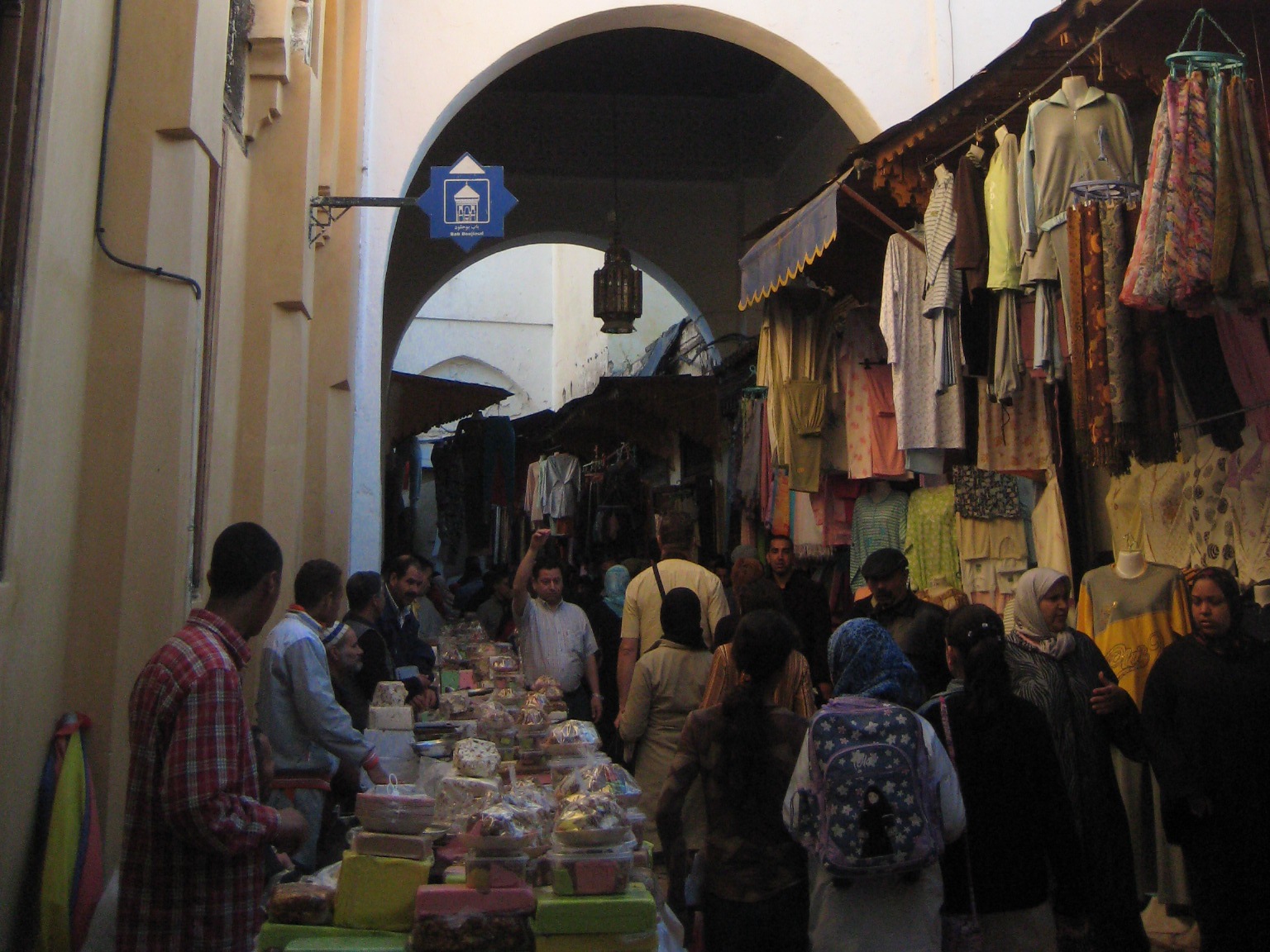
Sweetmeat sellers in the street alongside Qarawiyyin Mosque, Fes, Morocco. The brightly coloured sweets you see here are the sort I imagine (though don’t know, not being up to speed on thirteenth century candy-making….) composing the wall in the story- if so, they were pretty tought to tear down, as these things are quite a task to eat!