Many Worlds in One Manuscript: A Close Reading of Ms. Yah. Ar. 765, Part III

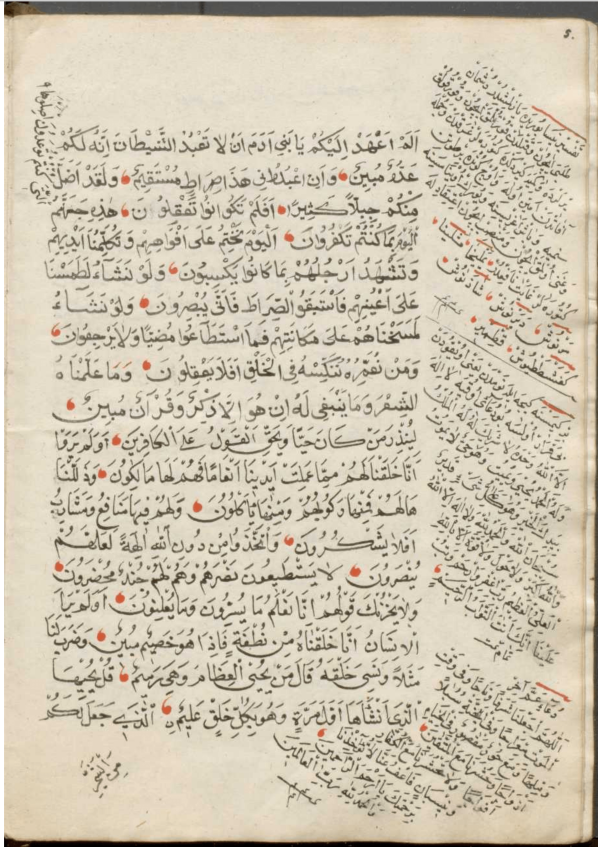
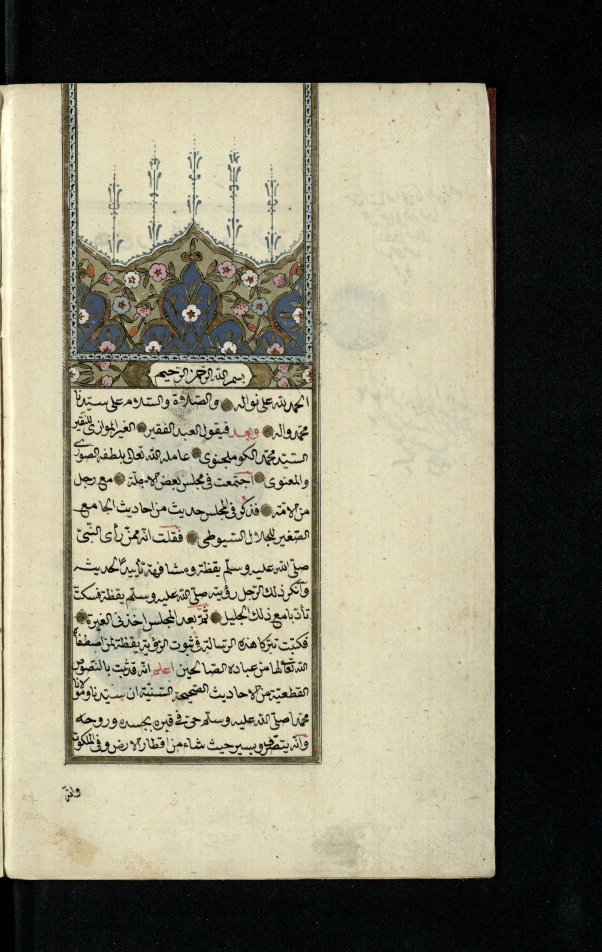
National_Library_of_Israel_Jerusalem_Israel_Ms._Yah._Ar._765.pdf_page_8

This post concludes my series introducing, discussing, and rendering in translation a short Arabic treatise by an eighteenth century Ottoman scholar, Muḥammad b. Aḥmad al-Kūmuljinawī. In this final section he brings together additional authorities to defend the validity of waking visions of Muḥammad and their fundamental reality (the exact ontological and metaphysical contours of which remain somewhat mysterious however, no doubt deliberately). The authorities upon which he draws will be familiar to anyone with broad familiarity with medieval and early modern Islam, I suspect, with a couple of individuals of a more Ottoman range. Jalāl al-Dīn al-Suyūṭī, a late Mamluk era polymath who seems to have written on quite literally everything (including not one but three sex manuals!), is perhaps unsurprisingly a key figure, particularly since he wrote an entire treatise on this controversy. Today we tend to think of figures like al-Suyūṭī primarily as scholarly authorities, speaking from a position secured by their extensive learning and command of the canonical Islamic disciplines; however, as is visible here, al-Suyūṭī was seen as much if not more as a man of personal sanctity, his authority proceeding from his special connections with God and with Muḥammad, including through waking visions. The distinction between the authority of the faqīh, the jurist, and that of the sufi saint was not a sharp dichotomy, or even a dichotomy at all, as the example of al-Suyūṭī in particular illustrates.
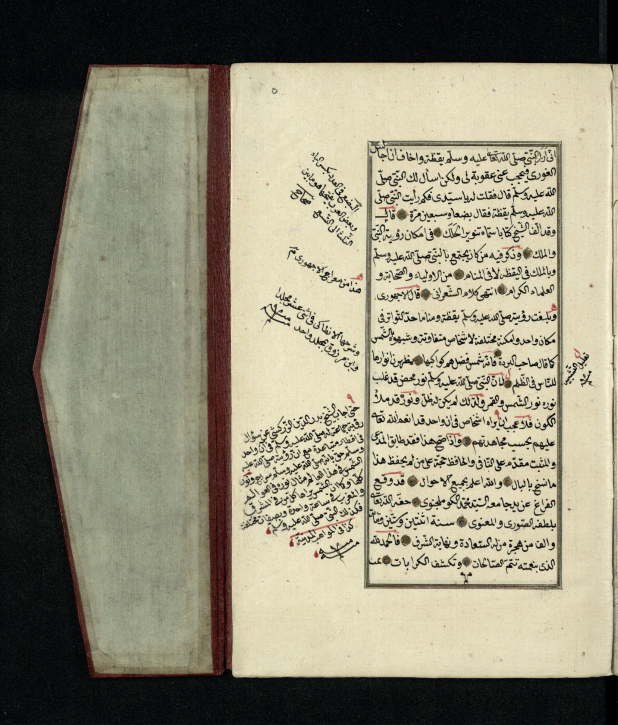
National_Library_of_Israel_Jerusalem_Israel_Ms._Yah._Ar._765.pdf_page_15

It is certainly the case, as al-Kūmuljinawī argued in a previous section, that saintly authority and its validity are assumed here: the witness and experience of the saints form a central pillar of al-Kūmuljinawī’s argument, while vice versa the validity of communication with Muḥammad served as a support to sainthood. At the same time al-Kūmuljinawī draws upon the most broadly ecumenical sources and authorities as well, most obviously ḥadīth, but also other basically canonical texts, such as the famous devotional poem Qaṣīdat al-Burda, the ‘Poem of the Mantle,’ which by the eighteenth century was all but globally ubiquitous among Muslims of many different persuasions and affiliations. All in all, al-Kūmuljinawī situated himself within a much larger universe of texts and ideas and debates, drawing upon a wide range of texts from the late medieval period forward. How he would have accessed these texts is an interesting question, and one I cannot answer here: it is possible that he had something like library access, with a number of possibilities by this period of Ottoman history; he almost certainly would have maintained some kind of personal notebook or curated majmū’a, material copied and collected from libraries, endowed collections, the libraries of friends, books found in the market, and so forth.

Sections of this last portion proved the most challenging to translate, primarily because- if I may be a bit blunt- our author’s Arabic was not always quite up to speed, but I can hardly be one to judge; if I were to try and write a treatise of any sort in Arabic it would probably have similar issues! His relation of the ḥadīth in the first section here is marked by the only significant misspellings and suggestions of lack of full comprehension, though it is not too surprising given that hadith tend to retain quite archaic usages, challenging any readers no matter their linguistic background (and thus giving rise to commentaries to tease out the meanings of often quite opaque texts).

Finally, it is worth noting here how al-Kūmuljinawī sees himself as an author- or not as an author as the case may be. The word he uses for himself is best translated in this instance as ‘compiler,’ literally one who brings things together, and this is an apt description, as his primary mode of work here is locating appropriate sources, finding the relevant material within them, and then judiciously excerpting from those sources to make his arguments. The marginal materials, the minhu notes, can be seen as supplementing his in-text strategy, charting the lines and sources of authority and expanding upon them.

I hope this short series has proven helpful and hopefully interesting, both in terms of the content- about which there is much more that can be said (and interested readers should consult among other things the articles in the recent open-source volume The Presence of the Prophet in Early Modern and Contemporary Islam, Volume 3)- and the codicological and related matters.

The firmly established one al-Jalāl al-Suyūṭī says in Tanwīr al-ḥalak fī ruʾyat al-Nabī wa-al-malak: ‘Vision of his noble essence in body and spirit is not impossible, because he—God bless him and give him peace—and all of the prophets—God’s blessing and His peace be upon our Prophet and upon them all—are alive, their noble spirits returning to them after they die, and they are given leave to go forth from their tombs and leave to act in the upper and lower realms.’ And he mentions the ḥadīth of Ibn ’Abbās: ‘We traveled between Mecca and Medina with the Messenger of God, God bless him and give him peace, and we passed by a valley. [Muḥammad] said, “What valley is this?” They replied, “Wādī al-Azraq.” He said, “It is as if I am gazing at [the prophet] Yūnus, wearing [a jubba of] wool, passing by this valley upon a red she-camel, saying the talbīya.’ Then he said, “It is as if I am gazing at my brother Mūsā, placing his fingers in his ears, supplicating God, saying the talbīya, passing by this valley.” Then [al-Suyūṭī] said, ‘It is not improbable that they make the ḥajj, pray, and draw close [to God] as they are able. And if they are in the other world they are [also] in this one which is the abode of action until its term is concluded, and it is succeeded by the other world, which is the abode of reward, in which action ceases.’ He then quotes Qāḍī ‘Iyāḍ [author of the famous devotional work al-Shifā’], God be merciful to him: ‘“Now, if the prophets, upon whom be blessing and peace, separate from their tombs and make the ḥajj in accordance with what he related, then how improbable is our Prophet’s, upon him be peace and blessing, separation from his noble tomb?”’

However many senseless prattlers have denied such, someone who argues thus, saying that the rudiments of intellect understand its rottenness, as his coming out of the tomb and going about in the markets meeting people and people meeting him necessitates that his tomb be empty of his holy body, nothing of it remaining therein, such that people are visiting the tomb along and bestowing peace upon mere absence. But al-Ghazālī indicates the rebuttal of such an idea in that the one who sees [Muḥammad] in a dream vision sees his reality (ḥaqīqa), then sees him thus in waking life, but the attribution of some necessity [entailing the previous argument] to that [state] is the essence of ignorance and obduracy. The proof of that is that the waking vision of him, God bless him and give him peace, does not require his going out from his tomb is because from among the miracles of the saints is that God, exalted is He, rends for them the veils, such that nothing of reason, sharī’a, or custom gainsays that the saint, whether he be in the furthest east or west, be granted by God the grace of having no obstructing veil between himself and between the noble essence of [Muḥammad], it still in its place in the noble grave, nor is there any need that He make these veils like the glass which assimilates itself to what is behind it. And then it is possible that the saint’s gaze falls upon him, upon him be peace—and we know that he, God bless him and give him peace, is alive in his grave, praying, and if one is blessed with the befalling of his sight upon him then there is no reason to preclude that it be in relation to his doings and speech and asking about things (and none of this goes against sharī’a or reason), and that he would answer him is also correct. So it is [discussed] in my commentary on al-Qārī and [in] ibn Ḥajar on Shamā’il al-Tirmidhī. Continue reading “Many Worlds in One Manuscript: A Close Reading of Ms. Yah. Ar. 765, Part III”
Many Worlds in One Manuscript: A Close Reading of Ms. Yah. Ar. 765, Part II

This post continues my three-part exploration of a short Ottoman manuscript text, Risāla fī ithbāt ruʾyat al-nabī yaqaẓatan li-man iṣtafāhu min ʿibādihi al-ṣāliḥīn, by the otherwise obscure scholar Muḥammad b. Aḥmad al-Kūmuljinawī; if you have not already read Part I much of the following will not make sense, so start there then proceed to the following.

In Part I we were introduced to the manuscript as a codicological unit, and reviewed some of the paratextual aspects that appear in this handful of folios. In the remaining pages the same elements continue, plus some additional ones, which we’ll examine before plunging into the main topic of this post, the theological content and the way in which al-Kūmuljinawī drew upon existing authorities, how he might have gone about locating sources, and what we can gather about ‘canonical’ theological authorities in the eighteenth century Ottoman world. Let’s have a look at the second page in the treatise and note the paratextual elements visible there:

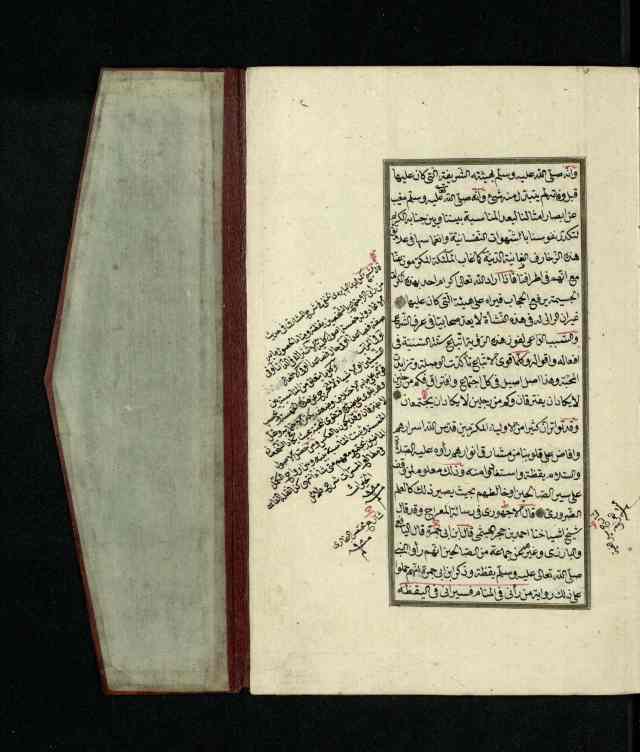
National_Library_of_Israel_Jerusalem_Israel_Ms._Yah._Ar._765.pdf_page_9

First, it’s important to pay attention to things that might otherwise fade into the background: for instance, this manuscript features a frame around the main text, a common feature but not a universal one, bespeaking the refined nature of the manuscript and its intended purpose as a presentation text. More mundanely, the frame neatly demarcates the main text from its marginal apparatus: in the case of this manuscript, primarily comments that are the functional equivalent of footnotes in modern book practice. In the example above, three annotations are visible, all examples of the minhu, ‘from him,’ type of note, placed there by the author of the text (at least in this case- in other cases the provenance of such notes can vary). The notes are linked to particular points in the main text via rubricated letters, very much akin to the footnote, although spatially they are placed more or less proximate to the linked section of main text, and hence in a variety of arrangements- an affordance of handwritten texts that is considerably more of a challenge for typography (though not insurmountable; not a few early Ottoman printed works featured sloping commentary text, though not at varying angles as here).

Nearly all of the minhu comments in this section, save a single (incorrect as it turns out!) translation of an obscure Arabic word into Ottoman Turkish, are in the same hand as the main text, which we’ve every reason to believe is the hand of the author (or, if not in his actual hand, the hand of a scribe to whom he dictated). For more on these notes and their relationship to authorship, manuscript transmission, and so forth, see A Tunç Şen’s ‘Authoring and Publishing in the Age of Manuscripts: the Columbia University Copy of an Ottoman Compendium of Sciences with Marginal Glossing.’

The other paratextual element to notice in this section of the text is the use of red overlining at various points: there is no single modern equivalent for this overlining, as at points it functions like italicizing or bolding, drawing attention to a particular point in the text; at other points it functions somewhat akin to quotation marks, or, at least, the first set of quotation marks. In the example above, the final line is largely overlined, marking out a particular ḥadīth visually from the rest of the text (in Persian texts from this period, switching from nasta’liq to naskh for ḥadīth and Qur’ān did similar visual denotation work). Taken together, all of these paratextual elements- dots, rubricated words and letters, and overlining- aid the reader in navigating and interpreting the text, knowing immediately where cited texts begin, or where important arguments or transitions are located. In my translation below I’ve largely ‘translated’ these elements into modern punctuation; on reflection I think it would be interesting to try and replicate them exactly, and will try to do in the final installment of this series.

I have aimed for a relatively literal translation, while trying to draw out some of the nuance in the usage of technical vocabulary, the most challenging aspect of this text to render in English. I initially tried a two-column display here, but found that it caused a serious error when displayed on the front page of the website, unfortunately, so I have had to drop the marginal notes down to the end of the translated section.

Know that it has been established by definite texts from among the sound and sunna-conforming aḥādith that our lord and master Muḥammad, God bless him and give him peace, is alive in his grave in body and soul, and that he has freedom of action and can go where he wills in the quarters of the earth and in the imaginal realm (al-malakūt). Verily, he—God bless him and give him peace—is [still] in his noble form in which he was before his death, nothing has been changed. And if he, God bless him and give him peace, is hidden from the sight of the likes of us, it is due to the relational distance between us and between his noble person, due to the turbidity of our lower selves due to the passions of the self and their immersion in the attachments to these trifling vain wordly babbles, just as the noble angels are hidden from us even as they are in our very midst.

Now, if God desires to honor anyone with this bodily miracle, He raises the veil and he is able to see him in his true form (this does not entail that the one who so sees him is in the ranks of the Companions in a sharī’a-accordant sense). The generative cause for the obtainment of this vision is his following the sunna in his deeds and words. The more that he strengthens his following [of the sunna] the more resilient will be his personal connection [with Muḥammad], and love [for him] will increase. This is the fundamental root of all union and separation—there are those people who are scarcely ever in a state of separation and those people who are scarcely ever in a state of union [marginal note a.].

It has been established by multiple avenues of transmission that many among the noble saints, God sanctify their inner secrets and pour out blessing upon our hearts from the orients of their lights, see him, upon him be peace and blessing, in waking life, and spiritually benefit from him—that is something that is known to the one who comes to the path of the saintly or who associates with them, such that it becomes akin to necessary knowledge.

Al-Ajhūrī (d. 1655) [marginal note b.] said, ‘The shaykh of our shaykhs, Aḥmad ibn Ḥajar al-Haythamī said that Ibn Abī Jamra [marginal note c.] said that al-Yāfi’ī and al-Bārazī and others from among the community of the saintly pious have said that they have seen the Prophet, God bless him and give him peace, in waking life. And Abū Jamra mentioned that they experienced that in accordance with the transmitted saying, “The one who has seen me in a dream-vision, he will see me in waking life.” Truly, they have seen him in dreams and they have seen him afterwards in waking life, and have asked about various things and he has reported to them concerning those things, and it has turned out as he has related to them.’

The one who denies that, if he is from among those who cast calumny upon the miracles (karāmāt) of the saints—then we have nothing to say to such a one. Otherwise, this [vision] is from among [their miracles], when in the rending of [the] customary [nature of things] there is unveiled to them things in the world above and below.

Al-Fāsī (d. 1698) says in Maṭāli’ al-massarāt [his commentary (sharḥ) on] Dalā’il al-khayrāt: ‘Shaykh Abū ‘Abd Allāh al-Suhaylī [also vocalized as al-Sahlī], God be pleased with him, has said: “In order to affix love of the Prophet in the soul, do not let his noble form be hidden from the eye of insight for a moment—it is the true vision because the vision of sight is due to his conveyance of the true essence of the one who sees to the eye [or essence] of insight, so that in the presence of insight there occurs comprehension regarding the true reality of what is conveyed to [sensory] sight from among the visible things. There is no doubt that ṣalāt upon the Prophet, God bless him and give him peace, if one’s innate disposition (mashrab) is purified, will shed forth its lights and the lower self (nafs) will become a mirror for [Muḥammad’s] form, God bless him and give him peace, and will not be hidden from it. This is true knowledge in which there is no doubt. Continue reading “Many Worlds in One Manuscript: A Close Reading of Ms. Yah. Ar. 765, Part II”

The Seven Sleepers In Islamicate Textuality: Complex Crossings

MCRGenPDF.pdf_page_6

During an Islamicate manuscripts reading group I am coordinating this semester, I was looking around in my archive of digitized manuscripts for some nice examples of marginal texts and came across the manuscript from which the above image comes, a majmū’a (a collective volume of many discrete texts between two covers) of various sorts of material, produced somewhere in the Turkish-speaking part of the Ottoman Empire in the eighteenth century or so. As we read through some of the marginal comments surrounding this particular main text (a compilation of awrād, devotional litanies for use throughout the day), we came to the one in the top right corner of this page. Written in Ottoman Turkish, the note claims to relay information from the tafsīr of al-Nīsābūrī concerning the effaciousness of writing out the names of the Aṣhāb al-kahf, generally known as the Seven Sleepers of Ephesus in Christian tradition, which will ward off all manner of evil and bring much good. Briefly for those not familiar with the story, the ‘Companions of the Cave’/’Seven Sleepers of Ephesus’ were seven (though the number varies in pre-Islamic traditions, variance which is referenced- and not resolved- in the Qur’an) young men who fled from Roman persecution into a cave and were granted divine sleep for three hundred and nine years, awoke to find a totally transformed world in which Christianity was now dominant, disclosed themselves to the wondering population, then died. While the exact origin of the story and devotion to the Sleepers is now obscure, their hagiography circulated in numerous languages, from Sogdian to Old Irish, ending up in the Qur’an as a sizeable portion of Surat al-Kahf (‘the Cave’), alongside other material (including renderings of the names of the Sleepers, which are not given in the Qur’an).

In the marginal notation above only six of the human Sleepers’ names are given out of the usual Islamic seven (a number not however fixed by the Qur’an), plus that of their dog, Qiṭmīr, himself a de facto saint in Islamic tradition (his name has sometimes been treated as prophylactic aid on its own in fact). The notation is brief, but it got me thinking about the textual traces of the Seven Sleepers in the Islamicate world, which I’d like to explore a bit here. The use of names of the Seven Sleepers/Aṣhāb al-kahf provide a good view into the ways in which elements of ‘manuscript culture,’ of the textual materia of the book, crossed over into other media and spheres of life, parallel to the boundary-crossing nature of devotion to and the semantic traces of the Seven Sleepers themselves. As I discuss in a parallel but more philosophical and speculative essay on my Substack, there is a lot that we can continue to glean from this strange story and its incredible historical afterlives.

In Islamic contexts, devotion to the Seven Sleepers was expressed in multiple ways, but two stand out: one, the ‘finding’ and veneration of caves associated with them, to the point that caves reputed to have held the Sleepers in their several centuries of sacred slumber proliferated across the Islamicate world, from Turkestan to the Maghrib (with a similar proliferation present in Christian lands). But even more widespread were the names of the Sleepers: as with several other sites of Islamic devotion, in the general absence of pictorial icons, names and verbal descriptions served as de facto ‘icons’ reproducing the presence and the sacred power of holy figures. In the early modern Ottoman context, beyond Muhammad and his house, verbal ‘icons’ of the Four Rightly Guided Caliphs, of the Ahl al-Badr (fighters and martyrs in the Battle of Badr), and the Aṣhāb al-kahf were frequently reproduced within manuscripts and across other media, in some cases also embedded in other texts. There are no doubt many reasons for this focusing on names; in the case of the Companions/Sleepers, it is partially an inheritance of the late antique heritage, as visible in lines from the sixth century Syriac poet St. Jacob of Serug (translated here by Sebastian Brock):

There were there two wise men, sons of the leading men,
and they reckoned that the Lord would resurrect them,
so they made tablets of lead and placed them beside them,
on them they wrote down the names of the children of light…

Already there is a sense of their names having an important function, if not quite the prophylactic one they would gain in early modern Islam. By whatever routes however, those names- which as we will discuss below, were inherently distinctive just in their spelling- would be the locus of devotion and power for Islamic audiences, and traces of that devotion and power are readily visible in the manuscript tradition.

In the example below, a short poem (for those who do not read Arabic, it is the section marked with what look like red commas) off gives their names in succession and then details the particular potencies of each name when written down, either for a certain thing or upon certain media. The names of the Sleepers are written in red (fifth through seventh lines), the virtues of each then adumbrated in a series from ‘the first’ to ‘the seventh,’ the numbering also rubricated:

25_00b96_default

Early modern Islamic audiences took such messages to heart: the names of the Companions do indeed appear in many, many contexts outside of manuscripts. Here are two of them: first, a prophylactic seal made in the eighteenth century Ottoman world (Met. 1983.135.11), the text consisting primarily of the Sleepers’ names intertwined; the stamp produced by this seal could have been applied to manuscripts, or perhaps for the production of stand-alone amulets, upon documents, and so forth (perhaps even on walls, one wonders). As with many such calligraphic amuletic devices, human legibility is not primary in terms of the effectiveness of the writing; and in this case, even a cursory look at the writing suggests whose names are given here:

DP299947

At the other end of portability (well, almost- obviously it was disassembled and moved at some point!) is this fireplace of Iznik tile (V&A 703-1891), built in 1731 for the home of someone quite well off indeed; the names of the Sleepers run across the very middle of the installation, the only instance of text in the entirety of the piece: Continue reading “The Seven Sleepers In Islamicate Textuality: Complex Crossings”

Shaykh Ṣafī al-Dīn’s Gifts for ‘Īd al-Fiṭr

The following story, from that seemingly inexhaustible source of late medieval hagiography, the Ṣafvat al-ṣafā of Ibn Bazzāz, seemed appropriate to translate and post today given that April 21 and 22 of this year marks ‘Īd al-Fiṭr, the feast at the end of Ramadan, for the world’s Muslim communities. The story below has to do with the festivities- or, more properly, the preparation for them- that continue to be a feature of modern celebrations. As with many of the stories concerning Shaykh Ṣafī al-Dīn, the main subject of the hagiography (though far from the only subject!), it is quite straightforward. The word ‘akhī’ in ‘Akhī Shādī’ (whose name occasions some punning in the Persian) requires some explanation: the akhīs were members of ‘fraternities’ of urban workers, especially workers in various crafts, drawing upon the canons of futuwwa for their identity and practices, sometimes exerting political power in cities of Iran and, especially, Anatolia, in which context they are best known. Akhīs appear not infrequently in Ibn Bazzāz’s work, perhaps as a reflection of his own origins in the world of craftsmanship and the urban marketplace. As is so often the case, scenes of everyday life and activity are preserved, as it were, within the format of a miracle story, giving us a nice glimpse of the practices and relationships of ordinary people in the late medieval Persianate lands.

L'épisode_du_sheïkh_de_Sana an_[...]Haïder_Me zoub_btv1b8415000w_71
In this detail from an early 16th century Safavid miniature, a depiction of a market stall selling bread, such as Akhī Shādī would have been preparing for the ‘Īd festivities (Bibliothèque nationale de France, Département des Manuscrits, Supplément turc 978)

Akhī Shādī of Ardabil said: At the end of Ramadan the Shaykh, may his secret be sanctified, sought for me, so I went. Pīr Ibrāhīm Kurd-i Chust came and took me by the hand and led me to the kitchen. I worked for two days, cooking the bread for ‘Īd [al-Fiṭr]. While cooking that bread my hand was burned. During the night, just before morning, the Shaykh, may his secret be sanctified, came to the kitchen, and I came before him so as to kiss his blessed hand. The Shaykh looked and saw that my hand was burned, so he took my hand in his blessed hand and vigorously rubbed it, and in that very moment it became better, the traces of the burn completely disappearing! I was overjoyed, and in the exuberance of this joy returned home. While performing the morning prayer of the day of ‘Eid, it suddenly entered into my mind: ‘Wouldn’t it be nice if the Shaykh sent me a plate of some saffron rice?’ An hour later I saw that a servant was coming, bringing a plate of saffron rice. He said to me, ‘The Shaykh declares that if Akhī Shādī has a friend who is sick he should give him this pilaf.’

I did have a friend who was grievously sick, such that we had all given up hope of his recovery, things reaching a point at which he was no longer eating or drinking, hope for his living becoming cut off. I brought that pilaf before him and said, ‘The Shaykh has sent this, eat it so that you can get better!’ He said, ‘I don’t have the strength [to feed myself], please place a portion of it in my mouth.’ So I put two or three bites of it in his mouth and he ate it, then said, ‘More please!’ So I gave him more, and he ate, saying, ‘Make a bigger portion!’ So I did, and in that moment he sat up and with me ate that plate of pilaf and was completely healed.

Ibn Bazzāz Ardabīlī, Ṣafvat al-ṣafā: dar tarjumah-ʼi aḥvāl va aqvāl va karāmāt-i Shaykh Ṣafī al-Dīn Isḥaq Ardabīlī, ed. Ghulām Riẓā Ṭabāṭabāʼī Majd (Tabriz: G.R. Ṭabāṭabāʼī Majd , 1373 [1994]).

AKM264.f376r_HERO
A delivery of food- perhaps pilaf?- in a detail from an illustration for another story from the Ṣafvat al-ṣafā (AKM264 (fol.376r))
___________________________
 

Creative Commons License
This work is licensed under a Creative Commons Attribution-NonCommercial 4.0 International License.


Of a Lion, Dog, Shayṭān, and Snake: Sīdī al-Ḥasan Abirkān of Tlemcen

2008BU0720
The walls of the village of Manṣūra outside of Tlemcen, 1870, by Sir John Baptist Joseph, 12th Baron Dormer (V&A SD.340)

That sainthood and social and cultural marginality have a tendency to go together, in Christian and Islamic traditions anyway, will hardly come as a surprise to anyone versed in such things: this is not the place for such speculations, but my personal working theory is that when we see Late Paleolithic burials of unusual individuals whose grave goods mark them as special, what we are seeing is a trace of something very much like sainthood. Regardless of the veracity of such speculatory reconstruction, it is quite clear from medieval and early modern hagiography in both Christian and Islamic traditions that while hardly a prerequisite for sanctity, difference, marginality, even outright societal opposition were all potential entryways into sainthood, not necessarily barriers. To discuss the reasons for this sustained relationship through time would require a book, or several of them (though, this is as good a place as any to mention that I have in various states of development not one but two such books in the offing, details to come!).

Instead, I want to introduce here an early modern- well, really, on that cusp between what we think of as medieval and as early modern- saint of the city of Tlemcen (in modern-day Algeria) who exemplifies inhabitation of both ‘centrality’ and ‘marginality,’ Sīdī al-Ḥasan Abirkān, as described by the late sixteenth century century hagiographer Ibn Maryam (d. 1605) in his al-Bustān fī dhikr al-awliyāʼ wa-al-ulamāʼ bi-Tilimsān. The saint’s name already identifies him as occupying two areas of identity sometimes indicative of marginality relative to scholarly urbane culture: ‘Abirkān’ is Kabyle Amazigh for ‘black’; J. M. Dallet’s dictionary gives the following definition: ‘Noir; noiraud; teint foncé, basané (nuance défavorable, dépréciative pour les personnes).’ And indeed Ibn Maryam, in giving Shaykh Abirkān’s genealogy, includes a couple of stories in which the shaykh is shown to be of a holy genealogy through his father and grandfather, without any trace of his ancestors’ apparent servility remaining. The suggestion of course is that the casual observer night take the shaykh’s skin color and evident ‘racial’ origin (not precisely the language a sixteenth century observer would have used, but close enough) as evidence of his inferiority. That this is the case is reinforced by a story that Ibn Maryam tells in which a young man who has come to Tlemcen to study initially disparages Shaykh Abirkān’s exoteric knowledge, but is urged to study with the shaykh in a dream, and in so doing finds the shaykh’s depth of knowledge confirmed. Overall, as is often the case in premodern Islamicate societies generally, racial origin and skin color were neither invisible nor were they totalizing facts about an individual; in Shaykh al-Ḥasan Abirkān’s case they were arguably part of his identity in a complex manner, both placing him somewhat at the margins but in a powerful manner, his being marked out as different both a feature of his sainthood as well as a sometime social stumbling block on the part of others.

That I have led with this particular saint’s racial background is very much indicative of our own contemporary concerns and interests; it is not addressed in Ibn Maryam’s lengthy treatment until well after many other stories and discussions. Instead, the picture that emerges, which I have tried to pick up in my translations below, is of a saint marked by both the scholarly and the, for lack of a better word, ludic. His encounters with animals stands out in this regard, with several of the stories below having to do with such interactions, all with creatures which were themselves generally seen as on the edge of human society if not an outright danger. I’ll discuss them a bit more after the text itself.

[Shaykh al-Sanūsī] used to say: ‘I have seen [many] shaykhs and saints but I have never seen the like of Sīdī al-Haṣan Abirkān!’ He was not absent from the presence of God for even an instant, and whenever he laughed his teeth would show. He was merciful towards the believers, solicitous towards them, rejoicing in their joy and feeling pain over evil inflicted on them. He had prayer beads from which he was rarely ever parted, for he was constant in remembrance of God. He was held in great esteem by the common and the elite alike. [He was] devoted to the Risālah of Ibn Abū Zayid, and whenever al-Sanūsī came to visit he smiled broadly and would open their conversation with theological discussion, [al-Sanūsī] saying to him, ‘God has made you to be among the God-fearing imāms.’ He was graced with many miracles and wonders, among them one that al-Sanūsī and his brother Sīdī ‘Alī described:

He was performing ablutions out in the wild desert one day when an enormous lion approached and knelt down over [Sīdī Abirkān’s] shoe. When he was finished with his ablutions, he turned to the lion and said to him three times, “May God, the most beautiful of creators, bless you!” The lion bowed his head to the earth as if were bashful, then arose and went on his way.’

Also, that which Shaykh al-Sanūsī mentioned, saying, ‘The illustrious saint Sīdī Sa’īd bin ‘Abd al-Ḥamīd al-‘Aṣinūnī related to me at his home in the Ouarsenis Mountains—he was from among [Sīdī Abirkān’s] oldest companions—saying, “I visited Sīdī al-Ḥasan one hot day and found him in great fatigue, sweat running down him, and he said, ‘Do you know why I’m so exhausted?’ I replied, ‘No, Sīdī!’ He said, ‘Yesterday I was sitting in this spot when Shayṭān entered in a particular form so I stood up to him and he fled before me, so I followed him and recited the call to prayer—he did not stop running from me, and he farted, as is mentioned in the ḥadīth, until he was hidden from me. And now I am just returned from pursuing him!’”’

Al-Sanūsī also related that when [Sīdī Abirkān] returned from the East, he came across a Friday market village which had fallen into ruin, though it had once been inhabited by his forefathers. He decamped to Tlemcen but his thought reverted to returning to that village and revitalizing what had fallen into decay. He said: ‘So I went out to it and sat down contemplating its traces, how ruin had overtaken it and its inhabitants compelled to depart, when a dog came up to me and sat down next to me, looking sad and dejected like me. I thought to myself, “Will this village ever be inhabited again or not?” Then the dog lifted his head and said in clear speech, “[Not] until the day they are resurrected,” that is, it will never be inhabited again. When I heard what he had said to me I returned to Tlemcen.’ Continue reading “Of a Lion, Dog, Shayṭān, and Snake: Sīdī al-Ḥasan Abirkān of Tlemcen”

Discovering the Nature of True Alchemy

a7v772a
An illustration from a text on aspects of literal alchemy (and quite a few other topics), Kitāb al-Burhān fī asrār ‘ilm al-mīzān, copied in the Maghrib in the mid to late 19th century (National Library of Medicine MS A 7)

From the medieval period down to the dawn of modernity, sufi saints and the discipline of alchemy have had a long and often fraught relationship with one another, reflective of the sometimes positive, sometimes ambiguous position alchemy held in Islamicate societies (and elsewhere in the medieval and early modern world). To contend that a given sufi shaykh was an adept of the alchemical arts, or of other occult sciences for that matter, could be a form of praise or condemnation or caution. The delightful story I’ve translated below represents an interesting juncture in the relationship of alchemy and sufi saint: it comes from a source into which I’ve dipped several times now, the hagiography of the nineteenth century Ottoman Syrian saint Shaykh Muḥammad al-Jsir written by his deeply learned (in both ‘traditional’ and ‘modern’ arts and sciences) son Ḥusayn. The context and ultimate message- the true alchemy is the practice of piety- would have been familiar to generations of sufi devotees before the nineteenth century, just as many a previous shaykh no doubt had to field similar requests for instruction in the arts of material transfiguration of the elements. There is however here I think a more marked sense of irony, the implication that alchemy isn’t just suspect for its occupation of the fringes of proper belief and practice but also that it is really no longer imaginable as a pursuit- which might have been true for Ḥusayn al-Jisr but was not necessarily true for all of his contemporaries, as the copying and presumable use of the treatise illustrated above would indicate. The subtext might well be that while alchemy is outmoded, the true and ultimately alchemy is not, and that devotional piety remains capable of transforming human beings in ways that neither the ancestor of chemistry nor other systems of knowledge could ever hope to do.

DT262290

And from that is what my aforementioned uncle related to me also: he said: my barber, Shaykh Ḥusayn ‘Alwān used to say to me, ‘Your brother Shaykh Muḥammad knows how to do alchemy, so you ought to get him to teach you its art!’ So I went to your father one day looking vexed, and he said to me: ‘What’s with you O brother?’ I replied, ‘You know how to perform alchemy, so what’s keeping you from teaching it to me, your own brother?’ The shaykh laughed and said to me, ‘Oh Muṣṭafā, I’d like to spend the next three days alone at home in order to prepare an alchemical course—it’s your duty to turn away from me anyone who seeks me out.’ So I said yes, after which he stayed in his home three days, in the uppermost floor, and I made sure that anyone who came to see him was kept away from the shaykh, turning him away politely. And as the shaykh had withdrawn your mother into seclusion [with him] too I did not see her either, as she stayed with him in the upper floor. It was impossible that I go up and see what was going on; however, I asked a servant girl who was serving him and said to her, ‘What is my brother doing?’ She replied, ‘For a while he prays, then he recites taṣliya, then he reads books.’ I replied, ‘He’s not lighting any fire or asking for any specific amounts of substances from you?’ She said, ‘No.’ I was amazed at that and said to myself, ‘How does he perform this alchemy?’ All that was from the vain thoughts of youth.

Then, after the three days were up, I was in the market when the shaykh sent for me. I came quickly and found him sitting in the lower part of the house in the iwān, a satchel of riyāls in front of him. He looked at me and said, ‘O my brother, take them!’ So I took those riyāls, imagining that they were the product of alchemy, it not occurring to me due to the intensity of my happiness that alchemy doesn’t produce minted coin but rather bullion, or so they allege. Then the shaykh grabbed my ear and turned it, saying to me, ‘You and your barber ‘Alwān are nuts! O brother, our alchemy is blessing upon the Prophet, God bless him and give him peace! Don’t listen to the words of the like of this fellow!’ I paid heed to these words and learned that the shaykh did not perform alchemy at all as I had initially supposed, but rather had taken advantage of the secluded retreat of those days in order to be away from people and devoted to worshiping his Lord.

Ḥusayn al-Jisr, Kitāb nuzhat al-fikr fī manāqib mawlānā al-ʻārif billāh taʻālá quṭb zamānih wa-ghawth awānih al-Shaykh Muḥammad al-Jisr (Beirut: al-Maṭbaʻah al-Adabīyah, 1888), 132-133.

DT262290

___________________________

This work is licensed under a Creative Commons Attribution-NonCommercial 4.0 International License.

A Basket of Halwa Sent by God

wb-93.26.15
Window with colored panes (not really visible in this view) from a house in 17th century Ottoman Damascus (Met. 93.26.15)

Dear reader, I’m aiming to have some more substantial posts here soon- our family has been in the midst of a move and the post-move work of getting our new house and budding (hopefully!) small farm up and running, while I have also been busy with my day-job work, elements of which I will cover in more detail on my Substack newsletter. In sharp contrast to all that busyness, I’ve translated the following story, which is related by Ḥusayn al-Jisr in his hagiography of his saintly father; it does not however directly relate to his father’s life, but is instead precipitated by an episode in the shaykh’s career that involved a large basket filled with tobacco and money, the latter fulfilling the need of one of the shaykh’s disciples. Ḥusayn al-Jisr does not tell us from whence he got this story, but it is part of a long tradition of sufi tales having to do with tawakkul, which might best be translated as ‘extreme trust in God.’ It’s also really quite funny, and could have come from a collection of popular stories, ḥikāyāt. Otherwise it is pretty self-explanatory- enjoy!

DT262290

I have seen a similar story in a book concerning what happened to one of the people of pious trust in God. A man from among them was continuously present in a mosque when another man who prayed there noticed him, seeing that he did not leave the mosque nor did he have a job, so he came to him and said, ‘O brother, how do you manage to eat?’ He replied, ‘God, exalted is He, provides for me.’ The man replied, ‘You speak truthfully, but still God makes a means for everything—is He going to send your sustenance down in a basket?’ The man who put all his trust in God replied, ‘Verily God is able to do that.’

So the man invited him to his house, making him to believe that he wanted to honor him, but instead he seized hold of him and put him down in a well that belonged to him and left him there, saying to him, ‘Now we’ll see whether God sends a basket down to you or not!’ Then he went away to his shop stall. Now it so happened that the man’s wife and her maidservant really wanted some halwa, so they made some and were about to eat it when the man, her husband, knocked at the door, and the two were afraid of his displeasure over their making halwa, so they put it in a basket and in their alarm dropped it down in the well. The man who trusted in God who was down in the well took hold of it and began eating from its contents. The wife of the man opened the door and he came in to attend to some business of his, then he remembered the man who was in the well so he went to the brim of the well and called out to him, ‘Hey so-and-so, has God sent you a basket down yet?’ The man replied, ‘Yes, He sent me some halwa in a basket, in spite of you!’ So he took him out of the well, and, things becoming clear to him took admonition from this happening, honored the man and sought from him his forgiveness.

Ḥusayn al-Jisr, Kitāb nuzhat al-fikr fī manāqib mawlānā al-ʻārif billāh taʻālá quṭb zamānih wa-ghawth awānih al-Shaykh Muḥammad al-Jisr (Beirut: al-Maṭbaʻah al-Adabīyah, 1888), 132-133.

DT262290

___________________________

This work is licensed under a Creative Commons Attribution-NonCommercial 4.0 International License.

Sharing a Pipe with the Shaykh

Abu Daood, Shaikh of the Coptic Quarter, in Cairo
A watercolor portrait, by the European artist Carl Haag, of a shaykh in Cairo, one Abū Dawūd; not a sufi shaykh alas (rather a shaykh in charge of an urban quarter, the Coptic one in this case), but displaying both 19th century dress and more importantly for the story below the sizeable nature of tobacco pipes! Painted in 1886 but based on observations from Haag’s 1858-9 visit to Cairo (V&A SD.462)

Apologies for the long delay in posting new material here- as is often the case many other things have intervened, the good and the bad as it were, and the several translations and short essays I had hoped to present here have been pushed back. Much of my ‘free’ time has been taken up teaching a course on modern Islam, which has entailed a great deal of secondary literature reading on my part given that my scholarly training focused pretty much exclusively on the pre-19th century world, with the exception of my recent work as a post-doctoral researcher examining issues in modern Arabic script book history. One of the happy benefits of my recent pivots towards the modern world has been getting to extend my exploration of saints and sainthood in the Islamicate world forward in time, particularly into the 19th century. Far from being marginalized by the developments of modernity, saints and sainthood remained- and in fact remain- vital forces in Islamicate history, in some cases becoming even more salient than in previous centuries. Movements such as the late 19th century Mahdiyya in the Sudan or the emergence of various millenarian and apocalyptic new religious movements like the Aḥmadiyya or the Bābīs are only really explicable within a framework of saints and sainthood.

That said, the saintly subject of the short story I’ve translated here did not herald any grand political movements or religious transformations, but rather can be seen as carrying forward older traditions of sufism and sainthood into the 19th century. We’ve encountered Shaykh Muḥammad al-Jisr (1792-1845) before (see this post for an introduction), and will be meeting him again in these digital pages no doubt, as his hagiography, penned by his scholarly son, is a wonderful source for exploring the transition of Islamic sainthood to the modern world. The story I’ve selected for today, set at some point during the 1830s (the period in which Mehmed ‘Alī’s forces occupied Ottoman Syria) reveals more in the way of continuity than change- while the 19th century would see many reformist and outright puritanical movements either begin outright or emerge into prominence from 18th century origins, here we see Shaykh Muḥammad continuing in a vein of saintly behavior exemplified by the late 17th to early 18th century ‘Abd al-Ghanī al-Nābulusī and others, including the unproblematic use of tobacco. It is also a lovely reminder of the aural presence of sufi ritual: in a world with considerably less noise pollution, and much more oriented around foot-traffic, nocturnal sufi practices such as vocal dhikr had no small aural footprint, attracting passerby such as the young man in our story, even if, as in the story, their reactions could vary in appropriateness!

16.7-27-1967-Stjerneformet-cuerda-seca-flise

‘Shaykh Muḥammad Abū Khalīl Efendī Abāẓa the well known and trusted, whose recognition in the Syrian and Egyptian lands is such that he requires no introduction, said to me: ‘I was in Cyprus during the days of the Egyptian government’s dominion in the land of Syria. I was in the bloom of my youth and the mirth of my youthful inclinations and was not yet following the ṭarīqa, nor did I have an inkling of the spiritual states of its sons. One night I came upon the dhikr circle which your father led with his brethren in Cyprus, and it happened that all while I watched them seeing the effects of the dhikr upon the sons of the path caused me to secretly laugh. When the shaykh completed the dhikr he called to me and sat me down next to him, treating me kindly, then offering me his tobacco pipe from which he had been smoking, which I then returned to him [after smoking]. After the session concluded I returned to my lodgings and lay down on my bed, but it happened that every time I fell asleep I found that pope that the shaykh had offered me that night striking me upon my face! So I would awake with a start, then go back to sleep—and again find it striking me upon my face and I would awake, and so my entire night passed until morning dawned. I was most distressed due to lack of sleep and intensity of fear such that I worried I’d lose my mind! So I went ot the shaykh, God be merciful to him, and as soon as he saw me he started laughing. I bent down and kissed his hand and said to him, ‘Yā sayyidī, what sin is it that I did that caused you to act in such a way with me?’ He replied, ‘What is it I did to you?’ So I related to him the story of the pipe in the night, and he said to me, ‘What does that concern me? I didn’t do anything to you other than offering you my pipe!’

I began seeking his intercession, saying, ‘Yā sayyidī, I’m afraid I’m going to lose my mind! I desire your forgiveness!’ At that he said, ‘My son, for what? You stopped by our dhikr circle last night and began to laugh—we are dervish folk and you are a lordly man, it is most befitting to you that you mock and laugh at us.’ I replied, ‘Yā sayyidī, I did not intend to laugh at you, God forbid from that! But the state and levity of my youth are not hidden from you, so I hope you will forgive me!’ At that the shaykh, my God be merciful to him, was pleased with me, and so I set out on the Khalwatiyya ṭarīqa and so continued on from there.’

Ḥusayn al-Jisr, Kitāb nuzhat al-fikr fī manāqib mawlānā al-ʻārif billāh taʻālá quṭb zamānih wa-ghawth awānih al-Shaykh Muḥammad al-Jisr (Beirut: al-Maṭbaʻah al-Adabīyah, 1888), 99-100.

Shaykh Muḥammad al-Jisr and the Snake in the Wall

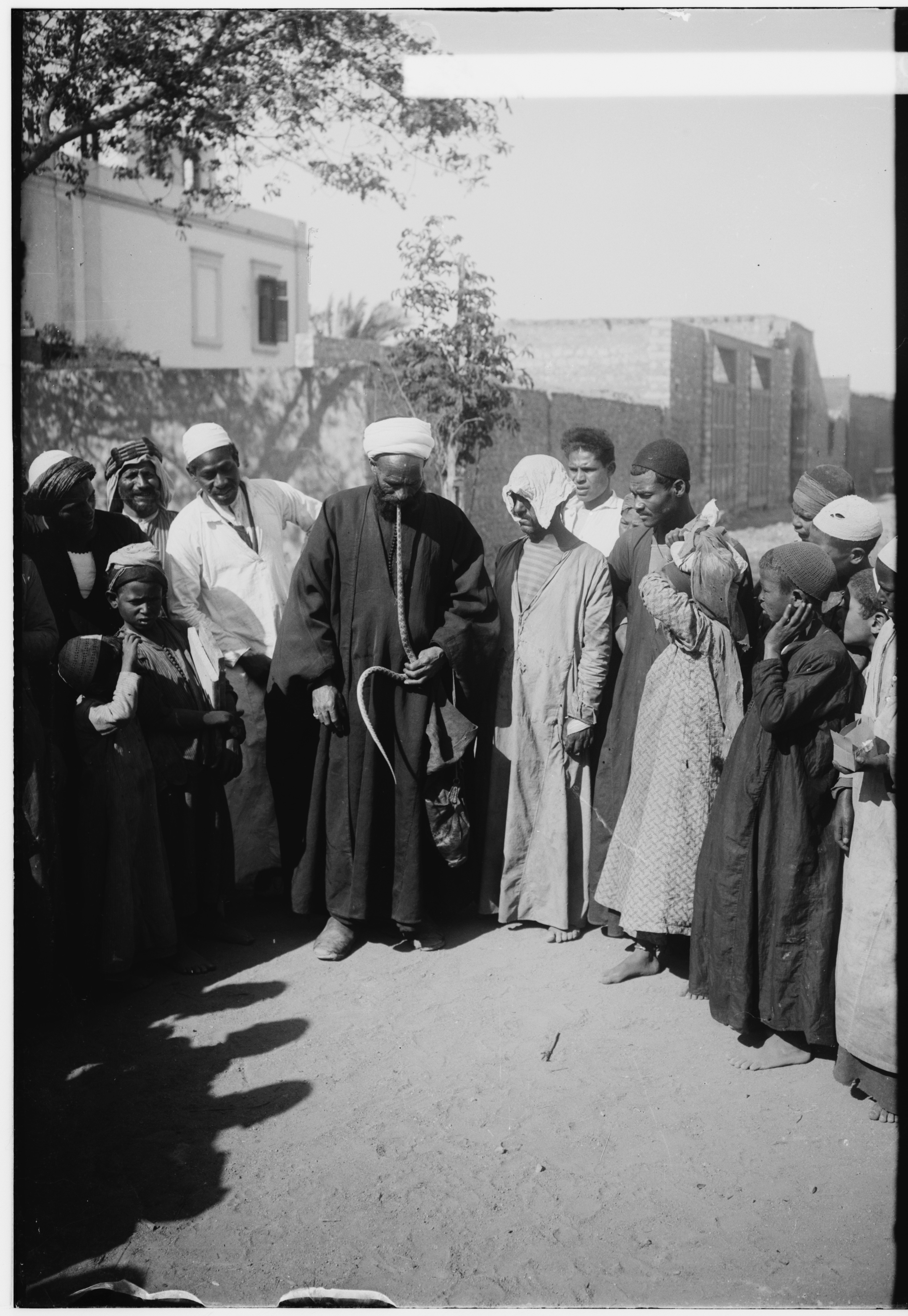
Egyptian characters, etc. Snake charmer, Cairo 2
A snake charmer at work in early 20th century Cairo, photographed by a photographer from the American Colony in Jerusalem; this is the sort of performer, increasingly associated with ‘the Orient’ in the 19th century, that Ḥusayn al-Jisr wished to differentiate his father from (Library of Congress LC-M32- 994 [P&P])
As anyone who has followed my work here and elsewhere will be aware, until recently my scholarly research was focused all but exclusively on the early modern and medieval worlds, with a rough cut-off date of 1800 beyond which my expertise thins out considerably. Over the last couple of years since completing my PhD and assuming a post-doctoral research position my interests and research responsibilities have diversified considerably (a diversification which comes with its own risks, I might note), running backwards and forwards in time from the periods with which I am most familiar and comfortable. On the one hand I have taken up a much greater interest in the study of deep time and possible ways of integrating perspectives from paleontology, geology, climatology, archeology, and paleoanthropology into the kinds of historical study and teaching I do located within the ‘shallow’ past. Running in the other direction, on the other hand, I have become much more involved in nineteenth and twentieth century topics, some quite new to me, such as the history of technology and communication, others continuations of my long-standing interests such as saints and sainthood.

I learned about the subject of this week’s essay and translation (and who will certainly figure in future posts over the next month or so) by way of Marwa Elshakry’s book Reading Darwin in Arabic, 1860-1950, an exploration of the complex and often quite surprising ways in which Ottoman and post-Ottoman Arab thinkers dealt with the emergence and elaboration of Darwinian evolutionary theory and the permutations that engagement underwent vis-a-vis other concerns and political developments. Shaykh Muḥammad al-Jisr’s son, Ḥusayn al-Jisr, was one of the many thinkers, Muslim, Christian, and otherwise, who grappled with evolution and other aspects of the biological sciences, threading a path that was at once critical and open to scientific insights while also remaining very committed to ‘traditional’ Islam (though in ways that would have been unfamiliar even to his own father in the decades prior), remaining largely critical of evolutionary theory but suggesting that given sufficient proof nothing in Islam prevented acceptance of evolutionary theory provided God was understood to be the first and final cause- materialism was Ḥusayn al-Jisr’s primary foe.

Ḥusayn al-Jisr’s position on evolutionary theory in relation to theology is actually related to the work of his translated here, a hagiography, written in 1888, of his father Shaykh Muḥammad al-Jisr (1792-1845), a Khalwatī teaching shakyh and widely acclaimed saint active in Syria and Palestine (though due to political instability he also spent time in Cyprus and Constantinople). Ḥusayn’s account of his father- who died shortly after Ḥusayn’s birth- is striking for the way in which the author engages in extensive epistemological and other routes of analysis and digression, with much of the introduction devoted to tracing Ḥusayn’s own journey from relative skepticism about his father’s sanctity to embracing it, based on the accumulation and weighing of oral and written evidence, including from non-Muslims. These traces of modernity, as it were, continue throughout, even as the world of sanctity and sainthood revealed is not very far from that of early modernity- it is the framing and the tone that has changed, though certainly not into a voice of disenchantment or skepticism. As such it is a good example of the complex ways Muslims and others have constructed their own ‘modernities’ not necessarily along the lines of a neat trajectory of ‘secularism’ and ‘disenchantment that have so often been seen by many as normative and either automatic or only avoidable by ‘relapsing’ into some form of reaction and obscurantism.

I have selected the following short story mostly because it’s memorable and in the voice of the shaykh’s sister, but also because it captures part of Shaykh Muḥammad’s own saintly charisma- his connections with axial saints of the past, including Aḥmad al-Rifā’ī, and his interventions in everyday life- as well as possible objections that were more likely to arise in the modernizing milieus of the late nineteenth century, with Ḥusayn al-Jisr confronting such objections directly with an explicitness unusual within the genre. We will see other interactions of ‘tradition’ and ‘modernity’ in future installations from this saint’s life, so stay tuned!

hb_x.228.1

‘And from what the aforementioned sister of the shaykh related to me about him: she said: “After the incident I told you about before, among the things that happened to me in that house is that there came to us from Beirut a covered basket of zucchinis, and when I opened the basket up to take the zucchinis out, a snake that had been hidden within came out and slithered into a hole in the house. I was very frightened and resolved to flee the house, but when I came into the presence of the shaykh, your father, I related the story to him and revealed my fear. He said to me, ‘Don’t be afraid!’ Then he came and stood in front of the hole into which the snake had entered and said, ‘Yā Sayyidī Aḥmad! Yā Rifā’ī! My sister is afraid of snakes!’ In that very moment I had barely blinked when the snake came out of the hole and the shaykh killed it, and my heart was calmed thereby.”

This happening points to the administrative power (taṣarruf) of the shaykh and his close relationship with the venerable Shaykh al-Rifā’ī, God sanctify his inner secret. If it is said that the snake charmers do the like of this deed, we say, yes, but the action of the snake charmers is of the nature of a trick, but that which is related here is the action of a man from among the people of piety and sanctity, who sought the aid of a spiritual axis (quṭb) from among the spiritual axes of the age, one would not deny his virtue save one who is utterly effaced of vision. The one who knows what the learned in religion have written about the distinction between prophetic sign (al-mu’jiza) and saintly miracle (al-karāma) and between bewitchment and the art of persuasion, with all being things outside of the ordinary, such foolish doubt will not trouble his heart.’

Ḥusayn al-Jisr, Kitāb nuzhat al-fikr fī manāqib mawlānā al-ʻārif billāh taʻālá quṭb zamānih wa-ghawth awānih al-Shaykh Muḥammad al-Jisr (Beirut: al-Maṭbaʻah al-Adabīyah, 1888), 82, translated by Jonathan Parkes Allen, August, 2021.

___________________________

This work is licensed under a Creative Commons Attribution-NonCommercial 4.0 International License.

Ṭāhā al-Kurdī Meets His Spiritual Master

bibliothecc80que-nationale-de-france.-decc81partement-des-manuscrits.-arabe-6074-dervish
A sufi in a somewhat different socio-cultural context concentrating as he prays dhikr using his prayer-beads, in a mode of bodily deportment likely very similar to what Ṭāhā would have used. Bibliothèque nationale de France. Département des Manuscrits. Arabe 6074.

One of the most fascinating sources that I came across in the course of researching and writing my dissertation was an Arabic text simply titled ‘Riḥla,’ which might be translated as ‘Travel Narrative’ though it has other connotations as well, written by an otherwise fairly obscure Kurdish author named Ṭāhā al-Kurdī who was born in on the night of December 11, 1723, in a small village in the vicinity of the town of Koy Sanjaq, about two hundred miles north of Baghdad and fifty north of Kirkuk, in the foothills of the Zagros Mountains. Then as now the region was predominantly Kurdish and while usually under the suzerainty of the Ottomans had a degree of autonomy, and was in some ways quite distant culturally and socially from the more urbane parts of the empire. Much of the population was nomadic or semi-nomadic, non-elite women played a much more prominent role in religious and cultural life than was typical in much of the rest of the empire, and the practices of sainthood- a major concern for Ṭāhā- in the region had their own distinctive aspects. At the same time, there was much that would have been familiar anywhere in the Ottoman world or indeed elsewhere in the vast Islamicate: Ṭāhā traveled to Koy Sanjaq as a youth to study in the madrasa there, learning various subjects in Arabic and Persian, perhaps, though he does not say so, using Kurdish glosses or helping texts initially. His relative mastery of prestige bodies of texts and learned, literate skills would serve him well in the coming years of his peregrinations around the empire, following routes that many learned Kurds took over the course of the seventeenth and eighteenth centuries, with scholars from other tiny towns and villages often playing outsized roles in Ottoman religious and intellectual life.

But even more important for Ṭāhā’s self-image and as an impetus for his travels was his love of the saints and his commitment to the practices and doctrines of sufism as transmitted and inculcated by the living friends of God of his day, beginning with his first and most important saintly shaykh, Darwīsh Muṣṭafā. The story from Ṭāhā’s Riḥla that I have translated below relates his first encounter with this saint, and it is a remarkably detailed and emotionally rich story, written in what we might today call a voice of openness and vulnerability, Ṭaha frankly describing his unsettled emotional state, with which I think most people can readily sympathize. We see in the story the way in which a local saint inhered in the social life of a rural community (and navigated its built spaces), and the sheer importance attached to him; we see the process, both in terms of inner states and emotions and in terms of practicalities and ritual actions, of becoming affiliated to such a saintly shaykh, and entering into the sufi ‘path.’ While Darwīsh Muṣṭafā is described as connected to the ṭarīqa of the famed saint and sufi eponym ‘Abd al-Qādir al-Jilānī, there is no sense of institutional organization here or even a set of regularized practices. Instead the stress is on transmission of a saintly lineage from one saintly figure down to another, ending up at ‘Abd al-Qādir. Ṭaha is given a ‘personalized’ dhikr (ritual remembrance of God) to perform, which he finally succeeds in through the dream-intercession as it were of another saint, his shaykh’s shaykh, whose hagiography- which I have not translated here- picks up where the following passage concludes.

The deeply personal voice of Ṭāhā al-Kurdī is perhaps the most striking aspect of not just this story but the whole of his Riḥla; he does not simply narrate the exterior ‘facts’ of his life but is even more interested in relating his inner states and conditions, even when they are not especially flattering. In so doing he was not alone in the early modern Ottoman world, or the world more generally, as this sort of subjective turn is visible in many contexts- as for why this would be so, that is another story entirely and one that I do not think has yet been adequately answered. Certainly however we should not be surprised at this sort of subjective exploration given the emphasis in much sufi training on inner states and conditions; what is perhaps more surprising is its being written down and circulated (there are multiple copies of the Riḥla; I have worked from the one pictured below for the simple reason it’s currently accessible to me!). Regardless, this account is a wonderful view of the operation of sainthood and sufi discipleship in one corner of the rural hinterland of the Ottoman Empire, which, despite the predominance of literary production taking place in and focusing on cities, held the vast majority of the empire’s inhabitants, and no small number of the special friends of God who left their mark upon Ottoman space and society over the centuries.

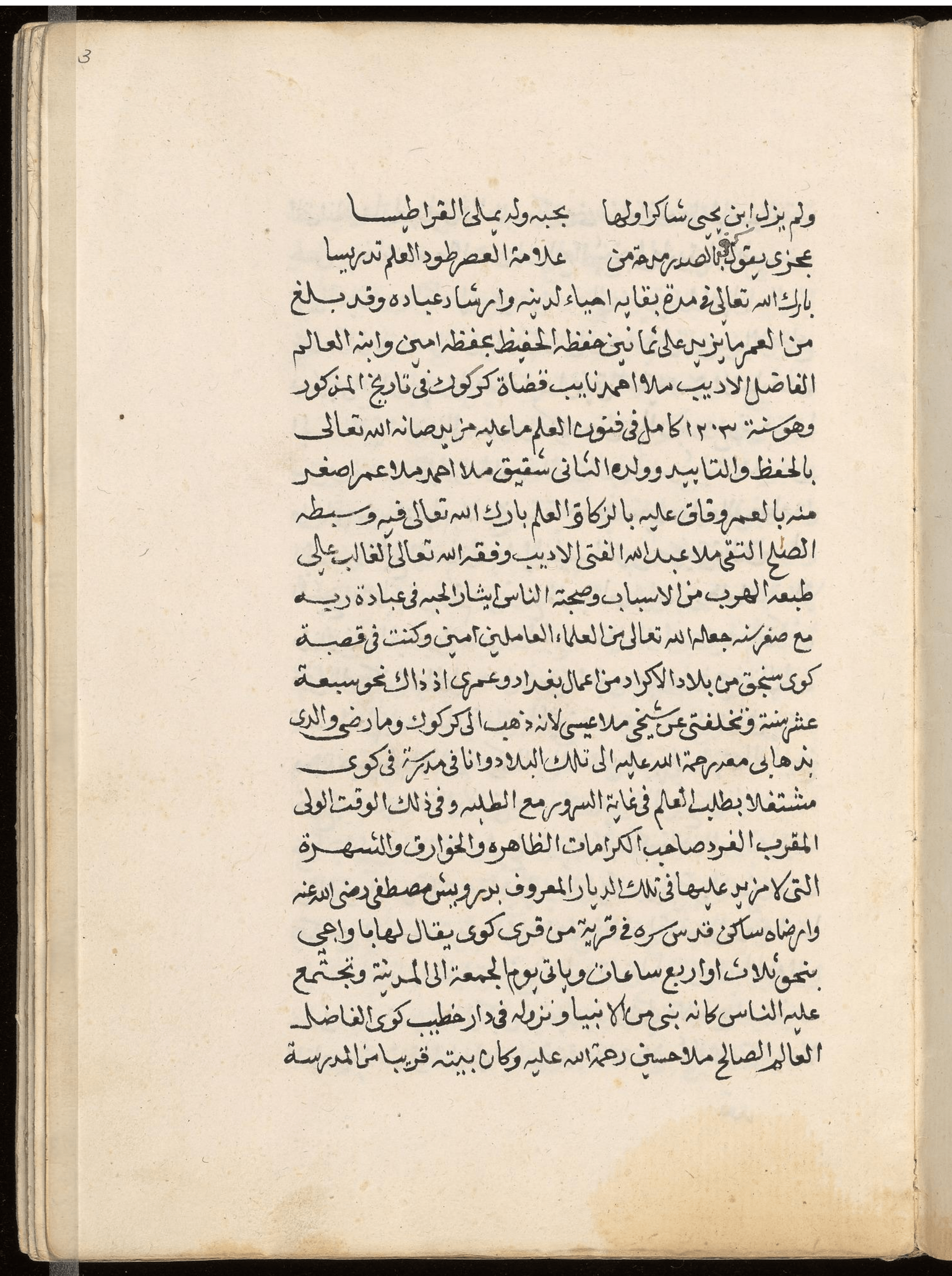
Rihlah__Ibn_Yahya_al-ʻIraqi_Sahih_al-Din_Abu_al-Fayd_Muhammad_T_UZ1kBEQ
A page from a holograph copy of the Riḥla, Yale University Library Landberg MSS 220

In that time there was dwelling in a place called Awājī—a village from among the villages around Koy [Sanjaq], three or four hours’ walk from there—the singular and proximate [to God] saint and master of evident miracles, gracious signs, and fame unsurpassed in that region, known as Darwīsh Muṣṭafā, God be pleased with him and with his land. He would come to town every Friday, and the people would gather around him like he was a prophet from among the prophets. He would stay in the house of Koy [Sanjaq]’s preacher (khaṭīb), the pious, sound, and knowledgeable Mullā Ḥusayn, God be merciful to him, whose house was close to the madrasa in which I was studying. I had a companion in study who was both older than me and more knowledge and better versed in fiqh, named Faqīh Ḥasan ibn Khāneh, God be merciful to both of them. He had pledged allegiance to the Shaykh in accordance with the ṭarīqa of the saintly axis and reviver of religion ‘Abd al-Qādir al-Jīlī [i.e. al-Jilānī], God be pleased with him. He had mentioned to me several times the spiritual condition of his shaykh and his miracles and spiritual states and this and that, to the point that there arose in my heart love for encountering him in order to pay pious visitation and to pledge allegiance to him. So I said to my companion Faqīh Ḥasan, ‘When next Friday comes take me to his presence and tell him about my condition and what I desire and so act as a translator (turjumān) between me and him, and yours will be the reward with God!’

And so towards the end of the month of Sha’bān, six days remaining to it, in the year 1151 [1738], Friday came and the shaykh arrived and stayed in the house of the aforementioned preacher. My companion said to me, ‘The shaykh has come—if you still want, stand and let’s go!’ So we went, but I saw the teeming assembly and I was deeply embarrassed before all the people. The shaykh was inside the house with lots of people before him, likewise outside the house. Still my companion went inside and told the shaykh about me, then he came back out and said to me, ‘I spoke to him.’ An hour later the shaykh had come forth and looked at me, and I had in my hand an inkwell with a tense firm cover such that it could be shaken to rectify the ink. When I saw the shaykh come out I kissed his hand and my companion said to him, ‘This is he,’ meaning me. I was dazed and embarrassed, I couldn’t see anything else save the shaykh stretching out his blessed hand and taking up the inkwell from my hand and saying to me, ‘What is this?’ I replied, ‘This is ink which can be well mixed through motion.’ He stopped for a while to talk with the people, then went back inside the house, saying to me, ‘With your permission—‘ and we entered the house together and sat down, I faced the shaykh with my head bowed for a while. Then he commanded me to come before him so I stood and sat upon my knees in front of him, the space quite filled up with those seated.

Then he said to me, ‘You wish to repent?’ I replied, ‘If God wills!’ He said, ‘Do not return to your sin,’ to which I replied, ‘If God wills!’ He said, ‘Repent from every sin!’ I replied, ‘I repent from all of my sins!’ Now there was to one side of the shaykh his companion, God be merciful to him, who was from among the folk of divine attraction (jadhb) whose state was evident and not hidden, named Mullā ‘Alī, from the people of Koy [Sanjaq]. He said to the shaykh, ‘This boy’—meaning me—‘from what does have to repent?’ He said this in joking manner to the shaykh, but the shaykh replied, ‘No, there is none who is free of sins great and small!’ I felt astonished, and in my heart there was shame over their mentioning sins, due to my own knowledge of my immoderation in regards to my lower self, so that I could verify in my own heart that the shaykh spoke the truth in what he said—this was the first miracle (karāma) manifest to me from him, God be pleased with him! Continue reading “Ṭāhā al-Kurdī Meets His Spiritual Master”