An Early Modern Monastic Baking Disaster

Over the course of the eighteenth century Orthodox monasticism and spiritual life would undergo a considerable revival, beginning in various parts of the Ottoman Empire and spread north into the borderlands along the Dniester River, regions contested between the expanding Russian and Austrian Empires and the contracting Ottoman Empire and the Polish-Lithuanian Commonwealth, in addition to the maneuverings of local forces such as the Zaporozhian Cossacks and the various nobility of the Ottoman semi-autonomous principalities of Wallachia and Moldova. In time the currents of spiritual revival would make their way into Russia, contributing to the re-formation of the starets tradition in Russian monasticism and spiritual life, known to many readers in the West through Dosteovsky’s The Brothers Karamazov.

One of the key figures in this spiritual revival was St. Paisius Velichkovsky (20 December 1722 – 15 November 1794). Born in what is now Ukraine, Paisius made his way as a young man to various monastic settlements in Wallachia, followed by a stay at Mount Athos, then a return north to Moldavia at the invitation of Prince Gregory III, the Ottoman-appointed ruler of the principality. The story below comes from his sojourn at the monastery and hermitage of Trǎisteni in what is now Romania. He later moved to a monastery at the northern edge of Moldavia, in the region of Bucovina, only to see the Austrians invade and annex Bucovina to their expanding empire. Due to the hostility of the Catholic Austrian polity to Orthodoxy, Paisius and many of the brothers retreated to Ottoman lands, settling at the monastery of Neamţ, where Paisius would die in 1794. Before his death, Paisius would devote much of his time to translating the now beloved spiritual classic The Philokalia into Slavonic, allowing its transmission throughout the northern Orthodox world. He also helped to introduce the practice of the Jesus Prayer to the same Slavonic lands, as part of his emphasis on reinvigorating older forms of Orthodox spirituality. In addition to these efforts, he began, though did not complete, an autobiography, which describes his travels and labors. The 17th and 18th centuries of the Ottoman world saw an explosion of travel narratives, autobiographical accounts, and personal chronicles or diaries, of which this account is no doubt an example, as well as being part of a West Eurasian-wide increase in literacy and authorship. As the excerpt below makes clear, Paisius wished to relate the mundane in addition to the sublime, and in so doing, reveals precious details of everyday life- in this case, an attempt at bread baking gone very wrong!

For more on Paisius’ life and historical legacy, see John C. McGuckin, “The Life and Mission of St. Paisius Velichkovsky (1722-1794): An Early Modern Master of The Orthodox Spiritual Life,” in Spiritus 9.2. (2009).

A detail from the Gospel manuscript of Luke the Cypriot (active 1583-1625), who worked in various places in the Ottoman Empire before settling in Moscow, where this Gospel was completed.

When everyone had gone off to the forest, then, to do the aforementioned work, the superior called one of the brethren who was the most experienced of all in the baking of bread and ordered him to show me the procedure for baking bread; and he ordered me to bake the bread, that it might be ready for the meal. This brother showed me in detail the procedure: pouring water into the cauldron, he showed me the pans of flour and the jug of kvass. He told me, ‘After you have heated the water, pour it into the flour in the pans and begin to knead it; then pout all the kvass from the jug into the dough and knead it all together.’

Having said this, he went off to the brethren in the forest. But wretch that I was, after his departure I heated the water and poured in the flour, completely forgetting to add the kvass. When I began to knead it, there was too little water, and too much flour. Having no experience, I did not know that it was possible to heat more water and add it, but thinking that once the brother had measured out so much water and flour it was in no wise possible to add or take away from it, I labored with great toil to knead all the flour; and the dough became so hard that it was impossible to put my fingers in it. At a loss for what to do with all the remaining flour, I cut the dough in pieces with a knife and placed it on the table. Sprinkling flour upon it, I beat it with a piece of wood and thus scarcely managed to knead in all of the flour; and placing all the dough in the pans with the greatest of difficulty, I scarcely managed to set them on the oven, so that the dough might rise more quickly in the warmth.

I waited for quite a while, and then I lit the oven so that it might be ready, but after I had burnt a great quantity of wood, the dough had still not risen. I was grieved by this, not knowing why it would not rise, but remained hard and immovable like a rock. In the afternoon one of the brethren came from the forest, not the one who had shown me how to bake the bread, but another, sent by the superior to learn whether the bread was ready or not. He asked me, ‘Why is the bread still not ready?’ Answering him with a sigh, I told him that it still had not risen. He and I then took the pans off the oven and, feeling it with his hand, found that it had been kneaded as hard as rock. Learning the reason for this, he smiled and said,’ You ignoramus! When you saw that there was too little water you ought to have added more without hesitation, or else taken away some of the flour, and thus you wold have kneaded the dough as one needs do.’ Then he asked me, ‘Did you add kvass to this dough?’ What fear and shame came upon me when I heard this! I scarcely managed to answer that I had forgotten to add the kvass. But seeing that I was terrified, and being a sensible man, he began to console me with spiritual words: ‘Do not grieve over this,’ he said, ‘for it was not from contempt, but from your inexperience in this work that you have erred.’ He heated some water and pour it upon the dough, and he and I began to knead it, adding the kvass. With great difficulty we scarcely managed to knead it somewhat, though it was impossible to knead it thoroughly on account of its great hardness.

Then, having given me instructions what to to do, he went back to the forest. I waited a rather long time, and when I thought the dough had risen somewhat, I made it into loaves and placed them on the table. After sufficient time I built up the fire in the oven, and it grew so hot that it emitted sparks. I swept these up carefully and, allowing the oven to cool a little, though not as much as was necessary, I put the bread into it, thinking that it would bake well. But because of the oven’s great heat it turned black forthwith and began to burn, and it was burnt nearly two fingerbreadths from the top and bottom. At a loss for what to do, I fell into great despair, firstly because through my ignorance I had made such a mess of things in the bakery of the holy hermitage, and secondly because the holy fathers would not find anything to eat when they came back from the forest. Taking the bread, then, completely burnt, from the oven, I awaited with fear the arrival of the brethren. And when they returned from the forest and saw what I, wretch that I was, had done in my ignorance, what great fear and shame came upon me! Not knowing what to do, I fell down at their holy feet with tears and asked forgiveness. The father superior and all the brethren, imitating Christ’s mercy, forgave me. Cutting one of the loaves, they saw that it was in no wise fit to be eaten; and they boiled corn mush (mǎmǎligǎ) and made a meal of this. No more did they bid me to bake the bread. But once having endured this, I thereafter watched diligently how the bread was baked and, with God’s assistance, I learned to do this. I describe here how I suffered because of my inexperience in this matter for the sake of the brethren who come now to our community, that they may not be frightened because of their inexperience in this or a similar obedience. For through God’s help and their own fervor they will be able to gain experience in the obediences assigned them.

Paisius Velichkovsky, The Life of Paisij Velyčkos’kjy, trans. by J.M.E. Featherstone (Harvard: Harvard University Press, 1989), 70-72.

On True Spiritual Seclusion and Exercise

Bridging the gap between how we intuitively understand words and concepts and how people in the past, or people in the present but in quite different cultural-linguistic worlds from us, understood those same words and concepts is often a difficult task. In the text I’ve translated here from the great early-modern Ottoman Damascene mystical philosopher, poet, and traveler (to name but three of his occupations) ‘Abd al-Ghanī al-Nābulusī (1641-1731), we encounter both dissonances of meaning endemic to the gap between our time and his, as well as dissonances that ‘Abd al-Ghanī introduces. Easily one of the most fascinating and versatile thinkers of early modern Islam, ‘Abd al-Ghanī simultaneously defended the practices and concepts of Sufism, especially as embodied in the thought of Ibn ‘Arabī, while also frequently refashioning them and integrating them into a wider-ranging philosophy of Islam that embraced the rapidly changing world of early modernity, against the puritanical, ‘fundamentalist’ strains of Islam that fitfully circulated in the Ottoman world. In addition to defending the legal validity of smoking, coffee-drinking, dancing, musical performances, and other activities, ‘Abd al-Ghanī generally argued for a broad social ethic that rejected moralism and morality policing, instead encouraging positive, indeed tolerant social interactions across class and confessional lines. This is not to say that he advocated some sort of proto-liberalism or modernism: as is clear from the following text, ‘Abd al-Ghanī did not reject the practice of the sharī’a or traditional theological beliefs. But what he did with those beliefs and how he interpreted them in doctrine and practice could be quite surprising and even innovative (a term he would not have appreciated, I should note). His often bold textual moves can be quite jarring at times- as they no doubt were in some cases for people in his own day.

This text is the bulk of a letter ‘Abd al-Ghanī sent, in April of 1678, to one Mulla Aḥmad of Hayrabolu, in what is now the European portion of Turkey (it was evidently conveyed by friends of ‘Abd al-Ghanī, as the note at the end indicates). In it our author discusses ‘true’ and ‘metaphorical’ acts and states, in so doing reversing the ways in which we tend to speak now (though reflecting language C.S. Lewis used in some of his works): the really real seclusion (khalwat, a type of ascetic withdraw for spiritual purposes) takes place within the self and in relation to God and through Him the rest of the world; that of the body and in relation to physical society is merely ‘metaphorical,’ obtaining reality through its contact with the true practice of seclusion. And so on- ‘Abd al-Ghanī explains it pretty well, I think, though this English translation does not convey the word-play and subtlety of the Arabic original- always a problem in translation, especially in religious-philosophical language such as this. But so it goes- ‘Abd al-Ghanī would no doubt argue from such a state to the ultimately metaphorical nature of language, realized only through connection with the truly Real.

a_damascus_pottery_tile_ottoman_syria_17th_century_d5479930h

And I have heard regarding you, O brother, that you are firmly fixed in your religion, desiring conformity with the command and the prohibition, and I love you for that. And I love for you what I love for my own self: that you enter into the path of inner piety (ṭarīqat al-taqwā al-bāṭiniyya), so that the interior and exterior be made perfect for you. What I mean by ‘inner piety’ is your crossing from the outward ordinances to the knowable realities, so that you witness through the eye of spiritual perception that every motion out of the motions of canonical prayer and other than those from among the acts of worship possess a lordly sign (ishāra)  and merciful secrets. And every ordinance from the ordinances of the sharī’a has an application in the exterior and an application in the interior. The sharī’aic ordinance (ḥukm) is a body, while the divine wisdom (ḥikma) is the spirit of that body. Do not be content with the bodies apart from the spirits, and do not be distracted from the bodies by the spirits: rather, bring together the exterior and the interior.

And let my friend—God, exalted is He, give him peace—know that there is no recourse for that besides entering into sharī’aic seclusion (khalwat) and doing sharī’aic spiritual exercises. And I mean by ‘seclusion’ only your solitude in witnessing the true Doer apart from the metaphorical doer, then the witnessing of the true One Described, apart from the metaphorical one, then the witnessing of the true Existence, apart from the metaphorical existence. And persist in this witnessing so that the senses and the intellect are fully immersed. This is true spiritual seclusion. As for the metaphorical seclusion, it is that you enclose your body in a ḥalāl house and ḥalāl sustenance, and cut off your sight interiorly and exteriorly from all that is outside that house by negation or affirmation, until you find the true seclusion, then come out of the metaphorical seclusion.

Among that which brings you to this is your concern for and your paying attention to the books of the knowledge of Sufism, such as the books of Ibn ‘Arabī, Ibn Sab’īn, al-‘Afīf al-Tilimsānī, and the like of them—God hallow their spirits—after washing the spiritual sight of the dirt of rejection of any of them, so that the door of their luminescent secret is opened for the heart, and the reality of their stationing upon the stations of the Muhammadan sharī’a is unveiled for the heart. And it knows that they are knowledge of it in the most perfect sense, acting according to it without innovation (bid’a) in the exterior or interior. And someone is not veiled from them through unknowledgeable rejection of their path, unreflexively being against them due to uncritical imitation [of anti-Sufi views], or from being fearful in regards to others due to his not understanding their doctrine, hiding in his [public] disavowal with faith in their doctrine without thinking evil of them—that is more beneficial for him, if such a person is not an enemy of that which he does not know. Junayd, God be pleased with him, said: ‘Faith (al-īmān) in the doctrine of this group is wilāya.’ Meaning, with neither understanding nor critical objection. For every entity among the learned has technical vocabulary which they use but others do not know, so accusing them of error without awareness of their technical vocabulary is itself a mistake. And there is a people who understand the doctrine of Sufism in accordance with the Book and Sunna, even if the exterior of the.doctrine appears to be in opposition. Its people always exist—to God belongs praise in every place and time! The one who licitly seeks them, finds them. ‘Licit seeking’ is sincere devotion, trust in God, thinking evil of the lower self, and the non-existence of thinking evil of others, whoever it may be, and submission to God in every place of His judgement and His decree, good and ill. As for the practitioner of innovationist seeking, he is not benefited by anyone he meets, even a prophet from among the prophets, upon them be peace.

And I mean by ‘exercise’ (riyāḍa) whenever I mention it, the directing of the soul towards the attaining of the realities and their habituation in every state, little by little. And that is by attachment to the clear Truth (al-ḥaqq), then by being characterized by it, then by ultimate realization—that is real spiritual exercise. As for metaphorical bodily exercise by the limiting of the eating of food and the drinking of water, as he—peace be upon him—said: ‘The sufficiency of the son of Adam are morsels which suffice his loins,’ so it is an excercise seeking other than itself, not for its own sake. It is constituted in the whole and is an aid for the fulfillment of the spiritual exercise, and is what does not go to excess and so lead to corrupt imaginings, so becoming a harmful interdicted thing—for this reason the jurists discuss it in their books.

So I have explicated for you seclusion and its conditions, real and metaphorical, and its like, exercise, but we hastened the matter due to the closeness of the travel of the brothers to you. God guide us and you on a straight path, and upright religion, in every moment, to the hour of death.

‘Abd al-Ghanī al-Nābulusī, Risāla 6, in Wasā’il al-taḥqīq wa rasā’il al-tawfīq, edited by Samer Akkach, in Letters of Sufi Scholar (Leiden: Brill, 2010), 116-119. Translation by Jonathan P. Allen, 2014, no rights reserved.

The Great Comet of 1680

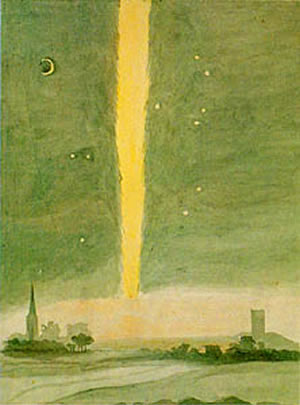
The little excerpt of translated text below is from the Kunnāsh, or notebook, of a scholarly resident of Damascus, Ismā’il al-Maḥāsinī, who died in 1690. In his notebook he records matters of local, regional, and even empire-wide importance, as well as various things and events that concerned or interested him. The events described range from an excursion to some neighboring towns to take in the country air, to the appointments and removals of various Ottoman officials in Damascus. In this entry he notes the occurrence of what in Western Europe would become known as Kirch’s Comet, as illustrated below in a painting from Rotterdam. Read Ismā’il’s description after the image:

comet

It befell that the first of the month of Ramaḍān, in the year 1091 [1680], was a Tuesday, and the Day of the Sacrifice likewise, and likewise the first of Muḥarram in the year 1092. And from the beginning days of the month of Dhū al-Ḥijja in the year 1091 [December 1680] a star went out which was seen in the lower third of the heavens in the direction of the qibla, and there extended out from it light like a solid column, around a cubit wide, inclining towards the west. And it remained like that every night for around a month.

Ismā’il Maḥāsinī, Kunnāsh, entry no. 25

Journeying Through the Veils

The below passage is from an introductory ‘handbook’ of Sufism in Arabic by the seventeenth century Aleppine Sufi Qāsim al-Khānī (d. 1697). His description here is hardly original, rather, it represents the shifting through and representation of centuries of Sufi thought and practice. At times his writings reflect a concern with theological ‘deviance,’ a particularly acute concern for Sufis like him who sought to defend and perpetuate the long tradition of Sufism- including the many theo-philosophical developments of the thirteenth century, such as those associated with Ibn ‘Arabi. Many of these beliefs and practices came under increasing scrutiny in the Ottoman Empire and elsewhere from the sixteenth century onward, even if such critiques did not become truly mainstream until much closer to our own age. al-Khānī seeks to defend such beliefs as ‘oneness of being,’ while also decrying allegedly incorrect interpretations of such beliefs, for instance here:

That which benefits the wayfarer in his journey is witnessing (shuhūd) of oneness of being not its gnosis. Witnessing is a state (ḥāla) necessarily realized from struggle, privation, successive exercise, lowliness, poverty, and need. And this state does not benefit the wayfarer unless there is with it following of the Shari’a, for if there is not with it following of the Shari’a, then it is damning zandiqa [heresy or deviance].

The passage below is less concerned with fending off theological error; rather, it presents a pretty traditional Sufi understanding of spiritual journeying: the passage through successive ranks of ‘veils’ preventing human cognizance and connection with God. As it is written in a straight-forward, pedagogically-inclined manner, I will leave off further commentary of this fine example of early modern Sufi teaching.

And the greatest of the veils that are between the servant and his Lord are the veils of sins, because they are darkness. As for veils other than them, to be sure the servant should hasten to dispel them, although they are luminescent, not totally veiling the servant. For the likeness of the veil constituted by sins is the likeness of an encompassing wall between you and your goal, and you cannot see essence or trace, due to its preventing, nor shape—which is different from the luminescent veils. They are like glass, with what is behind them being seen, obscuring and revealing by their increase or decrease. If the glass is increased greatly, then the intended object behind it is hidden, though the hiddenness of what is behind the wall is not the case here—at least the shape of the object can be discerned. All of this is what can be seen with the eye of the senses.

The heart is likewise. So long as its eye, which is called discernment (al-baṣīra) is veiled by the darkness of disobedience, which is called overcoming, imprinting, and sealing, it does not see anything of the lights of the Unseen, and has no awareness of what sin and evil does to it.

Then if one turns from what one is in, the veils of sins are lifted from his heart, and he beholds divine things, and begins to feel fear concerning his punishment, and hopes for reward, and persists in obedience to God, and turning away of evil deeds. Now he is veiled with luminescent veils, which are his dependence upon these deeds, for he now believes that he is the one who brings them into existence.

Then, after that, God lifts this veil from him, through the blessing (baraka) of acts of obedience, and he sees that the grace upon him belongs to God, for God causes him to be successful in these deeds, and that he is insufficient in giving thanks for them, and that the effective Giver is God. If God desires of someone good, he invests him with the garment of pious fear (taqwa) so as to make sound his presentation before His presence—and nothing of good or evil is by the hand of the servant, rather, all is by the hand of God.

Then, when this veil is lifted from his heart, he imagines that he has attained to God, for there is spiritual delight in this station. But if the hidden subtleties encompass him, this veil too is raised from him, and he does not cease cutting through the veils, one after another, as per the arrangement of stations and gates as in this book, until he attains to true station, the stopping place of the Most Veiled—so understand!

Do not believe, because of the likeness of the veils to panes of glass, that God is a thing which can be seen by the perceiving eye—for He is free of that. God take in hand your guidance!

Qāsim al-Khānī, al-Sayr wa al-sulūk ilā malik al-mulūk

A View of Constantinople, 1756

The following effusive description of Ottoman Constantinople/Istanbul is from the pen of Timothy Gabashvili, a Georgian cleric who embarked, in the mid 18th century, on a long journey across the Ottoman realms visiting sacred sites, various Orthodox communities, and other sights and places along the way, all of which he would later describe in his Georgian-language record of his pilgrimage. Timothy’s perspective is a somewhat unique one: Georgia in the mid 18th century was still within the Ottoman orbit, but was being aggressively courted by an expansive Russian empire. Timothy himself had previously visited Moscow and the new city of St. Petersburg. Yet in much of his narrative his treatment of the Ottomans is remarkably positive- all of his interactions with Ottoman officials were amiable and productive, and the relationships he managed to forge enabled the success of his pilgrimage. In a relatively few short years- unbeknownst to Timothy or anyone else- the Ottoman world would change a great deal, and a pilgrimage of this sort, and the relationships that made it possible, would be forever lost. In 1756, however, a pious Georgian pilgrim could still feast and drink with Muslim Ottoman notables, and wax poetic in praise of the the Ottoman incarnation of the City of cities.

Panorama of Istanbul, Ottoman, late 18th – early 19th century, 58 x 27.1 cm, SHM 12449 – İ.1285 / From the Sadberk Hanım Museum, Istanbul

*

Now, I’ll say something about the city of Constantinople. The lure of the city’s radiance has spread its beauty to distant parts of the world and even the capitals, because in no other place can one find Asia and Europe together. Among them, running down from the Black Sea, there flows a narrow sea like a river. It runs, with spouts of foam. Constantinople is founded on it and on the mountains by the hand of Sabaoth. The mountains are lavishly covered with spruce trees and Lebanese cypresses. The city has been built on both sides of the sea that flows in a narrow stream. The structure of the walls, the towers and the battlements are splendidly coloured. The windows of the palaces sparkling in different ways, resembled Eden.

Some of the palaces, vaults and bazaars of the city were covered with lead, the gilded roofs of the palaces and springs shone like the sun shining on the city, and the colour of other buildings in the city was scorched clay, or purple, a hue also like the sunset. The ships in the city stood erect like the trunks of poplar trees. Among the groves of selvinu, ghaji, and cypress trees, there was a glimpse of the royal palaces, and the buildings were veiled in the forest of pine and spruce groves. This capital seemed to me like the brightest among the stars, like a rose among the flowers of Eden, like a jacinth among the precious emeralds, like the rainbow in the clouds, and Augustus Caeser among the kings. I found it very difficult and sad to be leaving Constantinople, as I, who had come here after a great many sufferings and hardships, would never see it again. My eyes and my mind competed in emotion when viewing this marvelous city

Timothy Gabashvili, Pilgrimage to Mount Athos, Constantinople, and Jerusalem, 1755-1759, trans. by Mzia Ebanoidze and John Wilkinson


To Drive Away the Vampires: Music from the Balkans

Below is a wonderful sampler of music, via Baltimore-based Canary Records, from across the Balkans, culled from albums produced from the 1930s to the 1970s, so ‘modern,’ but not that far removed from the pre-radio, pre-recording, pre-nationalist past. One of the enduring legacies of the Ottoman Empire is the vast, diverse, yet inter-related soundscape of music practiced by the various ethnic, religious, and linguistic groups that dwelt in and moved across the Ottoman realms, carrying and transmitting and sharing their musical traditions, to the extent that no musical tradition remained sealed off from others. One can hear that multiplicity and interconnectedness in this lovely sampler; another good example, drawn from recent field recordings, is the album Mountains of Tongues, an assembly of contemporary ‘traditional’ music from the Caucuses, a region that, like the Ottoman Empire (which indeed included parts of the Caucuses) was and is a tapestry of traditions and identities.

A Moving Experience

Sufism, particularly in its more ecstatic and speculative forms, was not universally admired in the Ottoman world (or in the contemporary world, for that matter). Opposition to particular Sufi practices and doctrines, or Sufism as a whole, could come from various quarters, whether from the ranks of the learned elite or from the pious masses. In the short story below, taken from Aḥmad ibn Muṣṭafá  Tāshkubrīʹzādah’s biographical dictionary (a frequent contributor to this blog in recent days, regular readers will notice), we see both the tenor this opposition could take, and an instance of a rather dramatic conversion from an anti-Sufi stance (or, at least, anti-ecstatic Sufism). The story mostly speaks for itself. A couple of things are a little less obvious perhaps: one, note that the Sufi shaykh featured here is described as only having a Turkish name, unlike the majority of people featured in Tāshkubrīʹzādah’s collection. Does this indicate a rural origin, or perhaps outsider status vis-a-vis the ‘learned hierarchy’ of Istanbul and the rest of the empire? Why does Tāshkubrīʹzādah give only this one anecdote for substantial content of this shaykh’s life? I’m not sure. Ottoman Sufism and religion in general is an area of study I’m still very much a novice in; I might also add, my transcription of the Turkish shaykh’s name is a contingent guess for now. I have but lately begun studying Ottoman Turkish, and will probably come back and modify my transcription in time to something more accurate.

Among them, the Knower of God, Shaykh Sūndīk known as Qūghejēdede: He was a master of great divine ecstasies, sunnaic states, and performed miracles.

It is related that he met with Mullah al-Karamāsī—the qāḍī of Constantinople[1]—along with Mullah Ḥamīd al-Dīn ibn Afḍal al-Dīn, who was at the time a mufti. Mullah al-Karamāsī complained to him regarding the Sufism of the age, in that they danced and entered trance-states during dhikr,[2] which was in disagreement with the shari’a. So Mullah ibn Afḍal al-Dīn said to Mullah al-Karamāsī that their leader was this shaykh, pointing to Qūghejēdede, and said: If you make him sound, all will be sound. At that Mullah al-Karamāsī stood up and took Qūghejēdede to his house and fetched his disciples [of Qūghejēdede], and prepared food for them. After finishing the food, he said to them: ‘Sit, and practice your remembrance (dhikr) of God in propriety, sobriety, and silence!’ They said: ‘We will do that.’ Then, when they began their dhikr, Qūghejēdede shouted very loudly in Mullah al-Karamāsī’s ear, so that the Mullah stood up, threw off his turban from his head[3] and his outer robe from his shoulders, and began dancing and entered a trance-state until an entire third of the day had passed. When the Mullah’s disturbance had stilled, Qūghejēdede sad: ‘For what were you so disturbed, O Mullah—and you had said it was evil?’ The Mullah replied: ‘I repent! And I revoke before God that rejection [of Sufism], and I will never return to it!’

The aforementioned shaykh died in the city of Constantinople and was buried in it—God hallow his mystery (sirrahu).

Aḥmad ibn Muṣṭafá  Ṭāshkubrīʹzādah, Al-Shaqāʼiq Al-Nuʻmānīyah Fī ʻulāmāʼ Al-Dawlah Al-ʻUthmānīyah (Bayrūt, Lubnān: Dār al-Kitāb al-ʻArabī, 1975), 220-1. Translation by Jonathan P. Allen, 2012. No rights reserved.


[1] That is, the chief judge of Constantinople/Istanbul.

[2] Dhikr—literally, ‘remembrance’—is a Sufi practice in which the name of God or certain short devotional phrases or prayers are uttered (either vocally or silently/mentally) in succession, over and over, sometimes leading up to a trance-like state (though not in all forms of dhikr).

[3] An action strongly indicating abandonment of propriety and self-control.

Sufi Concision

One of the most prolific Sufi masters and authors to live in the Ottoman Empire was a Turkish mystic and scholar named Ismāʿīl Ḥaqqī (1063-1133/1652-1725), who spent his childhood near Edirne, then received his education in Edirne and Istanbul. After several years of traveling to various corners of the empire, he settled down in Bursa, where he lived as a Sufi master and teacher and eventually head of the Jilwatiyya order. Besides his training in the Sufi path, Ismāʿīl Ḥaqqī received, and deployed in the course of his career, a broad education, from philosophy and music to Qur’anic exegesis and Persian poetry. He wrote a great deal- some 104 works, a majority in Turkish, though with a sizeable number in Arabic. The excerpt below comes from his primarily Arabic (with a little Persian mixed in) Qur’an tafsīr, the Rūḥ al-bayān, a multi-volume work that stands out as a quite original and often creative endeavor. Philosophy, mysticism, grammatical science, hadith, and many other components all make up this major work, which, so far as I know, has received little notice from Western scholars.

The excerpt below represents an aspect of Ismāʿīl Ḥaqqī’s tafsīr that I think might well be unique to him (though of course I could be quite wrong on that, so don’t quote me on this!); if not unique, it still stands out as unusual and rare. After providing a somewhat eclectic but largely ‘exoteric’ interpretation of the first few verse of Sura al-Hūd, Ismāʿīl Ḥaqqī presents a lemma-by-lemma ‘mystical’ commentary that is highly abbreviated, similar to the concise, abbreviated ‘exoteric’ commentaries that were especially popular in the Ottoman realms (see Bayḍawī’s relatively short commentary, the Tafsīr Anwār al-Tanzīl wa Asrār al-Ta’wīl, for an example). He titles these sections Stellar Interpretations, a phrase which immediately calls to mind mystical modes of exegesis (see note one below). Whereas most Sufi commentaries dealt with particular verses or blocks of verses, our author works through each lemma and line, integrating the whole of the text into a concise Sufic interpretation. What is the logic of such an approach? Perhaps Ismāʿīl Ḥaqqī wishes to demonstrate the complete compatibility of the Qur’anic text with the Sufi path and Sufi doctrine. Against naysayers who might wish to contest the Qur’anic quality of Sufism (and especially the ibn ‘Arabi influenced Sufism someone like Ismāʿīl Ḥaqqī espoused), our author presents a lemma-by-lemma reading of the scriptural text that uncovers Sufi belief and practice consistently and clearly, with little metaphysical or rhetorical maneuvering.

Alif-Lam-Ra: A Book whose verses were established, then were set forth in detail, from the Presence, Wise, Knowing. Serve none save God; I am to you from Him a warning, and good news. And you that seek forvgiveness of your Lord, then turn to Him, He gives you enjoyable provision to an appointed term. And there comes to every possessor of grace His grace. And if you turn back, then I fear for you the punishment of a great Day. To God you return, and He is over everything powerful.

And in the Stellar Interpretation [1] (al-ta’wīlāt al-najmiyya): Alif-lam-ra: the alif points to God (Allāh), the lam, to Gabriel, and the ra, to the Prophet (al-rasūl). A Book whose verses were established: meaning the Qur’an, a book whose verse are established by wise ordinance, as His words say: He makes you to know the Book and wisdom. So the Book is the Qur’an, and the wisdom is the realities, the meanings, and the mysteries that are incorporated in its verses. Then were set forth in detail: that is, these realities and wisdoms were made evident to the hearts of the gnostics. From the presence of [the] Wise: He deposited in [the Qur’an] the overwhelming wisdom which no one else is capable of depositing in it, and this is a mystery from among the mysteries of the inimitability (i’jāz) of the Qur’an. Knowing: over the instruction of those things from His presence to whomever He wills among His servants, as His words say: Then they found one of Our servants, unto whom We had brought mercy from Us and had taught him knowledge from Our Presence (Q. 18.65). Pointing out that the Qur’an has an exterior which the grammarians (ahl al-lugha) know about, and an interior which only the lords of hearts whom God has graced with knowledge from the Presence know about. And the summit of wisdom and its mystery is that you say: O Muhammad, what relates to you will not perish [?]. Serve none save God: that is, do not serve Satan, the world, the passions, nor what is other than God. I am to you from Him a warning: I warn you against being cut off from God, you that serve, obey, or love other than God; and the punishment of the servant is in Gehenna. And good news: I give you good news of mystical union and the graces of reunion [with God] in the house of magnificence, you that you serve Him and obey Him and love Him.

And the Prophet is specified by the call to God from among the prophets and the messengers, as indicated by His words: O Prophet, We sent you as a witness, a herald, a warning, and a caller to God by His permission (Q. 33.45). And you that seek forgiveness of your Lord: from what causes you to slip during the days of your lives into seeking other than God and the abandonment of seeking Him, and the occurrence of veiling [from God] and the vanities of people’s natural dispositions—for the seeking of of forgiveness is purification for your souls and cleansing for your hearts. Then turn to Him: return by preceding along the practice of wayfaring to God, so that repentance be a ornamentation for you after the purification of seeking forgiveness, per His words: He gives you enjoyable provision: the raising in stations from the low to the high, and from the high to the presence of the Exalted, the Great. To an appointed time: the termination of the stations of wayfaring (sulūk) and the beginning of the degrees of union. And there comes to every possessor of grace: possessor of truthfulness and struggle in the seeking. His grace: in the degrees of union; the witnessings are in accordance with the measure of the struggles. And if you turn back: to turn away from the seeking and the journey to God. Then (fa-): Say: I fear for you punishment of a great Day: the punishment of the Day of the cutting off from God, the Great—He is the greatest of the great, and His punishment is the hardest of strikings. To God you return: voluntarily or with detestation. If voluntarily, He will draw near to you with the utmost of attractions, as He said [in a ḥadīth qudsī: Whoever draws near to Me an inch, I will draw near to him a cubit. If with detestation, you deserve to be in the fire upon your faces. And He is over every thing: in both kindness and victorious might: powerful.

Ismāʿīl Ḥaqqī, Rūḥ al-bayān, Volume 4, 93-94.


[1] Ta’wīlāt is a somewhat ambiguous word: it can mean simply ‘commentary’ or ‘intepretation’; it can mean ‘commentary by personal opinion,’ with a negative sense attached to it; or it can stand for ‘mystical’ interpretation. Here it would seem to entail aspects of all three meanings, though without any negative sense attached to it.

The Traces of Reverent Fear

The sixteenth-century Ottoman scholar Aḥmad ibn Muṣṭafá Ṭāshkubrīʹzādah‘s biographical work, Al-Shaqāʼiq Al-Nuʻmānīyah Fī ʻulāmāʼ Al-Dawlah Al-ʻUthmānīyah, is full of fascinating lives and vignettes, dealing with all sorts of people within the Ottoman realms, from powerful judges to humble rural mystics. While many of his entries are perfunctory, giving only basic data and usually some nice words about the subject’s piety, other entries include short stories, relate sayings or teachings of the person under discussion, and sometimes include observations from the author’s own personal experience. In the case of the following short life, we get most of those things, albeit in a short space. We see, among other things, the sort of spiritual and social capital and cache a single Sufi could draw upon, touching everyone from a young Ṭāshkubrīʹzādah to a burnt-out scholar to the Sultan himself.

Among them, the Knower of God the Exalted, Shaykh Muṣlaḥ al-Dīn al-Ṭawīl:

He was from the rural district of Naḥḥās in the province of Kastamonu. At first, he busied himself with exalted knowledge (al-‘ilm ash-sharīf)[1] and was well-known by virtue of his reception among the learned men of his time. Then love for Sufism arose in him, and he made the rounds among the shaykhs of his time, until he settled upon Shaykh al-Alhī, and persisted in his service until [the shaykh] died. In his presence he joined the Sufi path and achieved the furthest perfection. He was cut off from the people, stripped of the states of the world, without inclination towards the customs of the people. One saw in his outward visage the traces of reverent fear and sublimity, though he was in companionship kind and beautiful. As a child I saw him, and he brought about in me great reverent fear, and this reverent fear is in my heart up to the present.

He wrote an epistle in the time of the Sultan Bayazīd Khān and sent it to him, mentioning therein relinquishment from the throne and the chair. He mentioned in its conclusion that if there befell injustice in any region among the various regions, the upright people of that region would see in their dreams the Prophet, peace and prayer of God be upon him, sorrowing. And the upright people of the rural district of Naḥḥās saw the Prophet, peace and prayer of God be upon him, sorrowing, so they kept watch and found in that region great injustice. That injustice was described, and Sultan Bayazīd Khān lifted that injustice from the people of that region.

And it is related about one of the members of the learned class, that he said: I went into his [Shaykh Muṣlaḥ al-Dīn al-Ṭawīl] service once, and said: I want to abandon this path. He said: Which path? I replied: [That of] knowledge (‘ilm). He replied: Have you found a better path? Then he was silent. Then he said to those present: Do you know Sinān Jalabī al-Karmiyya’ī? They replied, Yes, we know him. He said: How do you know him? They replied, He’s an excellent judge. He said: He is a most perfect person of the Sufi path—but none of you know this his state! The one who has exalted intention perfects the path, be he a judge or a professor, though no one is aware of it, but he who does not have exalted intention, his lower self spurs him on to abandoning the path of knowledge, but that will not be made possible for him, and he is forbidden from the Path.

Among his many mystical states was [the following occurrence]: he unrolled his mat in a place close to the grave of Shaykh Tāj al-Dīn in the city of Bursa, and he recited Surah Ya-Sin every morning for forty days, and when those forty days were completed, he died, and was in buried in the place of that mat, his secret be sanctified.

Aḥmad ibn Muṣṭafá  Ṭāshkubrīʹzādah, Al-Shaqāʼiq Al-Nuʻmānīyah Fī ʻulāmāʼ Al-Dawlah Al-ʻUthmānīyah (Bayrūt, Lubnān: Dār al-Kitāb al-ʻArabī, 1975), 217-218. Trans. Jonathan Allen, 2012. No rights reserved.


[1] ‘Ilm here means the study of things such as jurisprudence (primarily), hadith, grammar, rhetoric, and so on- the standard curriculum of an Ottoman madrasa; it might most accurately be translated ‘exoteric knoweldge.’It is commonly contrasted with ma’rifa, or esoteric knowledge, also, perhaps most accurately, translated as ‘gnosis,’ which focuses on the personal, experiential nature of this knowledge, as opposed to ‘ilm, which is transmitted and standardized.

War, Travel, Commentary, Alchemy: An Ottoman Life

The following life is a marked departure from the two previous biographies from Ṭāshkubrīʹzādah’s Shaqa’iq that I’ve translated and posted here and here. Whereas the previous two figures are depicted as mystics and having an ambiguous, even conflicted relationship with both wider society and the Ottoman state structure, the subject of today’s biography does not seem to have had such problems, working in close company with first a Mamluk Sultan and then the Ottoman Sultan. His relationship with the Ottoman state, interestingly, is also different: rather than “official” posts such as judge, teacher, or mufti, Muhammad ibn ‘Amr ibn Hamza is what we might call a “popular preacher,” or at least that is the way he is depicted here. The “people” (ahl) love him, we are told; yet it isn’t just the people who love him; the holders of the highest political power in the lands he sojourns in also love him, and he seems to return the favor.

Ibn Hamza’s life trajectory is somewhat unusual: while being from a Transoxanian family is not particularly unusual, his birthplace of Antioch does stand out. While a major city of late antiquity and the middle ages, by the Ottoman period Antioch had declined greatly due to invasion and, more importantly, the silting up of the Orontes, which crippled Antioch’s port capacity and hence value as a trade entrepot. Leaving Antioch, ibn Hamza’s career would come to move in tandem with some of the central trends of his era: increasing Ottoman power and vastly widened territory, conflict between the Sunni Ottoman state and the Shi’i Safavid state, conflict that was itself part of a wider trend of state-formation across Eurasia, often in an atmosphere of inter-confessional conflict.

This inter-confessional conflict makes up the central element of ibn Hamza’s life: participating in and indeed encouraging the war against the “heretical” Shi’i Safavids, here refered to as the Qizilbāsh (literally, the “red-heads,” after their red turbans) in reference to the religio-military group that had facilitated the Safavid rise to power. Ibn Hamza’s fight against Shi’ism takes multiple forms, most virulently as a preacher in the service of Sultan Selīm; we may wonder to what extent this anti-Shi’i stance preceded ibn Hamza’s association with the Ottoman state, and to what extent it was simply precipitated by a commitment to Sunni orthodoxy. At any rate, anti-Shi’i activity would be central to Ottoman efforts within and without the empire, a situation somewhat analogous to the Cold War of the twentieth-century between the United States and the Soviet Union. People suspected of Shi’i leanings constituted, in the eyes of the Ottoman authorities, a central threat to the Ottoman state; Sufi groups could fall under suspicion, as we see in ibn Hamza’s life (although also note that Sufism per se is not condemned, at least not in Ṭāshkubrīʹzādah’s rendering, only a particular practice of some Sufis). But it should be noted that preaching holy war against heretics was not the only concern in ibn Hamza’s life—he also seems to have been deeply concerned with the wider social and religious welfare of Ottoman society, or at least this is the impression Ṭāshkubrīʹzādah wants to give us. In addition, while not exactly a conventional scholar, he did engage in book writing and other scholarly pursuits, alongside his preaching of holy war, acting as the companion of sultans, building mosques, preaching often, mastering alchemy, raising a massive family, and apparently engaging in commerce. It is perhaps not coincidental that the appellative that comes to mind is “Renaissance man,” but a discussion of the truth that lies behind such a thought is best saved for another time.

Finally, a note on the new format I have used here: having recently discovered how simple inserting endnotes into a WordPress post is, I have therefore included explanatory notes throughout the text, which I hope will make some of the technical language and historical references clearer.

Among them is the Knowledgeable, the Noble, the Virtuous Mulla Muhyi al-Din Muhammad ibn ‘Amr ibn Hamza:

His grandfather was from Transoxiana [1] and was among the disciples of Sa’ad al-Din al-Tuftazani. He then traveled and settled in Antioch, where this Muhammad was born. He memorized the Qur’an at an early age, then al-Kanz and al-Shatabi and others, then studied fiqh [2] under his paternal uncle Shaykh Hussayn and Shaykh Ahmad, virtuous men, studying under them the principles of jurisprudence (al-usul), Qur’an, and the Arabic language. He then journeyed to Hasn Kifa and Amada, then to Tabriz, learning from its ‘ulama, busying himself there for two years, studying in Tabriz under the learned, the virtuous Mulla Muzid. He then returned to Antioch and Aleppo and remained there for a time, preaching, teaching, and issuing fatwas, his virtues becoming well known. Then he went to Jerusalem and lived nearby, then to Mekka and performed the hajj, then to Egypt. There, he heard hadith from al-Siyuti and al-Shamani, both giving him ijāzas. [3] He preached, taught, and gave fatwas, having great reception for a time, until Sultan Qāʾitbāy [4] sought him out and he appeared before him, preached to him, and wrote a book for him on fiqh titled The Conclusion, so he loved him and honoured him with great honour and rewarded him well. [The Sultan] would not give him permission to travel, so [ibn Hamza] remained in [the Sultan’s] presence until King [sic] Qāʾitbāy passed away in the year 903 [1497].[5]

Then [ibn Hamza] traveled to Anatolia (al-Rum) by way of the sea, and then made his way to Bursa, whose people loved him greatly, so he stayed there and busied himself with preaching and forbidding the wrong.[6] Then he went to the city of Constantinople and its people loved him also, and Sultan Bāyazīd [7] heard his sermon and bestowed upon him all of his wealth, and he used to send rewards to him all the time. [Ibn Hamza] wrote for him a book titled Explication of the Excellent Qualities in the Life of Our Prophet (peace and prayers of God—exalted is He—be upon him), and another book on Sufism, and was present before him, exhorting him. Then the Sultan went out on the holy frontier campaign,[8] and [ibn Hamza] was with him. Together they conquered the fortress of Methoni, and this was their second or third entrance therein.[9] Then he returned to Constantinople and remained there, commanding the right and forbidding the wrong, for he did not fear the reproach of God, and he opposed the heretics and the Sufi practice of dancing. He next returned with his family to Aleppo the Protected, and Melik al-Amra’ Khayrbek honoured him greatly and studied under him, being responsible for all of his needs, so that [ibn Hamza] did not require anything else. So [ibn Hamza] stayed there eight years, occupied with tafsir, hadith, and refuting heretics and the Rāfiḍa bearing the name of the tyrant Ardabik.[10] This sect hated him, cursing him in their assembly while cursing the Companions of the Prophet.

[Ibn Hamza] then returned to Anatolia during the reign of Sultan Selīm Khan,[11] urging him on to holy war (jihād) against the Qizilbāsh,[12] writing a book for him on the conditions and virtues of holy frontier campaigns (it is a very fine book); [ibn Hamza] then went with him to the war against this sect, preaching to the army every day during the campaign, reminding them of the rewards of holy war, especially against this sect. The Sultan honoured him and was very generous towards him. When the two armies met, fierce fighting broke out, and as eyes were averted and hearts rose into throats, the Sultan commanded [ibn Hamza] to proclaim the call (al-dawa’a). So he occupied himself with proclaiming the call, and the Sultan cried, “Amen!” So the enemy was put to flight through the help of God—exalted is He—and he journeyed to Rumelia, preaching to its people, forbidding them disobedience [towards God] and commanding them to do the obligatory deeds. So many among them were [morally] improved because of him, and he built two Friday mosques in the town of Saray [Sarajevo], as well as a neighborhood mosque there and another neighborhood mosque in Uskub [Skopje], and remained there approximately twenty years, doing Qur’an interpretation every day, converting many unbelievers. In the year 932 [1525] he went on campaign with our magnificent Sultan [13] to Ankeros, and he called to him at the time of the fighting, and the glorious conquest came as before.[14] Then [ibn Hamza] went to Bursa and dwelled there and began to build a large mosque, but passed away before its completion, on Muharram 4, 938 [August 18, 1531]; he was close to seventy years old, and was buried in the precincts of the mosque.

He beget from his loins nearly a hundred souls; he had many books and treatises on numerous arts, especially on the science of alchemy (al-kīmiyāʾ), being among those who persevere in it. He traveled to many places, was beloved by many, many souls being attracted to him. He was greatly pious, and had perfect watchfulness in his manner of eating, dress, and ritual purity. His cost of living was covered by his commercial activity, while much of his time was expended in the betterment of people through preaching, teaching, and fatwa-giving. There are few hadith mentioned in books which he did not have committed to memory; he was perfect in his Qur’an commentary (tafsir), without recourse to study or books. He used to devote himself on Fridays to commentary (tafsir) on what the preacher had recited during prayers, with perfectly elegant style, variety of aspects, and abundant knowledge, which daily amazed those who thought on it. The common people and the elite among the ‘ulama and the Sufis learned from him: he was knowledgeable, lordly, always summoning to right-guidance and good conduct; putting to death many bad innovation and bringing to life many good traditions (sunnan). People beyond the count of any but God benefited through him; such would not be possible to anyone else unless there came the like of what was sent from the grace of God [through him]—may God breathe upon his face and enlighten his grave!

Aḥmad ibn Muṣṭafá  Ṭāshkubrīʹzādah, Al-Shaqāʼiq Al-Nuʻmānīyah Fī ʻulāmāʼ Al-Dawlah Al-ʻUthmānīyah (Bayrūt, Lubnān: Dār al-Kitāb al-ʻArabī, 1975), 247-249.


[1] Lit., “what lies beyond the river,” roughly modern-day Tajikistan, Uzbekistan, part of Kyrgyzstan, and Kazakhstan.

[2] Islamic jurisprudence.

[3] “License,” certification that one is qualified to transmit hadith (or a book or other text) from a given person via an authorized chain of transmitters.

[4] Important late Mamluk ruler, carried out extensive military campaigns and building projects; died a few years before the Ottoman conquest of Egypt. See M Sobernheim, “Ḳāʾit Bāy, al-Malik al-As̲h̲raf Abu ‘l-Naṣr Sayf al-dīn al-Maḥmūdī al-Ẓāhirī” in Encyclopaedia of Islam, Second Edition, edited by: P. Bearman; , Th. Bianquis; , C.E. Bosworth; , E. van Donzel; and W.P. Heinrichs (Leiden: Brill, 2011).

[5] Qāʾitbāy actually died in 901/1496.

[6]The second half of the phrase “commanding the right and forbidding the wrong,” a basic Islamic ethical injunction incumbent upon all believers; the exact dynamics and parameters were, however, widely debated. See Michael Cook, Commanding Right and Forbidding Wrong in Islamic Thought (Cambridge: Cambridge University Press, 2010).

[7] Sultan Bāyazīd II, ruled 886-918/1481-1512.

[8] Ghazu, literally a raid, but in this context a campaign on the Ottoman frontier, here given a sacred function (see below), hence my somewhat inelegant translation.

[9] Methoni (also known as Modon) is a heavily fortified town in Morea, Greece; it had been held by the Venetians for nearly three hundred years until its fall, mentioned here, on August 9, 1500. For photos of surviving fortifications and a plan of the town, see: Methoni.

[10] “Rāfiḍa” by this period had become a derogatory term for Shi’i Muslims in general; I have not been able to uncover to whom the name Ardabik refers.

[11] Ruled 918-926/1512-1520.

[12] That is, the Persian Safavids, relatively recently converted to Shi’a Islam.

[13] Sultan Süleymān I, ruled 926-74/1520-66.

[14] This must refer to either Süleymān’s conquest of Belgrade in 1521 or his 1525 Hungary campaign; I suspect the former, though that would mean Ṭāshkubrīʹzādah’s date is wrong.