Many Worlds in One Manuscript: A Close Reading of Ms. Yah. Ar. 765, Part II

This post continues my three-part exploration of a short Ottoman manuscript text, Risāla fī ithbāt ruʾyat al-nabī yaqaẓatan li-man iṣtafāhu min ʿibādihi al-ṣāliḥīn, by the otherwise obscure scholar Muḥammad b. Aḥmad al-Kūmuljinawī; if you have not already read Part I much of the following will not make sense, so start there then proceed to the following.

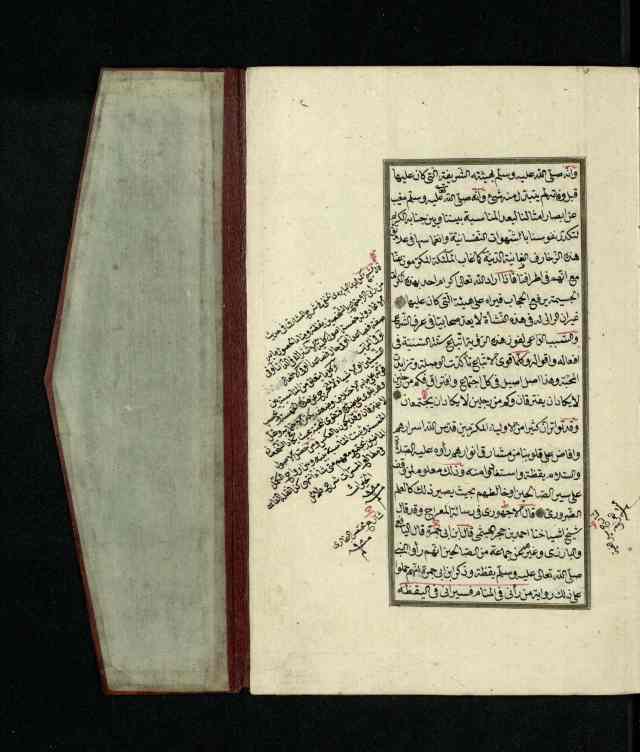
In Part I we were introduced to the manuscript as a codicological unit, and reviewed some of the paratextual aspects that appear in this handful of folios. In the remaining pages the same elements continue, plus some additional ones, which we’ll examine before plunging into the main topic of this post, the theological content and the way in which al-Kūmuljinawī drew upon existing authorities, how he might have gone about locating sources, and what we can gather about ‘canonical’ theological authorities in the eighteenth century Ottoman world. Let’s have a look at the second page in the treatise and note the paratextual elements visible there:
National_Library_of_Israel_Jerusalem_Israel_Ms._Yah._Ar._765.pdf_page_9

First, it’s important to pay attention to things that might otherwise fade into the background: for instance, this manuscript features a frame around the main text, a common feature but not a universal one, bespeaking the refined nature of the manuscript and its intended purpose as a presentation text. More mundanely, the frame neatly demarcates the main text from its marginal apparatus: in the case of this manuscript, primarily comments that are the functional equivalent of footnotes in modern book practice. In the example above, three annotations are visible, all examples of the minhu, ‘from him,’ type of note, placed there by the author of the text (at least in this case- in other cases the provenance of such notes can vary). The notes are linked to particular points in the main text via rubricated letters, very much akin to the footnote, although spatially they are placed more or less proximate to the linked section of main text, and hence in a variety of arrangements- an affordance of handwritten texts that is considerably more of a challenge for typography (though not insurmountable; not a few early Ottoman printed works featured sloping commentary text, though not at varying angles as here).

Nearly all of the minhu comments in this section, save a single (incorrect as it turns out!) translation of an obscure Arabic word into Ottoman Turkish, are in the same hand as the main text, which we’ve every reason to believe is the hand of the author (or, if not in his actual hand, the hand of a scribe to whom he dictated). For more on these notes and their relationship to authorship, manuscript transmission, and so forth, see A Tunç Şen’s ‘Authoring and Publishing in the Age of Manuscripts: the Columbia University Copy of an Ottoman Compendium of Sciences with Marginal Glossing.’

The other paratextual element to notice in this section of the text is the use of red overlining at various points: there is no single modern equivalent for this overlining, as at points it functions like italicizing or bolding, drawing attention to a particular point in the text; at other points it functions somewhat akin to quotation marks, or, at least, the first set of quotation marks. In the example above, the final line is largely overlined, marking out a particular ḥadīth visually from the rest of the text (in Persian texts from this period, switching from nasta’liq to naskh for ḥadīth and Qur’ān did similar visual denotation work). Taken together, all of these paratextual elements- dots, rubricated words and letters, and overlining- aid the reader in navigating and interpreting the text, knowing immediately where cited texts begin, or where important arguments or transitions are located. In my translation below I’ve largely ‘translated’ these elements into modern punctuation; on reflection I think it would be interesting to try and replicate them exactly, and will try to do in the final installment of this series.

I have aimed for a relatively literal translation, while trying to draw out some of the nuance in the usage of technical vocabulary, the most challenging aspect of this text to render in English. I initially tried a two-column display here, but found that it caused a serious error when displayed on the front page of the website, unfortunately, so I have had to drop the marginal notes down to the end of the translated section.

Know that it has been established by definite texts from among the sound and sunna-conforming aḥādith that our lord and master Muḥammad, God bless him and give him peace, is alive in his grave in body and soul, and that he has freedom of action and can go where he wills in the quarters of the earth and in the imaginal realm (al-malakūt). Verily, he—God bless him and give him peace—is [still] in his noble form in which he was before his death, nothing has been changed. And if he, God bless him and give him peace, is hidden from the sight of the likes of us, it is due to the relational distance between us and between his noble person, due to the turbidity of our lower selves due to the passions of the self and their immersion in the attachments to these trifling vain wordly babbles, just as the noble angels are hidden from us even as they are in our very midst.

Now, if God desires to honor anyone with this bodily miracle, He raises the veil and he is able to see him in his true form (this does not entail that the one who so sees him is in the ranks of the Companions in a sharī’a-accordant sense). The generative cause for the obtainment of this vision is his following the sunna in his deeds and words. The more that he strengthens his following [of the sunna] the more resilient will be his personal connection [with Muḥammad], and love [for him] will increase. This is the fundamental root of all union and separation—there are those people who are scarcely ever in a state of separation and those people who are scarcely ever in a state of union [marginal note a.].

It has been established by multiple avenues of transmission that many among the noble saints, God sanctify their inner secrets and pour out blessing upon our hearts from the orients of their lights, see him, upon him be peace and blessing, in waking life, and spiritually benefit from him—that is something that is known to the one who comes to the path of the saintly or who associates with them, such that it becomes akin to necessary knowledge.

Al-Ajhūrī (d. 1655) [marginal note b.] said, ‘The shaykh of our shaykhs, Aḥmad ibn Ḥajar al-Haythamī said that Ibn Abī Jamra [marginal note c.] said that al-Yāfi’ī and al-Bārazī and others from among the community of the saintly pious have said that they have seen the Prophet, God bless him and give him peace, in waking life. And Abū Jamra mentioned that they experienced that in accordance with the transmitted saying, “The one who has seen me in a dream-vision, he will see me in waking life.” Truly, they have seen him in dreams and they have seen him afterwards in waking life, and have asked about various things and he has reported to them concerning those things, and it has turned out as he has related to them.’

The one who denies that, if he is from among those who cast calumny upon the miracles (karāmāt) of the saints—then we have nothing to say to such a one. Otherwise, this [vision] is from among [their miracles], when in the rending of [the] customary [nature of things] there is unveiled to them things in the world above and below.

Al-Fāsī (d. 1698) says in Maṭāli’ al-massarāt [his commentary (sharḥ) on] Dalā’il al-khayrāt: ‘Shaykh Abū ‘Abd Allāh al-Suhaylī [also vocalized as al-Sahlī], God be pleased with him, has said: “In order to affix love of the Prophet in the soul, do not let his noble form be hidden from the eye of insight for a moment—it is the true vision because the vision of sight is due to his conveyance of the true essence of the one who sees to the eye [or essence] of insight, so that in the presence of insight there occurs comprehension regarding the true reality of what is conveyed to [sensory] sight from among the visible things. There is no doubt that ṣalāt upon the Prophet, God bless him and give him peace, if one’s innate disposition (mashrab) is purified, will shed forth its lights and the lower self (nafs) will become a mirror for [Muḥammad’s] form, God bless him and give him peace, and will not be hidden from it. This is true knowledge in which there is no doubt. Continue reading “Many Worlds in One Manuscript: A Close Reading of Ms. Yah. Ar. 765, Part II”

Dalā’il al-Khayrāt Coming Out on Top

MUHAMMAD BIN SULAYMAN AL-JAZULI (D.1465 AD)- DALA'IL AL-KHAYRAT NORTH AFRICA, PROBABLY MOROCCO, 17TH CENTURY
A 17th century copy of the Dalā’il from somewhere in the Maghrib (priv. coll., sale information here), executed in Maghribi script but in the rectangular format more typical of the eastern Islamicate world. Note the use of multicolored inks to write Muḥammad’s name, as well as the presence of marginal notations.

As discussed previously in these pages, one of the single most popular Islamic texts of any sort in the early modern world was the book of taṣliya- prayers and blessings upon Muḥammad- titled Dalā’il al-khayrāt, composed by Muhammad Sulaymān al-Jazūlī (d. 1465) of Fes and soon dissimulated east and south across Afro-Eurasia. The history of the text’s reception and transformation is long and complicated in no small part because it was such a ‘bestseller,’ taking on different profiles of production and use in different places. But like any book that becomes popular or even canonical, it’s success was not automatic, but involved ‘boosting’ on the part of various persons and groups, particularly in light of the fact that Dalā’il al-khayrāt was far from the only such book of devotion to Muḥammad on the market. There were older, already established texts such as the devotional poem Qaṣidat al-burda by al-Būsīrī (d. 1294), as well as more recent texts composed in response to the upsurge in devotion to Muḥammad that marked the late medieval into early modern period.

One of these was a text known as Tanbīh al-anām wa-shifāʼ al-asqām fī bayān ‘ulūw maqām nabīyinā Muḥammad ʻalayhi al-salām, also a book of invocations and blessings upon Muḥammad, written by a member of a prominent family of scholars from what is now Tunisia, ʻAbd al-Jalīl al-Qayrawānī (d. 1553). While similar in content and manuscript execution- see the examples below for instance- to the Dalā’il, it would prove far less successful (I was unfamiliar with it until coming across the story translated here!). The sense of competition is relayed in the following story, which comes from Muḥammad al-Mahdī ibn Aḥmad al-Fāsī hagiographical account of the author of the Dalā’il, Mumtiʻ al-asmāʻ fī al-Jazūlī, written in the early seventeenth century. Al-Fāsī’s text can be seen both as part of the process of the Dalā’il’s ascent into ubiquity, and as a reflection of its already existing popularity. Besides establishing the sanctity of the Dalā’il‘s compiler, al-Fāsī’s account also underlines the potency of the text itself, as in the following story, one which suggests the Dalā’il’s superiority in rather literal terms!

A section (juz') of a Koran, sura 3:92-170 Manuscript

It is related that someone from among the people had copies of Dalā’il al-khayrāt and of Tanbīh al-anām, and when he put them down he would place Dalā’il al-khayrāt on the bottom and Tanbīh al-anām on top of it. Then, when he went out and came back to his place he would find Dalā’il al-khayrāt on top of Tanbīh al-anām. This happened more than once, and no one else had come into his place other than him.

Also someone whom I trust related to me the story one from among the students told him along the same lines, it having happened to him as well—it’s possible the two stories have to do with the same person, or with two separate persons, this occurrence being multiple. I heard our master and intermediary with our Lord, Shakh Sīdī Abū ʿAbdallāh ibn Muḥammad ibn Muḥammad ibn ʿAbdallāh ibn Maʿn al-Andalusī, God be pleased with him and with us through him, say words to the effect that Dalā’il al-khayrāt suffuses light (al-nūr), Tanbīh al-anām knowledge (al-‘ilm). [1]

I found in the handwriting of Shaykh Abū ʿAbdallāh al-ʿArabī, God be merciful to him, upon the surface of a copy of Dalā’il al-khayrāt the following text: ‘One of the Qur’an-memorizing fuqahā’ mentioned to me that among the things he had tried for the meeting of needs and the alleviation of distress was reciting Dalā’il al-khayrāt forty times, the reciter striving to complete this number of recitations before the passage of forty days. The need was fulfilled through the baraka of blessing (al-ṣalāt) upon the Prophet, peace and blessing be upon him!’ [2]

2018_CKS_15505_0027_000(muhammad_bin_sulayman_al-jazuli_dalail_al-khayrat_north_africa_probabl)
From the same privately held manuscript as the above, facing pages depicting the Prophet’s minbar (left) and his tomb (right), the tomb depiction having received a great deal of pious rubbing to ‘activate’ its baraka. For more on this visual schemata, see this post.

Continue reading “Dalā’il al-Khayrāt Coming Out on Top”

Ottoman Cultural Exchange and Devotional Art in the Islamic Far West

Bibliothèque nationale de France. Département des Manuscrits. Arabe 6983 iv
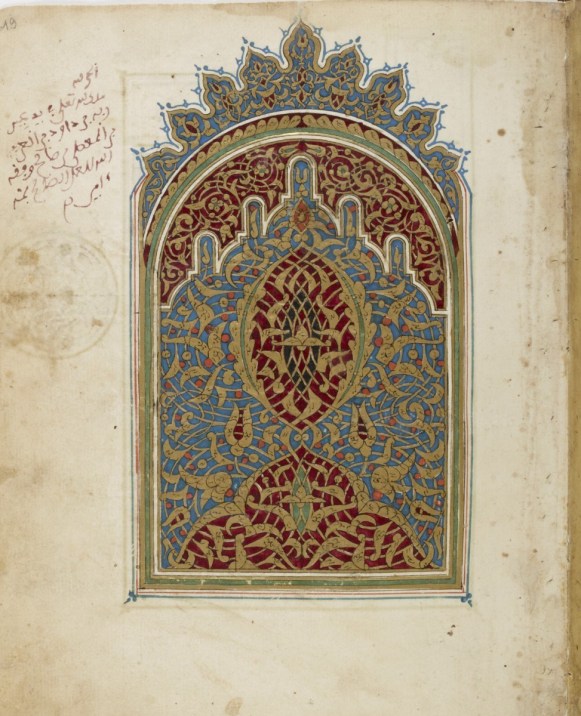
Miḥrab page, Dalā’il al-khayrāt, completed 1705 (Bibliothèque nationale de France. Département des Manuscrits. Arabe 6983, fol. 19r).

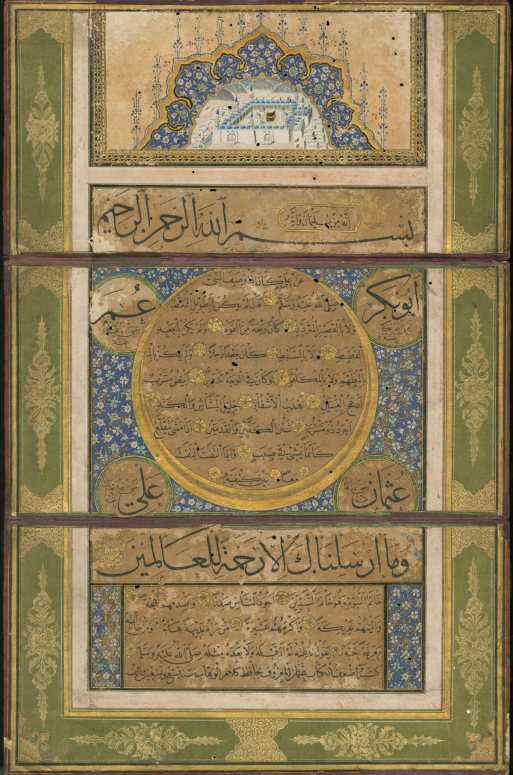
The famed late medieval book of prayer and blessings upon the Prophet of Islam, Muhammad, known as Dalā’il al-khayrāt, written by Muhammad Sulaymān al-Jazūlī (d. 1465), would become one of the most popular texts of any sort across the early modern Islamicate world. From modern-day Morocco, where al-Jazūlī lived, worked, and died (he completed Dalā’il in Fes, while he would ultimately be buried in Marrakesh), his most famous work would rapidly spread to points east, with copies appearing by the mid eighteenth century as far afield as Eastern Turkestan and the Indonesian archipelago. As this text and its devotional regime spread, the text itself took on what was in some regards a relatively stable visual schemata- depictions of Mecca and Medina, schematics of Muhammad’s tomb and minbar, and an overall ornamentation and careful, often fully vocalized script could all be found in copies across the Islamicate world. At the same time, different regions drew the text into their own traditions of art and manuscript production, while in some cases adding additional material. In the eighteenth century, for instance, Ottoman copies of Dalā’il would often come to include hilye-i şerif panels, calligraphic ‘verbal icons’ of Muhammad (which themselves had originally existed in a medieval treatise).

In the Maghrib- the Islamic ‘Far West’- where the text originated, copies of Dalā’il would often include unique to the region elements, elaborated in a variety of styles. One such unique (so far as I can tell) element was the inclusion, in the opening pages of the manuscript, of an illuminated genealogy of Muhammad. Here is a relatively plain example, making use of name roundels (which were also common in Ottoman productions and may have their origin in such a milieu) and extensions of names into the neutral space of the illumination:

Library of Congress. Arabic manuscript, SM 85.
A genealogy page from a copy of the Dalā’il made in the Maghrib during the second half of the 18th century. (Library of Congress, Arabic manuscripts, SM 85)

However, the manuscript that I want to focus on here, now classified as BnF Arabe 6983, is another Maghribi version of the famous prayer book, and was completed in 1705 in what is now Morocco and held in the library of the Nāṣiriyya sufis in Tamegroute on the edge of the Sahara until it came into the collection of Hubert Lyautey, the French Resident-General of Morocco in the early twentieth century, and thence to the Bibliothèque nationale de France. This manuscript, which in its provenance history already bespeaks to much historical change, has one of the most spectacular and beautiful visual schemes of any copy of Dalā’il I have come across. The mihrab page above- an unusual feature in itself- hints at some of the artistic vigor and cultural exchange visible in this manuscript, which is very much oriented towards the Ottoman world, even as its core features speak to its Maghribi origins. The following page, an example of the above-mentioned genealogy component, demonstrates the Ottoman stylistic aspects especially well:

Bibliothèque nationale de France. Département des Manuscrits. Arabe 6983
Dalā’il al-khayrāt. (Bibliothèque nationale de France. Département des Manuscrits. Arabe 6983, fol. 6r)

Here, the illumination’s neutral space, while like the first example containing the winding names of Muhammad’s ancestors attached to calligraphic roundels, has been filled with a delicate swirling floral pattern. Anyone with some familiarity with Ottoman history is likely to recognize that pattern- it originated in the illumination of the sultanic calligraphic emblem, the tuǧra, as visible in the following example, from the late sixteenth century:

A firman (imperial decree), paper, written in Divani Istanbul, Turkey; 981 H = 1573 L: 295; W: 56 cm
The tuǧra of Sultan Selim II, as affixed to a fermân issued in 1573. Note the intricate floral ornamentation filling the interior of the calligraphy- this is an especially colorful example. (David Collection Inv. no. 51/2002)

Continue reading “Ottoman Cultural Exchange and Devotional Art in the Islamic Far West”

O Monarch of the Heart

In yesterday’s post I introduced the theme of late medieval and early modern devotion to Muhammad, a ‘movement’ within Islam that became dominant and widespread by the end of the middle ages, especially flourishing in the early modern period. The texts of this devotion were not only written in Arabic: rather, devotion to Muhammad was often expressed in vernaculars. The following translated poem, by an Ottoman sufi şeyh and saint, Muhammed Nasûhî Üsküdarî (d. 1718), is a part of a larger collection of poetry of praise and supplication directed towards Muhammad, written in Ottoman Turkish. It is a good example of this genre of poetic composition, which was common across the Ottoman world and beyond, expressing theological concepts as well as emotional bonding between the poet and his object, Muhammad. I have included footnotes at points to clarify certain references that would have been relatively obvious to a contemporary reader or listener but might not be to my readers here.

Iznik Flower Panel

You are the cure of my sickness, yâ Muhammed Mustafa!
You are the sovereign of my heart, yâ Muhammed Mustafa!

Who am I that I dare to praise you, o monarch of the heart?
You are the light of the moon of Yâ-sin [1] yâ Muhammed Mustafa!

You hold sway over the inner secret of this habitation below, o mirror of the True!
You are the monarch of the throne of If you had not been [2], yâ Muhammed Mustafa!

Without sign, without place, in your inner secret I beheld your essence.
You are the spirits of the passionate lovers, yâ Muhammed Mustafa!

To the crooked-statured, sin-bearing Nasûhî [3] give
Help—you are a remedy, yâ Muhammed Mustafa!

Üsküdarlı Muhammed Nasûhî, [‘Poem 6’], in Üsküdarlı Muhammed Nasûhî ve Dîvânçe-i İlâhiyat’ı, ed. Mustafa Tatcı (Üsküdar, İstanbul: Kaknüs Yayınları, 2004), 166-167.

[1] A reference to the 36th surāh of the Qur’an, Surāh Yā’-Sīn, sometimes referred to as ‘the heart of the Qur’an.’

[2] An allusion to a hadith qudsi– a hadith said to convey God’s speech, though not as part of the Qu’ran- in which God says to Muhammad words to the effect of ‘If you not been I would not have created the universe.’

[3] Including one’s name in the penultimate line is an Ottoman convention, carried over from Persian poetic convention.

Devotion to Muhammad in Medieval and Early Modern Islam: An Introduction

Hilye triptych
A three-panel Ottoman ḥilye-i şerîf-  a description of Muhammad’s physical attributes, or ‘verbal icon’- by Ḥafîẓ Osmân Efendî (d. 1698). Note the miniature depiction of Mecca in the top panel. Special Collections Library, University of Michigan, Ann Arbor, Isl. Ms. 238.

There are a number of aspects of medieval and early modern Islam (and contemporary living Islam too, for that matter) that tend to surprise, even shock, many modern-day observers, especially non-Muslims who nonetheless have some degree of knowledge about the ‘basics’ of Islam. Because of the wide-spread and often quite profound changes that have transformed Islam in many places throughout the world over the last century and a half or so, there is a great deal in pre-modern ‘mainstream’ Islam that many contemporary Muslims might find odd, unexpected, or even heretical. One such source of surprise and even shock is the history of the image and meaning of Muhammad in Islamic theologies and devotional practices. If, like me, in your initial exposure to Islam you learned that Muslims—throughout time, perhaps?—viewed Muhammad as ‘only’ a prophet, and no more, then Islamic theology that talks about the Muhammadan light, the cosmic role of Muhammad within God’s creative plan, and the intercessory power of the Prophet, and so on, must all sound quite strange and even ‘un-Islamic.’ Indeed, I remember thinking, as I delved into the vastness of ‘Muhammadology,’ that much of the theology I was discovering bore a marked resemblance to Christology, in particular to Logos theology, in Christianity.

Yet far from being aberrant or peripheral, the theological ‘elevation’ of Muhammad that took place in the course of the Islamic medieval period was a transformation that occurred and impacted Islam across the board. It was not just a ‘Sufi’ thing or a matter of ‘popular’ religion. Devotion to Muhammad, alongside theological renderings of the ‘cosmic Muhammad,’ coursed through the very veins of Islam from the middle ages into early modernity and beyond. The person and role of the Prophet Continue reading “Devotion to Muhammad in Medieval and Early Modern Islam: An Introduction”