St. Paisius Loves Grapes

Paisi Velichkovski
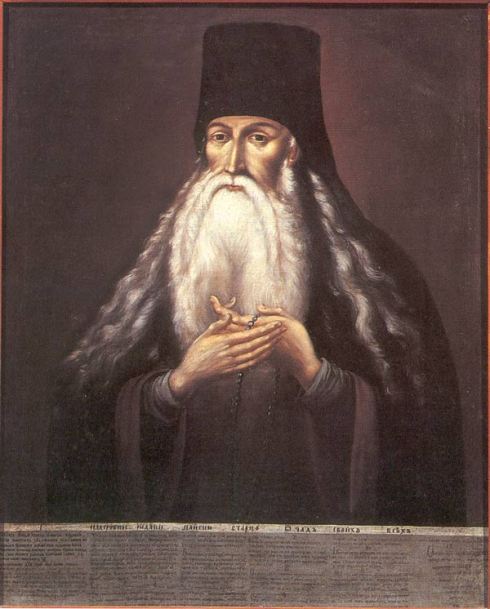
St. Paisius Velichkovsky in an early iconographic depiction.

Paisius Velichkovsky (1722-1794) was a monk, writer, translator, and spiritual guide who was born in what is now Ukraine, but who spent much of his life traveling through the Polish-Lithuanian Commonwealth and the Moldovian and Wallachian principalities of the Ottoman Empire, encountering many forms of monastic life and gathering spiritual and patristic writings. His spiritual disciples and his writings and translations would prove highly influential in the wider Orthodox world, providing the foundation for the Russian startets tradition made famous in Dostoevsky’s Elder Zosima. Paisius also wrote a fascinating and detailed autobiography of the first half or so of his life, from which the below is excerpted. The image of himself that he presents is of a young man who is pious and driven to deepen his spiritual practice, but also subject to numerous failings, ambiguous moral situations and decisions, and various difficulties and struggles. This particular story illustrates the quite intimate and human self-image that Paisius presents throughout his autobiography.

*

At the appropriate season the venerable superior of the hermitage, Father Dometij, assigned me the obedience of tending the hermitage’s vineyard, which was on level ground above the hermitage, at a distance of nearly one verst. He commanded me in no wise to dare eat any grapes until I had eaten at least a small piece of bread ; but provided I ate the bread, he gave me his permission and blessing to eat as many grapes as I wished , before or after the daily meal. He did this for two reasons, firstly because grapes were few in the country where I was born, and I had scarcely ever had the chance to taste them, and secondly, out of indulgence to my weakness, for he realized that I had a great desire to eat grapes and that I could not get my fill of them. Having received his command and blessing, then, after eating a bit of bread, I ate grapes often, both before and after the meal, choosing the one which grew sparsely, that is, not close together, for these were sweeter than the others. My passion for eating grapes came to such a pitch that I wanted no other food. When I went to the meal in the hermitage, I ate very little of anything else, but I ate grapes in abundance and with great relish. Having partaken of almost no other food that whole season until the harvest, I suffered no small illness of body, and my face grew thin as if from some disease. But after the harvest, when I ceased eating grapes and partook of the usual food with the brethren, I began to feel stronger day and night; and in a short time I was restored to my previous state of health.

Paisius Velichkovsky, The Life of Paisij Velyčkovs’kyj, translated by Jeffrey Featherstone (Cambridge, Mass.: Distributed by the Harvard University Press for the Ukrainian Research Institute of Harvard University, 1989), 82-83.

*

For further reading: John A. McGuckin, “The Life and Mission of St. Paisius Velichkovsky. 1722-1794: An Early Modern Master of the Orthodox Spiritual Life,” Spiritus 9, no. 2 (2009): 157–73.

Depicting Devotion to Muhammad: Images in An Ottoman Compendium

Names of God and Names of Muhammad Osmanische Sammelhandschrift , 17XX
Hilye-i Şerîf, from Ahlâk-i resûl Allâh, from Staatsbibliothek zu Berlin Ms. or. oct. 1602, 48v.
Muhammad's Sandal
Depiction of the sandal of the Prophet, Ms. or. oct. 1602, 44v.

These two images come from the same manuscript compendium of devotional texts, a manuscript now held in the Staatsbibliothek zu Berlin, but originally completed and used somewhere in the Turcophone part of the Ottoman Empire, during the seventeenth century. The particular text they are a part of, Ahlâk-i resûl Allâh, describes, as its name suggests, the ‘characteristics’ of Muhammad and aspects of his life, which entails, among other things, encountering, in both text and image, places and things entwined with his life. This includes marvelous schematics of Mecca, Medina, and Jerusalem, for instance. It also includes a couple of instances of hilye-i şerîf, which I’ve mentioned briefly before here. These are ‘verbal-pictorial icons’ that depict, through words and non-figural (at least not of humans) images and design, the attributes of Muhammad, physical and otherwise. The hilye-i şerîf I’ve included above is a somewhat unusual example: instead of reproducing hadith-based descriptions of Muhammad’s physical characteristics, it features, side by side, names of God and names of Muhammad, filling the big flowers that dominate the top of the page. Below these ‘verbal icons’ are calligraphic renderings of Qur’anic phrases (some barely visible because of the poor contrast between flower color and script) along with the names of other important holy figures from the founding generation of Islam.

The second image is a heavily stylized and decorated rendering of Muhammad’s sandal, one of several physical traces- relics, in a sense- associated with Muhammad from the middle ages on and which seem to have grown in importance in the Ottoman period, as part of the general intensification of devotion to the Prophet across Islam in this period. In addition to objects claimed to be actual physical relics- hairs from Muhammad’s beard, the impress of his foot in a rock, cloaks he once wore- visual reproductions of those relics also proliferated, usually in the context of devotional texts such as this one. What was the devotional content of these images, or, to put it differently, what did these images ‘do’? For the artist, patron, and purchaser or owner or endower of a manuscript such as this, the act of creating the image and beautifying it- the gorgeous rich flowers of the hilye, the bright colors and delicate designs of the sandal, or instance- could serve as acts of devotion, of love, in themselves, as a type of offering. These depictions could also act as loci of remembrance, even for people who could not read or decipher the Arabic inscriptions: the image called to mind the person from whom the original relic was derived. An intrinsic connection was forged- hence my calling these images ‘icons,’ even though no human form is depicted- independent of a viewer, even as they summoned the viewer into an imaginative encounter with the referent. Following a similar logic, these images, by virtue of a perceived ‘link’ back to Muhammad himself, could carry a prophylactic charge. There are in fact hadith- devised very late (and in fact sometimes claimed to have been delivered via dreams)- that claim as much, to the effect that anyone who places a hilye-i şerîf in his or her home will be protected from all manner of misfortune.

In sum, far from being simply decorative objects or illustrations for a text, images such as these had a complex role in Ottoman devotional culture, containing meanings and applications that are not immediate obvious to modern-day viewers but which can give us valuable insights into the religious and emotional lives and practices of early modern Ottoman Muslims.

For further reading:

Christiane Gruber, The Prophet as a ‘Sacred Spring’: Late Ottoman Hilye Bottles

Christiane Gruber, “The Rose of the Prophet: Floral Metaphors in Late Ottoman Devotional Art,” in  Envisioning Islamic Art and Architecture, November 14, 2014, 223–49.


Devotional Art in White and Blue: An Ottoman Tile Panel from Damascus

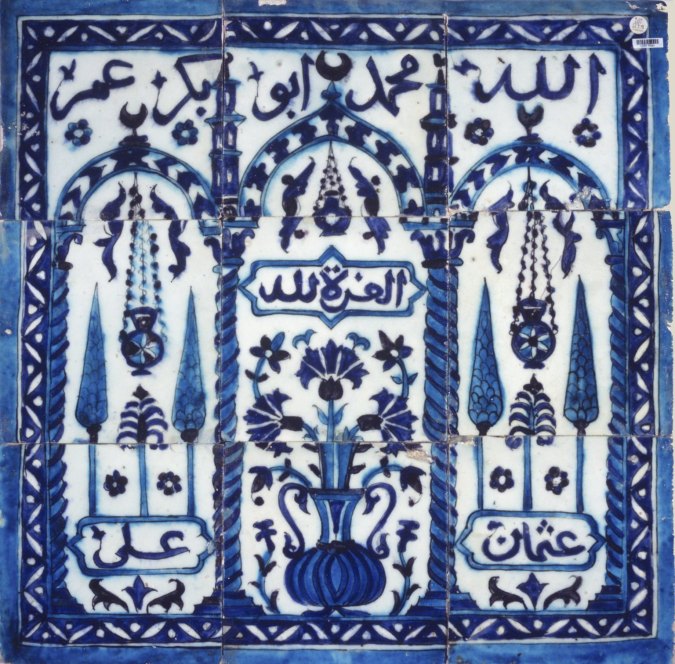
Panel of Tiles, 17th century
Panel of Tiles, 17th century. Ceramic; fritware, painted in cobalt blue and turquoise under a transparent glaze, 28 x 28 x 1 in. (71.1 x 71.1 x 2.5 cm). Brooklyn Museum,

It’s been a busy few several days for me, so the translations of Arabic and Ottoman Turkish devotional texts I had hoped to have completed or at least in the works will have to wait. For now, I’d like to share this lovely wall panel of tiles from Ottoman Damascus (the museum’s description does not reveal where exactly it was originally located, though my guess would be in a mosque or other religiously-oriented structure, perhaps as part of a mihrab installation). The blue and white, the thin, pointy trees (probably cypresses), and especially the stylized flower arrangement in the center all reveal this piece as clearly Ottoman, while the border ornamentation and style of execution suggest the ‘provincial’ (as opposed to closer to the imperial core of Constantinople/Istanbul).

The visual ‘message’ of this tiled panel, and the sort of devotional ‘work’ it might have done, is also pretty clear: the three arched niches suggest the mihrabs in a mosque, replete with depictions of mosque hanging lamps in each niche, with a crescent moon pendant above. Paradisical imagery of flowers and trees fills the niches below the lamps, suggestive of the Garden itself, while at the center is the phrase ‘To God belongs the power.’ On the top and bottom, in clockwise direction, are the names God, Muhammad, Abu Bakr, ‘Umar, Uthman, and ‘Ali, the last four being the Four Rightly Guided Caliphs, their memory increasingly venerated by Sunni Ottoman Muslims in light of conflicts with the Shi’i Safavid Empire. Like the imagery I discussed in a previous post, this one draws the viewer into a spiritual space, a paradisical space of worship, directed towards God, and mediated by Muhammad and his saintly immediate followers and bearers of his standard. Using stylized imagery, pattern, color, and calligraphy, it creates an ‘icon-like’ viewing experience, and probably also helped to render a particular space, within a mosque or elsewhere, as conducive towards attitudes and acts of devotion and worship.

Explicating Devotion to Muhammad, Part i.

image
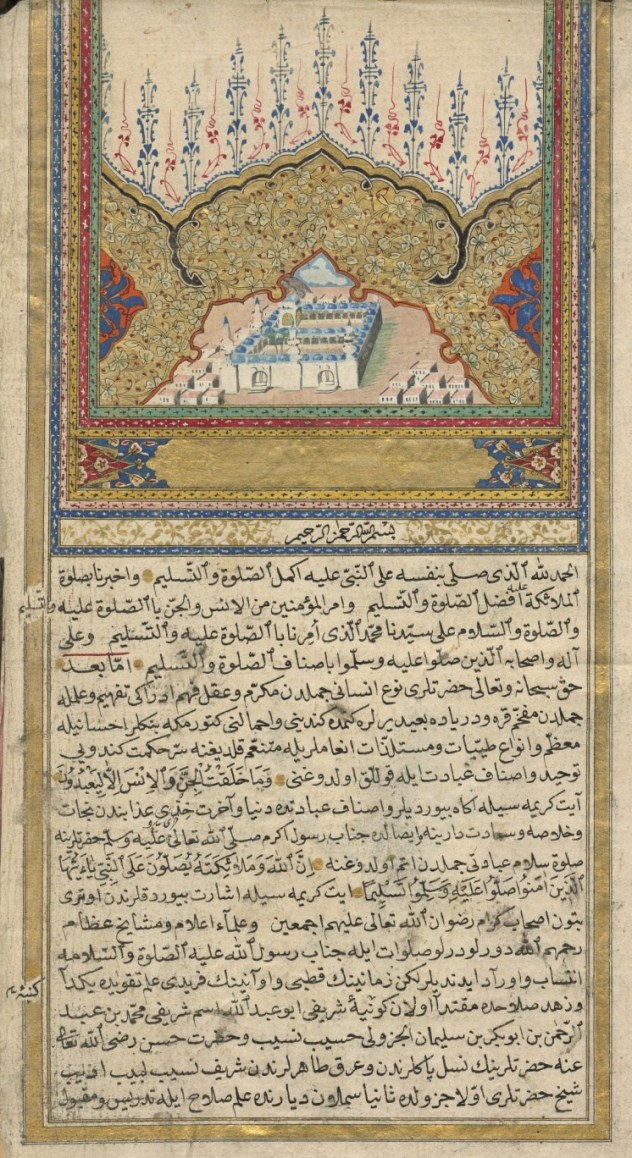
Opening page to Kara Davutzâde Mehmed Efendî, Tevfik muvaffikü’l-hayrât li-neyli’l-berekât fi hizmet menbai’s-saâdât, University of Michigan, Special Collections Library, Isl. Ms. 672

Late medieval and early modern devotion to Muhammad in Islam was first and foremost a matter of personal and communal practice, embodied in devotional regimes, public rituals, habitual expressions, and material objects, among other practices and techniques. But it also unfolded at a discursive, textual, and homiletical level, with scholarly and semi-scholarly productions explicating, extolling, and critiquing various aspects of devotion to the Prophet appearing from the late medieval period forward in multiple languages of Islam. The genre of commentary (Ar. sharḥ/Ott. Trk. şerh) was an important vehicle for delivering explication of devotional practices and their intersection with theology and other Islamic disciplines. Numerous commentaries on ṣalawāt– the litanies of blessing upon Muhammad- and related sorts of texts appeared across the Ottoman world and beyond, in both Arabic and Ottoman Turkish (and in other languages further east). Like much early modern commentary production in Islamic societies, these texts have received little engage scholarly attention, though the neglect of commentaries is starting to change. In the following weeks I’d like to give some samples of commentary on devotional texts, starting with excerpts from commentary on what was perhaps the most important text of devotion to Muhammad, al-Jāzūlī’s Dalā’il al-khayrāt.

But before presenting translated texts and analysis of them, I’d like to start with the above image. It comes from the opening page of a beautifully executed manuscript copy of an Ottoman Turkish translation and expansion of an Arabic commentary on al-Jāzūlī’s prayerbook. Titled Tevfik muvaffikü’l-hayrât li-neyli’l-berekât fi hizmet menbai’s-saâdât, this work, which goes through, line by line, the text of Dalā’il al-khayrāt, was composed by an eighteenth century author, Kara Davutzâde Mehmed Efendî, about whom I know no more than can be gleaned from the text. The commentary was aimed at many audiences, especially, it seems, pious women, and may have been meant to furnish material for preachers.

The charming miniature that is framed at the top of the page, a depiction of Medina, centered on the Prophet’s Mosque, is a good example of the devotional iconography that grew up around devotion to Muhammad, in many contexts, featuring images of Mecca and Medina, the tomb of Muhammad and the tombs of the Four Rightly Guided Caliphs, the footprint of Muhammad (and other physical traces), and so on. Such images had many functions: they presented the physical presence of Muhammad and his close associates in an iconographic manner but without actually depicting Muhammad directly. Instead they summoned his presence by pointing the viewer at the material traces of his life and memory, a sort of icon at remove. They had an educational value, giving the reader or viewer a sense of what the holiest places of Islam and the artefacts of the Prophet looked like. And finally they had a prophylactic purpose- that is, early modern Muslims might display or otherwise have on hand these images as a way of warding off evil and misfortune, based on their icon-at-a-remove connection to Muhammad and his powerful intercession. The above image- which is also just simply beautiful and delicately rendered- participates in all of the above.

O Monarch of the Heart

In yesterday’s post I introduced the theme of late medieval and early modern devotion to Muhammad, a ‘movement’ within Islam that became dominant and widespread by the end of the middle ages, especially flourishing in the early modern period. The texts of this devotion were not only written in Arabic: rather, devotion to Muhammad was often expressed in vernaculars. The following translated poem, by an Ottoman sufi şeyh and saint, Muhammed Nasûhî Üsküdarî (d. 1718), is a part of a larger collection of poetry of praise and supplication directed towards Muhammad, written in Ottoman Turkish. It is a good example of this genre of poetic composition, which was common across the Ottoman world and beyond, expressing theological concepts as well as emotional bonding between the poet and his object, Muhammad. I have included footnotes at points to clarify certain references that would have been relatively obvious to a contemporary reader or listener but might not be to my readers here.

Iznik Flower Panel

You are the cure of my sickness, yâ Muhammed Mustafa!
You are the sovereign of my heart, yâ Muhammed Mustafa!

Who am I that I dare to praise you, o monarch of the heart?
You are the light of the moon of Yâ-sin [1] yâ Muhammed Mustafa!

You hold sway over the inner secret of this habitation below, o mirror of the True!
You are the monarch of the throne of If you had not been [2], yâ Muhammed Mustafa!

Without sign, without place, in your inner secret I beheld your essence.
You are the spirits of the passionate lovers, yâ Muhammed Mustafa!

To the crooked-statured, sin-bearing Nasûhî [3] give
Help—you are a remedy, yâ Muhammed Mustafa!

Üsküdarlı Muhammed Nasûhî, [‘Poem 6’], in Üsküdarlı Muhammed Nasûhî ve Dîvânçe-i İlâhiyat’ı, ed. Mustafa Tatcı (Üsküdar, İstanbul: Kaknüs Yayınları, 2004), 166-167.

[1] A reference to the 36th surāh of the Qur’an, Surāh Yā’-Sīn, sometimes referred to as ‘the heart of the Qur’an.’

[2] An allusion to a hadith qudsi– a hadith said to convey God’s speech, though not as part of the Qu’ran- in which God says to Muhammad words to the effect of ‘If you not been I would not have created the universe.’

[3] Including one’s name in the penultimate line is an Ottoman convention, carried over from Persian poetic convention.

An Ottoman Book Binding by Way of Tabriz

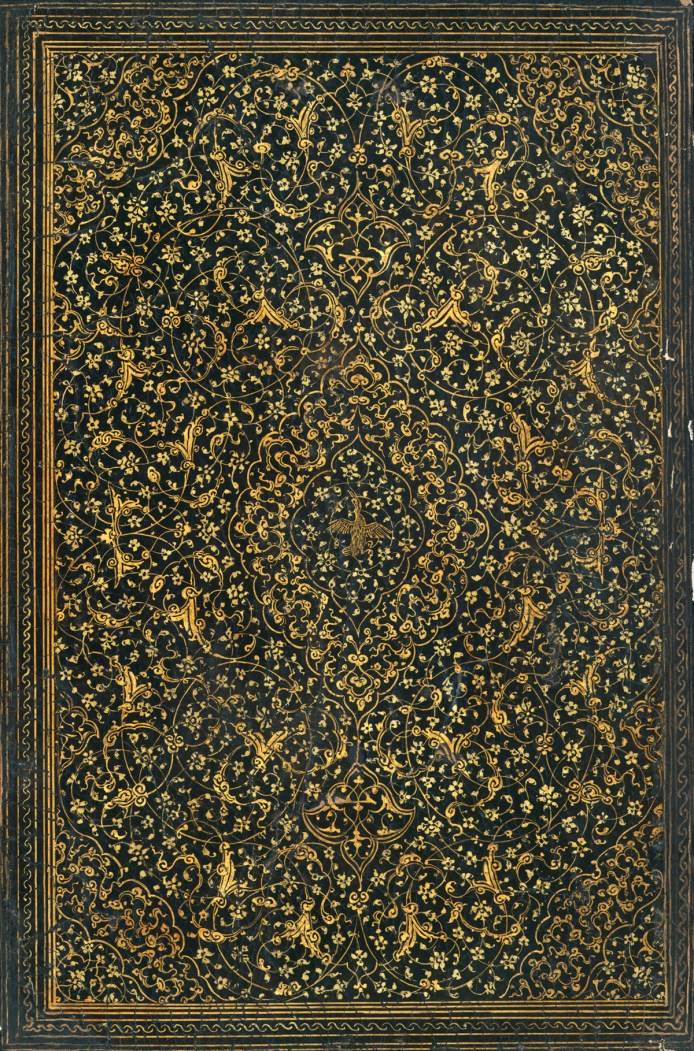
Binding of a copy of the Bustan of Sa‘di MSS 712
Binding of a copy of the Bustan of Sa‘di, Khalili Collections, MSS 712. Istanbul, Ottoman Empire (likely), 1530–1540. (Papier-mâché boards, painted and varnished; with paper doublures; 24.7 x 16.5cm (covers, each); 24.7 x 11cm (flap and fore-edge)

This spectacular example of book binding was probably produced in the workshops of the Topkapı Palace by artisans from Tabriz (modern-day Iran, at the time part of the Safavid Empire, though periodically contested by the Ottomans). As such it is a good demonstration of the interconnection between the Persianate world and that of the Ottomans, especially in the 16th century (Persian influence and connections would decline somewhat in the coming centuries). This cover protects a copy, executed in Tabriz in 1530, of one of the great works of Persian poetic literature, Sa’di’s Bustan (‘Garden’), which, along with other works of Persian poetry, would have a long-lasting influence on the production of Ottoman Turkish poetry. The artwork, with its intricate interlacing tendrils, delicately rendered foliage and single creature at the center, is redolent of the Persian world, and would have been immediately recognized as such by whatever connoisseurs of art would have had access to the finished product, probably in the Topkapı itself.


The Thought of Fishing

As noted in a previous post, the Ottoman majdhūb/meczûb (the first is the Arabic rendering, the second the same term but in Ottoman Turkish)- the divinely drawn saint or holy madman- was often involved in the details of everyday life, such as the smoking of tobacco. In the following story, which comes from a compilation of meczûb lives in a sprawling 17th work of hagiography by Mehmed Nazmî EfendiHediyyetü’l-ihvân, we see one of these holy madmen miraculously discern the wandering thoughts of the imam in the greatest mosque of Ottoman Istanbul.

IMG_2952
A view of the courtyard of the Süleymâniye Mosque, the setting of the following story

‘And there was one, Hızır Aşak, who was from among the great (ulular) of the meczûb. He was a powerful meczûp capable of unveiling inner secrets. It is related that the imam of the Süleymâniye Mosque, Süleymân Efendi—who was later dismissed and sent into retirement—was one day leading the noon prayers, when the thought came to him: “After completing the salât, I’ll go to Hisar [on the Bosporus] and go fishing.’ Just as this thought was occurring to him, Hızır Aşak came to the mosque, and, as was his custom, cried out “Hû!” [i.e. ‘He,’ meaning God, a common sufi form of zikr] and said, “Süleymân Çelebi! You are here, your mind ought not be off fishing in Hisar. There is no prayer without presence of heart. Lead these men in prayer a second time.” Having said this he left the mosque. Süleymân Çelebi related thus: “This unveiling of the mad one brought about divine fear and embarrassment before the people in me. For a little while I passed out! Coming to, I properly completed the prayers.”’

Mehmed Nazmî Efendi, Hediyyetü’l-ihvân