The Great Comet of 1680

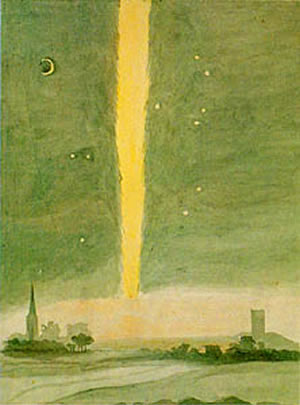
The little excerpt of translated text below is from the Kunnāsh, or notebook, of a scholarly resident of Damascus, Ismā’il al-Maḥāsinī, who died in 1690. In his notebook he records matters of local, regional, and even empire-wide importance, as well as various things and events that concerned or interested him. The events described range from an excursion to some neighboring towns to take in the country air, to the appointments and removals of various Ottoman officials in Damascus. In this entry he notes the occurrence of what in Western Europe would become known as Kirch’s Comet, as illustrated below in a painting from Rotterdam. Read Ismā’il’s description after the image:

comet

It befell that the first of the month of Ramaḍān, in the year 1091 [1680], was a Tuesday, and the Day of the Sacrifice likewise, and likewise the first of Muḥarram in the year 1092. And from the beginning days of the month of Dhū al-Ḥijja in the year 1091 [December 1680] a star went out which was seen in the lower third of the heavens in the direction of the qibla, and there extended out from it light like a solid column, around a cubit wide, inclining towards the west. And it remained like that every night for around a month.

Ismā’il Maḥāsinī, Kunnāsh, entry no. 25

On Service to One’s Shaykh

The below brief text is excerpted from a short Ottoman Turkish manual of Sufism by Mahmut Hüdayı, an important shaykh, and indeed early organizer, of the Celvetiyye ṭarīqa, the adherents of which mostly lived in the Anatolian and Rumelian parts of the Ottoman domains. Much of Mahmut Hüdayı’s output was in Arabic, but a substantial number were in Ottoman Turkish- not quite a colloquial register, but more likely to be read and understood by a wider number of people in Anatolia and Rumelia.

This passage is emblematic of one of the prevailing themes in the work from which it is excerpted: the importance of having a shaykh (in this context, a spiritual master/instructor) and being constant in honoring and obeying him. While such sentiments were hardly new in Sufism in the sixteenth century, there were also a seemingly increasing number of people who contested, explicitly or implicitly, the authority and knowledge of living shaykhs. By the eighteenth century it is easy to find many people practicing what was essentially a ‘privatized’ mystical Islam, with little need for a shaykh or regular communal life. Such a possibility is clearly not in view for Mahmut Hüdayı, however- quite the opposite, as is clear from the following passage.

If the shaykh enjoins as a duty any service (khidmet, mod. Turkish hizmet), [the disciple] ought to carry that service out, without delay, without adding any other business to it, without asking for explanation of cause or detail, and without stopping. It is related about a shaykh that he asked one of his disciples: ‘If your shaykh sent you off to do some service, and on the way you passed by a mosque in which they were performing congregational ritual prayers, what would you do?’

The disciple answered, ‘First, I would carry out that service, then I would perform the ritual prayers.’ The shayhk commended his answer. The intended moral from this [antecdote] is the bestowal of great care in service [to one’s shaykh]; it is not, God forbid, the disparagement of ritual prayer!

Mahmut Hüdayı, 1543 or 1544-1628, Ṭarīqat-nāme, Princeton Islamic Manuscripts, New Series no. 307, fol. 128-129.

Journeying Through the Veils

The below passage is from an introductory ‘handbook’ of Sufism in Arabic by the seventeenth century Aleppine Sufi Qāsim al-Khānī (d. 1697). His description here is hardly original, rather, it represents the shifting through and representation of centuries of Sufi thought and practice. At times his writings reflect a concern with theological ‘deviance,’ a particularly acute concern for Sufis like him who sought to defend and perpetuate the long tradition of Sufism- including the many theo-philosophical developments of the thirteenth century, such as those associated with Ibn ‘Arabi. Many of these beliefs and practices came under increasing scrutiny in the Ottoman Empire and elsewhere from the sixteenth century onward, even if such critiques did not become truly mainstream until much closer to our own age. al-Khānī seeks to defend such beliefs as ‘oneness of being,’ while also decrying allegedly incorrect interpretations of such beliefs, for instance here:

That which benefits the wayfarer in his journey is witnessing (shuhūd) of oneness of being not its gnosis. Witnessing is a state (ḥāla) necessarily realized from struggle, privation, successive exercise, lowliness, poverty, and need. And this state does not benefit the wayfarer unless there is with it following of the Shari’a, for if there is not with it following of the Shari’a, then it is damning zandiqa [heresy or deviance].

The passage below is less concerned with fending off theological error; rather, it presents a pretty traditional Sufi understanding of spiritual journeying: the passage through successive ranks of ‘veils’ preventing human cognizance and connection with God. As it is written in a straight-forward, pedagogically-inclined manner, I will leave off further commentary of this fine example of early modern Sufi teaching.

And the greatest of the veils that are between the servant and his Lord are the veils of sins, because they are darkness. As for veils other than them, to be sure the servant should hasten to dispel them, although they are luminescent, not totally veiling the servant. For the likeness of the veil constituted by sins is the likeness of an encompassing wall between you and your goal, and you cannot see essence or trace, due to its preventing, nor shape—which is different from the luminescent veils. They are like glass, with what is behind them being seen, obscuring and revealing by their increase or decrease. If the glass is increased greatly, then the intended object behind it is hidden, though the hiddenness of what is behind the wall is not the case here—at least the shape of the object can be discerned. All of this is what can be seen with the eye of the senses.

The heart is likewise. So long as its eye, which is called discernment (al-baṣīra) is veiled by the darkness of disobedience, which is called overcoming, imprinting, and sealing, it does not see anything of the lights of the Unseen, and has no awareness of what sin and evil does to it.

Then if one turns from what one is in, the veils of sins are lifted from his heart, and he beholds divine things, and begins to feel fear concerning his punishment, and hopes for reward, and persists in obedience to God, and turning away of evil deeds. Now he is veiled with luminescent veils, which are his dependence upon these deeds, for he now believes that he is the one who brings them into existence.

Then, after that, God lifts this veil from him, through the blessing (baraka) of acts of obedience, and he sees that the grace upon him belongs to God, for God causes him to be successful in these deeds, and that he is insufficient in giving thanks for them, and that the effective Giver is God. If God desires of someone good, he invests him with the garment of pious fear (taqwa) so as to make sound his presentation before His presence—and nothing of good or evil is by the hand of the servant, rather, all is by the hand of God.

Then, when this veil is lifted from his heart, he imagines that he has attained to God, for there is spiritual delight in this station. But if the hidden subtleties encompass him, this veil too is raised from him, and he does not cease cutting through the veils, one after another, as per the arrangement of stations and gates as in this book, until he attains to true station, the stopping place of the Most Veiled—so understand!

Do not believe, because of the likeness of the veils to panes of glass, that God is a thing which can be seen by the perceiving eye—for He is free of that. God take in hand your guidance!

Qāsim al-Khānī, al-Sayr wa al-sulūk ilā malik al-mulūk

A View of Constantinople, 1756

The following effusive description of Ottoman Constantinople/Istanbul is from the pen of Timothy Gabashvili, a Georgian cleric who embarked, in the mid 18th century, on a long journey across the Ottoman realms visiting sacred sites, various Orthodox communities, and other sights and places along the way, all of which he would later describe in his Georgian-language record of his pilgrimage. Timothy’s perspective is a somewhat unique one: Georgia in the mid 18th century was still within the Ottoman orbit, but was being aggressively courted by an expansive Russian empire. Timothy himself had previously visited Moscow and the new city of St. Petersburg. Yet in much of his narrative his treatment of the Ottomans is remarkably positive- all of his interactions with Ottoman officials were amiable and productive, and the relationships he managed to forge enabled the success of his pilgrimage. In a relatively few short years- unbeknownst to Timothy or anyone else- the Ottoman world would change a great deal, and a pilgrimage of this sort, and the relationships that made it possible, would be forever lost. In 1756, however, a pious Georgian pilgrim could still feast and drink with Muslim Ottoman notables, and wax poetic in praise of the the Ottoman incarnation of the City of cities.

Panorama of Istanbul, Ottoman, late 18th – early 19th century, 58 x 27.1 cm, SHM 12449 – İ.1285 / From the Sadberk Hanım Museum, Istanbul

*

Now, I’ll say something about the city of Constantinople. The lure of the city’s radiance has spread its beauty to distant parts of the world and even the capitals, because in no other place can one find Asia and Europe together. Among them, running down from the Black Sea, there flows a narrow sea like a river. It runs, with spouts of foam. Constantinople is founded on it and on the mountains by the hand of Sabaoth. The mountains are lavishly covered with spruce trees and Lebanese cypresses. The city has been built on both sides of the sea that flows in a narrow stream. The structure of the walls, the towers and the battlements are splendidly coloured. The windows of the palaces sparkling in different ways, resembled Eden.

Some of the palaces, vaults and bazaars of the city were covered with lead, the gilded roofs of the palaces and springs shone like the sun shining on the city, and the colour of other buildings in the city was scorched clay, or purple, a hue also like the sunset. The ships in the city stood erect like the trunks of poplar trees. Among the groves of selvinu, ghaji, and cypress trees, there was a glimpse of the royal palaces, and the buildings were veiled in the forest of pine and spruce groves. This capital seemed to me like the brightest among the stars, like a rose among the flowers of Eden, like a jacinth among the precious emeralds, like the rainbow in the clouds, and Augustus Caeser among the kings. I found it very difficult and sad to be leaving Constantinople, as I, who had come here after a great many sufferings and hardships, would never see it again. My eyes and my mind competed in emotion when viewing this marvelous city

Timothy Gabashvili, Pilgrimage to Mount Athos, Constantinople, and Jerusalem, 1755-1759, trans. by Mzia Ebanoidze and John Wilkinson


To Drive Away the Vampires: Music from the Balkans

Below is a wonderful sampler of music, via Baltimore-based Canary Records, from across the Balkans, culled from albums produced from the 1930s to the 1970s, so ‘modern,’ but not that far removed from the pre-radio, pre-recording, pre-nationalist past. One of the enduring legacies of the Ottoman Empire is the vast, diverse, yet inter-related soundscape of music practiced by the various ethnic, religious, and linguistic groups that dwelt in and moved across the Ottoman realms, carrying and transmitting and sharing their musical traditions, to the extent that no musical tradition remained sealed off from others. One can hear that multiplicity and interconnectedness in this lovely sampler; another good example, drawn from recent field recordings, is the album Mountains of Tongues, an assembly of contemporary ‘traditional’ music from the Caucuses, a region that, like the Ottoman Empire (which indeed included parts of the Caucuses) was and is a tapestry of traditions and identities.

Battleground National Cemetery

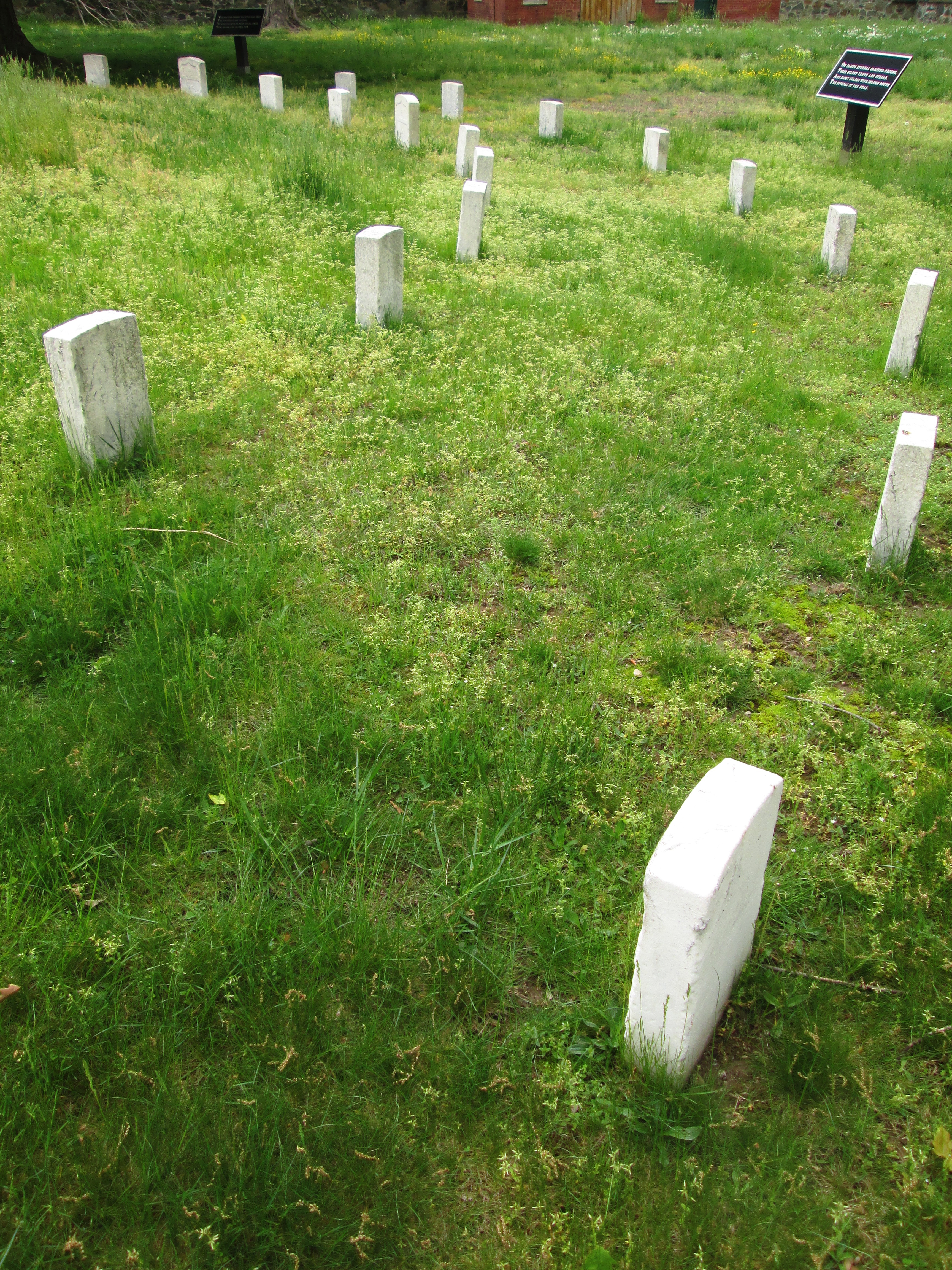
One of the smallest American national cemeteries, this tiny cemetery is wedged between residential developments off of Georgia Avenue in the far northeast corner of the District of Columbia. The soldiers (mostly soldiers anyway) interred there were, for the most part, killed during the battle of Fort Stevens, a half mile or so distant, in 1864. Today the cemetery is an odd little oasis of green, the grass tall, the trees rambling, a rather poignant setting for the bits of nationalist piety, half bellicose, half sorrowful, that pepper the little block of green.

IMG_0573


IMG_0571


IMG_0575


IMG_0576

Sufi Air Delivery

[The Sufi shaykh] Abū Turāb al-Ramlī: He was setting out from Mecca with his companions when he said to them: ‘You will go on the road to Jeda, while I go on the road to Tubuk.’ They said: ‘The heat is oppressive!’ He said: ‘No help for that—but, when you get to Ramla, go into the house of So-and-So, our friend!’ When they arrived in Ramla, they went into his house. He brought them four pieces of broiled meat, and a hawk swooped down from the sky and snatched one of the pieces. They said, ‘Well, that wasn’t meant for us,’ and ate the remaining pieces. When, after two days, Abū Turāb came, they asked him: ‘Did you find nothing on the journey?’ He answered: ‘No, rather, on such-and-such day a hawk tossed a piece of hot broiled meat to me!’ They said: ‘Well then, we have eaten together, for it was snatched from us.’ Abū Turāb said: ‘True, it was thus!’

From Jāmī (1414-1492), Nafaḥāt al-uns ḥaḍarāt al-quds

Fragments. Mississippi. The Eschaton.

i.

Buried under twenty feet of pine mould,
Magnolia cones, and red soil washed out,
Sins of a dozen generations, decomposed,
All these tendriled roots reach into our living flesh.
We are still the scattered bones and blood,
Slave and free. Marbled pillar and rotting red rock pile
Mark their places, where our dark roots reach in,
And draw up our half-hidden present.
The old chains, which once we forged,
Rust close, next dissolve
Into the tannined water over red clay and white sand,
Black depths and inner sanctums,
The crack of bone, and the body in prayer.

ii.

At a certain age
The hearts of loblollies and longleafs go dark,
And rot. The fire takes them. Ash and smoke.
The remnants, transmuted, filter slow
Into the lost seas, the departed mountains, the wasted
Pasts that lapped up our blood, and the blood we spilled.
All trajectories merge.
Yet, things grow more fertile,
Marked by flame and flood—the
Mercy may overtake the Wrath, but both
Remain, this the great dialectic. None
Of us escape, only pass through.
Then—seeds open, and sing.

iii.

Open your mouth, taste
The old life, the new death hanging
After that morning’s rain, bearing a bit
Of those dead uplands to the unending sea. Know.
Other things happen, though. Those saplings’
Taproots run terribly deep. So you too
Must burrow, must find the far down place
Rooted in the life-giving decay and parted hills,
All the way down,
To the first Place,
The no-place. Uncreated.
Have your feet there, and the Fire will not consume you.
Only singe.
Then—
Return, rebirth, and the resurrection of the dead.

Advice for the Journey

In the vast field of medieval Arabic and Persian literature, it is not hard to find authors whose works seem all but impenetrable, cloaked in difficult syntax, obscure vocabulary, and constant, often infuriating motion from one perspective to another, full of occluded subjects, ambiguous referents, and unattributed references. ‘Azīz Nasafī, who seems to have lived at some point in the 13th century in what is now Uzbekistan, was not such a writer. Rather, his treatises, which defy easy categorization, are concise yet clear, carefully constructed with a pedagogical eye towards learners of varying skill levels; he is often humorous, drawing upon ‘real-world’ analogies in illustrating theological points. Some sources refer to him as a ‘Sufi,’ though this is a problematic characterization, as should be clear from the excerpt from one of his short treatises which I’ve translated and presented below, the Zubdat al-haqā’iq. He incorporates elements from the discursive tradition of Sufism, and had some sort of relationship or affiliation with a shaykh of the Kubrayi tariqa- but that is about the limit of it. He does not present himself as a Sufi shaykh, and his incorporation of Sufi material is selective. Likewise, he was clearly conversant with multiple streams of philosophy; his own particular philosophical perspective was a sort of monism, similar, but not dependent upon that of the rather more famous ibn ‘Arabi. But it would probably be inaccurate to simply call him a philosopher and be done with it.

And so on we might go with all of the conventional designations for thinkers and religious folk of this period- categories become rather difficult, if not impossible, to apply. He himself, in several of his treatises, deflects categorization: he instead tells his readers that his purpose is to present the teachings of multiple ‘schools’ of thought and practice, trying hard not to bias the reader in one direction or another. And, perhaps surprisingly given much of what we think we know about the Islamic middle ages, he is generally quite successful in his ecumenical endeavor. In the end, though, he does make sure that the most important things are clarified, the things that the spiritual seeker, he believes, cannot dispense with.

Regardless of how we classify him, ‘Azīz Nasafī was clearly a prolific enough author, with a deeply humane vision of religious and ethical practice, a vision he wished to impart to a wide audience. And he did reach a wide audience- his texts circulated far and wide, from South Asia to Southeastern Europe, both in their original Persian and translated into other vernaculars. Despite his relative obscurity in life, his texts and the mystical-ethical vision they contained have found considerable reception. I hope this short text, taken from the final section of the final chapter of the Zubdat, imparts a glimpse of that vision, as our author describes the sort of conduct the spiritual seeker ought to engage in, and what she ought to avoid, and how to truly become ‘an inhabitant of heaven.’

Finally, for more information on this figure, see the quite good Encyclopedia Iranica article on him: Nasafi, ‘Aziz.

O dervish! If you yourself are not able to arrive at the limit of spiritual stations, or spend the entire day in gazing upon the divine attributes and the spiritual stations, or persist in contemplating what no eye has seen nor ear heard nor thought entered the human heart, or always dwell in the highest heaven and in closeness to the Divine Presence in the station of absolute proximity, in the witnessing and the encountering of the Beauty of the Divine Presence, the Possessor of Magnificence—well, at least strive that you be saved from hell and become an inhabitant of heaven!

O dervish! Everything that falls into the salt mine becomes salt, and everything that falls into a filthy place becomes filthy—dirt from dirt, purity from purity! First of all you make yourself pure so that everything that comes from you is pure.

O dervish! Don’t obsess about praying a great deal, nor about fasting a lot. Don’t obsess about making the ḥajj a lot—just do what is obligatory. Don’t obsess about expanding your vocabulary, don’t obsess about reading lots of stories, don’t obsess about increasing in philosophical knowledge—just be content with the necessary amount. Rather, you should be concerned with being honest and good-hearted, for the torment of the folk of hell is mostly from dishonesty and bad-heartedness, while the comfort of the inhabitant of heaven is from honesty and good-heartedness. It is necessary that your inner self become honest and good-hearted so that you be delivered. For if you bind yourself with affectedness, you are in hell. It is necessary that you become such that, all day, goodness and comfort [towards others] spontaneously pour out of you. Do not be like those who all day, evil and pain [towards others] pour out of them. Their inner selves have become the doing of dishonesty and evil. Your inner self must be honesty and the doing of goodness.

O dervish! You will be ornamented with the characteristics of God when you entirely act with goodness, neither desiring compensation for yourself nor imposing obligation; rather, you take the obligation upon yourself. For bad-heartedness is when all day you cause pain to people and desire pain in people, whether by word, deed, or property. When you know the meaning of evil, it is necessary that you be far from it!

Good-heartedness is when all day you desire comfort for people and all the time cause comfort for people, whether by word, deed, or property. When you know the meaning of good-heartedness and bad-heartedness then know that everyone who is honest and good-hearted is delivered from hell and becomes an inhabitant of heaven. Then, if you seek either remaining [in this state] or a higher degree—it is well and good, in view of the fact that for the inhabitant of heaven everything that she achieves in this world or the other, her heaven becomes more expansive, while for inhabitant of hell everything she achieves in this world or the other, her hell becomes tighter.

O dervish! From the beginning to the end of spiritual journeying, this little treatise suffices for the spiritual wayfarers.

 ‘Azīz Nasafī, Zubdat al-haqā’iq.


The Mirror of the Heart

The following is from the opening pages of the superb treatise on Sufism, practical and theoretical, by Najm al-Dīn al-Rāzī Dāya (1177-1256), entitled Mirṣād al-‘ibād ilā ’l-mabdaʾ wa ’l-maʿād. Dāya was a disciple of another, rather more famous Najm al-Dīn, the one known as al-Kubrā; Dāya studied the Sufi path under him in the city of Nishapur. However, unlike his master, Dāya seems to have been little concerned with the practice of taking on disciples. Instead, in the course of his wandering life- from Central Asia to Anatolia to Tabriz to Baghdad, all during a period of intense and often violent change and dislocation in the region, with the Mongol invasions being the most famous of these changes. The period in which Dāya lived was also a period of incredible productivity in Sufi circles: many of the intellectual and organizational formations pioneered during the era would continue to deeply shape the practice of taṣawwuf up to the present. Two of Dāya’s works would become part of this long-term legacy: the work excerpted here, and the tafsīr to which he contributed, described in my previous post.

Unlike the tafsīr composed by al-Kubrā’s disciples, Dāya’s most famous work, the Mirṣād al-‘ibād, was composed in Persian, which was quickly becoming a central language of intellectual life across many Muslim communities, and not just in regions that were historically Persian-speaking. Dāya’s magnum opus, for instance, was composed in Konya, in Anatolia, under Seljuk Turkic patronage. Of course, Arabic remained the ‘first’ language of Muslim intellectuals, Sufi or otherwise, and would continue to be given at least nominal priority, even as more and more works were produced in Persian, and, in time, other vernaculars, including different Turkic dialects (themselves influenced heavily by the diffusion of Persian). In the excerpt given here, wholesale Arabic phrases are incorporated, without being translated (which is not always the case- many later authors will translate or expansively paraphrase almost all Arabic material in their works). However, alongside the direct quotation of Qur’an and hadith in Arabic is another feature deeply ingrained in Persian Sufic texts: the use of poetry, which in time would appear even in Arabic treatises as authoritative texts closely behind hadith in authoritative value.

As for the content of this excerpt: Dāya’s stated intention is to show the reader the incredible glory of human nature and potential, potential that must be ‘unlocked,’ or perhaps more fittingly, hammered back into shape. In the cosmology and anthropology he unfolds here- itself a piece with similar intellectual currents au courant among other thirteenth-century Sufis- the human person is the center of the created cosmos, and more. It is in the fully-realized human heart that the divine essence and attributes is truly manifest and refracted, as it were, to the rest of creation. The heart is, for Dāya, the supremely deiform aspect of the human person: but it must be refined through the careful tutelage of spiritual masters before it can shine with its primordial splendour. Here we see the deeply social setting of taṣawwuf: for the full realization of this high anthropology, particular human relationships are necessary. The return to the cardial deiform shape, the cosmic centrality, for which humans were created is possible: but it is only truly realized in the presence and under the care of an already-realized master, a Friend of God. And, for Dāya at least, it must occur gradually, as he makes clear in the final lines of this introduction.

Finally, a note on the remainder of the text, which in printed edition comes in at some 300 plus pages: after some further introductory material, Dāya presents some essential cosmology. This is followed by a description of the proper path to true gnosis, from basic adherence to the shari’a, adherence to a master, and, ultimately, divine realization. Next, Dāya turns to an examination of different sorts of human ‘types,’ which neatly leads into a concluding chapter on the different sorts of Sufis and Sufi organizations, which include people from the top of human society down to the ‘working classes.’

The purpose of the existence of the human person is gnosis (ma’rifat)[1] of the essence and attributes of God, just as David asked: O Lord, why did You create the creation? He said: I was a hidden treasure and I lovingly wished to be known, so I created the creation that I might be known.[2] True gnosis comes only from the perfect human person, notwithstanding the fact that in servanthood the angels and jinn are participants with humans—but as for the human person, he is distinguished from all other beings by the bearing of the burden of the trust (amānat) of gnosis that [is described in the verse] Verily, We offered the trust to the heavens and the earth, et al.[3] The intended meaning of ‘heaven’ is the folk of heaven, meaning, the angels; by ‘earth,’ the folk of earth, meaning, the animals, the jinn, and the devils; by ‘mountains,’ the folk of the mountains, meaning, the wild creatures and the birds. Out of these, none are capable of the burden of the trust except the human person, because, out of all His creation, it is the human soul that is the mirror of the beauty and majesty, which makes manifest the divine Presence, and is the point of manifestation of the universality of the attributes [of God]. [The words] He created Adam in His own image are an indication of this.

The quintessence of the soul of the human person is the heart, and the heart is the mirror, and each of the two worlds are the covering of that mirror. And the manifestation of the totality of the attributes of the beauty and majesty of the divine Presence are by means of this mirror that is We will show them Our signs on the horizons and in their souls. In this vein it is said:

The purpose of the being of mankind and jinnkind is the mirror/ The object of sight in the two worlds is the mirror.

The heart is the mirror of the beauty of the  King of Kings/ And these two worlds are the covering of that mirror.

And when the soul of the human person, which is predisposed for mirrorhood (āyina-gī), finds pedagogical upbringing (tarbiyat) and arrives at completion, it witnesses the manifestation of the totality of the attributes in itself, the soul itself recognizing why it was created. Then the reality of He who knows himself knows his Lord is realized, and he again knows what he is, and for whom the secret of grace and beneficience is found, just as [it is said]:

O copy of the divine book that you are!/ O perfect royal mirror that you are!

Outside, nothing in this world is/  From yourself, in seeking, is everything that you wish.

But until the soul of the human person arrives at the perfect degree of the limpidity of mirrorhood, he must engage in much journeying and struggle. This only be means of the main thoroughfare of the sharī’a and the true ṭarīqa,[4] and only by gradation. It is just as iron must be first extracted from a mine, then fashioned and shaped through skill and learning of various sorts which they manifest, just as transmitted by the master of the craft, before it can become a mirror.

The human person is in the beginning a mine of the iron of this mirror, for humans are mines, like mines of gold and silver. That iron must be, brought forth from the mine of the being of the human person through sound oversight (ḥusn-i tadbīr), and through pedagogical upbringing , so that you arrive at the degree of mirrorhood, by gradation and gradual advance.

_______________________

[1] Gnosis being the special, experiential knowledge/comprehension of God, distinct from more discursive, rational reason, ‘ilm. The two are not necessarily opposed so much as they represent, in classical taṣawwuf, hierarchical degrees of knowledge.

[2] Probably one of the most famous and most cited of hadith among Sufis, this is a so-called hadith qudsi, or ‘sacred’ hadith, attributed directly to God. Its import for establishing Sufi cosmology is pretty evident, even apart from the expansions of meaning interpretation provides.

[3] A partial citation of Q. 33.72. The entire verse runs: Verily, we offered the trust to the heavens and the earth and the mountains, but they declined to bear it and were afraid of it. The human person accepted it; he is oppressive and ignorant.

[4] These two terms are frequently paired in Sufi texts, in order to emphasize the necessity of both the ‘external’ religious ‘path’ (the literal meaning of shari’a) and the ‘internal’ religious way (tariqa also meaning path or way): in other words, the whole gamut of Islamic practice, not just legal obligation or mystical practices.