The Khan and the Vardapet

The following passage, which comes from a 17th century work of Armenian history focusing primarily, though not exclusively, on happenings in the Safavid Empire, reveals some of the complexities of relations that could arise between the Armenian Orthodox minority and the majority Muslim populations in the Safavid and neighboring Ottoman polities. In this instance, an important early 17th century religious reformer, Vardapet Movsēs (a vardapet/վարդապետ is a type of teacher–scholar-clergyman in the Armenian Church, whose function, as in this case, might also shade towards preacher), forges a bond with the local Safavid governor, an Emir Gūna Khan. Movsēs would go on to build good relations with the Safavid shah himself, even as Movsēs found himself in bitter conflict with other members of his own church’s hierarchy.

In this story, excerpted from a much longer hagiographic account embedded in Aṛakʻel of Tabriz’s chronicle, we see Movsēs interacting with the khan and receiving him as a patron. This relationship allows Movsēs to pursue his goal of renewing the Armenian Church in the border region around Erevan (modern-day Yerevan, Armenia), a work of renewal and reform that simultaneously seems to have won him renown as a living saint and enemies threatened by his upsetting of the church’s status quo. What was ‘in it’ for the khan? Perhaps he saw in Movsēs saintly practice and power- many of the vardapet’s ascetic and devotional practices would have been quite familiar to an early modern Muslim as marks of sainthood, and so carried an ecumenical ‘charge.’ The khan probably also hoped that Movsēs’ work would help to stabilize the Armenian community and encourage its growth, especially since the region had long been contested between Ottomans and Safavids, the resulting warfare hardly being good for what we would now call ‘infrastructural’ development. At any rate, the vardapet and the khan’s mutualistic bonds point towards the dynamic range of relations- positive and negative and neutral- early modern Armenian Christians and Ottoman and Safavid Muslims could have with one another, something that is easily forgotten in the shadow of the tragedies of the modern period that would devastate Armenian communities in the region.
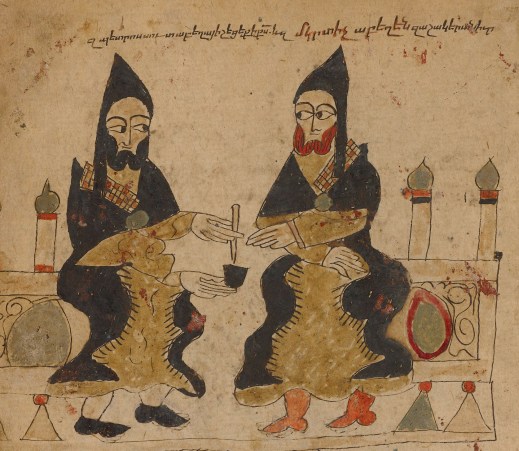
The Scribe Petros and his Pupils, 1386
The scribe Petros and a pupil, offering a good example of the sort of clothing an Armenian vardapet might have worn in the late medieval or early modern period. From a Gospel book completed in 1386 in the Lake Van region (J. Paul Getty Collection, Ms. Ludwig II 6, fol. 13v).

The prince and ruler of the city of Erevan and the Ararat province at that time was the great and mighty governor, Emir Gūna Khan, who somewhat accidentally met Vardapet Movsēs. The khan asked about him from the Christians who stood before him, who replied that who he was and where he came from. It so happened that the khan met the vardapet once again and, during their meeting and conversation, the khan was pleased with the vardapet, for God’s kindness made his servant appear agreeable in the eyes of the ruler. The khan did not let Movsēs go to the Western provinces [ie the Ottoman Empire] but kept him in the city of Erevan. Day after day the khan came, witnessed the liturgy and other church ceremonies, conversed with him about knowledge and religion, and listened to the vardapet’s replies, which were polite, pleasant, and bearing God’s graces. The khan grew fond of him because of his pious lifestyle; that is why he kept him in the city of Erevan. The vardapet stayed three years in the Kat’ohike church.

From olden days in the northern part of the city of Erevan, among the vineyards, stood a beautiful chapel, built on the grave of the holy apostle Anania. It was in ruins and uninhabited. The khan told the vardapet, ‘Do you see this church, which stands uninhabited? Pay heed to me and do not go to another province. Make it your home, settle here, so that we can be near and comfort each other.’ All the parishioners, citizens and merchants, begged and asked the vardapet to do the same. Their words pleased the saintly vardapet, and he undertook to build that place through the income and with the help of local Christians and merchants, who, because of their love for the vardapet, willingly gave alms for the construction, so that the vardapet would reside among them. That is why the surrounding fence, cells, chapel, sacerdotal, and other structures were quickly built, When all the construction was completed, the vardapet, together with his fellow monks, settled there and established the order and regulations practiced in the Great Hermitage. Many monks, hermits, and men who wished to study the scriptures and who were wise and led a saintly life, gathered there. They lived together, young and old, happily, based in cells, praying continuously and reading holy books.

His fame and truthful sermons, as well as word of his pleasant disposition spread to all the lands in Rum, Kurdistan, Georgia, and Persia, for merchants from all lands came there [to Erevan], met him, and spread the word.

Aṛakʻel of Tabriz, The history of Vardapet Aṛakʻel of Tabriz ( Patmutʻiwn Aṛakʻel Vardapeti Dawrizhetsʻwoy)  Translated by George A Bournoutian. (Costa Mesa, Calif.: Mazda Publishers, 2005), 217-218.

Depicting Devotion to Muhammad: Images in An Ottoman Compendium

Names of God and Names of Muhammad Osmanische Sammelhandschrift , 17XX
Hilye-i Şerîf, from Ahlâk-i resûl Allâh, from Staatsbibliothek zu Berlin Ms. or. oct. 1602, 48v.
Muhammad's Sandal
Depiction of the sandal of the Prophet, Ms. or. oct. 1602, 44v.

These two images come from the same manuscript compendium of devotional texts, a manuscript now held in the Staatsbibliothek zu Berlin, but originally completed and used somewhere in the Turcophone part of the Ottoman Empire, during the seventeenth century. The particular text they are a part of, Ahlâk-i resûl Allâh, describes, as its name suggests, the ‘characteristics’ of Muhammad and aspects of his life, which entails, among other things, encountering, in both text and image, places and things entwined with his life. This includes marvelous schematics of Mecca, Medina, and Jerusalem, for instance. It also includes a couple of instances of hilye-i şerîf, which I’ve mentioned briefly before here. These are ‘verbal-pictorial icons’ that depict, through words and non-figural (at least not of humans) images and design, the attributes of Muhammad, physical and otherwise. The hilye-i şerîf I’ve included above is a somewhat unusual example: instead of reproducing hadith-based descriptions of Muhammad’s physical characteristics, it features, side by side, names of God and names of Muhammad, filling the big flowers that dominate the top of the page. Below these ‘verbal icons’ are calligraphic renderings of Qur’anic phrases (some barely visible because of the poor contrast between flower color and script) along with the names of other important holy figures from the founding generation of Islam.

The second image is a heavily stylized and decorated rendering of Muhammad’s sandal, one of several physical traces- relics, in a sense- associated with Muhammad from the middle ages on and which seem to have grown in importance in the Ottoman period, as part of the general intensification of devotion to the Prophet across Islam in this period. In addition to objects claimed to be actual physical relics- hairs from Muhammad’s beard, the impress of his foot in a rock, cloaks he once wore- visual reproductions of those relics also proliferated, usually in the context of devotional texts such as this one. What was the devotional content of these images, or, to put it differently, what did these images ‘do’? For the artist, patron, and purchaser or owner or endower of a manuscript such as this, the act of creating the image and beautifying it- the gorgeous rich flowers of the hilye, the bright colors and delicate designs of the sandal, or instance- could serve as acts of devotion, of love, in themselves, as a type of offering. These depictions could also act as loci of remembrance, even for people who could not read or decipher the Arabic inscriptions: the image called to mind the person from whom the original relic was derived. An intrinsic connection was forged- hence my calling these images ‘icons,’ even though no human form is depicted- independent of a viewer, even as they summoned the viewer into an imaginative encounter with the referent. Following a similar logic, these images, by virtue of a perceived ‘link’ back to Muhammad himself, could carry a prophylactic charge. There are in fact hadith- devised very late (and in fact sometimes claimed to have been delivered via dreams)- that claim as much, to the effect that anyone who places a hilye-i şerîf in his or her home will be protected from all manner of misfortune.

In sum, far from being simply decorative objects or illustrations for a text, images such as these had a complex role in Ottoman devotional culture, containing meanings and applications that are not immediate obvious to modern-day viewers but which can give us valuable insights into the religious and emotional lives and practices of early modern Ottoman Muslims.

For further reading:

Christiane Gruber, The Prophet as a ‘Sacred Spring’: Late Ottoman Hilye Bottles

Christiane Gruber, “The Rose of the Prophet: Floral Metaphors in Late Ottoman Devotional Art,” in  Envisioning Islamic Art and Architecture, November 14, 2014, 223–49.


Devotional Art in White and Blue: An Ottoman Tile Panel from Damascus

Panel of Tiles, 17th century
Panel of Tiles, 17th century. Ceramic; fritware, painted in cobalt blue and turquoise under a transparent glaze, 28 x 28 x 1 in. (71.1 x 71.1 x 2.5 cm). Brooklyn Museum,

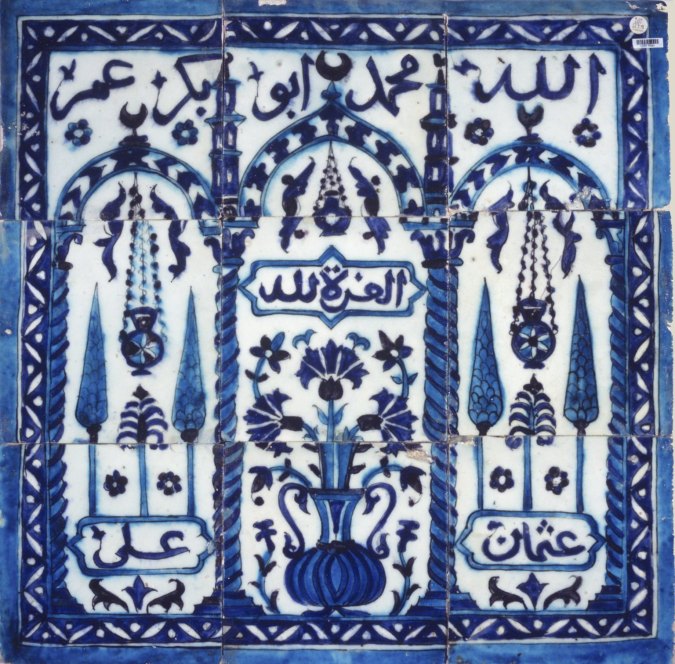
It’s been a busy few several days for me, so the translations of Arabic and Ottoman Turkish devotional texts I had hoped to have completed or at least in the works will have to wait. For now, I’d like to share this lovely wall panel of tiles from Ottoman Damascus (the museum’s description does not reveal where exactly it was originally located, though my guess would be in a mosque or other religiously-oriented structure, perhaps as part of a mihrab installation). The blue and white, the thin, pointy trees (probably cypresses), and especially the stylized flower arrangement in the center all reveal this piece as clearly Ottoman, while the border ornamentation and style of execution suggest the ‘provincial’ (as opposed to closer to the imperial core of Constantinople/Istanbul).

The visual ‘message’ of this tiled panel, and the sort of devotional ‘work’ it might have done, is also pretty clear: the three arched niches suggest the mihrabs in a mosque, replete with depictions of mosque hanging lamps in each niche, with a crescent moon pendant above. Paradisical imagery of flowers and trees fills the niches below the lamps, suggestive of the Garden itself, while at the center is the phrase ‘To God belongs the power.’ On the top and bottom, in clockwise direction, are the names God, Muhammad, Abu Bakr, ‘Umar, Uthman, and ‘Ali, the last four being the Four Rightly Guided Caliphs, their memory increasingly venerated by Sunni Ottoman Muslims in light of conflicts with the Shi’i Safavid Empire. Like the imagery I discussed in a previous post, this one draws the viewer into a spiritual space, a paradisical space of worship, directed towards God, and mediated by Muhammad and his saintly immediate followers and bearers of his standard. Using stylized imagery, pattern, color, and calligraphy, it creates an ‘icon-like’ viewing experience, and probably also helped to render a particular space, within a mosque or elsewhere, as conducive towards attitudes and acts of devotion and worship.

Fire Poured Out From Heaven: Muslim Saints’ Shrines in Safavid Miniature Painting

Miniature from a copy of Jafar al-Sadiq_s Falnama. “Scene From a Mausoleum” Iran, Tabriz or Qasvin; c. 1550
Miniature from a copy of Jafar al-Sadiq’s Falnama. “Scene From a Mausoleum”
Iran, Tabriz or Qasvin; c. 1550 (David Collection, Inv. no. 28/1997)
“Prayers in a Mosque” Miniature from Kulliyat-i Mawlana Ahli Shirazi (Collected Works of Mawlana Ahli Shirazi) Shiraz, Iran; c. 1550
Miniature from Kulliyat-i Mawlana Ahli Shirazi (Collected Works of Mawlana Ahli Shirazi)
Shiraz, Iran; c. 1550, David Collection, Inv. no. Isl 161

As any long-time reader of this blog will know, one of my primary areas of scholarly interest is the history of saints and sainthood in the Islamic world, primarily within Islamic traditions but also in Christian and Jewish traditions practiced within or in contact with Islamicate cultures. The very fact that ‘Muslims have saints’ often comes as a surprise, with the usual follow up question being something along the lines of ‘Just what is a Muslim saint like?’ The answer, of course, varies from place to place and time to time, with the usual caveats that Muslims saints ‘look’ both like and unlike saints in other religious traditions, and that some forms of Islam, especially in the modern world, largely reject sainthood (similar to some forms of Christianity after the Protestant Reformation).

One difference between Muslim modes of understanding and depicting saints and sainthood and those found in many other traditions such as Christianity and Buddhism is the relatively low-key role of visual depictions in describing saints and in venerating them or inscribing their memory. While it is not true to say that Islam across the board lacks iconographic traditions, explicit uses of icon-like depictions for veneration has historically tended to be limited to either to depictions of non-human items and places, described in last week’s post, or in a rather supplemental manner (for private devotions or in the context of a shrine), such as has become common in contemporary Shi’i devotion (though certainly not only Shi’i- for instance, see this example from resolutely Sunni Morocco). The two miniatures above fall into another category altogether: in both we have something quite rare, namely, artistic renderings of practiced devotion to saints. These two images, both of which were produced in Safavid Iran while it was still in the long process of transitioning from a Sunni polity to a Shi’i one, give us a pretty good visual idea of what tomb veneration looked like in an early modern context- while they come from the Persian world, we know from literary evidence that the practices and architectural elements depicted in them would have been shared with other regions, including the neighboring Ottoman lands. The images are hence worth a closer look. Continue reading “Fire Poured Out From Heaven: Muslim Saints’ Shrines in Safavid Miniature Painting”

Explicating Devotion to Muhammad, Part i.

image
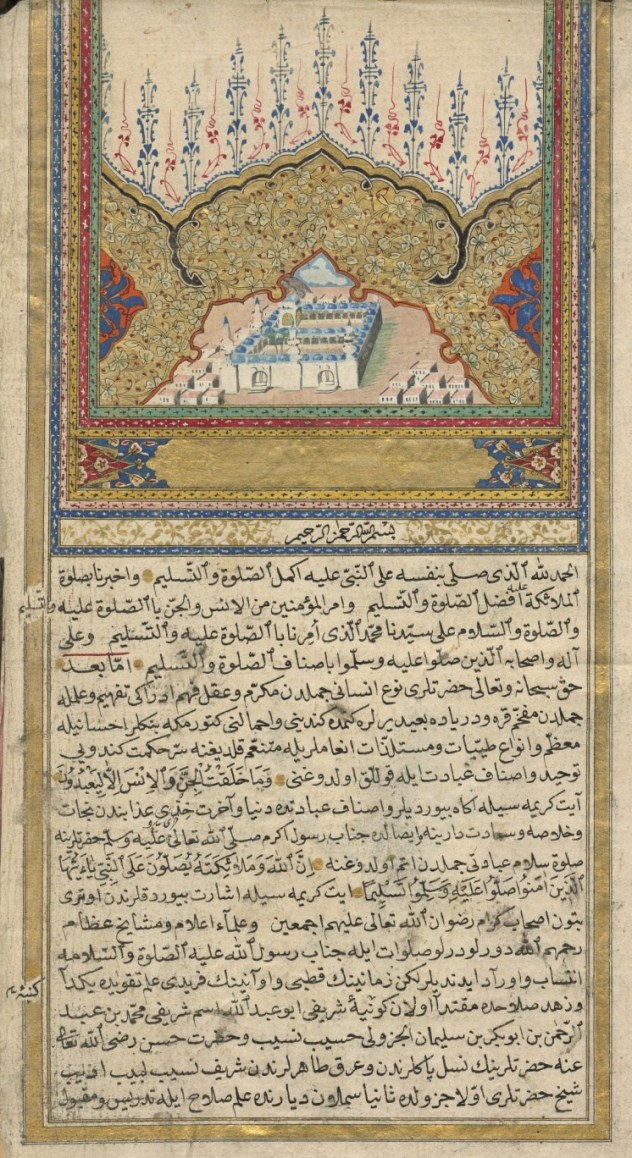
Opening page to Kara Davutzâde Mehmed Efendî, Tevfik muvaffikü’l-hayrât li-neyli’l-berekât fi hizmet menbai’s-saâdât, University of Michigan, Special Collections Library, Isl. Ms. 672

Late medieval and early modern devotion to Muhammad in Islam was first and foremost a matter of personal and communal practice, embodied in devotional regimes, public rituals, habitual expressions, and material objects, among other practices and techniques. But it also unfolded at a discursive, textual, and homiletical level, with scholarly and semi-scholarly productions explicating, extolling, and critiquing various aspects of devotion to the Prophet appearing from the late medieval period forward in multiple languages of Islam. The genre of commentary (Ar. sharḥ/Ott. Trk. şerh) was an important vehicle for delivering explication of devotional practices and their intersection with theology and other Islamic disciplines. Numerous commentaries on ṣalawāt– the litanies of blessing upon Muhammad- and related sorts of texts appeared across the Ottoman world and beyond, in both Arabic and Ottoman Turkish (and in other languages further east). Like much early modern commentary production in Islamic societies, these texts have received little engage scholarly attention, though the neglect of commentaries is starting to change. In the following weeks I’d like to give some samples of commentary on devotional texts, starting with excerpts from commentary on what was perhaps the most important text of devotion to Muhammad, al-Jāzūlī’s Dalā’il al-khayrāt.

But before presenting translated texts and analysis of them, I’d like to start with the above image. It comes from the opening page of a beautifully executed manuscript copy of an Ottoman Turkish translation and expansion of an Arabic commentary on al-Jāzūlī’s prayerbook. Titled Tevfik muvaffikü’l-hayrât li-neyli’l-berekât fi hizmet menbai’s-saâdât, this work, which goes through, line by line, the text of Dalā’il al-khayrāt, was composed by an eighteenth century author, Kara Davutzâde Mehmed Efendî, about whom I know no more than can be gleaned from the text. The commentary was aimed at many audiences, especially, it seems, pious women, and may have been meant to furnish material for preachers.

The charming miniature that is framed at the top of the page, a depiction of Medina, centered on the Prophet’s Mosque, is a good example of the devotional iconography that grew up around devotion to Muhammad, in many contexts, featuring images of Mecca and Medina, the tomb of Muhammad and the tombs of the Four Rightly Guided Caliphs, the footprint of Muhammad (and other physical traces), and so on. Such images had many functions: they presented the physical presence of Muhammad and his close associates in an iconographic manner but without actually depicting Muhammad directly. Instead they summoned his presence by pointing the viewer at the material traces of his life and memory, a sort of icon at remove. They had an educational value, giving the reader or viewer a sense of what the holiest places of Islam and the artefacts of the Prophet looked like. And finally they had a prophylactic purpose- that is, early modern Muslims might display or otherwise have on hand these images as a way of warding off evil and misfortune, based on their icon-at-a-remove connection to Muhammad and his powerful intercession. The above image- which is also just simply beautiful and delicately rendered- participates in all of the above.

O Monarch of the Heart

In yesterday’s post I introduced the theme of late medieval and early modern devotion to Muhammad, a ‘movement’ within Islam that became dominant and widespread by the end of the middle ages, especially flourishing in the early modern period. The texts of this devotion were not only written in Arabic: rather, devotion to Muhammad was often expressed in vernaculars. The following translated poem, by an Ottoman sufi şeyh and saint, Muhammed Nasûhî Üsküdarî (d. 1718), is a part of a larger collection of poetry of praise and supplication directed towards Muhammad, written in Ottoman Turkish. It is a good example of this genre of poetic composition, which was common across the Ottoman world and beyond, expressing theological concepts as well as emotional bonding between the poet and his object, Muhammad. I have included footnotes at points to clarify certain references that would have been relatively obvious to a contemporary reader or listener but might not be to my readers here.

Iznik Flower Panel

You are the cure of my sickness, yâ Muhammed Mustafa!
You are the sovereign of my heart, yâ Muhammed Mustafa!

Who am I that I dare to praise you, o monarch of the heart?
You are the light of the moon of Yâ-sin [1] yâ Muhammed Mustafa!

You hold sway over the inner secret of this habitation below, o mirror of the True!
You are the monarch of the throne of If you had not been [2], yâ Muhammed Mustafa!

Without sign, without place, in your inner secret I beheld your essence.
You are the spirits of the passionate lovers, yâ Muhammed Mustafa!

To the crooked-statured, sin-bearing Nasûhî [3] give
Help—you are a remedy, yâ Muhammed Mustafa!

Üsküdarlı Muhammed Nasûhî, [‘Poem 6’], in Üsküdarlı Muhammed Nasûhî ve Dîvânçe-i İlâhiyat’ı, ed. Mustafa Tatcı (Üsküdar, İstanbul: Kaknüs Yayınları, 2004), 166-167.

[1] A reference to the 36th surāh of the Qur’an, Surāh Yā’-Sīn, sometimes referred to as ‘the heart of the Qur’an.’

[2] An allusion to a hadith qudsi– a hadith said to convey God’s speech, though not as part of the Qu’ran- in which God says to Muhammad words to the effect of ‘If you not been I would not have created the universe.’

[3] Including one’s name in the penultimate line is an Ottoman convention, carried over from Persian poetic convention.

Devotion to Muhammad in Medieval and Early Modern Islam: An Introduction

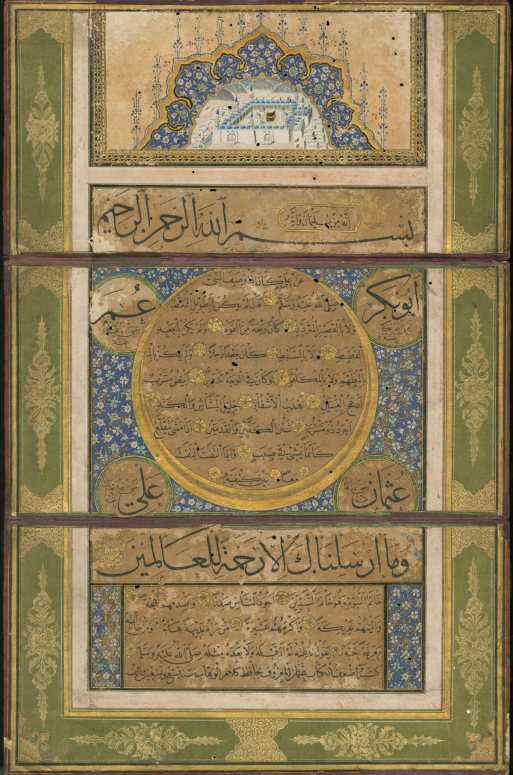
Hilye triptych
A three-panel Ottoman ḥilye-i şerîf-  a description of Muhammad’s physical attributes, or ‘verbal icon’- by Ḥafîẓ Osmân Efendî (d. 1698). Note the miniature depiction of Mecca in the top panel. Special Collections Library, University of Michigan, Ann Arbor, Isl. Ms. 238.

There are a number of aspects of medieval and early modern Islam (and contemporary living Islam too, for that matter) that tend to surprise, even shock, many modern-day observers, especially non-Muslims who nonetheless have some degree of knowledge about the ‘basics’ of Islam. Because of the wide-spread and often quite profound changes that have transformed Islam in many places throughout the world over the last century and a half or so, there is a great deal in pre-modern ‘mainstream’ Islam that many contemporary Muslims might find odd, unexpected, or even heretical. One such source of surprise and even shock is the history of the image and meaning of Muhammad in Islamic theologies and devotional practices. If, like me, in your initial exposure to Islam you learned that Muslims—throughout time, perhaps?—viewed Muhammad as ‘only’ a prophet, and no more, then Islamic theology that talks about the Muhammadan light, the cosmic role of Muhammad within God’s creative plan, and the intercessory power of the Prophet, and so on, must all sound quite strange and even ‘un-Islamic.’ Indeed, I remember thinking, as I delved into the vastness of ‘Muhammadology,’ that much of the theology I was discovering bore a marked resemblance to Christology, in particular to Logos theology, in Christianity.

Yet far from being aberrant or peripheral, the theological ‘elevation’ of Muhammad that took place in the course of the Islamic medieval period was a transformation that occurred and impacted Islam across the board. It was not just a ‘Sufi’ thing or a matter of ‘popular’ religion. Devotion to Muhammad, alongside theological renderings of the ‘cosmic Muhammad,’ coursed through the very veins of Islam from the middle ages into early modernity and beyond. The person and role of the Prophet Continue reading “Devotion to Muhammad in Medieval and Early Modern Islam: An Introduction”

An Ottoman Book Binding by Way of Tabriz

Binding of a copy of the Bustan of Sa‘di MSS 712
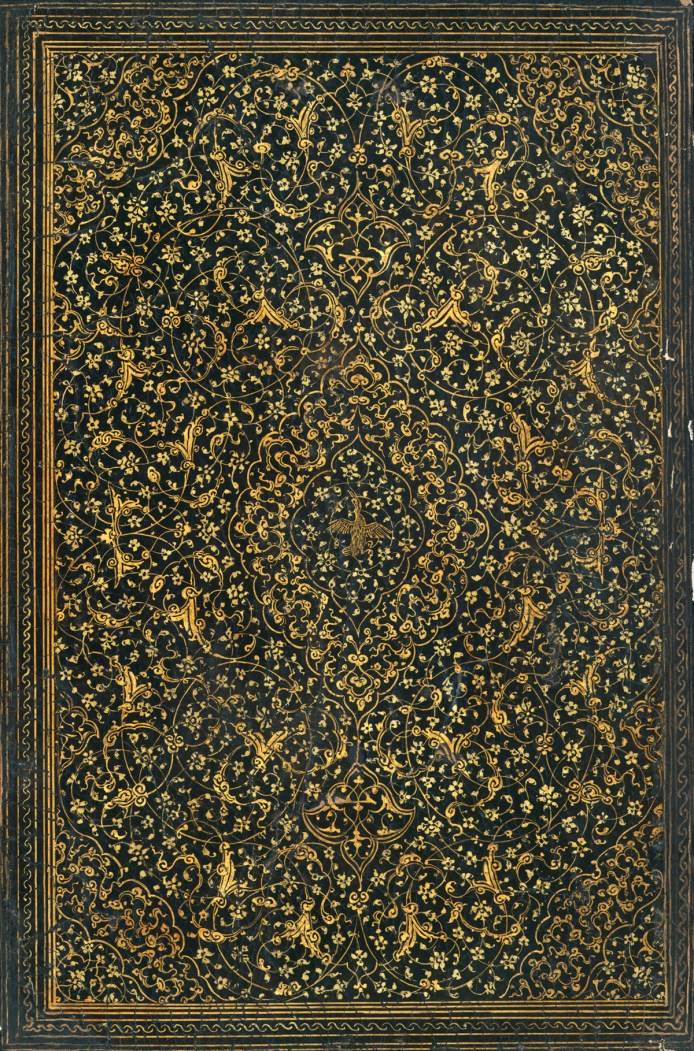
Binding of a copy of the Bustan of Sa‘di, Khalili Collections, MSS 712. Istanbul, Ottoman Empire (likely), 1530–1540. (Papier-mâché boards, painted and varnished; with paper doublures; 24.7 x 16.5cm (covers, each); 24.7 x 11cm (flap and fore-edge)

This spectacular example of book binding was probably produced in the workshops of the Topkapı Palace by artisans from Tabriz (modern-day Iran, at the time part of the Safavid Empire, though periodically contested by the Ottomans). As such it is a good demonstration of the interconnection between the Persianate world and that of the Ottomans, especially in the 16th century (Persian influence and connections would decline somewhat in the coming centuries). This cover protects a copy, executed in Tabriz in 1530, of one of the great works of Persian poetic literature, Sa’di’s Bustan (‘Garden’), which, along with other works of Persian poetry, would have a long-lasting influence on the production of Ottoman Turkish poetry. The artwork, with its intricate interlacing tendrils, delicately rendered foliage and single creature at the center, is redolent of the Persian world, and would have been immediately recognized as such by whatever connoisseurs of art would have had access to the finished product, probably in the Topkapı itself.


The Thought of Fishing

As noted in a previous post, the Ottoman majdhūb/meczûb (the first is the Arabic rendering, the second the same term but in Ottoman Turkish)- the divinely drawn saint or holy madman- was often involved in the details of everyday life, such as the smoking of tobacco. In the following story, which comes from a compilation of meczûb lives in a sprawling 17th work of hagiography by Mehmed Nazmî EfendiHediyyetü’l-ihvân, we see one of these holy madmen miraculously discern the wandering thoughts of the imam in the greatest mosque of Ottoman Istanbul.

IMG_2952
A view of the courtyard of the Süleymâniye Mosque, the setting of the following story

‘And there was one, Hızır Aşak, who was from among the great (ulular) of the meczûb. He was a powerful meczûp capable of unveiling inner secrets. It is related that the imam of the Süleymâniye Mosque, Süleymân Efendi—who was later dismissed and sent into retirement—was one day leading the noon prayers, when the thought came to him: “After completing the salât, I’ll go to Hisar [on the Bosporus] and go fishing.’ Just as this thought was occurring to him, Hızır Aşak came to the mosque, and, as was his custom, cried out “Hû!” [i.e. ‘He,’ meaning God, a common sufi form of zikr] and said, “Süleymân Çelebi! You are here, your mind ought not be off fishing in Hisar. There is no prayer without presence of heart. Lead these men in prayer a second time.” Having said this he left the mosque. Süleymân Çelebi related thus: “This unveiling of the mad one brought about divine fear and embarrassment before the people in me. For a little while I passed out! Coming to, I properly completed the prayers.”’

Mehmed Nazmî Efendi, Hediyyetü’l-ihvân

Pious Graffiti at the Church of the Holy Sepulchre: Pilgrims’ Prayers and Traces of the Self

A Visual Essay

The Church of the Holy Sepulchre in Jerusalem, as any pilgrim or tourist visiting it quickly discovers, is a massive, maze-like structure, or, really, assemblage of structures, including the Tomb of Christ and of Golgotha but also numerous other chapels, rooms, and other elements. Somewhat closer investigation starts to reveal the multiple layers of construction and use, going all the way back the first century AD (and probably further, since the Tomb was located in the side of an already old quarry outside of the Herodian walls of the city). While the names of prominent men and women are often attached to these various architectural layers, beginning with Constantine and his mother Helena, the traces of far humbler pilgrims to the great church are also visible, if one knows where to look. Yet, as I observed on my visits to the church earlier this year, the steady streams of pilgrims and tourists, clergy and tour guides, pass right by these fascinating reminders of the centuries of pious visitors who have traveled- often over great distances and in difficult circumstances- to venerate the empty Tomb of Christ.

IMG_4901
The largely Crusader-era main entrance to the church, with entrance and front facade giving little indication of the size of the church’s sprawling interior. The pious graffiti is most abundant around the doors near the center of the picture.

Covering the columned framing of the great doors to the main entrance to the church are perhaps hundreds of instances of ‘pious graffiti’- prayers, names, dates, and short texts carved into the stone by pilgrims. Deeper inside the church, in a stairwell leading down to the Chapel of St. Helena, sunk within the living rock, are hundreds of neatly carved crosses left by Crusaders, also as pious graffiti marking and memorializing their pilgrimage. While in the modern world such defacement is looked down on and even seen as criminal, Continue reading “Pious Graffiti at the Church of the Holy Sepulchre: Pilgrims’ Prayers and Traces of the Self”