‘Influence’ is a curse of art criticism primarily because of its wrong-headed grammatical prejudice about who is the agent and who the patient: it seems to reverse the active/passive relation which the historical actor experiences and the inferential beholder will wish to take into account. If one says that X influenced Y it does seem that one is saying that X did something to Y rather than that Y did something to X. But in the consideration of good pictures and painters the second is always the more lively reality. It is a very strange that a term with such an incongruous astral background has come to play such a role, because it is right against the real energy of the lexicon. If we think of Y rather than X as the agent, the vocabulary is much richer and more attractively diversified: draw on, resort to, avail oneself of, appropriate from, have recourse to, adapt, misunderstand, refer to, pick up, take on, engage with, react to, quote, differentiate oneself from, assimilate oneself to, assimilate, align oneself with, copy, address, paraphrase, absorb, make a variation on, revive, continue, remodel, ape, emulate, travesty, parody, extract from, distort, attend to, resist, simplify, reconstitute, elaborate on, develop, face up to, master, subvert, perpetuate, reduce, promote, respond to, transform, tackle… – everyone will be able to think of others. Most of these relations just cannot be stated the other way round- in terms of X acting on Y rather than Y acting on X. To think terms of influence blunts thought by impoverishing the means of differentiation.
Michael Baxandall, Patterns of Intention: On the Historical Explanation of Picture (Yale: Yale University Press, 1985) 58-59.
In thinking and talking about the work of history as a discipline, I have long enjoyed using the metaphor of ‘inhabiting’ a given past, but it has often occurred to me that I ought to build upon and expand from that metaphor, to develop an argument or an explanation—I am not sure what word works here—for why history matters, how one encounters the past, and what that does in one’s life, work, being. Here are a few thoughts towards that end, essentially my own thinking out loud, for which I ask your indulgence and, perhaps, participation should you feel inclined.
In the work of historical encounter, especially, I think, in the work of encounter with individual and collective lives in the past, one expands one’s own self, you become richer and deeper and are able to see the contingency of the present and the multitude of possibilities inhering in the past and in the flow of human history. There is a sort of loneliness and poverty that afflicts someone whose knowledge begins and ends with his contemporary world, in which the only emotions imaginable, the only configurations of self conceivable, the only moral universe explicable, the only languages comprehensible, are those of one’s own narrowly circumscribed present. What is more, one does not even fully grasp one’s own present: for all of those things—emotions, sense of self, morality, and so on—are expressed in and through us because of the work and being of past worlds. And whatever genealogies extend backwards from our particular presents at some point intersect with or overlap or contrast with other genealogies, other worlds of the past, spread out across this earth. We are now living in a historical moment in which our tools and our manner of life, at least in the post-industrialized nations, allows us an unprecedented ability to delve into the past and to encounter great sweeps and depths of the human experience. At the same time, we are perhaps more than ever in human history constrained by our governing and prevailing ‘inner technics,’ by our ideologies, by our habits of thought from looking beyond the narrow boundaries of the present or of what is familiar and safe.
Yet people long for these sorts of encounters with the past, they long for both the stability of connecting with long traditions and the dynamism and vitality that comes from stepping into streams of time and practice longer and larger than ourselves. Not unlike previous periods in modernity, false encounters with the past, and manipulative iterations of nostalgia and propagandized memory so often end up being the means whereby people try to ground themselves in history or seek encounters with other, past worlds. Such means can range from mostly benign indulgence in nostalgic media or advertising campaigns to recruitment into resurgent authoritarian leftist or rightist movements which promise the recovery of some lost golden age, whether it is one of the power of workers or the unity of the nation. Unsurprisingly the time horizons on such nostalgic endeavors is rarely very deep, the twentieth and nineteenth centuries providing the usual frames of reference, even if colored, on the right, with vague appeals to ‘tradition’ and to deeper pasts.
History by itself is not sufficient to give people a sense of meaning or to ground them in connection with others and with deep pasts and traditions. In some ways the discipline of history runs counter to any political project that would seek to use the past for justification, in fact, for the discipline of history rightly done reveals a dynamic and contingent past, looks at the inner logics and developments of traditions and ways of life. Rather, history offers a space for encountering the past in its complexity and wonder (and, to be sure, terror and darkness), of enriching one’s self through stepping into other worlds and out of one’s own, expanding the bounds of what is imaginable. History erodes the feeling of loneliness and of a crippling ‘autonomy’ by revealing the interconnections and interdependencies that all humans, ourselves included, partake of. We inhabit, for a moment and of course partially (but this is always true for us) the lives of others, encounter their fears and dreams and catch glimpses of how the world looked through their eyes. What we may then do with the knowledge—a knowledge that is, or at least should be, multifaceted and not easily described—so gained is not dictated by the knowledge itself. There is no political program determined by deep encounters with human pasts. Rather, any political program or cultural ambit or whatever else that we may embark on in the here and now ought to be informed by, situated within encounters with and awareness of many human pasts, with persons in the past, an experience and knowledge which may then help lead towards wiser, more human, more emphatic and adroit, actions and policies and works of life.
The mosque-shrine of Nabi Samwil, now split between Muslim Palestinians who use the above-ground mosque, and Jewish Israelis, who control the tomb-shrine itself. The figures atop the structure are members of the IDF.
i. I am standing, a few miles north of the Holy City, on a rise of ground that slopes off to one side towards the Jordan River, on the other towards the Great Sea. Like every rise of ground in this angry and holy land, it is covered over by a vast sea of the past and present commingled and churning. When the Crusaders crested this hill they could see the walls of their goal, or so the story goes, though today we can see only the ever expanding sprawl of modern Jerusalem, rising and falling over hills where a few decades ago there were only olive trees and flocks of sheep and goats and little villages. But we are not looking out over the rolling hills that spill out, east and west, from along the invisible Green Line that divides—in theory at least, one that that grows less relevant day by day—Israeli and Palestinian territory. We are watching, my friend and I, in transfixed anger, a momentary act in the interminable drama that plays out on this hill and in so many other places in this land, day after day after day, the long ugly drama on endless repeat. As the sun sets over the great corrupting sea to the west, I find myself right in the thick of that drama, feeling emotions to which I am unused and which terrify me even as they shoot through my body and heat my blood. I clench my fists, fight back hot tears, fight back the urge to pick up a stone and crack someone in the head. Instead I curse under my breath, tell M. that I am going back to the car, and hurry down the hill to the rental, parked precariously on an incline. I climb inside, grab the wheel, and weep angry tears. M. follows close behind and we drive off in bitter silence, processing what we’ve seen and felt and how very ordinary it is for this land.
ii. I was staying for several days in an Airb&b rental on El-Wad street, one of the main arteries of Jerusalem’s Old City, in an apartment being rented out by a French archeology student whom I never met. M. was staying there as well, while taking Arabic lessons. We had spent this particular day taking a break from the Old City and its tensions, the strain of soldiers on every corner with heavy weaponry slung in front, the constant watch of cameras on every other rooftop, perched above the street, the heaviness that percolates through the air, the loud silent confrontation of the settlers’ bristling rooftops. I could not then and cannot now imagine what it must be like to live here as a resident, to have this be your reality every day and night. After a week it was too much for me. Perhaps you adjust. Perhaps you bottle it up until it snaps. During my stay I wondered more than once what I would do were I in the place of a Palestinian Jerusalemite, or an Israeli settler. I don’t know, but I can speculate, and it’s not very pretty.
After picking up our rental car, at an agency down the street from the King David Hotel of lore—every block, every stone here has some world-historical significance, it gets old really, and I’m a historian—we cross through the Separation Barrier into the West Bank, then through another checkpoint, past a settlement, eventually winding down to Ein Prat National Park, our main destination for the day. Like almost everywhere else here it goes by at least two names—in Arabic it’s Ayn Farar, close, but not quite the same, as the Hebrew. Unlike most places around this city, though, it is an island of calm and coexistence. Apart from a couple of Japanese tourists who arrive as we are leaving, we are the only foreigners. Israelis and Palestinians—more of the latter than the former, at least today, it seems—are enjoying the cool waters of the springs and creek cutting through the desert, or are out hiking along the steep wadi, or enjoying a picnic in the eucalyptus groves planted during the British Mandate (growing alongside the ruins of a Byzantine church, in the shadow of a still functioning monastery inhabited by monks of Eastern European extraction…). There are no guns or uniforms or political slogans in sight. The settlements that cling to the ridgetops in this part of the West Bank are invisible, having receded behind the crags lining the wadi. We climb into caves used by late antique hermits, trail gazelles up a hill to a village site dating back, so they say, to the late Neolithic, sink into the marvelous papyrus reed jungles that hug the course of the stream. The conflict is far away, and here, at least, we feel as if there are possibilities open beyond merely tracing new permutations in the never-ending struggle.
iii. We spend the rest of the day exploring, down to Jericho, motoring into town past the languid Palestinian Authority checkpoint, get a bite to eat, and try to find an Umayyad ruin. We end up by the Jordan instead, at a site claimed to be where St. John baptized Jesus, but which today is dominated by a looming Israeli military instillation and mine-seeded zone, a parking lot full of tourist buses, and gaudy new churches across the holy river on the Jordanian side. It’s a strange and vaguely disturbing scene, and I remark that I feel like I’ve scene it all in a dream. Continue reading “The Incident at Nabi Samwil”→
Hilye-i Şerîf, from Ahlâk-i resûl Allâh, from Staatsbibliothek zu Berlin Ms. or. oct. 1602, 48v.Depiction of the sandal of the Prophet, Ms. or. oct. 1602, 44v.
These two images come from the same manuscript compendium of devotional texts, a manuscript now held in the Staatsbibliothek zu Berlin, but originally completed and used somewhere in the Turcophone part of the Ottoman Empire, during the seventeenth century. The particular text they are a part of, Ahlâk-i resûl Allâh, describes, as its name suggests, the ‘characteristics’ of Muhammad and aspects of his life, which entails, among other things, encountering, in both text and image, places and things entwined with his life. This includes marvelous schematics of Mecca, Medina, and Jerusalem, for instance. It also includes a couple of instances of hilye-i şerîf, which I’ve mentioned briefly before here. These are ‘verbal-pictorial icons’ that depict, through words and non-figural (at least not of humans) images and design, the attributes of Muhammad, physical and otherwise. The hilye-i şerîf I’ve included above is a somewhat unusual example: instead of reproducing hadith-based descriptions of Muhammad’s physical characteristics, it features, side by side, names of God and names of Muhammad, filling the big flowers that dominate the top of the page. Below these ‘verbal icons’ are calligraphic renderings of Qur’anic phrases (some barely visible because of the poor contrast between flower color and script) along with the names of other important holy figures from the founding generation of Islam.
The second image is a heavily stylized and decorated rendering of Muhammad’s sandal, one of several physical traces- relics, in a sense- associated with Muhammad from the middle ages on and which seem to have grown in importance in the Ottoman period, as part of the general intensification of devotion to the Prophet across Islam in this period. In addition to objects claimed to be actual physical relics- hairs from Muhammad’s beard, the impress of his foot in a rock, cloaks he once wore- visual reproductions of those relics also proliferated, usually in the context of devotional texts such as this one. What was the devotional content of these images, or, to put it differently, what did these images ‘do’? For the artist, patron, and purchaser or owner or endower of a manuscript such as this, the act of creating the image and beautifying it- the gorgeous rich flowers of the hilye, the bright colors and delicate designs of the sandal, or instance- could serve as acts of devotion, of love, in themselves, as a type of offering. These depictions could also act as loci of remembrance, even for people who could not read or decipher the Arabic inscriptions: the image called to mind the person from whom the original relic was derived. An intrinsic connection was forged- hence my calling these images ‘icons,’ even though no human form is depicted- independent of a viewer, even as they summoned the viewer into an imaginative encounter with the referent. Following a similar logic, these images, by virtue of a perceived ‘link’ back to Muhammad himself, could carry a prophylactic charge. There are in fact hadith- devised very late (and in fact sometimes claimed to have been delivered via dreams)- that claim as much, to the effect that anyone who places a hilye-i şerîf in his or her home will be protected from all manner of misfortune.
In sum, far from being simply decorative objects or illustrations for a text, images such as these had a complex role in Ottoman devotional culture, containing meanings and applications that are not immediate obvious to modern-day viewers but which can give us valuable insights into the religious and emotional lives and practices of early modern Ottoman Muslims.
Christiane Gruber, “The Rose of the Prophet: Floral Metaphors in Late Ottoman Devotional Art,” in Envisioning Islamic Art and Architecture, November 14, 2014, 223–49.
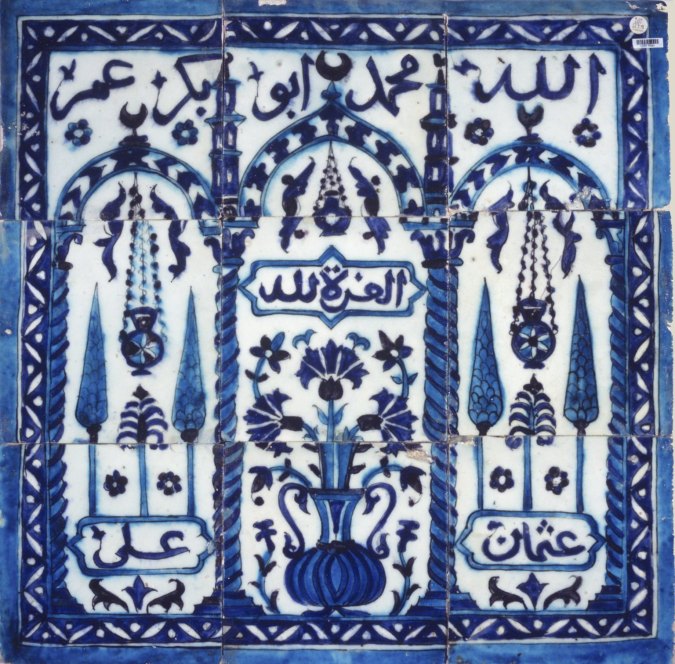
Panel of Tiles, 17th century. Ceramic; fritware, painted in cobalt blue and turquoise under a transparent glaze, 28 x 28 x 1 in. (71.1 x 71.1 x 2.5 cm). Brooklyn Museum,
It’s been a busy few several days for me, so the translations of Arabic and Ottoman Turkish devotional texts I had hoped to have completed or at least in the works will have to wait. For now, I’d like to share this lovely wall panel of tiles from Ottoman Damascus (the museum’s description does not reveal where exactly it was originally located, though my guess would be in a mosque or other religiously-oriented structure, perhaps as part of a mihrab installation). The blue and white, the thin, pointy trees (probably cypresses), and especially the stylized flower arrangement in the center all reveal this piece as clearly Ottoman, while the border ornamentation and style of execution suggest the ‘provincial’ (as opposed to closer to the imperial core of Constantinople/Istanbul).
The visual ‘message’ of this tiled panel, and the sort of devotional ‘work’ it might have done, is also pretty clear: the three arched niches suggest the mihrabs in a mosque, replete with depictions of mosque hanging lamps in each niche, with a crescent moon pendant above. Paradisical imagery of flowers and trees fills the niches below the lamps, suggestive of the Garden itself, while at the center is the phrase ‘To God belongs the power.’ On the top and bottom, in clockwise direction, are the names God, Muhammad, Abu Bakr, ‘Umar, Uthman, and ‘Ali, the last four being the Four Rightly Guided Caliphs, their memory increasingly venerated by Sunni Ottoman Muslims in light of conflicts with the Shi’i Safavid Empire. Like the imagery I discussed in a previous post, this one draws the viewer into a spiritual space, a paradisical space of worship, directed towards God, and mediated by Muhammad and his saintly immediate followers and bearers of his standard. Using stylized imagery, pattern, color, and calligraphy, it creates an ‘icon-like’ viewing experience, and probably also helped to render a particular space, within a mosque or elsewhere, as conducive towards attitudes and acts of devotion and worship.
We are standing on a flood-scoured tongue of rock that juts down from the banks of the Potomac River, a mile or so below the mouth of the river’s great gorge, a gorge headed by the mighty Great Falls. The cries of geese settling down into an open basin of water within the ice-choked river overwhelm the distant hum of the interstate. That hum is the only indication of how close we are to ‘civilization,’ and to the very seat of the American imperium. The sprawling organs of that state are but a few miles downstream, but here—here the broad river is silent under sheets of ice, melt-water pooling here and there as the temperature has risen a bit above freezing the last couple of days. Beneath the ice the river is strong, is pure power and energy, surging towards the sea. It bubbles up from under the ice in the oval basin where the geese have found refuge, and here and there in riffles and surges. I scan the sprawling sheets of ice, multicoloured, sinuous, maps to other worlds that intertwine with ours but will always lie out of our grasping reach. Near the river’s right bank—the Maryland side, though this is a designation that lies so lightly on the land, and will one day pass away—my eyes fall upon a scuttling, flapping black mass. A circle of black vultures, gathered around some victim of the river’s ice, stark and brilliant against the pale grays, blues, and whites. Overhead, a grey sky hangs heavy and cold, reaching down into the ghostly limbs of the sycamores that rise above the river’s banks, seeps into the ancient stone.
I shift upon the river-scoured stone, witness to the last great age of ice, when the decaying continental ice sheets unleashed world-shaking floods on this stretch of river, and cut across and down into the incredibly ancient metamorphic rock that jaggedly breaks upon the earth’s surface here. The cold rises up from the frozen river’s surface. I check to make sure my little son—tomorrow is his tenth month birthday—is warm, his face turned inwards to my chest, snuggled and asleep for now. Later, by the lively river rapids further down he will wake back up and take in the mighty beauty, but at the moment he sleeps against me, warm and peaceful. There are no other humans in sight from here. At points along the river, outside of the Park Service domains, mansions of the rich leer down, but from where we are standing they are invisible, cloaked by hill and stone and tree.
For a moment I think of the halls of power downstream. The river’s waters will flow past them soon, but they will pay the halls and the mighty men and women and the monuments and the sprawling buildings and high-rises no heed. I think: one day, perhaps soon, perhaps in the far distant future if the Eschaton tarries, the monuments will crumble, the detritus of empire will accumulate out in the Potomac’s outflow into the Chesapeake. The river will still be here. The ice will spread across the river, the vultures will gather and enact their age-old somber and joyous dance, turning death back into life. Perhaps the ravens and bears will have come down from the mountains by then, adding their gronks to the cold air, their tracks over the snow. The works of men will perish, thank God. There is a strange comfort in the thought, and comfort in our sharing in this moment and space of the wild, the sublime and the beautiful, so close to so much that is not beautiful, that is destructive and terrible and which lays waste to the earth, to the soul, to the good. I cannot dislodge the systems and powers downstream, and I do not love to think that my son will inherit a world marked by the same or similar ones. I do not know what the ecologies and landscapes that I love and that I hope he will love, too, will be like in ten or twenty years. But while nothing is certain, I am hopeful that places like this, moments like this, will remain, that one day he can stand above a frozen river in the depths of January, perhaps with a germ of memory of this very day, and breath in the wild, feel the charge of—yes—holiness, of the grandeur of God, and the impermanence of the works of man, good and bad, and listen to the silence of the ice, the faint rustle of the river oats, the power of the river in motion, and to be present in it.
‘The omnipresent Nietzschean or Sartrean chimera which proclaims that man can liberate himself totally, from everything, can free himself of tradition and of all pre-existing sense, and that all sense can be decreed by arbitrary whim, far from unfurling before us the prospect of divine self-creation, leaves us suspended in darkness. And in this darkness, where all things are equally good, all things are also equally indifferent. Once I believe that I am the all-powerful creator of all possible sense, I also believe that I have no reason to create anything whatsoever. But this is a belief that cannot be accepted in good faith and can only give rise to a desperate flight from nothingness to nothingness.
‘To be totally free with respect to sense, free of all pressure from tradition, is to situate oneself in a void and thus, quite simply, to disintegrate. And sense can come only from the sacred; it cannot be produced by empirical research. The utopia of man’s autonomy and the hope of unlimited perfection may be the most efficient instruments of suicide ever to have been invented by human culture.’
/
« La chimère nietzschéenne ou sartrienne, tellement répandue parmi nous, selon laquelle l’homme peut se libérer totalement, se libérer de tout – de toute la tradition et de tout sens préexistant– et qui proclame que tout sens se laisse décréter selon une volonté ou un caprice arbitraires, cette chimère, loin d’ouvrir à l’homme la perspective de l’autoconstitution divine, le suspend dans la nuit. Or dans cette nuit où tout est également bon, tout est, aussi bien, également indifférent. Croire que je suis le créateur tout-puissant de tout sens possible, c’est croire que je n’ai aucune raison pour créer quoi que ce soit. Mais c’est une croyance qui ne se laisse pas admettre de bonne foi, et qui ne peut que produire une fuite enragée du néant vers le néant.
« Être totalement libre à l’égard du sens, être libre de toute pression de la tradition, c’est se situer dans le vide, donc éclater tout simplement. Et le sens ne vient que du sacré, parce qu’aucune recherche empirique ne peut le produire. L’utopie de l’autonomie parfaite de l’homme et l’espoir de la perfectibilité illimitée sont peut-être les outils de suicide les plus efficaces que la culture humaine ait inventés. »
Leszek Kolakowski, ‘La revanche du sacré dans la culture profane,’ translated by Agnieszka Kolakowska, in Le besoin religieux, 1973
The Church of the Holy Sepulchre in Jerusalem, as any pilgrim or tourist visiting it quickly discovers, is a massive, maze-like structure, or, really, assemblage of structures, including the Tomb of Christ and of Golgotha but also numerous other chapels, rooms, and other elements. Somewhat closer investigation starts to reveal the multiple layers of construction and use, going all the way back the first century AD (and probably further, since the Tomb was located in the side of an already old quarry outside of the Herodian walls of the city). While the names of prominent men and women are often attached to these various architectural layers, beginning with Constantine and his mother Helena, the traces of far humbler pilgrims to the great church are also visible, if one knows where to look. Yet, as I observed on my visits to the church earlier this year, the steady streams of pilgrims and tourists, clergy and tour guides, pass right by these fascinating reminders of the centuries of pious visitors who have traveled- often over great distances and in difficult circumstances- to venerate the empty Tomb of Christ.
The largely Crusader-era main entrance to the church, with entrance and front facade giving little indication of the size of the church’s sprawling interior. The pious graffiti is most abundant around the doors near the center of the picture.
Covering the columned framing of the great doors to the main entrance to the church are perhaps hundreds of instances of ‘pious graffiti’- prayers, names, dates, and short texts carved into the stone by pilgrims. Deeper inside the church, in a stairwell leading down to the Chapel of St. Helena, sunk within the living rock, are hundreds of neatly carved crosses left by Crusaders, also as pious graffiti marking and memorializing their pilgrimage. While in the modern world such defacement is looked down on and even seen as criminal, Continue reading “Pious Graffiti at the Church of the Holy Sepulchre: Pilgrims’ Prayers and Traces of the Self”→
The following is a pair of Muslim saints’ lives, included in a biographical compilation (Luṭf al-samar wa qaṭf al-thaman) by an early 17th century Ottoman author from Damascus, Najm al-Dīn al-Ghazzī, the scion of a prominent family of ‘ulama, and one of the more prolific Damascene authors of the first part of the 17th century. His biographical histories include many saints’ lives, with a special emphasis on holy men with whom he or his saintly brother Shihāb al-Dīn al-Ghazzī had contact. Perusing the pages of these collected lives, a veritable ecosystem of sainthood and sanctity comes to life, populated by individuals of striking piety and of often controversial actions and behavior. Sainthood was and is a deeply social phenomenon, particularly in the Ottoman world wherein no ecclesial or political authority offered canonical guidance in the question of who was and was not a ‘true’ friend of God. Rather, something of a consensus among devotees would emerge, often alongside challenges from other directions, concerning a given person’s sanctity and closeness to God.
In the first life which I have translated here, we meet an enigmatic majdhūb, or possessed saint, who displayed seemingly erratic and irrational behavior, interpreted by those around him as the manifestation of jadhb, or divine attraction. Like many such majadhīb, he seems to have come from a rural environment, and in lieu of complex doctrinal teachings, he manifested his sainthood through strange, even shocking actions. And like many such possessed saints, he deliberately transgressed social boundaries, in particular, strictures on gender segregation and contact. His companion, Dervish Ḥusayn, was also marked by his transgressing of social norms, in his case, through living for a time an extremely hermetical life, even refusing to speak directly to most pious visitors. Yet before we imagine a gulf between such ‘transgressive’ forms of sanctity and the scholarly ‘ulama class from which our author hailed, al-Ghazzī also describes the ties of members of the ‘ulama with these two saints. Dervish Ḥusayn, for instance, made an exception to his hermit’s life to discuss religious matters with al-Ghazzī and his shaykh.
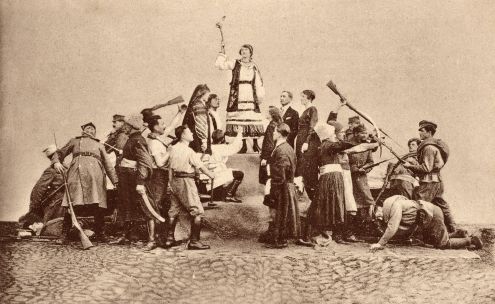
A symbolic depiction of Ukrainian nationalism, c. 1920
While the world probably doesn’t need any more commentary on the recent American election, I’d like to offer some anyway, though in a way that looks at happenings beyond the US to the rest of the world, where we see related patterns unfolding according to local particularities and conditions. While the US is its own case, it is also part of an interconnected world, the ties of global capitalism, human movement, globalized classes, elites, and political structures, and other things working to move American realities in directions broadly congruent with other, often quite different, parts of the world. My thoughts here—which are reflective of the halting directions my political thought have been taking as of late, but should not be interpreted as final or fully coherent—are springing off an article by Jonathan Haidt from back in the summer, but which is rather prescient and worth reading in its own right. What follows here, then, are three interlinking thoughts precipitated by, but in some cases sharply diverging from, Haidt’s article.
One, while right now the dominant options are either liberal ‘cosmopolitan’ globalism or some form of nationalism, within the framework of nation-states (whether more autonomous or more directed from supra-national entities being at question) and of some form of globalized (if not globalist) capitalism, those are not in fact the only options. To give but one example, Continue reading “Nationalisms, Globalisms, and Their Alternatives”→



 Thicket & Thorp