A depiction, from a mid-sixteenth century illumined copy of the Divân of Mahmûd ‘Abdülbâkî, of the most prominent Ottoman jurist of the century, Muhammad Ebussuûd Efendi, (d. 1574), and a circle of students, wearing clothing typical of the Ottoman ‘ilmiye hierarchy from which kâdîs, such as the one in the story below, were recruited.
As I’ve discussed in these digital pages before, one of the most fascinating and insightful ‘variety’ of Muslim saint in the early modern Ottoman world was the majdhūb (Ott. Turk. meczûb), the ‘divine attracted one,’ a strange and often disruptive and even antinomian figure who became a fixture of many Ottoman cities and towns in both the Arabic and Turkish speaking portions of the empire. Like the holy fool (yurodivy) in the Russian lands during the same period, [1] the majdhūb often engaged in public acts of disrespect towards holders of political power and authority, often with a sharp edge of political critique which might not have been tolerated from other actors. Such an act of transgressive, symbolic political intervention featured strongly in the remembered life story of the majdhūb I’m profiling today, one Abū Bakr al-Mi’ṣarānī al-Majdhūb (d. 1605), of Damascus.
He was profiled by the prominent Damascene scholar and biographer Najm al-Dīn al-Ghazzī, who personally knew and revered the saint, to the point that towards the end of Abū Bakr’s life he would even spend nights in the al-Ghazzī family home, talking with Najm al-Dīn deep into the night. Abū Bakr had humble origins and source of livelihood, having worked, as his laqab al-Mi’ṣarānī indicates, as an oil-presser, until one night while in a dhikr assembly (that is, a session of ritual remembrance of God) under the leadership of Shaykh Sulimān al-Ṣawāf al-Ṣufī, Najm al-Dīn’s brother Shihāb al-Dīn in attendance as well, ‘lightning flashes from God flashed out to him and seized him, so that he entered divine attraction, stripping off his clothes and going naked, save for his genitals. Then the state left him after some months, returning to him every year for three or four months. He was hidden in it from his senses, and would utterly shave away his beard and go naked [2].’ Besides embracing the typical majdhūb distaste for proper clothing and facial hair, both also characteristics of ‘antinomian’ dervishes, Abū Bakr also engaged in playful ‘assaults’ on people, demanding money from them, which he would then distribute to the poor. When not in his state of jadhb he would practice silence and acts of worship, secreting himself in the Umayyad Mosque. When ‘under the influence’ his state was clearly a fierce and potentially dangerous one, especially to members of the Ottoman elite. His inner potency was further indicated by a dream al-Ghazzī reports, in which, having asked God to reveal Abū Bakr’s true ‘form’ to him, the scholar behold the majdhūb transmuting into the form of a lion, then back to his human form. ‘That made manifest that he was from among the Abdāl. When day came I saw him, in his condition, and he laughed at me, and said to me: “How did you see me last night?”’ [3]
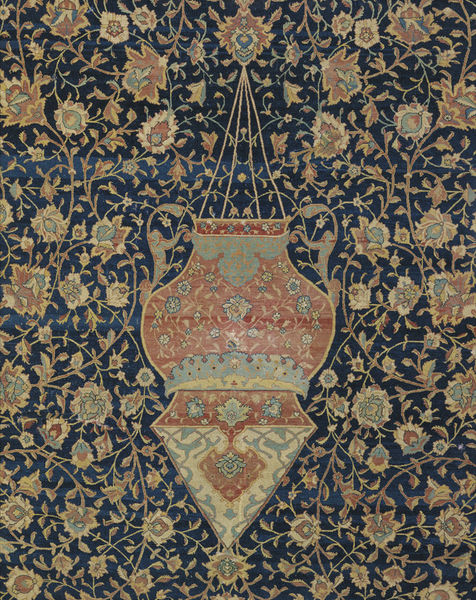
The Prophets Ya’qub and Yusuf seated together, from the 1585-1590 ‘Cream of Histories’ (Zubdat al-tawârîḫ) by Lokmân-i ‘Âshûrî (d. 1601), (Chester Beatty Library T 414)
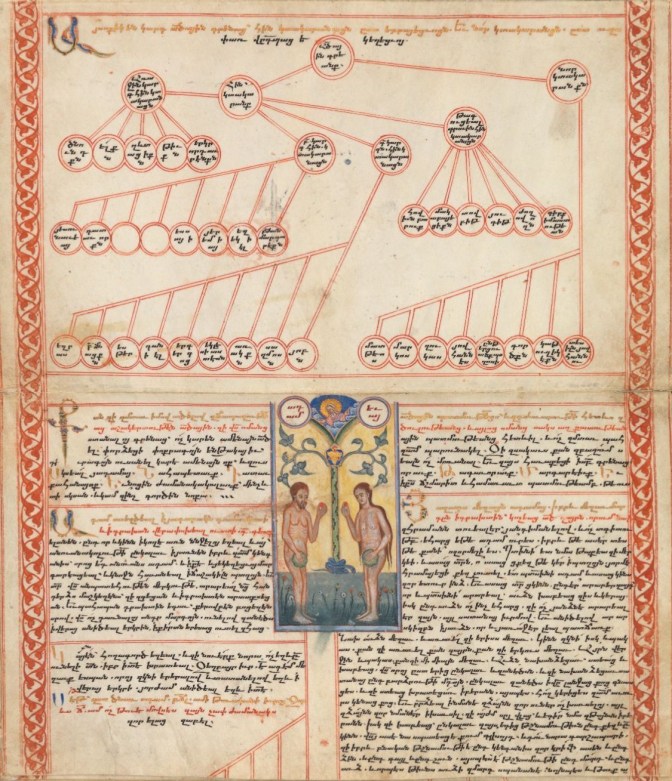
The two images in this post come from almost contemporary Ottoman manuscripts, one (above), a major work of history in Ottoman Turkish, the Zubdat al-tawârîḫ of Sayyid Lokmân produced in Istanbul, the other (below) a sort of abridged Bible (though it might be better thought of as an exegetical textual and visual condensation and rearrangement of the Bible) in Armenian, produced in Amida (modern-day Diyarbakır). The Zubdat was completed in 1590, while the Bible chart- and chart is probably the aptest term here- in 1601. There is much that could be said about these texts, and the Zubdat has been studied both for its art historical value as well as in reference to recent scholarly literature on Ottoman historiography and memory construction. The Armenian text (though neither work is fully described by ‘text’ in any meaningful sense) may have been studied in some context but I myself am not aware of any such work.
What struck me in looking at these two manuscripts side-by-side, as it were, is the similarity in the visual structuring of the information on the page. Both manuscripts employ a similar cartographic, architectural style, even if the details and other artistic traditions at work obviously vary. In the one history in a universal (but still very much ‘sacred’) key is displayed and ‘mapped,’ in the other history as a part of the Biblical narrative. Images of important figures are framed- literally- by architectural details, while names and terms are mapped out along the page in hierarchical, linked order, the little textual roundels like points on a map.
No doubt there is much that could be made of the similarities in these works, similarities which suggest shared ways of organizing and visualizing information, the relationship of text and space, as well as understandings of the nature of scripture and history. Determining why these similarities exist would require examining just such shared contexts as well as other historical, and perhaps Ottoman-specific, developments and historical rhythms. These two works placed in dialogue are also a good demonstration of the limitations of ‘influence’ as a category of analysis: completed within ten years of one another, one in the world of the Topkapı at the imperial, the other in an Armenian scriptorium at the eastern edge of the empire, the came into being all but simultaneously, and point to contexts and historical currents operative across the empire and through multiple social and cultural channels, not confined to particular locations or to one religious and linguistic tradition only.
Page from an Armenian ‘abridged Bible’ produced in Amida in 1601 by Aslan and Hovannes (Chester Beatty Library Arm 551)
An illustration from the life of Shaykh Ṣafī al-Dīn, during his adulthood, depicting a dream concerning the rise and fall of a local post-Ilkhanid dynasty, the Chūbānids (their members symbolized by the candles), with the shaykh himself depicted in the lower half asleep, dreaming. Unfortunately, so far as I know, the story recounted below was never illustrated. (Aga Khan Museum AKM264)
Shaykh Ṣafī al-Dīn (d. 1334) is best known as the founder and eponym of the Safavid sufi ṭarīqa, which in the late fifteenth into early sixteenth century would be the basis for the Safavid dynasty and empire, one of the major Islamic empires of the early modern world. He was commemorated in a number of ways: for instance, architecturally by a monumental and expansive shrine complex in Ardabil, and textually by an equally monumental and expansive menāqib (hagiography) composed in Persian by Ibn Bazzāz Ardabīlī, completed in 1358, in consultation with Ṣafī al-Dīn’s son and successor to head of the ṭarīqa, Ṣadr al-Dīn. Clocking in at over eight hundred folios in manuscript form, and almost twelve hundred in the modern printed edition, it must surely rank as one of the longest saint’s lives in Islamic history. Like other hagiographies, much of the social and cultural context and particularities of past worlds can be discerned in this text, such as in the story I have selected here.
The following account comes from the chapter on Shaykh Ṣafī al-Dīn’s childhood, during a period in which, as the first paragraph suggests, the saint was just beginning to discover his powers, not unlike many modern-day superhero stories in which the newly endowed superhero must learn to control his or her spectacular abilities, perhaps with the help of a mentor. Something similar is the case here: Ṣafī al-Dīn discovers strange and sometimes disturbing spiritual powers, such as an ability to see dead people, which, naturally, freaks him out, causing him to stop eating and to worry his mother (who is really his first mentor and a major presence in this chapter), who eventually coaxes the reason out of him. Understanding that her son is special, she seeks out holy men nearby who might direct him, but none are capable of training a prodigy like Ṣafī al-Dīn. In the story that follows, our protagonist sets out to a local holy place with hopes of finding an instructor, or at least some powerful baraka that will help him gain control of his powers and potent spiritual states. Additional commentary follows, but first the tale itself, which centers on Mount Sabalan, a high, prominent peak west of Ardabil:
Story (ḥikāyat): Shaykh Ṣadr al-Dīn, God perpetuate his baraka, said that when the spiritual state (ḥāl) of the shaykh, God sanctify his inner secret, grew more powerful, and when exalted conditions would occur which could not be stopped and which the shaykh found difficult to disclose [to others], by necessity he occupied himself with seeking out a guide (murshid) who could bring him out of this tumult of waves and will. He threw his entire body into this search, though he did not know from whence this impetus for searching came [1].
During that time people often had recourse to Mount Sabalan, it being well known that there were folk of God, exalted is He, atop Mount Sabalan. So the shaykh desired to go to Mount Sabalan, in order to find one of these people. The first time he went he found no one. The second time that the season for visiting came—for other than in the heart of summer it is not possible due to the intensity of the snow, ice, and cold—he went again and took from that place, in accordance with the custom of ordinary people, water and soil from the summit of Sabalan in order to derive baraka thereby. On his descent he passed through a couloir in the mountain, and saw a Turk [here with the sense of a nomad] squatting down, having taken up a bow and arrow and put the arrow to the bow, waiting in ambush for the shaykh. Other than [the Turk] there were no people in the vicinity—[Ṣafī al-Dīn] looked to see if he had an entourage or followers, but no, he was like a spider all alone. Continue reading “Shaykh Ṣafī al-Dīn Goes Mountain Climbing”→
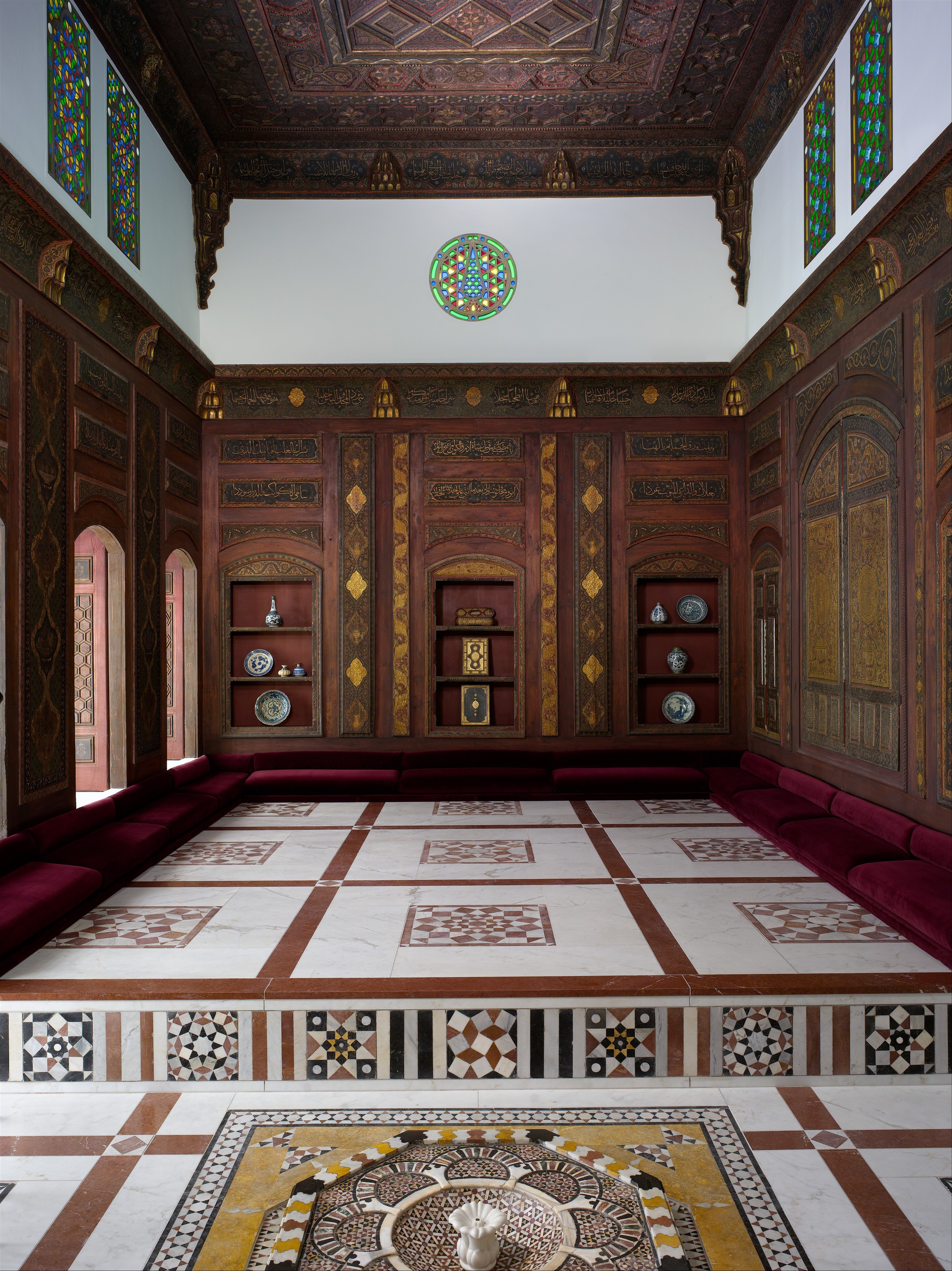
The Damascus Room at the Metropolitan Museum of Art, a winter reception room (qa’a), dating to c. 1707 (Met 1970.170). Once part of a home in Damascus before its disassembly and transportation to New York City in the 1930s, this room resembles the reception hall of a well-to-do Ottoman family in early modern Damascus, though some elements were added later or otherwise modified. ‘Abd al-Ghanī’s house may well have contained a room, if not quite of this opulence, along these lines, for the greeting and hosting of guests.
Introduction: ‘Abd al-Ghanī al-Nābulusī (1641-1731), a frequentpresence on these pages, embodied many roles and identities over the course of his long life, a life that spanned major transformations in the nature of the Ottoman Empire in which he lived, as well as changes occurring in the wider world of early modernity. For many during his lifetime, and even more so after his death, he was a preeminent, even the preeminent ‘friend of God’- saint- of his age. His role as a major theological and philosophical thinker, author, and teacher was often seen as an aspect of his sainthood, the sheer scope of his literary productions and teaching activities, instructing all sorts of people in all sorts of subjects, as evidence of his special relationship with God. The passages that I have translated below are taken from the expansive biography written by ‘Abd al-Ghanī’s great-grandson, Muḥammad ibn Muḥammad al-Ghazzī (1760-1799), titled Wird al-unsī wa-al-warid al-qudsī fī tarjamat al-ʻārif ʻAbd al-Ghanī al-Nābulusī. One of the longer chapters of this work consists of biographical entries, some brief, some quite long, of ‘Abd al-Ghanī’s many disciples and students, demonstrating the shaykh’s numerous social ties and relationships as well as the geographic reach of his instruction and saintly reputation.
The entry translated here- aside from the introductory paragraph, which I will summarize- concerns one Muṣṭafá Ṣafī al-Dīn al-‘Alwānī (1696-1779), a member of the ‘ulama of the city of Hama, descendant of a sixteenth century sufi saint, but whose later career was primarily based upon his skill as a poet and littérateur. In 1722 he came to Damascus from Hama in the company of his primary teaching shaykh, one Muhammad ibn Maḥmūd al-Ḥabbāl, taking up residence in the Bādharā’iyya madrasa. They both went together to visit ‘Abd al-Ghanī, who by 1722 was advanced in years and well established reputation-wise as both a saint and scholar. Our account picks up with Muṣṭafá meeting ‘Abd al-Ghanī for the first time.
Commentary follows the translation, but a few explanatory words will guide the reader unfamiliar with some of the conventions and terminology. Muṣṭafá wants to ‘read’ a book under ‘Abd al-Ghanī’s supervision, which entails, following a long-standing convention in the Islamic world (with analogues elsewhere in medieval and early modern Eurasia) whereby one would study a book by writing it down for one’s self or even memorize it, reciting back what one had written or memorized to the author, who would then grant an ijāza, a ‘certificate,’ stating that the student had properly received the text in question and was authorized to transmit it himself (or on occasion herself). The sessions in which this process took place could also allow the author to explicate and clarify the text. The verb that I alternatively translate as ‘read’ and ‘recite’ is qara’a, a particularly multivalent verb, which can also have the meaning of ‘study,’ as it in fact does here.
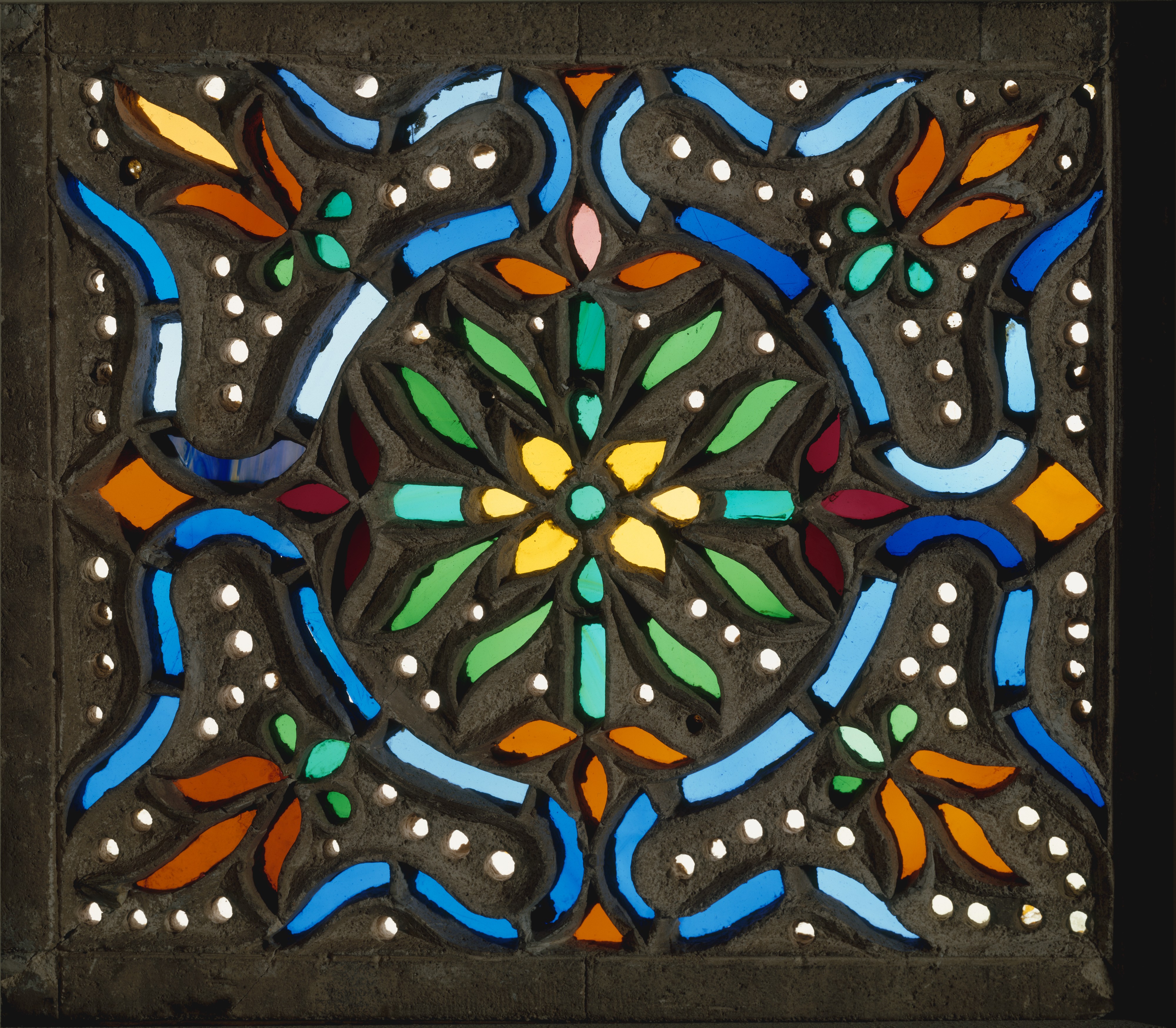
A stained glass window that once decorated an Ottoman home in Syria or Egypt, made at some point in the 18th century (Met. 93.26.3).
Translation: Love of [‘Abd al-Ghanī] seized the whole of his heart, so he returned to him and sought permission to read under him, asking which book [he should read]. The Master (al-ustādh) said to him: “Read our book on the oneness of being named al-Wujūd al-ḥaqq.” Then the Master gave him a quire (kurrās) from out of his own copybook, saying to him, “Write it down in your own handwriting, lesson (dars) by lesson.” He specified to him that the time of the lesson would be on Friday after the ṣalāt, and that every week he would read one lesson. [Muṣṭafá] would take the notebook and write it down in it. So it occurred that every Friday he would go to the Ṣālaḥiyya [neighborhood] and enter the house (dār) of the Master after the ṣalāt, kiss the hand of the Master and sit down. Then the Master would raise his head from writing and say, “Recite.” He would recite, then kiss his hand and go. He did this for a while, though his shaykh, al-Ḥabbāl, did not know about it. One day this Shaykh al-Ḥabbāl entered [Muṣṭafá’s madrasa] room, previously mentioned, began leafing through his loose pages and books, and found the book of the Master, al-Wujūd al-ḥaqq, in his possession, he having written out a goodly portion of it. He asked him about it, and he told him that he was reading the book under the Master’s supervision and so forth. Al-Ḥabbāl said to him by way of advice, “My son, you are not ready to read the like of this book, you don’t have the disposition for understanding the books of ḥaqā’iq [‘esoteric’ theology]. If you want to receive something from the Master and derive blessing from him, read under him a book on the technical terms of hadith, and get an ijāza from him—that much will suffice you.” So [Muṣṭafá] complied with his words. In accordance with his custom on Friday he went with a portion of what he had written out to the Master, this time from the book Sharḥ al-Nukhba [by Ibn al-Ḥajar (1372-1449)], on the knowledge of technical vocabulary. He entered into the Master’s presence, kissed his hand, and sat down. The Master did not raise his head from his writing, and did not say anything to him! He remained looking at him until the ‘aşr adhān [call to prayer] of that day, and the Master arose, prayed the ‘aṣr ṣalāt, then after completing his prayer looked at [Muṣṭafá] and said, “Ya Sayyīd Muṣṭafá, we do not instruct save our own books, and if you wish to read under us then read our books!” He did not expand upon those words any further. Muṣṭafá understood that what he had intended to ask of the Master had been revealed to him by way of unveiling, and he resumed his completion of the recitation of the aforementioned book.’ Continue reading “Teacher, Student, Text, and the Control of Knowledge in Early Modern Damascus”→
I do not generally consider the kinds of history I do, either academically or for the wider public, to be especially ‘political’ (in the ordinary sense of the term at least) nor driven by a concern for activism. My own ideological and philosophical profile has become much more convoluted and much less clear over the years- in part because of the challenges my study of history has presented to many of my earlier presuppositions- and while I do not imagine that some pure ‘objective’ stance exists from which to do history, I do aim at letting the past in all its complexity and heterogeneity guide my own approaches as much as possible.
Of course, the fact that I do not put a great deal of energy into shaping the political profile of my scholarship or its possible political and cultural uses does not mean that my scholarship isn’t politically charged or that it might not make a difference (not necessarily predictable) in a given political or cultural situation. My focus on Islamic history arose in no small part out of the context of post-9/11 America and even more so the American invasion and occupation of Iraq in the early 2000s. I hoped that my scholarship, and perhaps also the whole tenor of my life, could act as a corrective, a sort of reparation even, for what my country had done and was doing to people across the Islamic world. That wasn’t my only motivation, to be sure, but it was- and is, in modified and I would like to think somewhat more sophisticated form- a part of why I embarked on the path upon which I still find myself.
The political potency and even importance of the sort of scholarship that I and many others in history, religious studies, and other disciplines do was driven home today with the horrific terrorist attack in Christchurch upon Muslims praying the Friday prayers. Last night, before the news had broken about what was happening on the other side of the world from me, I posted the following tweet, a rather casual observation about medieval artistic patterns in Iraq and points north into the Armenian lands:
I am not an art historian but it strikes me that these two manuscripts-(l) a c. 1250 Baghdadi Maqāmāt; (r) a 1455 Armenian Gospel made near Lake Van’-have a lot of overlap in visual vocabulary, color choices, and so on, indicative of shared and continuous late medieval traditions pic.twitter.com/lycD5xgFSg
On the surface this is not an especially ‘political’ observation. Late medieval Armenian art, even to a relatively untrained eye, displays many differences from earlier periods, with many components that appear ‘Islamic,’ even if the exact analogues in non-Armenian art are not always clear. It seems likely to me that the 13th century Maqāmāt painting tradition revealed in the Baghdad manuscript above can be connected to the 15th century Armenian Gospel and similar productions, as part of a shared cultural sphere that extended through the Jazīra into the Armenian lands and west to Syria, a shared sphere that can be seen in many other instances of art and architecture. ‘Armenian’ culture more broadly, in medieval and early modern periods alike, is marked by creative interaction with, and active integration within, the ‘Islamic’ cultures in which Armenian communities lived, creating a complex cultural world that cannot really be reduced to ‘Armenian’ or ‘Islamic’ or ‘Arabic’ or any other homogeneous-sounding appellation.
What does this have to do with the fascist terrorist in Christchurch? While the mimetic (in more than one sense) culture of online fascism is itself quite complex and notoriously slippery, it is very clear that the terrorist (possibly terrorists) in Christchurch, and their political kin elsewhere, draw upon a very particular ‘narrative’ of history, particularly Islamic history. I hesitate to call it a coherent narrative since it is really more an emotionally-charged bundle of stories, sentiments, memes, and fragments of narratives, images and moods. It does not depend so much on a structured account of history as an overall mood or sentiment, one in which ‘Islam’ is a looming and deadly mass, consuming and leveling all before it. Islam and everything non-Islam are imagined only in terms of conflict and violence and terminal struggle. The Christchurch terrorist emblazoned his weapons with verbal images of some of this imagined history- the Armenian genocide, the fall of Acre- which summon up images of stark conflict, of zero-sum interactions. There is no room in this historical imagination for ‘Islamized’ Armenian Gospels, or, say, the role of Muslim troops in the wars of the British Empire. He did not invent these images, nor did he devise the historical narrative of which they are a part. Rather, they have been put together by various actors, mostly online, and exist in the ethereal space of (mostly) social media. Given the right circumstances and agents, they can have real power, as today’s events reveal.
Which is why, I want to cautiously argue, presenting alternative images, alternative narratives, such as the very sort I suggested- rather offhandedly- on Twitter right on the cusp of the terrorist in Christchurch bringing his own historical narrative to bloody life. Now, the historical narrative I presented has the advantage of being true, or at least inclining towards historical truth, constructed carefully and as the result of much research and analysis. In the online world of meme and image and mood, however, if we’re being honest, the possession of historical truth or something like is not necessarily an advantage. What counts is the degree to which certain moods and imaginaries and narratives can capture people’s attention, structure their sense of what is real and what matters. Good historical scholarship, because it captures historical reality better and more fully and hence more powerfully than the manipulations of fascists or other ideologues for whom history is nothing more than raw material for politics and socio-cultural struggle, can put forward images and narratives and moods that can stand in opposition to the tendentious ones of fascists and others.
In other words, this machine of historical scholarship may not kill fascists, but it can create different emotional and imaginative spaces, one that can neutralize the narratives and emotional spaces that feed fascism (and other ideologies, too, I would add, such as militant ‘Islamism,’ itself a fascist-like tendency). ‘Public history,’ whether that means tweeting, writing books for a wide audience, participating in community events, giving lectures, or whatever, puts the narratives and spaces that arise from scholarship out into the wider world, where they can potentially have very real power. It would be naive, of course, to imagine that historians can somehow by themselves stop the next mosque shooting, or prevent ISIS from re-organizing. These movements and tendencies are multi-causal and complex, like everything in human society. However, I do think that we- self included- as historians, particularly of Islam, have a role to play, that even small things like presenting different images (sometimes quite literally), of making worlds and realities visible that would not otherwise be seen by the wider public, that such things can make a cumulative difference.
That the position of dogs in Islamic societies has often been an ambiguous one is relatively well known. However, the ambiguous and sometimes hostile attitudes and practices directed at canines by some in the Islamic world down through the centuries is but part of the story of the place of the dog in Islamic societies and Islamic traditions. The role of dogs in elite culture is relatively well known- the modern day saluki, for instance, probably traces its ancestors back to dogs owned by members of elite groups in the Middle East and elsewhere- with such dogs often being employed in both hunting and as every-day animal companions. But dogs could be found in many other capacities as well: any town or city would have its street dogs, animals who show up in the story from Rūmī’s life (1207-1273) illustrated below, and in the tale from the life of Şemseddîn Ahmed Sivâsî (1519-1597), while guard and herding dogs would be found in the countryside. And, as the following stories indicate, dogs could have a more intimate relationship with humans, even to the point of close companionship.
I’ve arranged these accounts, taken from Persian and Ottoman Turkish sources, in chronological order, each reflecting a somewhat different stance towards dogs and their relationship with humans, each involving ‘friends of God’ in an Islamic setting, as described by a hagiographer. The first, written sometime before 1291, concerns the canine companion of Rūmī’s grandson, Chalabī Amīr ‘Āref, a dog named Qeṭmīr after the famed canine companion of the Seven Sleepers of Ephesus, a dog who is described as being effectively a saint in his own right. The second story, from the life of Shaykh Ṣafī al-Dīn al-Ardabalī (1252–1334), the eponym of the Safavī sufi order and later Shi’i dynasty that would rule over the Iranian lands for some two and a half centuries, is the oddest and most ambiguous of the two, as it suggests a sort of sanctity on the unnamed dog’s part, but in a very ambiguous way. The final story is from a compilation of saints’ lives produced in the late 17th century Ottoman Empire, and may very well be ‘in dialogue’ with the preceding two, since both the menâkıb of Rūmī and of Shaykh Ṣafī, in both their Persian originals and in later Ottoman Turkish translations, were well known in the Ottoman lands.
It is also transmitted that, having received Qeṭmīr [the dog] from Shaykh Nāṣeh al-Dīn, Chalabī [Amīr ‘Āref] set off and instructed Qeṭmīr: ‘Come along with us!’ When the dog had gone a few steps, he turned around and looked at Nāṣeḥ al-Dīn, who said: ‘What are you looking at? Would that I were in your place and might become the dog of that royal court!’ Then Qeṭmīr rolled about, let out a yelp, and set off running.
Similarly, in the city of Lādīq during the samā’ he would enter the circle of the companions and turn about with the noble disciples. Another of his miracles was that whether at home or abroad no dog ever attacked him, nor did any dog bark at him. When they sniffed him, they would form a circle around him and lie down. And whenever Chalabī sent a messenger somewhere, he would join Qeṭmīr to him. Indeed, whether it was a journey of ten days or a month, Qeṭmīr would escort him to his destination and then return. Moreover, they [burned] his hair and used the smoke to treat fever. The fever would depart.
Whenever he saw a denier, without mistake he would piss on him. And he would never eat food from deniers of [Mowlānā Rūmī’s] family. If they secretly mixed that food from the companions and gave it to him, he sniffed it and wouldn’t eat it!
Shams al-Dīn Aḥmad Aflākī, The Feats of the Knowers of God: Manāqeb al-ʻārefīn, translated by John O’Kane (Leiden; Boston: Brill, 2002), 659
Commentary: This is just a selection from the ‘biography’ of the dog Qeṭmīr, who receives fairly extensive treatment from Aflākī- who was himself a companion and disciple of Shaykh Chalabī. In this section, Qeṭmīr is treated much as a saint would be, with a description of his entry into the company of Shaykh Chalabī, himself sanctified primarily through his descent from Mavlānā Rūmī, followed by practices typical of a ‘friend of God,’ only here in canine form: entry into ecstatic dance (the samā’), recognition of his inherent sanctity by others of his kind, the ability to heal diseases, and preternatural recognition of interior human dispositions and other things otherwise impossible to discern. To my knowledge this is the only dog so depicted in Islamic hagiography, though the dog below comes close- if anyone out there is aware of other instances do let me know in the comments!
Another account involving dogs in the Manāqeb al-ʻārefīn: Rumi addresses the dogs of the marketplace, from a c. 1590 copy of the Ottoman Turkish translation of Aflākī’s menāqib (Morgan Library MS M.466, fol. 66v)
The custom of this dog was that if a hypocrite was in the midst of the [Sufi] assembly this dog would enter and would smell the men gathered, one by one, and upon the one who smelled of hypocrisy he would urinate, so that the person would be completely humiliated. One day a man of great reputation sat in the assembly, and when the dog smelled from this man the scent of hypocrisy, he urinated on him, so that the man was greatly embarrassed and mortified. The shaykh was angered by this, and cursed the dog that ‘He go to pieces!’ Then the dog disappeared and was not seen for one or two days. When they searched for him, they found him under a rosebush, dead, all gone to pieces.
Ibn al-Bazzāz al-Ardabalī, Ṣafvat al-ṣafā ([Tehran]: Intishārāt-i Zaryāb, 1376 [1997 or 1998]), 612. Translation by Jonathan Parkes Allen, 2019.
Commentary: The dog described here is described in a previous section as well, as being a black dog who hung around the zawīya of Shaykh Ṣafī as something of a regular fixture. The entire account is part of a chapter devoted to Shaykh Ṣafī’s miraculous interactions with the non-human world, including animals, which receive a sub-chapter. The unnamed black dog described here seems, at first glance, to be almost a facsimile of Qeṭmīr from a few decades previous: he can preternaturally detect ‘hypocrites,’ presumably meaning here people who did not believe in the sanctity of Shaykh Ṣafī or in the legitimacy of sufi practices. Yet when he seemingly righteously takes a piss on just such a person, Shaykh Ṣafī grows incredibly angry with him, employing his ‘jalāl,’ or power of divine wrath, upon the hapless animal. What are we to make of this? I am honestly not entirely sure. That Shaykh Ṣafī accumulated lands and goods and influence is not disguised in this saint’s life, so perhaps we are meant to understand him as being properly angry at alienating a man whose wealth could potentially be turned to the good use of Shaykh Ṣafī’s community. It is possible as well that the story is meant to distinguish Shaykh Ṣafī from Rūmī, though this seems a bit of stretch to me. Doubtless other things are going on in these accounts, with which I am generally less familiar than the other two examples- again, comments or suggestions are welcome!
From among [Şeyh Şemseddîn Ahmed Sivâsî’s] miracles was the following: the people of Karahisâr-ı Şarkî [modern Şebinkarahisar] sent messengers to Şems asking him that he honor them with his preaching, counsel, [performance of] zikr [remembrance of God], and his blessed noble beauty. In answer to their supplication he came, and was honored immensely, being given a fine place to stay as well as much feasting and amiable conversation. For some time he preached, gave counsel, and led zikr, then announced that he was returning to Sîvâs. When the scholars, şeyhs, merchants, notables, and ordinary people of the town all came together to give him a farewell with honor and respect, numerous dogs also came before the saint, and, as if presenting complaints, began barking! When Şems asked why they were barking so, the people replied, “Because there has been plague and pestilence in our town, the kadi [judge and administrator] of our town ordered the killing or banishing of the dogs, so that we killed some and we banished some. These are dogs that we banished.”
The saint cried out, “Your kadi was heedless of the hadith which says, If dogs were not a community (umma) from among the communities, then I would order them killed.” Saying that, he addressed the dogs: “Go safely and soundly back to dwell and to be at rest in your former places!” As the townspeople returned from bidding the saint farewell, they saw these words fulfilled as the dogs, understanding the command, followed after the people back into town to their usual places—and having done so, by the command of God, the plague was lifted on that very day!
Şeyh Mehmet Nazmî, Osmanlılarda tasavvufî hayat: Halvetîlik örneği : Hediyyetü’l-ihvân, edited by Osman Türer (İstanbul: İnsan Yayınları, 2005), 359-360. Translation by Jonathan Parkes Allen, 2018.
Commentary: In this story we see dogs recognizing someone’s sanctity, but this time that of a human saint. In recognizing Şemseddîn Ahmed Sivâsî’s holiness the dogs also engage in another typical action directed at saints, that of supplication in the face of unjust ‘secular’ authority, thus reinforcing the saint’s authority. This interaction with the dogs also allows Şeyh Şemseddîn to enact his saintly authority over the entirety of the town in a dramatic way: when he discovers that the dogs of the town have been unjustly displaced by the unkind and implicitly irreligious kadi, he rebukes the kadi and intervenes miraculously so as to restore the dogs to their rightful places in the town, restoring harmony, as indicated by the lifting of the plague. In returning the dogs to their places Şemseddîn also, at least temporarily, displaces the Ottoman kadi from his sultanically designated place, not only nullifying his anti-dog decree but also casting aspersion on the kadi’s knowledge of the Prophetic sunna, a reminder of Şemseddîn’s mastery of both the exoteric and the esoteric, mastery which could shape the very configuration of the places through which he passed, mastery to which even dogs might respond.
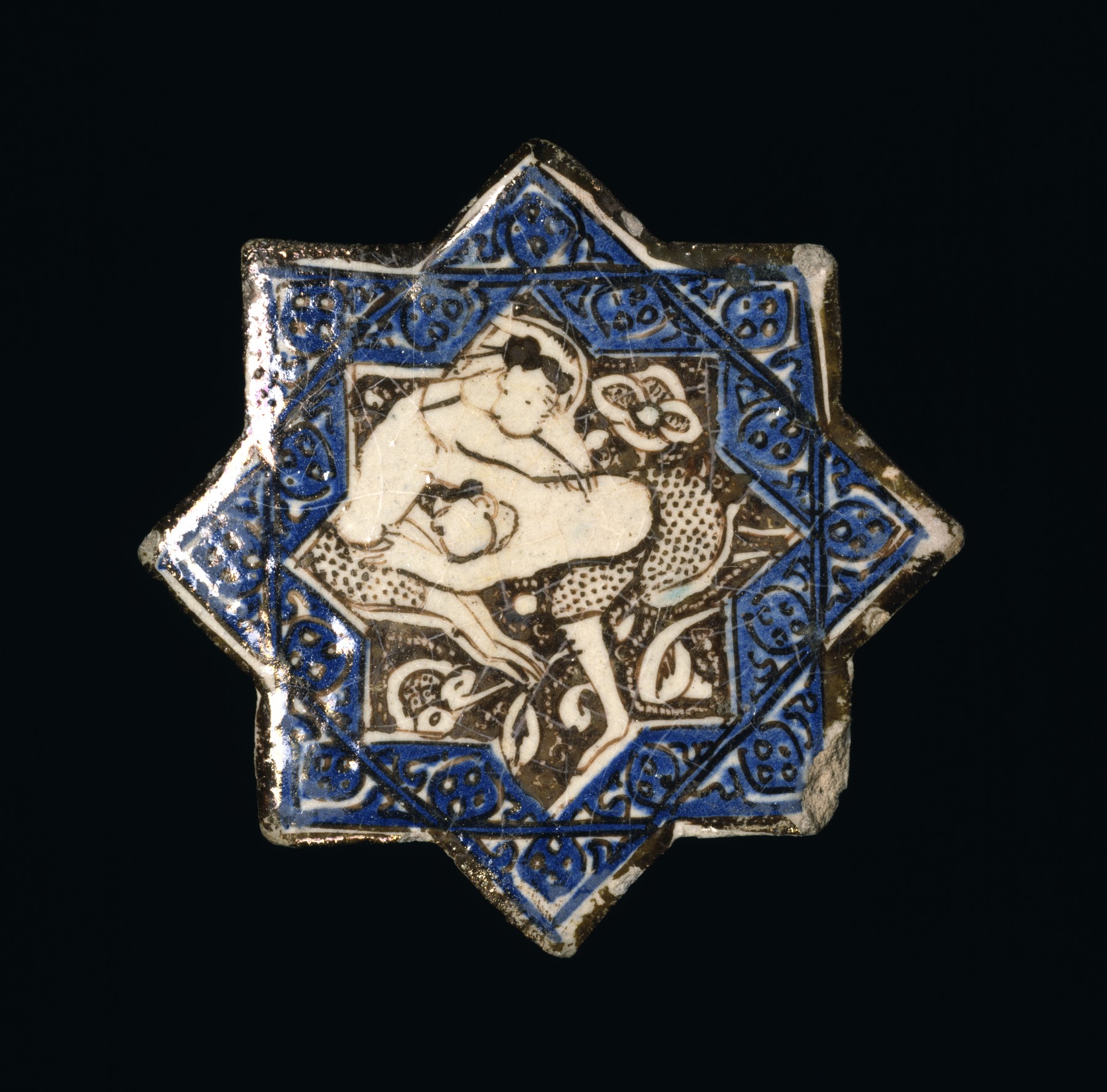
Wrestlers in a Persianate context, similar to that of the story below, as depicted in a sixteenth century Safavid illumined copy of Sa’di’s collected works (Walters W.618.31B)
Sufism has developed over the centuries a vast technical vocabulary, with many elements filtering out into wider Islamic (or, better, ‘Islamicate’) societies and languages. One of the more difficult terms that makes up this stock of words describing sufi practice and theology is the Arabic word himmah, taken into Persian as himmat. Its basic lexical meaning is, per Steingass’ Persian dictionary, ‘Inclination, desire, resolution, intention, design,’ with the additional meanings of ‘ambition, aspiration; mind, thought, attention, care; magnanimity; power, strength, ability; auspices, grace, favour.’ The sufi usage of himmah encompasses all of these: when a shaykh is said to possess or wield himmah, we might say that he exerts the power of his mindful intention, power which is invested in him by virtue of his relationship with God. It’s a bit like ‘the Force’ in Star Wars, in that through the use of his himmah the advanced master is able to psychically- so to speak- manipulate things in the physical world outside of his body, similar to the way a Jedi master might employ the Force to move objects or change a person’s thoughts or will.
The ambiguity of himmah is not simply the case of being at a remove from the original languages of sufism- it’s clear from the sources that medieval and early modern sufi authors felt a need to explicate what precisely was meant thereby to contemporary audiences. The story I’ve excerpted and translated below comes from a Persian-language collection of lives of Inner Asian Naqshbandī saints, entitled Rashaḥāt-i ʻayn al-ḥayāt, by Fakhr al-Dīn ʿAlī ibn Ḥusayn Wāʿiẓ Kāshifī Ṣafī (1463 – 1532-3). The story is part of longer clarifying discussion by Kāshifī about himmat, as an introduction to the miracles of the important fifteenth-century Naqshbandī saint Khwāja ‘Ubayd Allāh Aḥrār. It also speaks, by the by, to a major component of wider Persianate culture during this period and afterwards, namely, the role of wrestling, a sport which provides the setting for the miracle story.
From a somewhat earlier period, two wrestlers, as depicted on a 13th century Ilkhanid tile (Walters 48.1283)
One day we came to the wrestling-grounds where two people were wrestling—one was powerfully and immensely built of frame, while the other was weak and scrawny of body. The big fellow was making easy work of the weak one, so that we felt merciful towards him, and I said to Mawlānā Sa’d al-Dīn [Kashgārī], ‘Use your power of mind (himmat) and send out a thought (khāṭir) so that that weak one can triumph over that powerful one!’
He replied, ‘You pay heed, and we will also lend aid.’ So his thought turned in that moment to the weak one, and in a flash the weak one was invested with great strength so that he was able to extend his arm and with dexterous skill lifted the powerful-framed man from the ground, hoisted him overhead, then threw him down into the dust of the ring. A great exclamation went up from the crowd, the men watching amazed and bewildered by what had transpired, none of the spectators aware of the secret of it.
ʻAlī ibn Ḥusayn Kāshifī Ṣafī, Rashaḥāt-i ʻayn al-ḥayāt, ed. ʿA.A.’ Muʿīniyān (Tehran: Bunyād-i Nīkūkārī-i Nūriyānī, 2536/1977-8), v. II, 517.
Fig 1.: Manuscript Bible, illustrated by Hayrapet Jul’ayec’i, 1649 in New Julfa. (“Matenadaran” Mesrop Mashtots Instutute-Museum of Ancient Manuscripts, ms 189) .
The four images in this post- two from Western Europe, two from the Safavid Empire- paint a picture of the inter-connectivity of places, religious communities, and cultural traditions of early modern western Eurasia, inter-connectivity that took place without any single power or region dominating, as would be true from the nineteenth century forward. These images also illustrate the problems with the language of ‘influence,’ as well as the fact that religious communities and traditions that were at odds in some respects could still participate in shared cultural paradigms and draw upon the work and concepts of others in creative ways. In particular these images demonstrate the complicated place of ‘print culture’ in a Eurasian context, printed texts co-existing and interacting with non-print modes well through the seventeenth and eighteenth centuries.
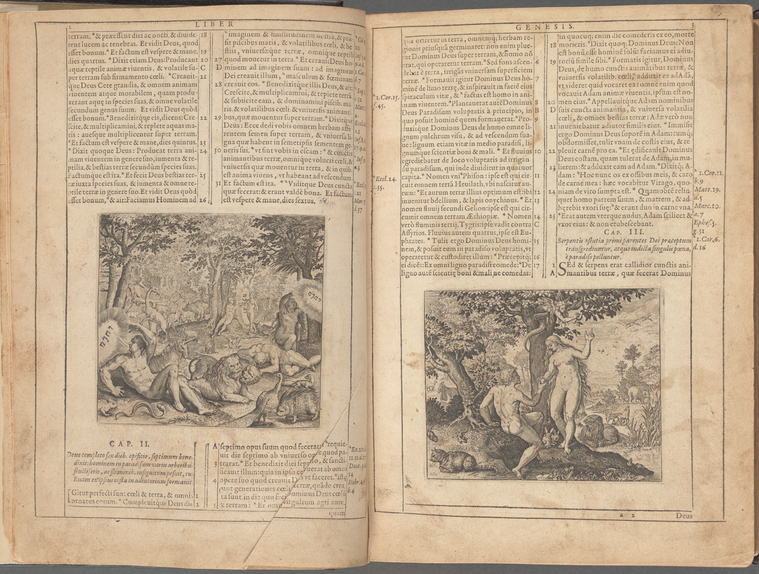
In this first pair of images, Fig. 1 and Fig. 2, illustrating the first chapters of Genesis, the Armenian illustrator Hayrapet Jul’ayec’i has drawn upon the images of Johann Theodor de Bry for his own illumination of the Bible. The relationship is obvious upon even casual examination, such that one might be tempted to call the Armenian paintings ‘copies.’ But slightly closer examination reveals something more subtle going on. Jul’ayec’i has followed the general form and many of the details of de Bry’s engravings, but has done so in a transformative way: the images have been placed in a new arrangement, one that proceeds in chronological order from left to right, the borders dividing the scenes employing motifs with deep roots in Armenian illumination. Most significantly, Jul’ayec’i has rendered these scenes in color, in brilliant color which calls to mind earlier illumined Armenian Bibles. The entire production has furthermore been placed within a manuscript Bible, instead of the printed Bible of de Bry. The reference to de Bry, and by extension, Western European art conventions, remains unmistakable- but in rendering them in the bright splashes of Armenian painting they have been translated and re-appropriated (there is literal translation as well- note the inclusion of Armenian text in Jul’ayec’i’s painting). ‘Remix’ is one way of thinking about such a piece, the form remaining but the interpretation rendered making the piece an effectively new creation, the mood and resonances it conveys departing dramatically from the original ‘cited’ imagery, even as the new art depends on the original to some degree.
Fig. 2.: Biblia Sacra vulgatæ, pages 2 & 3, engravings by Johann Theodor de Bry, Mainz, 1609 (General Research Division, The New York Public Library).
What is particularly notable about Jul’ayec’i’s art, and that of the many other Armenian artists and manuscript producers who employed similar techniques vis-a-vis print culture circulating in Armenian communities (which in itself reminds us that it was not unusual for a Bible printed in the Netherlands to end up in the Safavid lands), is that Armenians were not themselves strangers to print culture. The first Armenian book was printed in 1512, with an increasing pace of printing in a number of presses across the vast Armenian world of western Eurasia. Simultaneously, Armenians produced, sponsored, and purchased manuscripts such as that from which contain Jul’ayec’i’s illuminations. Print culture was useful for some things, while manuscript culture and its associated arts continued to play an important role, from liturgical texts to diaries to magical scrolls. And just as manuscript arts and traditions left their imprint in Armenian print culture (and many other iterations of print culture across early modern Eurasia), the new possibilities that printing opened up could find their way into manuscript production.
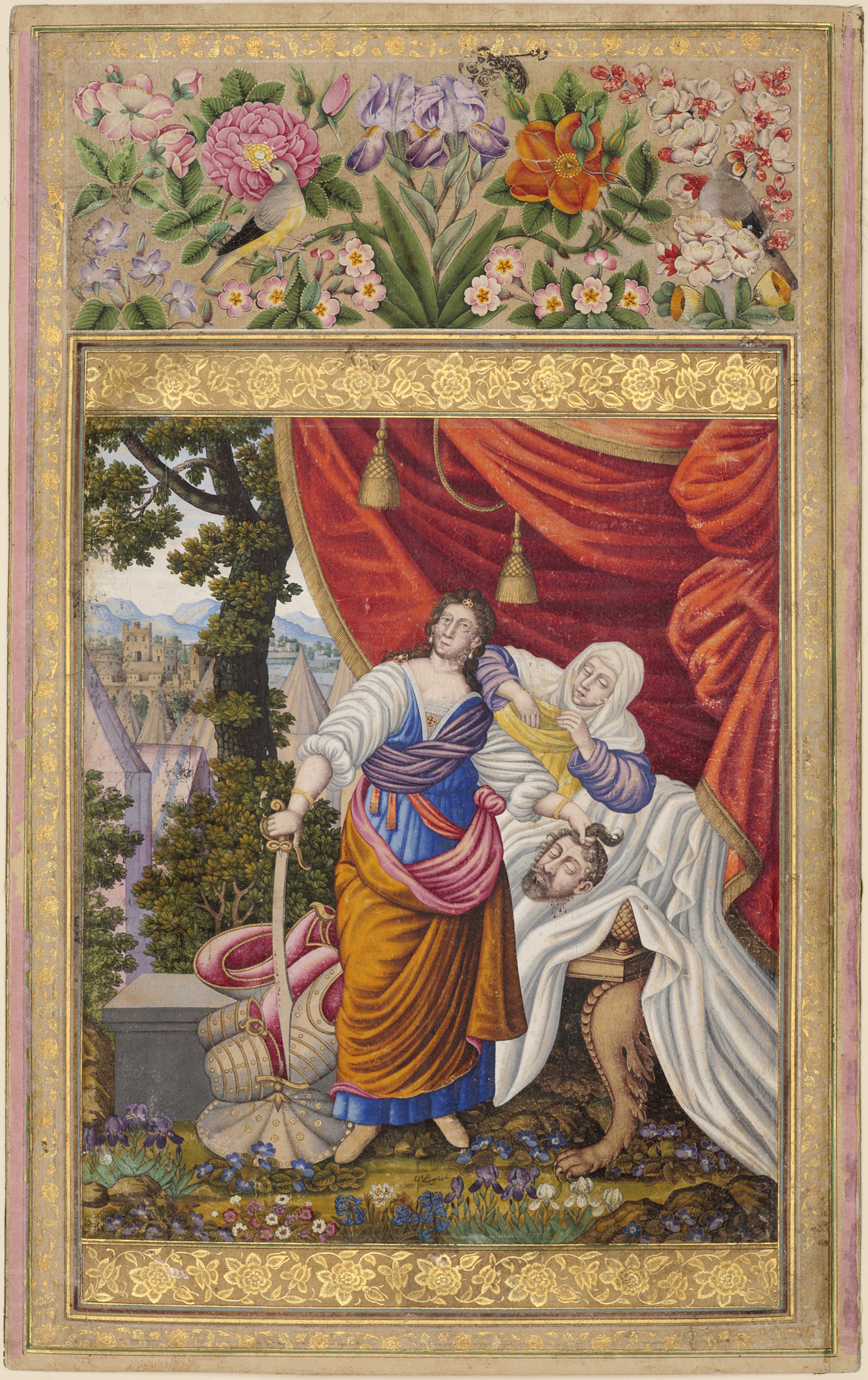
In the Safavid world, Armenians were not the only people creatively adapting and ‘remixing’ Western European print culture material. Persian-speaking Muslim artists, such as the seventeenth century painter Muhammad Zaman, were also making interesting use of imagery circulating out of Western Europe. Witness Zaman’s rendering of the iconic scene of Judith with the head of Holofernes:
Fig. 3.: Judith with the Severed Head of Holofernes, Muhammad Zaman, c. 1680, Isfahan, Safavid Iran (Khalili Collections MSS 1005).
Zaman’s depiction of this scene incorporates material from an etching of a painting by the fifteenth century Italian artist Andrea Mantegna (fig. 4). But just as his Armenian contemporary had done with de Bry’s etchings, Zaman has transformed the scene. It is now in bright and vivid color, reminiscent of more traditional forms of Persianate miniature (which itself had long been in dialogue with Armenian painting). Just as Jul’ayec’i reframed his source material, Zaman has not only filled out the scene around Judith and her maidservant with lush vegetation, vivid flora, and a scene of a camp and a city in the background, but in keeping with the conventions of Persianate art he has embedded his painting within a series of frames, frames that are as much a part of the painting as the main image itself. Particularly strikingly, he has filled the upper panel with realistic flowers, flora typical of alpine Eurasia such as primroses and irises. The result is a striking contrast between the delicate beauty of the flowers and the gory sight of Holofernes’ head being held aloft, a somewhat incongruous scene. What would Zaman’s viewers have taken away from this painting? Would they have known to what it was referring, whether in terms of story or in terms of the source in Andrea Mantegna’s depiction? The Western European elements, as in the Armenian imagery above, are unmistakable, diverging as they do from the canons of Persianate art: yet they have been rendered into a Persianate style and frame (literally and figuratively). Some of the meaning is retained, while other aspects are transformed- for instance, it is possible that most viewers would not have known the story itself, leading them to imagine their own story or to connect the image with stories they did know. Continue reading “Print Culture Remixed: Safavid Painting Across Confessional Boundaries”→
Birds, insects, and flowers, from the border of a c. 1500 calligraphic rendering of a different text by Jāmī, the Subḥat al-abrār. (Met 1985.149)
Shaykh Jawhar was in the beginning of his life the slave of someone, then became free, and took to buying and selling in the marketplace of Aden. He would attend the sessions of the [sufi] fuqarā’, [1] and had perfect belief in and loyalty towards them. He was illiterate. When the time of his shaykh’s death approached—the great shaykh Sa’d Ḥadād who is buried in Aden—the fuqarā’ said to him: ‘After you, who do you want to be shaykh?’ He replied: ‘The person who, on the third day after my passing, in the place where the fuqarā’ have gathered, a green bird comes and sits upon his head.’
When the third day came and the fuqarā’ had finished with Qur’an and dhikr they sat down in keeping with the shaykh’s words. Suddenly they saw a green bird had come down and had settled nearby, each of the important members of the fuqarā’ hoping that the green bird would sit on his head. But after a while that bird flew up and alighted on the head of Jawhar! He had not at all imagined that this would happen, nor had any of the other fuqarā’! They all came before him and were set to bear him to the shaykh’s zawīya [2] and seat him in the place of the shaykh. But he said, ‘What qualification do I have for this work? I’m just a man of the marketplace and am illiterate! I don’t know the adāb and the ṭarīqa of the fuqarā’, [3] and I have obligations towards others to fulfill and relations to untangle!’
They replied, ‘This is the will of Heaven, you don’t have any way out of it! God will help you in whatever ways are necessary.’ So he said, ‘Give me a delay so that I can go to the marketplace and fulfill my obligations towards the Muslims there.’ So he went to the marketplace and met his obligations towards everyone, then went to the shaykh’s zawīya and adhered to the instruction of the fuqarā’, and he became like his name a gem (jawhar), possessing virtues and perfections whose enumeration would stretch long—glory to the Noble Beneficient One, that is grace of God which He bestows upon whom He wills, God possesses great grace! [4]
Abb al-Raḥman ibn Aḥmad Jāmī (1414–92), Nafaḥāt al-uns min ḥadarāt al-quds, edited by Mahdi Tawhidipur (Tehran: Kitabfurushi-i Saadi, 1959), 573-4, translated by Jonathan Parkes Allen, 2018.
[1] Literally, ‘the poor ones,’ but by this period shorthand for sufi devotees (who may or may not have been literally poor).
[2] The structure devoted to a particular shaykh and his companions, for sufi ritual, teaching, and so forth. One of several words for a space of this sort.
[3] That is, the ‘mannered practices’ and ‘spiritual path’ of the sufi devotees. Both terms have so many resonances that I find it generally best not to translate them into English but to leave them in the original.
[4] The section in italics represents Jāmī’s switch from the Persian of the main narrative to Arabic.
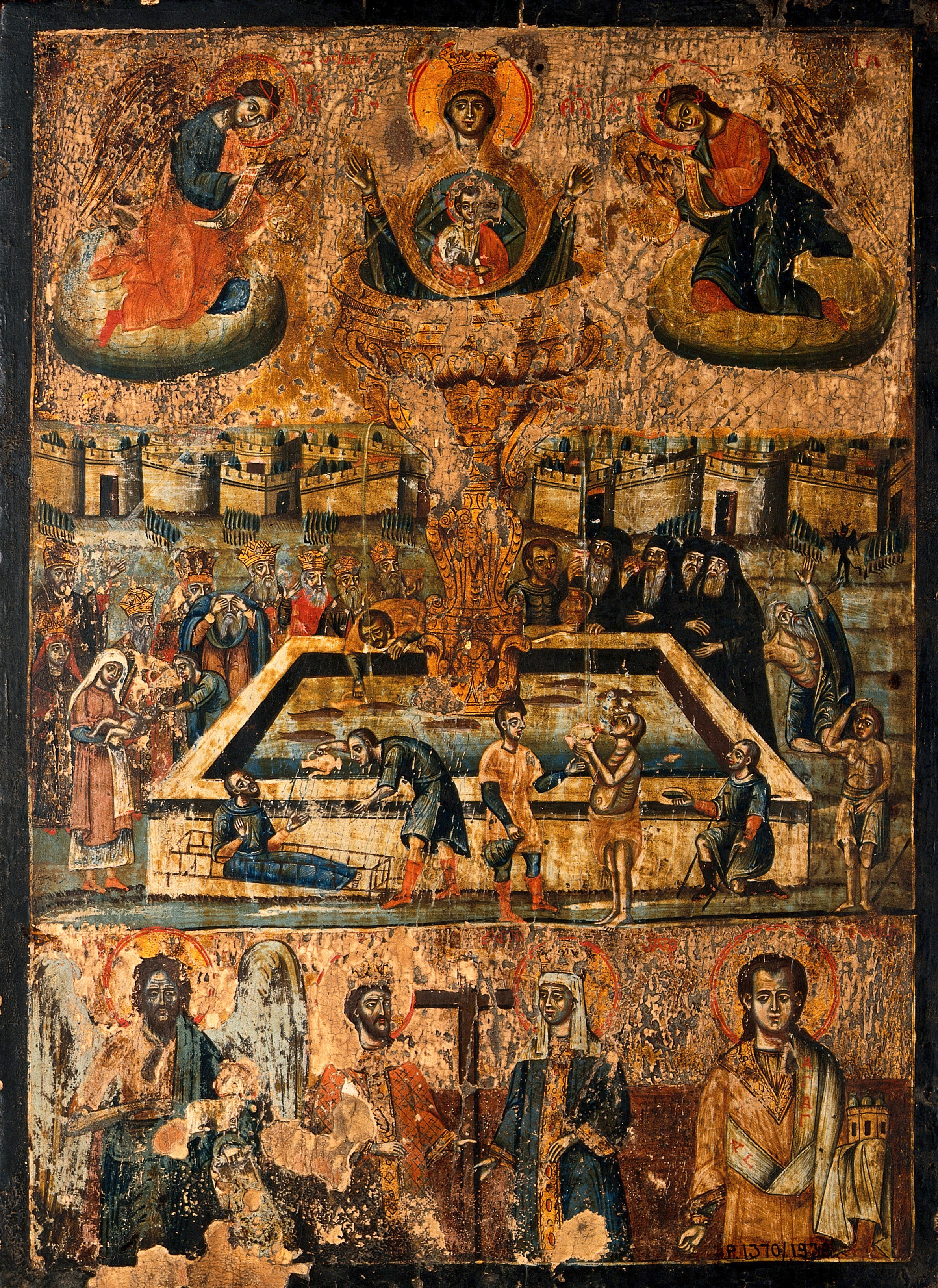
Fig. 1: A seventeenth century icon of the Zoödochos Pege, probably produced in Constantinople (Wellcome Library no. 44943i)
Just outside the Theodosian Walls of Istanbul is a spring which is today accessible from beneath a church of nineteenth century vintage, reached by a flight of marble stairs down into the living stone, a spring known as Zoödochos Pege (the ‘Life Giving Spring’) in Greek, Balıklı Ayazması (the ‘Fish Spring’) in Turkish, both names alluding to important features of this site of pilgrimage. One of numerous ayazmas, or holy wells, that appeared in and around Byzantine Constantinople and many of which have survived as places of veneration in modern Istanbul, the Zoödochos Pege is one of the most storied and most visited, from late antiquity to the present (it’s one of the handful of ayazmas I’ve visited, in fact). Long associated with the presence and activity of the Theotokos- as can be immediately surmised from the icon above- the spring’s veneration probably began during the reign of Justinian (527-565), though it might have begun even earlier, a vast trove of miracle accounts associated with the healing powers of the spring, blessed by the Theotokos, accumulating over the centuries. By Ottoman times, which are my concern here, the church above the spring had fallen into ruin, perhaps even before Mehmed II’s conquest of the city. Until the 1720s pilgrims visited a holy well that was, at least in part, out in the open, much as the icons I’ve selected here indicate (though they suggest a location on the surface of the ground, not essentially underground as was almost certainly true then and is definitely the case now.
The early modern Ottoman period seems to have seen a surge in interest in and veneration of this holy well, if we are to go by the numerous iconographic depictions that began to appear in the seventeenth, quite a few of which made their way into the Wellcome Collection (by a route unknown to me), from which I have drawn the two examples featured here. The above icon (fig. 1) lays out several repeating elements in these depictions, depictions which probably brought together a range of traditions and stories circulating among devotees: gathered around the stone basin of the holy well are representatives of miracle accounts, some whose stories we can easily put together- a man rising from his bed, a mother holding a healed child- others less evident to us now. The potency of the holy water of the well underlines each vignette, however, with the enthroned Theotokos and Christ rising above the waters, radiating holiness down into the well. The famed fish are also visible, themselves a part of the sacredness of the well, as the Turkish name indicates. This icon also features a row of ‘supporting figures’: St. John the Forerunner, Sts. Helena and Constantine at the Invention of the Cross, and a third saint, perhaps St. Mamas, an extremely popular saint during the Ottoman period. The icon is in rather rough shape, having been scratched or scraped at various points- not as iconoclastic damage (which would have targeted faces), but in order to use the scraped material for blessing, a way to participate in the holy power of the spring at a remove, as it were. The second icon I’ve included (fig. 2), at the end of this article, probably dates from the eighteenth century, and reproduces much of the same visual material as that above, but with the addition within the image of a stream of text coming from the Christ Child to a soldier, along with a gilded frame without. What drove this evident resurgence of interest in and devotion to the Zoödochos Pege? I am not sure, though, as I will hopefully soon discuss in a later post, early modern Ottoman Christians and Muslims alike expressed renewed devotions, often expressed visually, to their various holy places, from the seventeenth century forward. And indeed, it is possible, as the story of the second holy well might indicate, that it was not only only Orthodox Christians visiting this ayazma, but Muslims as well, which might help us understand the resurgence in interest of this particular ayazma, as a competitive process.
Less than a mile north of the Zoödochos Pege is the zaviye complex of a prominent Muslim saint of 16th century Constantinople, Merkez Efendi (d. 959/1552). While it does not seem to be very prominent today, this site also features a holy well, along with several other sites of veneration, at least in the early modern period, as described by Hafız Hüseyin Ayvansarayî in his late eighteenth century guide to the mosques and other religious structures in and around Istanbul: ‘There is an exalted ayazma in the vicinity of Şeyh Merkez Efendi’s tomb. One descends to it by steps. The abovementioned [Merkez Efendi’s] subterranean halvethane, which is like a cave, is still extant, and it is a place of pilgrimage for the Faithful [1]. The hamam located next to [Merkez Efendi’s zaviye] is one of its vakfs. The aforesaid [Merkez Efendi] had a private room in the hamam for bathing. At present the sick and invalid bathe [there] with purity of purpose and are restored to health.’ [2]







 Thicket & Thorp