Pious Graffiti at the Church of the Holy Sepulchre: Pilgrims’ Prayers and Traces of the Self

A Visual Essay

The Church of the Holy Sepulchre in Jerusalem, as any pilgrim or tourist visiting it quickly discovers, is a massive, maze-like structure, or, really, assemblage of structures, including the Tomb of Christ and of Golgotha but also numerous other chapels, rooms, and other elements. Somewhat closer investigation starts to reveal the multiple layers of construction and use, going all the way back the first century AD (and probably further, since the Tomb was located in the side of an already old quarry outside of the Herodian walls of the city). While the names of prominent men and women are often attached to these various architectural layers, beginning with Constantine and his mother Helena, the traces of far humbler pilgrims to the great church are also visible, if one knows where to look. Yet, as I observed on my visits to the church earlier this year, the steady streams of pilgrims and tourists, clergy and tour guides, pass right by these fascinating reminders of the centuries of pious visitors who have traveled- often over great distances and in difficult circumstances- to venerate the empty Tomb of Christ.

IMG_4901
The largely Crusader-era main entrance to the church, with entrance and front facade giving little indication of the size of the church’s sprawling interior. The pious graffiti is most abundant around the doors near the center of the picture.

Covering the columned framing of the great doors to the main entrance to the church are perhaps hundreds of instances of ‘pious graffiti’- prayers, names, dates, and short texts carved into the stone by pilgrims. Deeper inside the church, in a stairwell leading down to the Chapel of St. Helena, sunk within the living rock, are hundreds of neatly carved crosses left by Crusaders, also as pious graffiti marking and memorializing their pilgrimage. While in the modern world such defacement is looked down on and even seen as criminal, Continue reading “Pious Graffiti at the Church of the Holy Sepulchre: Pilgrims’ Prayers and Traces of the Self”

A Word to My Readers

Dear reader, whether long-time, occasional, or casual passer-by,

Over the coming months I would like to begin offering more original material in this space. Some of it will reflect my ongoing scholarly work, including excerpted topics and sources from my in-progress dissertation, or something drawn from the many other things I am interested in as a scholar. I am also committing myself to the regular writing and publishing of more personal essays, from a reflection on being drawn into the Palestinian-Israeli conflict to some thoughts on the intersection of fatherhood and ecology, and much more. I will also begin presenting at least two new poems a month- one by someone else, one an original composition of my own. Finally, I have a vast library of photographs I have taken and historical imagery I have accumulated that I want to begin sharing in earnest, so be on the lookout for more visual essays, starting with an exploration of the pious graffiti found in the Church of the Holy Sepulchre.

Part of my rationale for more writing is simply to improve my writing, in particular to refine my dissertation and the book project to come, God willing. Of a more philanthropic nature, I want to share the fruits of my scholarship with a wider audience, beyond the confines of the academy and of academic press paywalls. Finally, in order for this additional work I’m assigning myself to make some financial sense, I’ve decided to experiment with maintaining a Patreon account and soliciting supporters, as much as the thought of asking for money for my work grates on my genteel sensibilities and my resolute lack of entrepreneurship. If you’d like to sign up for a small, minuscule even, monthly donation- which you can of course cancel at anytime should you be dissatisfied with the quality or pace of my work- please head on over to my account, where you can also read my full spiel on why you should support me and what the benefits are: Jonathan Parkes Allen. New material will be posted here and on my Patreon page. I’d really, really appreciate any support you might be able to give!

That unfortunate business of soliciting money out of the way, I encourage you to check back into this space in the coming weeks and months, and to let me know if you have any topics that you think might be in my wheelhouse and which you’d like to hear something about.

Verses From Jerusalem

If I forget thee O Jerusalem—but how much do you, O Jerusalem, forget? Here
Is what you forget: all the lives lived and buried under your warm old stones, and
Stones that lie buried under newer stones, that give way to older cold stones,
Fenced and labeled, dead stones, an inner bark exposed to the air, the sap dried.
You forget too much, and not enough, O Jerusalem. If I forget thee—but how
Could I? You are lodged in me like the new old name of God lodged in the tongue
Of the mystic from Buffalo roaming your streets,
Like the crosses and the names sunk in the threshold of the holy Tomb.
Will you forget me after the dust of my feet has risen up into your air
And fallen east over the ridgetop settlements, over the bright waters of En Prat,
Over the high concrete walls, over dead forgotten cities in the desert,
Over Nabi Musa’s stark domes, over sad black tarps in the nomad camps?
What is the skill of your right hand, O Jerusalem? Gathering stones,
And in another time or in the same time, scattering them. Yet, in your left hand
Is remembering, rising up like scents in Suq al-‘Attarin, all your names
And the names within names in the many tongues
Pooling in your left palm, ephemeral, eternal,
But the right hand, it does not know what the left hand has.


September Beside the Potomac

Persimmon fruit hangs sweet and heavy in the air-
Bottomland forest along the Potomac,
First leaf falls whisp in and out, acorns, walnuts
Scatter and plop to the sandied floor, soundings.
Cool breeze washes the warm dense scent of the river
At end of summer up to us, promise of change. Memory’s scent,
Of my own late summer childhood nestling in
The sun-warmed receding pools, focusing the gentle force of drawn-
Down cascades in the Piney River, sniffing in the little river,
Shivering as the sun got low in afternoon
And we got out of the water. Now, my little son
Reaches out to feel the great round bole of a silver maple,
Smiling, two vigors, connecting. Together, we take in the
Touch, the forest and the river’s wafting multiplicities,
Such lines of continuity, untamed worlds, wild rivers,
Seasons in their turns and turns and turns.

Ottoman Majdhūb/Meczûb: Two Stories

The following accounts treat an important, and well-nigh ubiquitous, type of Ottoman Muslim saint, the majdhūb (meczûb in Ottoman Turkish), the ‘divinely attracted or drawn one.’ For a longer explanation of this ‘mode’ of sainthood, see this post of mine from a while back. One of the chapters of my forthcoming dissertation will consist of a detailed history and analysis of majdhūb sainthood, as well. The two accounts below represent the different ways and environments in which this ‘immersive’ saintly identity could operate, across the diverse lands of the Ottoman Empire. The first, from an Arabic biographical compilation from the mid-17th century, treats the arguably most important and well known majdhūb saint in the Ottoman world, Abū Bakr ibn Abū al-Wafā’ al-Majdhūb (d. 991/1583), of Aleppo. The dervish complex and mazār (place of visitation or shrine) that grew up during his lifetime and especially after his death still stands, having gone from being on the outskirts of the city to well enveloped within it, a monument to the centrality this strange and powerful saint took on both during and after his life on earth (for more on this saint and his legacy, see Watenpaugh, Heghnar Zeitlian. “Deviant Dervishes: Space, Gender, and the Construction of Antinomian Piety in Ottoman Aleppo.” International Journal of Middle East Studies 37, no. 4 (2005): 535–65). In the story I have translated we see the saint’s intervention in one of most dangerous and pressing situations in any pre-modern society, the threat of drought- with the mere suggestion that drought might be imminent enough to send local markets into a price-raising frenzy, as noted in this story. The saint’s strange behavior- open to all manner of interpretation- is also displayed here, out of a long list of stories of strange and far more shocking action than manifested here. Continue reading “Ottoman Majdhūb/Meczûb: Two Stories”

Southern Monuments

There our monuments red gritstone grave markers on a low rise
South of the Sipsey River, river where amongst the cypress knees
Whispering trace of baptisms in the tannin water flow silent and slow.
Jesus behind every sacred tree and over every fireant hill.

These our monuments kudzu covered loess hills
Towering above where the River once ran
Some blood bled white there, and the blood of our others went free.
One day we’ll all go free, a hot wind in August says low.

The man who tells you anything is any other than tragedy and transcendence
Is a fool or a liar or both. That is all there is here, that is all there is anywhere.
Here, here it is sharp and bright, engraved.

These our monuments the lilting into earth house our greatgrandfather built,
Where for a few seasons buzzards roosted.
The floorboards splattered white, in spring, the face of the world there renews,
Snowdrops scattered under the oaks the tornado three years back just missed.

These our monuments the burial grounds of ancestors and ancestors’ slaves,
Hollowed bald cypress, an arrowhead cupped in hand,
Concaved thunderheads looming in July longleaf heat.

These our monuments my sharecropper granny’s fingers that
Picked cotton like nobody’s business, coaxed bloom and beauty for
Year and years from the tough soil and the takings of time.

These our monuments on red clay and muddy water, grave and ghost,
Sweat on brows, the thick air filling up our lungs,
Life and death, hate and love, pedestals untoppled and unwreathed.
Memory, we fear and pray, eternal.

A Poem for Bright Monday

Bright Monday. Christ is risen sounds again
In the quiet of the church, and rises, more gently
Than the great eruption in the night. Outside, rain
Falls through the cool grey. After the great drama,
Rest, and the reflection of small spaces,
The garden close, spring leaves make bowers,
Huddled in a room, hands warming in the bright circle
Of a fish-cooking fire, the air still sharp these nights. Home-
Comings, partings, expectation. We will watch the trees
Grow dark and heavy, as the days stretch and fill. The warm
Melancholy of summer, the descent of the Spirit. Trampling
Down death by death, we will strain to hear, and remember.
Maranatha.

A Mad Saint, a Dervish, and a Flash-Flood

The following is a pair of Muslim saints’ lives, included in a biographical compilation (Luṭf al-samar wa qaṭf al-thaman) by an early 17th century Ottoman author from Damascus, Najm al-Dīn al-Ghazzī, the scion of a prominent family of ‘ulama, and one of the more prolific Damascene authors of the first part of the 17th century. His biographical histories include many saints’ lives, with a special emphasis on holy men with whom he or his saintly brother Shihāb al-Dīn al-Ghazzī had contact. Perusing the pages of these collected lives, a veritable ecosystem of sainthood and sanctity comes to life, populated by individuals of striking piety and of often controversial actions and behavior. Sainthood was and is a deeply social phenomenon, particularly in the Ottoman world wherein no ecclesial or political authority offered canonical guidance in the question of who was and was not a ‘true’ friend of God. Rather, something of a consensus among devotees would emerge, often alongside challenges from other directions, concerning a given person’s sanctity and closeness to God.

In the first life which I have translated here, we meet an enigmatic majdhūb, or possessed saint, who displayed seemingly erratic and irrational behavior, interpreted by those around him as the manifestation of jadhb, or divine attraction. Like many such majadhīb, he seems to have come from a rural environment, and in lieu of complex doctrinal teachings, he manifested his sainthood through strange, even shocking actions. And like many such possessed saints, he deliberately transgressed social boundaries, in particular, strictures on gender segregation and contact. His companion, Dervish Ḥusayn, was also marked by his transgressing of social norms, in his case, through living for a time an extremely hermetical life, even refusing to speak directly to most pious visitors. Yet before we imagine a gulf between such ‘transgressive’ forms of sanctity and the scholarly ‘ulama class from which our author hailed, al-Ghazzī also describes the ties of members of the ‘ulama with these two saints. Dervish Ḥusayn, for instance, made an exception to his hermit’s life to discuss religious matters with al-Ghazzī and his shaykh.

Finally, these two lives, Continue reading “A Mad Saint, a Dervish, and a Flash-Flood”

A Picnic on Imam al-Shafi’i’s Dome

maqbara-of-imam-shafee
The dome of al-Shāfi’ī’s tomb in Cairo, Egypt, with its distinctive and somewhat mysterious boat perched atop. Source.

When once [‘Abd al-Wahhāb al-Sha’rānī, d. 1565] was hindered from making a visit to [the tomb of] Imām al-Shāfi’ī, God be pleased with him, he [al-Shāfi’ī] came to him in a dream-vision and said to him: ‘O ‘Abd al-Wahhab, I am censuring you for your paucity in visiting me!’ ‘Abd al-Wahhāb replied, ‘Tomorrow I’ll come and visit you.’ But the Imām said to him: ‘I won’t release you until I go with you to my place.’ So he took him by the hand, until he ascended with him upon the back of his dome (qubba), underneath the boat (markab) that is upon it. He spread out for him a new mat and place before him a dining-cloth upon which was tender bread, cheese rounds, and split open for him an ‘abdallāwī melon. He said to him: ‘Eat, O ‘Abd al-Wahhāb, in this place which kings of the earth now departed desired to eat!’

Muḥammad Muḥyī al-Dīn al-Malījī, Tadhkirat ūlī al-albāb fī manāqib al-Shaʻrānī Sayyidī ʻAbd al-Wahhāb

Nationalisms, Globalisms, and Their Alternatives

ukrainian-nationalism-1920
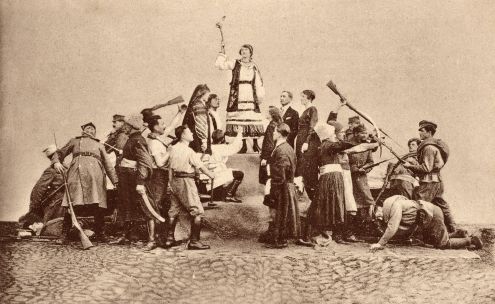
A symbolic depiction of Ukrainian nationalism, c. 1920

While the world probably doesn’t need any more commentary on the recent American election, I’d like to offer some anyway, though in a way that looks at happenings beyond the US to the rest of the world, where we see related patterns unfolding according to local particularities and conditions. While the US is its own case, it is also part of an interconnected world, the ties of global capitalism, human movement, globalized classes, elites, and political structures, and other things working to move American realities in directions broadly congruent with other, often quite different, parts of the world. My thoughts here—which are reflective of the halting directions my political thought have been taking as of late, but should not be interpreted as final or fully coherent—are springing off an article by Jonathan Haidt from back in the summer, but which is rather prescient and worth reading in its own right. What follows here, then, are three interlinking thoughts precipitated by, but in some cases sharply diverging from, Haidt’s article.

One, while right now the dominant options are either liberal ‘cosmopolitan’ globalism or some form of nationalism, within the framework of nation-states (whether more autonomous or more directed from supra-national entities being at question) and of some form of globalized (if not globalist) capitalism, those are not in fact the only options. To give but one example, Continue reading “Nationalisms, Globalisms, and Their Alternatives”