Many Worlds in One Manuscript: A Close Reading of Ms. Yah. Ar. 765, Part II

This post continues my three-part exploration of a short Ottoman manuscript text, Risāla fī ithbāt ruʾyat al-nabī yaqaẓatan li-man iṣtafāhu min ʿibādihi al-ṣāliḥīn, by the otherwise obscure scholar Muḥammad b. Aḥmad al-Kūmuljinawī; if you have not already read Part I much of the following will not make sense, so start there then proceed to the following.

In Part I we were introduced to the manuscript as a codicological unit, and reviewed some of the paratextual aspects that appear in this handful of folios. In the remaining pages the same elements continue, plus some additional ones, which we’ll examine before plunging into the main topic of this post, the theological content and the way in which al-Kūmuljinawī drew upon existing authorities, how he might have gone about locating sources, and what we can gather about ‘canonical’ theological authorities in the eighteenth century Ottoman world. Let’s have a look at the second page in the treatise and note the paratextual elements visible there:
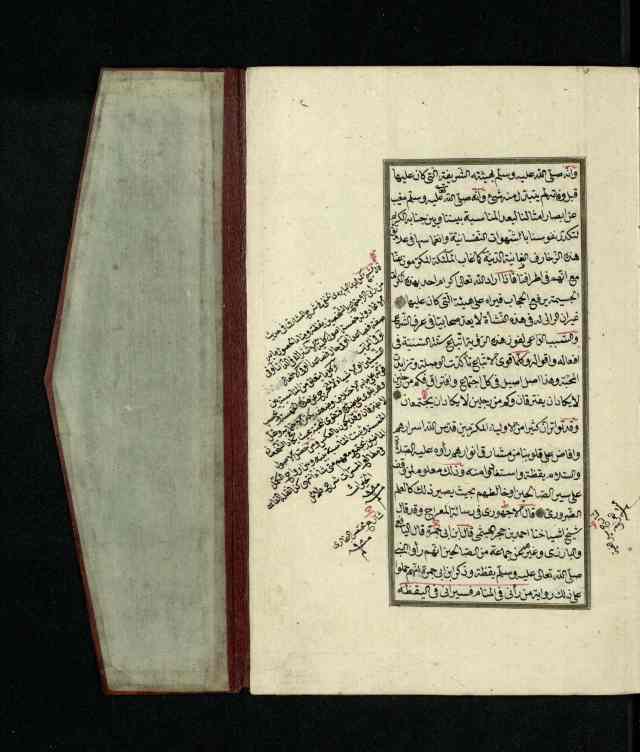
National_Library_of_Israel_Jerusalem_Israel_Ms._Yah._Ar._765.pdf_page_9

First, it’s important to pay attention to things that might otherwise fade into the background: for instance, this manuscript features a frame around the main text, a common feature but not a universal one, bespeaking the refined nature of the manuscript and its intended purpose as a presentation text. More mundanely, the frame neatly demarcates the main text from its marginal apparatus: in the case of this manuscript, primarily comments that are the functional equivalent of footnotes in modern book practice. In the example above, three annotations are visible, all examples of the minhu, ‘from him,’ type of note, placed there by the author of the text (at least in this case- in other cases the provenance of such notes can vary). The notes are linked to particular points in the main text via rubricated letters, very much akin to the footnote, although spatially they are placed more or less proximate to the linked section of main text, and hence in a variety of arrangements- an affordance of handwritten texts that is considerably more of a challenge for typography (though not insurmountable; not a few early Ottoman printed works featured sloping commentary text, though not at varying angles as here).

Nearly all of the minhu comments in this section, save a single (incorrect as it turns out!) translation of an obscure Arabic word into Ottoman Turkish, are in the same hand as the main text, which we’ve every reason to believe is the hand of the author (or, if not in his actual hand, the hand of a scribe to whom he dictated). For more on these notes and their relationship to authorship, manuscript transmission, and so forth, see A Tunç Şen’s ‘Authoring and Publishing in the Age of Manuscripts: the Columbia University Copy of an Ottoman Compendium of Sciences with Marginal Glossing.’

The other paratextual element to notice in this section of the text is the use of red overlining at various points: there is no single modern equivalent for this overlining, as at points it functions like italicizing or bolding, drawing attention to a particular point in the text; at other points it functions somewhat akin to quotation marks, or, at least, the first set of quotation marks. In the example above, the final line is largely overlined, marking out a particular ḥadīth visually from the rest of the text (in Persian texts from this period, switching from nasta’liq to naskh for ḥadīth and Qur’ān did similar visual denotation work). Taken together, all of these paratextual elements- dots, rubricated words and letters, and overlining- aid the reader in navigating and interpreting the text, knowing immediately where cited texts begin, or where important arguments or transitions are located. In my translation below I’ve largely ‘translated’ these elements into modern punctuation; on reflection I think it would be interesting to try and replicate them exactly, and will try to do in the final installment of this series.

I have aimed for a relatively literal translation, while trying to draw out some of the nuance in the usage of technical vocabulary, the most challenging aspect of this text to render in English. I initially tried a two-column display here, but found that it caused a serious error when displayed on the front page of the website, unfortunately, so I have had to drop the marginal notes down to the end of the translated section.

Know that it has been established by definite texts from among the sound and sunna-conforming aḥādith that our lord and master Muḥammad, God bless him and give him peace, is alive in his grave in body and soul, and that he has freedom of action and can go where he wills in the quarters of the earth and in the imaginal realm (al-malakūt). Verily, he—God bless him and give him peace—is [still] in his noble form in which he was before his death, nothing has been changed. And if he, God bless him and give him peace, is hidden from the sight of the likes of us, it is due to the relational distance between us and between his noble person, due to the turbidity of our lower selves due to the passions of the self and their immersion in the attachments to these trifling vain wordly babbles, just as the noble angels are hidden from us even as they are in our very midst.

Now, if God desires to honor anyone with this bodily miracle, He raises the veil and he is able to see him in his true form (this does not entail that the one who so sees him is in the ranks of the Companions in a sharī’a-accordant sense). The generative cause for the obtainment of this vision is his following the sunna in his deeds and words. The more that he strengthens his following [of the sunna] the more resilient will be his personal connection [with Muḥammad], and love [for him] will increase. This is the fundamental root of all union and separation—there are those people who are scarcely ever in a state of separation and those people who are scarcely ever in a state of union [marginal note a.].

It has been established by multiple avenues of transmission that many among the noble saints, God sanctify their inner secrets and pour out blessing upon our hearts from the orients of their lights, see him, upon him be peace and blessing, in waking life, and spiritually benefit from him—that is something that is known to the one who comes to the path of the saintly or who associates with them, such that it becomes akin to necessary knowledge.

Al-Ajhūrī (d. 1655) [marginal note b.] said, ‘The shaykh of our shaykhs, Aḥmad ibn Ḥajar al-Haythamī said that Ibn Abī Jamra [marginal note c.] said that al-Yāfi’ī and al-Bārazī and others from among the community of the saintly pious have said that they have seen the Prophet, God bless him and give him peace, in waking life. And Abū Jamra mentioned that they experienced that in accordance with the transmitted saying, “The one who has seen me in a dream-vision, he will see me in waking life.” Truly, they have seen him in dreams and they have seen him afterwards in waking life, and have asked about various things and he has reported to them concerning those things, and it has turned out as he has related to them.’

The one who denies that, if he is from among those who cast calumny upon the miracles (karāmāt) of the saints—then we have nothing to say to such a one. Otherwise, this [vision] is from among [their miracles], when in the rending of [the] customary [nature of things] there is unveiled to them things in the world above and below.

Al-Fāsī (d. 1698) says in Maṭāli’ al-massarāt [his commentary (sharḥ) on] Dalā’il al-khayrāt: ‘Shaykh Abū ‘Abd Allāh al-Suhaylī [also vocalized as al-Sahlī], God be pleased with him, has said: “In order to affix love of the Prophet in the soul, do not let his noble form be hidden from the eye of insight for a moment—it is the true vision because the vision of sight is due to his conveyance of the true essence of the one who sees to the eye [or essence] of insight, so that in the presence of insight there occurs comprehension regarding the true reality of what is conveyed to [sensory] sight from among the visible things. There is no doubt that ṣalāt upon the Prophet, God bless him and give him peace, if one’s innate disposition (mashrab) is purified, will shed forth its lights and the lower self (nafs) will become a mirror for [Muḥammad’s] form, God bless him and give him peace, and will not be hidden from it. This is true knowledge in which there is no doubt. Continue reading “Many Worlds in One Manuscript: A Close Reading of Ms. Yah. Ar. 765, Part II”

A Day in the Life of an Early Modern North African Scholar-Farmer

17th century Moroccan Tile V&A 1718-1892
17th century Tunisian tile with floral motifs (V&A 1718-1892)

[‘Alī bin Yaḥyā al-Salaksaynī al-Jādīrī, d. 1564] would spend his daytime fasting, teaching ‘ilm all day long, not stopping from his teaching except during the times of the ritual prayers and the call to prayer, and if he wanted to deliver the call to prayer a reciter who was with him reading out texts with him in his cell would accompany him on the way, coming and going, reading out loud, and he would give the call to prayer, and so maintain the duties of his position as imām. He was, God be pleased with him, extremely avid about teaching ‘ilm, and was an imām in the Ajādīr Masjid wherein he taught ‘ilm until late morning, then he depart and go down to his plot of land by Wādī al-Ṣafṣīf, which he cultivated by hoe. His students would go out with him, he teaching coming and going along the way. When he reached his plot of land he would get down off his mount, unload manure, remove the packsaddle from his mount, and tether her in place by his own hand, no one else being able to tether her but he. He would take up his hoe and set to cultivating his plot of land, the reciter still reading out loud, and [‘Alī bin Yaḥyā] giving exegesis until he was done with his work. Then he would remount his beast of burden, the reciter on his right or left—this was his custom!

When he was young and in the maktab [somewhat equivalent to an elementary school] he struggled with memorization, until one day a man came passing by and took from him his tablet and wrote upon it more than what the teacher had written out to be copied, which did not make the teacher happy, but he was unable to speak to the man about why he had written those things. A few days that man came to Sīdī ‘Alī bin Yaḥyā and commanded him to come out to him, which he did, and the two of them to the wādī named Būyaḍān. The man said to Sīdī ‘Alī, ‘Ride on my back!’ Then he forded him over the wādī and prayed for him- and from then on he was able to memorize [what was written on] his tablet.

Muḥammad ibn Muḥammad ibn Maryam, al-Bustān fī dhikr al-awliyā’ wa-al-ulamā’ bi-Tilimsān

*

When we read biographical accounts such as this, we can read them a bit against the grain in that we are as much interested in what would have been ordinary and uninteresting things to the original author(s) and readers as we are those matters that stood out at the time. In the first of these two vignettes, it is ‘Alī bin Yaḥyā’s sheer dedication to teaching that is of course exceptional: the man is kind of a machine! We can understand from this description that such dedication was unusual, which is not surprising (one also wonders if all teachers’ students would have been dedicated enough to follow behind their instructors’ donkeys out to the fields). For us in the present, who are far removed from early modern North Africa, one of the more interesting details is that ‘Alī bin Yaḥyā supplemented his income from teaching and work as an imām with small-scale farming, either on land he owned (which would be my guess) or which he held on lease. Either way, his farming- which based on the description here would no doubt have been a sort of market gardening, as we would say now- was something he himself did, every day at the same time, with his own hands, including dumping manure for compost.

Such bivocationalism comes as little surprise: indeed, probably the vast majority of pre-modern Islamic scholars (as well as scholars and associated identities in other traditions) had usually not one but multiple ‘side hustles,’ their incomes being derived from many sources patched together, often shifting over time. Farming or, better, market gardening was perhaps not the most frequent such supplementary (or in some cases, primary) source of their income, but it was not rare either, or at least that is my impression from years of reading biographical accounts of saints and scholars across the Islamicate. Because virtually all cities, with a couple of exceptions, in the premodern Islamicate world interfaced very directly with semi-rural or fully rural hinterlands, it was rarely very onerous for a scholar to make the walk from his madrasa or sufi zawiya to his field, and for rural sufis orchards and fields might be immediately adjacent to one’s home. There are a number of interesting take-aways from this situation, but one I want to suggest here and which I should at some point develop in a more formal manner is that the widespread existence of scholar-gardeners helps to explain the popularity and intended audiences of the Islamicate agronomy handbook tradition. To be sure, many of the users of manuals of filāḥa were no doubt estate owners who rarely or never got their own hands dirty; but I suspect not a few were like ‘Alī bin Yaḥyā, highly literate individuals who took up the hoe along with the pen. Continue reading “A Day in the Life of an Early Modern North African Scholar-Farmer”

Shaykh Ṣafī al-Dīn’s Gifts for ‘Īd al-Fiṭr

The following story, from that seemingly inexhaustible source of late medieval hagiography, the Ṣafvat al-ṣafā of Ibn Bazzāz, seemed appropriate to translate and post today given that April 21 and 22 of this year marks ‘Īd al-Fiṭr, the feast at the end of Ramadan, for the world’s Muslim communities. The story below has to do with the festivities- or, more properly, the preparation for them- that continue to be a feature of modern celebrations. As with many of the stories concerning Shaykh Ṣafī al-Dīn, the main subject of the hagiography (though far from the only subject!), it is quite straightforward. The word ‘akhī’ in ‘Akhī Shādī’ (whose name occasions some punning in the Persian) requires some explanation: the akhīs were members of ‘fraternities’ of urban workers, especially workers in various crafts, drawing upon the canons of futuwwa for their identity and practices, sometimes exerting political power in cities of Iran and, especially, Anatolia, in which context they are best known. Akhīs appear not infrequently in Ibn Bazzāz’s work, perhaps as a reflection of his own origins in the world of craftsmanship and the urban marketplace. As is so often the case, scenes of everyday life and activity are preserved, as it were, within the format of a miracle story, giving us a nice glimpse of the practices and relationships of ordinary people in the late medieval Persianate lands.

L'épisode_du_sheïkh_de_Sana an_[...]Haïder_Me zoub_btv1b8415000w_71
In this detail from an early 16th century Safavid miniature, a depiction of a market stall selling bread, such as Akhī Shādī would have been preparing for the ‘Īd festivities (Bibliothèque nationale de France, Département des Manuscrits, Supplément turc 978)

Akhī Shādī of Ardabil said: At the end of Ramadan the Shaykh, may his secret be sanctified, sought for me, so I went. Pīr Ibrāhīm Kurd-i Chust came and took me by the hand and led me to the kitchen. I worked for two days, cooking the bread for ‘Īd [al-Fiṭr]. While cooking that bread my hand was burned. During the night, just before morning, the Shaykh, may his secret be sanctified, came to the kitchen, and I came before him so as to kiss his blessed hand. The Shaykh looked and saw that my hand was burned, so he took my hand in his blessed hand and vigorously rubbed it, and in that very moment it became better, the traces of the burn completely disappearing! I was overjoyed, and in the exuberance of this joy returned home. While performing the morning prayer of the day of ‘Eid, it suddenly entered into my mind: ‘Wouldn’t it be nice if the Shaykh sent me a plate of some saffron rice?’ An hour later I saw that a servant was coming, bringing a plate of saffron rice. He said to me, ‘The Shaykh declares that if Akhī Shādī has a friend who is sick he should give him this pilaf.’

I did have a friend who was grievously sick, such that we had all given up hope of his recovery, things reaching a point at which he was no longer eating or drinking, hope for his living becoming cut off. I brought that pilaf before him and said, ‘The Shaykh has sent this, eat it so that you can get better!’ He said, ‘I don’t have the strength [to feed myself], please place a portion of it in my mouth.’ So I put two or three bites of it in his mouth and he ate it, then said, ‘More please!’ So I gave him more, and he ate, saying, ‘Make a bigger portion!’ So I did, and in that moment he sat up and with me ate that plate of pilaf and was completely healed.

Ibn Bazzāz Ardabīlī, Ṣafvat al-ṣafā: dar tarjumah-ʼi aḥvāl va aqvāl va karāmāt-i Shaykh Ṣafī al-Dīn Isḥaq Ardabīlī, ed. Ghulām Riẓā Ṭabāṭabāʼī Majd (Tabriz: G.R. Ṭabāṭabāʼī Majd , 1373 [1994]).

AKM264.f376r_HERO
A delivery of food- perhaps pilaf?- in a detail from an illustration for another story from the Ṣafvat al-ṣafā (AKM264 (fol.376r))
___________________________
 

Creative Commons License
This work is licensed under a Creative Commons Attribution-NonCommercial 4.0 International License.


Of a Lion, Dog, Shayṭān, and Snake: Sīdī al-Ḥasan Abirkān of Tlemcen

2008BU0720
The walls of the village of Manṣūra outside of Tlemcen, 1870, by Sir John Baptist Joseph, 12th Baron Dormer (V&A SD.340)

That sainthood and social and cultural marginality have a tendency to go together, in Christian and Islamic traditions anyway, will hardly come as a surprise to anyone versed in such things: this is not the place for such speculations, but my personal working theory is that when we see Late Paleolithic burials of unusual individuals whose grave goods mark them as special, what we are seeing is a trace of something very much like sainthood. Regardless of the veracity of such speculatory reconstruction, it is quite clear from medieval and early modern hagiography in both Christian and Islamic traditions that while hardly a prerequisite for sanctity, difference, marginality, even outright societal opposition were all potential entryways into sainthood, not necessarily barriers. To discuss the reasons for this sustained relationship through time would require a book, or several of them (though, this is as good a place as any to mention that I have in various states of development not one but two such books in the offing, details to come!).

Instead, I want to introduce here an early modern- well, really, on that cusp between what we think of as medieval and as early modern- saint of the city of Tlemcen (in modern-day Algeria) who exemplifies inhabitation of both ‘centrality’ and ‘marginality,’ Sīdī al-Ḥasan Abirkān, as described by the late sixteenth century century hagiographer Ibn Maryam (d. 1605) in his al-Bustān fī dhikr al-awliyāʼ wa-al-ulamāʼ bi-Tilimsān. The saint’s name already identifies him as occupying two areas of identity sometimes indicative of marginality relative to scholarly urbane culture: ‘Abirkān’ is Kabyle Amazigh for ‘black’; J. M. Dallet’s dictionary gives the following definition: ‘Noir; noiraud; teint foncé, basané (nuance défavorable, dépréciative pour les personnes).’ And indeed Ibn Maryam, in giving Shaykh Abirkān’s genealogy, includes a couple of stories in which the shaykh is shown to be of a holy genealogy through his father and grandfather, without any trace of his ancestors’ apparent servility remaining. The suggestion of course is that the casual observer night take the shaykh’s skin color and evident ‘racial’ origin (not precisely the language a sixteenth century observer would have used, but close enough) as evidence of his inferiority. That this is the case is reinforced by a story that Ibn Maryam tells in which a young man who has come to Tlemcen to study initially disparages Shaykh Abirkān’s exoteric knowledge, but is urged to study with the shaykh in a dream, and in so doing finds the shaykh’s depth of knowledge confirmed. Overall, as is often the case in premodern Islamicate societies generally, racial origin and skin color were neither invisible nor were they totalizing facts about an individual; in Shaykh al-Ḥasan Abirkān’s case they were arguably part of his identity in a complex manner, both placing him somewhat at the margins but in a powerful manner, his being marked out as different both a feature of his sainthood as well as a sometime social stumbling block on the part of others.

That I have led with this particular saint’s racial background is very much indicative of our own contemporary concerns and interests; it is not addressed in Ibn Maryam’s lengthy treatment until well after many other stories and discussions. Instead, the picture that emerges, which I have tried to pick up in my translations below, is of a saint marked by both the scholarly and the, for lack of a better word, ludic. His encounters with animals stands out in this regard, with several of the stories below having to do with such interactions, all with creatures which were themselves generally seen as on the edge of human society if not an outright danger. I’ll discuss them a bit more after the text itself.

[Shaykh al-Sanūsī] used to say: ‘I have seen [many] shaykhs and saints but I have never seen the like of Sīdī al-Haṣan Abirkān!’ He was not absent from the presence of God for even an instant, and whenever he laughed his teeth would show. He was merciful towards the believers, solicitous towards them, rejoicing in their joy and feeling pain over evil inflicted on them. He had prayer beads from which he was rarely ever parted, for he was constant in remembrance of God. He was held in great esteem by the common and the elite alike. [He was] devoted to the Risālah of Ibn Abū Zayid, and whenever al-Sanūsī came to visit he smiled broadly and would open their conversation with theological discussion, [al-Sanūsī] saying to him, ‘God has made you to be among the God-fearing imāms.’ He was graced with many miracles and wonders, among them one that al-Sanūsī and his brother Sīdī ‘Alī described:

He was performing ablutions out in the wild desert one day when an enormous lion approached and knelt down over [Sīdī Abirkān’s] shoe. When he was finished with his ablutions, he turned to the lion and said to him three times, “May God, the most beautiful of creators, bless you!” The lion bowed his head to the earth as if were bashful, then arose and went on his way.’

Also, that which Shaykh al-Sanūsī mentioned, saying, ‘The illustrious saint Sīdī Sa’īd bin ‘Abd al-Ḥamīd al-‘Aṣinūnī related to me at his home in the Ouarsenis Mountains—he was from among [Sīdī Abirkān’s] oldest companions—saying, “I visited Sīdī al-Ḥasan one hot day and found him in great fatigue, sweat running down him, and he said, ‘Do you know why I’m so exhausted?’ I replied, ‘No, Sīdī!’ He said, ‘Yesterday I was sitting in this spot when Shayṭān entered in a particular form so I stood up to him and he fled before me, so I followed him and recited the call to prayer—he did not stop running from me, and he farted, as is mentioned in the ḥadīth, until he was hidden from me. And now I am just returned from pursuing him!’”’

Al-Sanūsī also related that when [Sīdī Abirkān] returned from the East, he came across a Friday market village which had fallen into ruin, though it had once been inhabited by his forefathers. He decamped to Tlemcen but his thought reverted to returning to that village and revitalizing what had fallen into decay. He said: ‘So I went out to it and sat down contemplating its traces, how ruin had overtaken it and its inhabitants compelled to depart, when a dog came up to me and sat down next to me, looking sad and dejected like me. I thought to myself, “Will this village ever be inhabited again or not?” Then the dog lifted his head and said in clear speech, “[Not] until the day they are resurrected,” that is, it will never be inhabited again. When I heard what he had said to me I returned to Tlemcen.’ Continue reading “Of a Lion, Dog, Shayṭān, and Snake: Sīdī al-Ḥasan Abirkān of Tlemcen”

the life of St. Sozon: a retelling

his oratory the high wide lands, stone and thin soil in
the broad neolithic scape, scrubbed and sky dried.
the heavens were closer there, thinner air, a world’s distance
from the city-god drenched plain hard by
the corrupting sea, the malarial reaches of power.
in hand his shepherd’s crook, passed down
from one hand to another a thousand generations,
memory accumulating like the mounded tepes,
lately transformed into a cruciform shape.
so he spoke to his God,
reading the words of the holy Book in the land,
his flock spread out before him—wisdom! let us attend.
he wept that he could not be
more akin to the creatures under his care,
heart burning with the great merciful weight of things.
closing his eyes under the sheltering tree,
Sozon the friend of God looked
inward, was shown what would come to be:
a martyr’s death awful to the telling, and
a holy spring welling up at his feet, for the ages,
watering the earth with his blood and with water.
his spirit spread into the dolomitic cracks,
up surged the water cold, mixed with blessing.
dream and the mothering earth’s pure drink,
portal and vision and life,
the Cross tossed in the charging waters.
he picked up his shepherd’s crook and set out.
down from his hard and rough untilled garden,
leaving his sheep in the care of another,
down to the city and its viscous charms,
exquisite violence and offal piles.
up against the vain rage
he came, and with his staff struck down
the graven gold in the thronging temple,
burst it into a thousand pieces,
a fine loot and bold, gathered up,
and gave it to the city’s poor. the roman concreted
places rang out with the challenge, and the answer
was iron against flesh, the singe of the sword, and then
death upon a tree.
still blood lusting and even more so full of fear,
they dragged his holy flesh out to the edge of the city,
lit a fire, in unknowing sign of the cataclysm to come,
but the sky mocked them, the elements
overpowered the small weak weaponed men,
storm washed over them and washed out their flame.
time and distance condensed in him,
the heavens stayed their small fires, a greater flame
burned still in his several parts, hot and holy.
water, and blood, and the venerable body marked
with the pain and the dislocation, set to earth,
and still he shepherds us, drawn from the old soil,
cut from the new cloth of salvation, old wine
mingled with the new. Blessed Sozon,
pray God for us, send us out from the unabiding city,
and lay your staff against the idols yet.
the wild old lands wait a returning.

A Holy Historian and a Saintly Blacksmith

By definition the lives profiled in hagiography, of whatever religious tradition, are exceptional in some way as perceived by one or multiple audiences (or in some cases, only a single author attempting to make the case for wider public recognition). That said, as I have emphasized many times in my writings here and elsewhere, medieval and early modern hagiography, particularly within Islamic traditions, can shed a great deal of light on the lives and experiences of ordinary people and places, providing a richness of detail hard to find in other sorts of sources. Early modern North Africa is an especially rich source of hagiographical texts which allow us to peer into everyday life not just in urban areas but also- in fact perhaps predominately- in the vast rural ‘hinterlands’ of urban centers like Fes and Marrakesh and Tlemcen. The countryside of the Maghrib was a remarkably dynamic landscape in religious, cultural, and intellectual terms, with many of the major institutional sites of learning in the early modern Maghrib located within remote rural locations, zāwiyas- sufi ‘lodges,’ often with a shrine component, libraries, and teaching elements- existing high up in the Middle and High Atlas, in territory marked to this day by forms of seasonal transhumance.

The two lives I’ve translated here come from a sixteenth century Arabic work of biography and hagiography (most though not all of the figures therein are saints),Dawḥat al-nāshir, by one Ibn ‘Askar, its entries primarily focused on holy men and women from the Rif region of the Maghrib. Both of the men I’ve featured here would have been relatively unexceptional were it not for their piety and reputations for sanctity: one was a learned man who inhabited the countryside outside of the coastal city of Tetouan (a lovely place, by the way, well worth the visit if you are ever in northern Morocco!) who practiced subsistence agriculture as well as scholarship and sainthood. Calling him a ‘historian’ is a bit anachronistic though not entirely so, as while he would not have followed the canons of modern disciplinary history Ibn ‘Askar’s description suggests an interest in and deep knowledge of the wide spectrum of historical events and figures relevant to Islamic and Maghribi history; of course then as now it was hard to make a living on such knowledge and so Shaykh Aḥmad kept himself and his family going through his own practice of agriculture, practice which was, our author hints, blessed by divine intervention. Would that all historian-farmers, self included, were so fortunate!

The theme of agricultural involvement is a not uncommon one in Ibn ‘Askar’s hagiographies, not a few of his holy people growing their own food and offering the fruits of their lands to visitors and pilgrims and ‘sons of the road.’ Many seem to have practiced a sort of intensive gardening or intensive small-scale farming, though I am ignorant of the details of early modern Maghribi agriculture; it seems possible to me that the surprisingly abundant agronomical texts from the western Islamicate world might have found an audience precisely among such farming ‘ulamā’ and sufi shaykhs, people who possessed refined literacy but fully inhabited the rural, agricultural world.

Our second life is from a bit south of Tetouan, having to do with a pious blacksmith in the general vicinity of the famous, and indeed quite beautiful, town of Chefchaouen. This Aḥmad, ‘the Blacksmith,’ might have been literate to some degree given that he served as an imām in a rural mosque, but he certainly would not have been otherwise reckoned a member of the ‘ulamā’, making his living from a trade- a hot and dirty one at that! His ‘style’ of piety seems to have been rather improvised, as witnessed by the surprise expressed by our author. Yet this improvised rural piety of a working man is not disparaged in our text: instead, Aḥmad the Blacksmith gave a rather bold rebuke to our author concerning Ibn ‘Askar’s reliance on ‘book knowledge,’ a rebuke followed by a powerful prayer which Ibn ‘Askar credits with his own spiritual transformation. I’ve a bit more to say on this unexpected- to us at least- rebuke and prayer and what it suggests about the cultural worlds of the past versus our own present, but first here are the two entries in translation, my further thoughts following:


Aḥmad al-Shā’ir al-Yachmī: ‘And from among them, Shaykh Abū al-‘Abbās Aḥmad al-Shā’ir al-Yachmī, from the Banū Yachm in the vicinity of Tetouan. He was, God be merciful to him, a blameless jurist (faqīh), a knower of God, exalted is He, and very pious and ascetic. He was a memorizer of history and was passionate about much study thereof, he was given to deep thought and contemplation. Every Friday he went by foot to the city of Tetouan in order to pray the congregational prayer therein, even though his home was in Bū Khalād some twelve miles away. He was committed to reliance upon God (tawakkul) and never practiced any fixed profession. Instead, he had a space in front of his house which he cultivated, doing the digging by hand, and from the produce of that cultivation he supported himself and his family. He also fed from it all those who stopped in the mosque (masjid) opposite his house, as a way of providing traveling exigencies to the sons of the road. Those who saw [his garden plot] were certain that it was not enough to feed even one person, yet he never took from anyone. When he went to Tetouan he carried with him a large basket in his hand so as to buy what he needed and carry the items in it, such that the trace of it was marked in his left hand. If anyone going along with him offered to carry it for him he forbade it, his face scowling. I learned from him, God be merciful to him, knowledge of history and of philosophical reflection, and all of the times that I met with him over the years he talked with me of nothing but the knowledge of history and of reports of the doings in the past of ‘ulamā, saints, kings, and others. When he was finished talking of such he would say, ‘Permanence belongs to God, surely to God will all things return, and all things are perishing except His Face.’ Then he would grow pale, and a spiritual state would take him and he would turn away. Many miracles were manifest through him and the people of his land were agreed upon his sainthood and virtue. He died between the ‘fifties and ‘sixties of this century, and was buried opposite his mosque, God be merciful to him. [1]


Aḥmad al-Ḥaddād al-Khumsī: And from among them, the holy man, the saint humble in the presence of God, the faqīh Abū al-‘Abbās Aḥmad al-Ḥaddād. He practiced the trade of blacksmithing, and was also an imām in the Masjid al-Shurafā’ in the territory of the Banū Faltwāṭ. He was a preceptor in asceticism, piety, night-vigils, and struggle in good works. I entered his home in the fifty-fifth year of this century, along with our shaykh Abū al-Ḥajjāj and a group of the virtuous. He greeted us and provided for each of us what he could of different kinds of food, serving us himself. When we were ready to depart to the mosque, he went before us to the door of his house and said: ‘I have made a covenant with God, exalted is He, that no one from among the folk of good should leave my home until he has placed his foot upon my cheek.’ He regarded us as worthy and desired to do so to us, and Shaykh Abū al-Ḥajjāj said, ‘Let us help him in his desire, as his intention is the humbling of his lower self and lowliness towards God, exalted is He.’ So [Aḥmad] put his head on the ground and each of us put our feet to his cheek. Then we went on to the Masjid al-Shurfāt, which is said to be one of the mosques built by Ṭāriq ibn Ziyād during his first campaign of conquest [2]. When we reached the mosque a man brought us food which he had cooked with garlic. We ate it, but [Aḥmad] did not eat with us, excusing himself by saying that he did not eat garlic. When we went inside the mosque we asked him about his not eating garlic, and he replied: ‘On a certain night, in the middle of the night I came to this mosque and entered by way of the qibla door that is to the left of the miḥrab within. I had eaten garlic that night. When I entered I found two men from among the saints praying, their light filling the mosque. When they had given the greeting they stood and walked out through the eastern door. I went out following them, and when they were aware of me they stopped in a certain place’—he described the location—‘and I came before them and sought from them prayer. Then one of them said to me: ‘One who wishes to meet with other and to enter the mosque ought not eat garlic.’ So I said, ‘O Sīdī, I repent before God and will never eat garlic again!’ They gave me the greeting of peace and then turned and went. From that time forward I have never eaten it and will never eat it again.’

I sat with him, God be merciful to him, once in Chefchaouen and had begun talking with him about the art of sufism and the way of spiritual gifts, and I had memorized a great deal, saying to him ‘Shaykh So-and-So said,’ and ‘It is related from Shaykh So-and-So.’ But he said to me, ‘For how long will speak of ‘So-and-So said and related, and I related from So-and-So? When will you say “I and you”?’ I replied to him, ‘O Sīdī, pray to God for me!’ So he said for me, ‘Give us sustenance O God, with you is understanding! And give us knowledge, with You is knowledge that gives benefit!’ From that day God opened for me the gate of understanding and I knew of myself the answer to his prayer, benefiting greatly from his supplication, God be merciful to him.

He had many well-known miracles in answer to his supplications. He studied under Shaykh Abū Muḥammad al-Ghazwānī and from Shaykh Abū Muḥammad al-Habṭī. He died, God be merciful to him, around [9]68, and was buried opposite the Mosque of the Sharifs from the Banū Falwāṭ. [3]

1916.1236_o2


What is so striking to me about Ibn ‘Askar’s interactions with Aḥmad the Blacksmith- interactions with many an analogue in the early modern Maghrib and elsewhere- is the degree to which a humble (somewhat extravagantly so in fact!) blacksmith could participate in the discursive culture of the literate elite, of which Ibn ‘Askar and many of his shaykhs were indeed a part. It is hard to imagine similar interchanges occurring in the present-day on the same scale, as the discursive worlds of people of my class- the hyper-educated denizens of academia and academia-adjacent realms- have if anything grown further apart from the contemporary analogous discursive worlds of a Riffian blacksmith. There is precious little interaction between various discursive realms within academia itself: humanities scholars and researchers in the hard sciences, for instance, struggle to communicate effectively if they even note the existence of the other. Our interactions with ‘the public’ tend to be limited to those sectors with maximum exposure and formation within higher education and its analogous and connected institutions in wider society.

The many disconnects and discontinuities that mark contemporary American (and, arguably, global) society are all the more striking given that in our world, unlike in Ibn ‘Askar’s, we are beholden to and shaped by ideologies which officially at least proclaim the equality and inteconnectivity of, if not all people, at least all members of one’s own nation-state. Whether one presents one’s self as a citizen of a politically constituted nationality or as a ‘citizen of the world,’ some kind of equality and shared identity and heritage is implied. By contrast, in the early modern Maghrib as elsewhere no such ideas existed; religious identities provided the most universal forms of identity, but in practice identity and belonging were much more dispersed, into all sorts of localized identities and affiliations, some of a global nature (affiliation to a given saint or sufi ṭarīqa, for instance), others perhaps shared only with people in one’s village or rural district. In a world with quite limited literacy the rather kit-bashed piety of Aḥmad the Blacksmith was more often than not the norm, even if a universal or at least universalizing set of doctrines and practices provided a more over-arching framework (though the exact application of the universalizing sharī’ah was often highly localized, the sharī’ah itself and its infrastructure possessing mechanisms for some degree of localization in fact).

There are many reasons for why the kind of interaction and role inversion we see in Ibn ‘Askar’s encounters with Aḥmad the Blacksmith are rare in our world, but the decreased salience of religious faith in much of the ‘developed’ world is certainly a major component. Shared religious faith and practice meant, to varying degrees of extent to be sure, a shared discursive and epistemic world; a pious blacksmith could through his asceticism and other forms of bodily-practiced piety become an ‘expert’ in the ‘sufi arts,’ taking what he learned aurally and distilling it into potent guidance for someone well versed in textual knowledge. Of course exclusion and exclusivity existed in Ibn ‘Askar’s world, and command of elite, literate discourse and practice were powerful means of material advancement. That said, in many ways the cultural sphere inhabited by the literate elite was more open, not less, to those without the blessing of elite formation and education, there was more of a common world and shared sense of meaning and value than is usually the case in our, despite our formal commitment to equality and egalitarianism. We can take such early modern examples, not as precise models of course- those worlds are gone and cannot be retrieved even if we should want to do so- but as inspirations and suggestions for how things can be otherwise in our own world.


1916.830_print
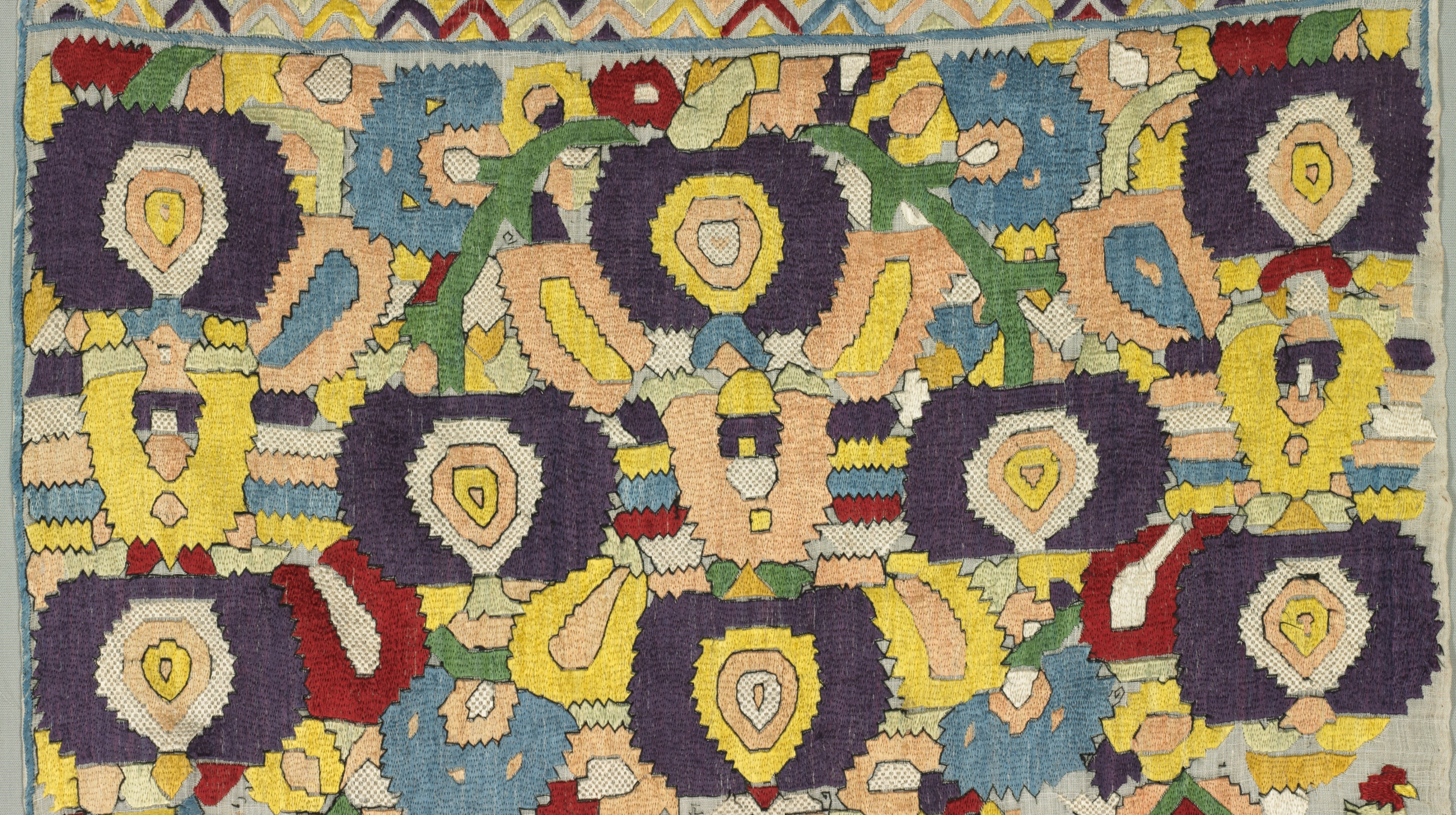
Detail of an 18th century ceremonial scarf with floral and vegetal patterns from Tétouan (Cleveland Museum of Art 1916.830)


[1] Abū ʿAbd Allāh Muḥammad b. ʿAlī b. al-Ḥusayn b. Miṣbāḥ Ibn ‘Askar, Dawḥat al-nāshir li-maḥāsin man kāna bi al-Maghrib min mashāyikh al-qarn al-ʿāshir (Rabat: Dār al-Maghrib, 1977), 20.

[2] That is, during the early 8th century AD.

[3] Abū ʿAbd Allāh Muḥammad b. ʿAlī b. al-Ḥusayn b. Miṣbāḥ Ibn ‘Askar, Dawḥat al-nāshir li-maḥāsin man kāna bi al-Maghrib min mashāyikh al-qarn al-ʿāshir (Rabat: Dār al-Maghrib, 1977), 21-23.

___________________________

This work is licensed under a Creative Commons Attribution-NonCommercial 4.0 International License.

Sharing a Pipe with the Shaykh

Abu Daood, Shaikh of the Coptic Quarter, in Cairo
A watercolor portrait, by the European artist Carl Haag, of a shaykh in Cairo, one Abū Dawūd; not a sufi shaykh alas (rather a shaykh in charge of an urban quarter, the Coptic one in this case), but displaying both 19th century dress and more importantly for the story below the sizeable nature of tobacco pipes! Painted in 1886 but based on observations from Haag’s 1858-9 visit to Cairo (V&A SD.462)

Apologies for the long delay in posting new material here- as is often the case many other things have intervened, the good and the bad as it were, and the several translations and short essays I had hoped to present here have been pushed back. Much of my ‘free’ time has been taken up teaching a course on modern Islam, which has entailed a great deal of secondary literature reading on my part given that my scholarly training focused pretty much exclusively on the pre-19th century world, with the exception of my recent work as a post-doctoral researcher examining issues in modern Arabic script book history. One of the happy benefits of my recent pivots towards the modern world has been getting to extend my exploration of saints and sainthood in the Islamicate world forward in time, particularly into the 19th century. Far from being marginalized by the developments of modernity, saints and sainthood remained- and in fact remain- vital forces in Islamicate history, in some cases becoming even more salient than in previous centuries. Movements such as the late 19th century Mahdiyya in the Sudan or the emergence of various millenarian and apocalyptic new religious movements like the Aḥmadiyya or the Bābīs are only really explicable within a framework of saints and sainthood.

That said, the saintly subject of the short story I’ve translated here did not herald any grand political movements or religious transformations, but rather can be seen as carrying forward older traditions of sufism and sainthood into the 19th century. We’ve encountered Shaykh Muḥammad al-Jisr (1792-1845) before (see this post for an introduction), and will be meeting him again in these digital pages no doubt, as his hagiography, penned by his scholarly son, is a wonderful source for exploring the transition of Islamic sainthood to the modern world. The story I’ve selected for today, set at some point during the 1830s (the period in which Mehmed ‘Alī’s forces occupied Ottoman Syria) reveals more in the way of continuity than change- while the 19th century would see many reformist and outright puritanical movements either begin outright or emerge into prominence from 18th century origins, here we see Shaykh Muḥammad continuing in a vein of saintly behavior exemplified by the late 17th to early 18th century ‘Abd al-Ghanī al-Nābulusī and others, including the unproblematic use of tobacco. It is also a lovely reminder of the aural presence of sufi ritual: in a world with considerably less noise pollution, and much more oriented around foot-traffic, nocturnal sufi practices such as vocal dhikr had no small aural footprint, attracting passerby such as the young man in our story, even if, as in the story, their reactions could vary in appropriateness!

16.7-27-1967-Stjerneformet-cuerda-seca-flise

‘Shaykh Muḥammad Abū Khalīl Efendī Abāẓa the well known and trusted, whose recognition in the Syrian and Egyptian lands is such that he requires no introduction, said to me: ‘I was in Cyprus during the days of the Egyptian government’s dominion in the land of Syria. I was in the bloom of my youth and the mirth of my youthful inclinations and was not yet following the ṭarīqa, nor did I have an inkling of the spiritual states of its sons. One night I came upon the dhikr circle which your father led with his brethren in Cyprus, and it happened that all while I watched them seeing the effects of the dhikr upon the sons of the path caused me to secretly laugh. When the shaykh completed the dhikr he called to me and sat me down next to him, treating me kindly, then offering me his tobacco pipe from which he had been smoking, which I then returned to him [after smoking]. After the session concluded I returned to my lodgings and lay down on my bed, but it happened that every time I fell asleep I found that pope that the shaykh had offered me that night striking me upon my face! So I would awake with a start, then go back to sleep—and again find it striking me upon my face and I would awake, and so my entire night passed until morning dawned. I was most distressed due to lack of sleep and intensity of fear such that I worried I’d lose my mind! So I went ot the shaykh, God be merciful to him, and as soon as he saw me he started laughing. I bent down and kissed his hand and said to him, ‘Yā sayyidī, what sin is it that I did that caused you to act in such a way with me?’ He replied, ‘What is it I did to you?’ So I related to him the story of the pipe in the night, and he said to me, ‘What does that concern me? I didn’t do anything to you other than offering you my pipe!’

I began seeking his intercession, saying, ‘Yā sayyidī, I’m afraid I’m going to lose my mind! I desire your forgiveness!’ At that he said, ‘My son, for what? You stopped by our dhikr circle last night and began to laugh—we are dervish folk and you are a lordly man, it is most befitting to you that you mock and laugh at us.’ I replied, ‘Yā sayyidī, I did not intend to laugh at you, God forbid from that! But the state and levity of my youth are not hidden from you, so I hope you will forgive me!’ At that the shaykh, my God be merciful to him, was pleased with me, and so I set out on the Khalwatiyya ṭarīqa and so continued on from there.’

Ḥusayn al-Jisr, Kitāb nuzhat al-fikr fī manāqib mawlānā al-ʻārif billāh taʻālá quṭb zamānih wa-ghawth awānih al-Shaykh Muḥammad al-Jisr (Beirut: al-Maṭbaʻah al-Adabīyah, 1888), 99-100.

Shaykh Muḥammad al-Jisr and the Snake in the Wall

Egyptian characters, etc. Snake charmer, Cairo 2
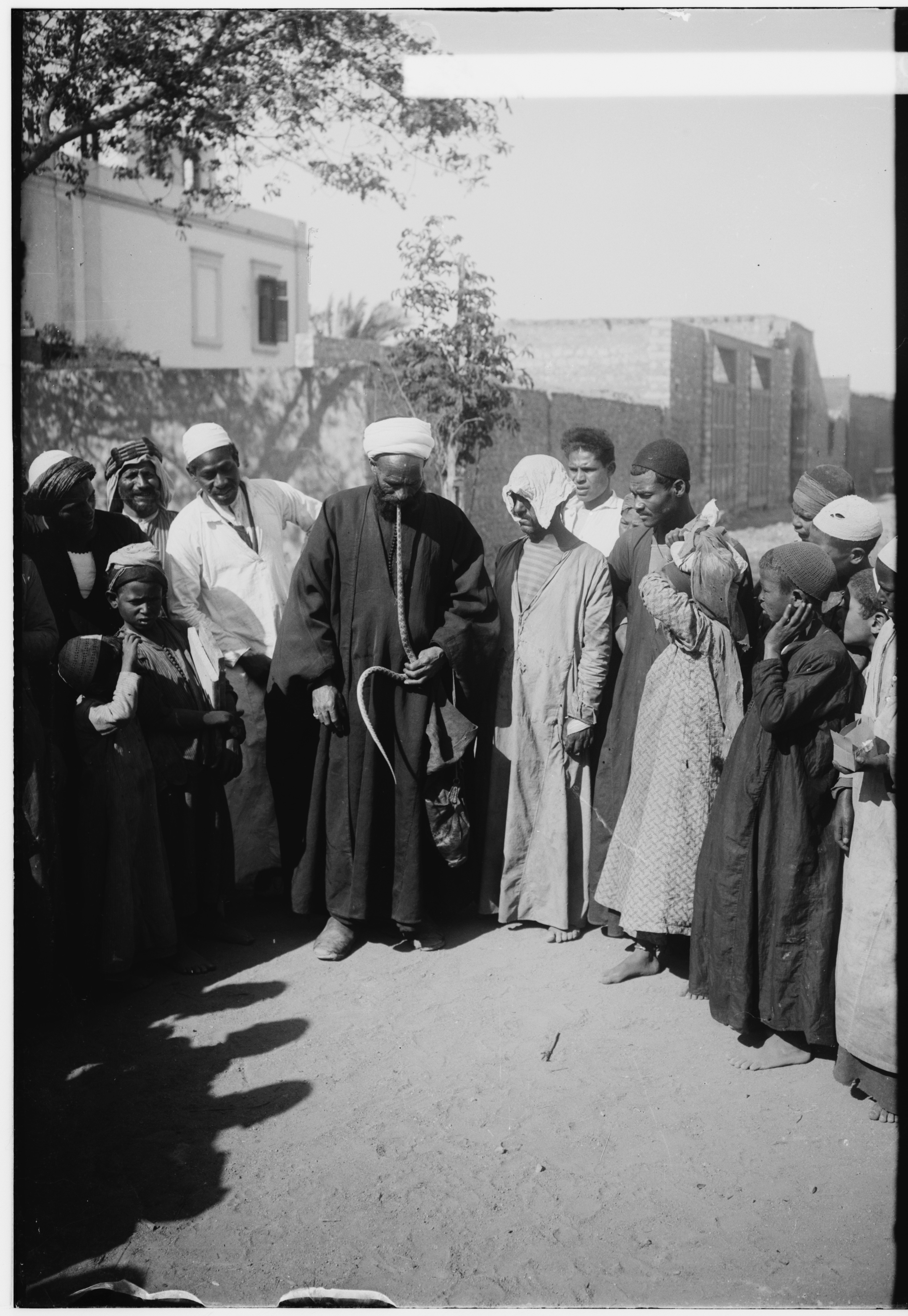
A snake charmer at work in early 20th century Cairo, photographed by a photographer from the American Colony in Jerusalem; this is the sort of performer, increasingly associated with ‘the Orient’ in the 19th century, that Ḥusayn al-Jisr wished to differentiate his father from (Library of Congress LC-M32- 994 [P&P])
As anyone who has followed my work here and elsewhere will be aware, until recently my scholarly research was focused all but exclusively on the early modern and medieval worlds, with a rough cut-off date of 1800 beyond which my expertise thins out considerably. Over the last couple of years since completing my PhD and assuming a post-doctoral research position my interests and research responsibilities have diversified considerably (a diversification which comes with its own risks, I might note), running backwards and forwards in time from the periods with which I am most familiar and comfortable. On the one hand I have taken up a much greater interest in the study of deep time and possible ways of integrating perspectives from paleontology, geology, climatology, archeology, and paleoanthropology into the kinds of historical study and teaching I do located within the ‘shallow’ past. Running in the other direction, on the other hand, I have become much more involved in nineteenth and twentieth century topics, some quite new to me, such as the history of technology and communication, others continuations of my long-standing interests such as saints and sainthood.

I learned about the subject of this week’s essay and translation (and who will certainly figure in future posts over the next month or so) by way of Marwa Elshakry’s book Reading Darwin in Arabic, 1860-1950, an exploration of the complex and often quite surprising ways in which Ottoman and post-Ottoman Arab thinkers dealt with the emergence and elaboration of Darwinian evolutionary theory and the permutations that engagement underwent vis-a-vis other concerns and political developments. Shaykh Muḥammad al-Jisr’s son, Ḥusayn al-Jisr, was one of the many thinkers, Muslim, Christian, and otherwise, who grappled with evolution and other aspects of the biological sciences, threading a path that was at once critical and open to scientific insights while also remaining very committed to ‘traditional’ Islam (though in ways that would have been unfamiliar even to his own father in the decades prior), remaining largely critical of evolutionary theory but suggesting that given sufficient proof nothing in Islam prevented acceptance of evolutionary theory provided God was understood to be the first and final cause- materialism was Ḥusayn al-Jisr’s primary foe.

Ḥusayn al-Jisr’s position on evolutionary theory in relation to theology is actually related to the work of his translated here, a hagiography, written in 1888, of his father Shaykh Muḥammad al-Jisr (1792-1845), a Khalwatī teaching shakyh and widely acclaimed saint active in Syria and Palestine (though due to political instability he also spent time in Cyprus and Constantinople). Ḥusayn’s account of his father- who died shortly after Ḥusayn’s birth- is striking for the way in which the author engages in extensive epistemological and other routes of analysis and digression, with much of the introduction devoted to tracing Ḥusayn’s own journey from relative skepticism about his father’s sanctity to embracing it, based on the accumulation and weighing of oral and written evidence, including from non-Muslims. These traces of modernity, as it were, continue throughout, even as the world of sanctity and sainthood revealed is not very far from that of early modernity- it is the framing and the tone that has changed, though certainly not into a voice of disenchantment or skepticism. As such it is a good example of the complex ways Muslims and others have constructed their own ‘modernities’ not necessarily along the lines of a neat trajectory of ‘secularism’ and ‘disenchantment that have so often been seen by many as normative and either automatic or only avoidable by ‘relapsing’ into some form of reaction and obscurantism.

I have selected the following short story mostly because it’s memorable and in the voice of the shaykh’s sister, but also because it captures part of Shaykh Muḥammad’s own saintly charisma- his connections with axial saints of the past, including Aḥmad al-Rifā’ī, and his interventions in everyday life- as well as possible objections that were more likely to arise in the modernizing milieus of the late nineteenth century, with Ḥusayn al-Jisr confronting such objections directly with an explicitness unusual within the genre. We will see other interactions of ‘tradition’ and ‘modernity’ in future installations from this saint’s life, so stay tuned!

hb_x.228.1

‘And from what the aforementioned sister of the shaykh related to me about him: she said: “After the incident I told you about before, among the things that happened to me in that house is that there came to us from Beirut a covered basket of zucchinis, and when I opened the basket up to take the zucchinis out, a snake that had been hidden within came out and slithered into a hole in the house. I was very frightened and resolved to flee the house, but when I came into the presence of the shaykh, your father, I related the story to him and revealed my fear. He said to me, ‘Don’t be afraid!’ Then he came and stood in front of the hole into which the snake had entered and said, ‘Yā Sayyidī Aḥmad! Yā Rifā’ī! My sister is afraid of snakes!’ In that very moment I had barely blinked when the snake came out of the hole and the shaykh killed it, and my heart was calmed thereby.”

This happening points to the administrative power (taṣarruf) of the shaykh and his close relationship with the venerable Shaykh al-Rifā’ī, God sanctify his inner secret. If it is said that the snake charmers do the like of this deed, we say, yes, but the action of the snake charmers is of the nature of a trick, but that which is related here is the action of a man from among the people of piety and sanctity, who sought the aid of a spiritual axis (quṭb) from among the spiritual axes of the age, one would not deny his virtue save one who is utterly effaced of vision. The one who knows what the learned in religion have written about the distinction between prophetic sign (al-mu’jiza) and saintly miracle (al-karāma) and between bewitchment and the art of persuasion, with all being things outside of the ordinary, such foolish doubt will not trouble his heart.’

Ḥusayn al-Jisr, Kitāb nuzhat al-fikr fī manāqib mawlānā al-ʻārif billāh taʻālá quṭb zamānih wa-ghawth awānih al-Shaykh Muḥammad al-Jisr (Beirut: al-Maṭbaʻah al-Adabīyah, 1888), 82, translated by Jonathan Parkes Allen, August, 2021.

___________________________

This work is licensed under a Creative Commons Attribution-NonCommercial 4.0 International License.

Ḥācım Sulṭān Fights a Dragon

Ident.Nr. I. 4 Sammlung- Museum für Islamische Kunst
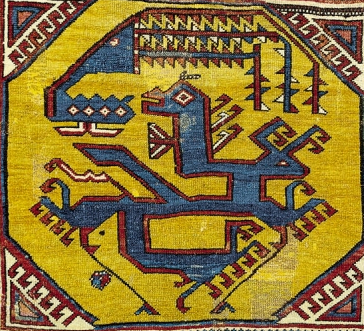
Detail of a woolen rug, roughly contemporary with the account of Ḥācım Sulṭān and the dragon, depicting a dragon and phoenix in highly stylized fashion. Produced- probably- in the expanding Ottoman lands by Turkman weavers (and so related to the carpet in our previous visit with Ḥācım Sulṭān), the motif looks to both long-standing Chinese artistic renderings of dragons and phoenixes as well as to textile art current among Turkic groups in Anatolia at the time. (Museum für Islamische Kunst, Ident.Nr. I. 4)

We’ve met Ḥācım Ṣultān before, so I will not give an introduction here, as the following account comes from the same late medieval into early modern hagiography translated in my previous post. This is one is a little different, however, both in subject matter- a battle with a mountaintop dragon!- and in its style, which I have tried to reproduce here as much as possible. Quite frankly, there are sections of this story that I do not fully understand, some of which it is possible the sixteenth century copyist did not fully understand either. The feeling of orality is very strong here, the core story- in which a mountaintop is broken into strange rock formations and colored red- sounding very much like an etiological tale in origin. The hagiography has done a couple of interesting things with the story: it is nested within a larger narrative in which rival dervishes and saints of Western Anatolia spar with and test Ḥācım Ṣultān, having just sent a man named Alaca Altu (‘one of the piebald horse’) to strike down the saint. Upon finding Ḥācım Ṣultān, Alaca Altu dismounted his horse, then

took his weapon in his hand. He gave a loud cry. He set out for Sulṭān Ḥācım. He struck but did not cut. Again he struck but he did not cut. A third time he struck but did not cut! Then the venerable Sulṭān Ḥācım said, ‘You must know, Alaca Atlu, your blade is not going to cut me. But mount your horse and so that you can come and fulfill my intention, upon that hill you ought to go and eat some food! When you ride up there let the dervishes cook you some kebab. We will not slice you up!’

The ‘hill’ becomes the focal point of the following story, which probably originally stood alone. After fighting the dragon, the hagiography continues beyond my translation, Alaca Atlu did indeed come up the mountain and eat some kebab with the dervishes and Ḥācım Ṣultān- a happy ending for everyone (except the dragon!). But before we think further about this tale, here it is, translated as best I could manage- with a stronger than usual caveat about the contingency of a translation.

Bibliothèque nationale de France. Département des Manuscrits. Persan 174 fol. 11v
Dragons have been fixtures of art and imagination in Anatolia for many centuries; this two-headed dragon (or, rather, the angel of the fourth station of the moon taking the form of a dragon!) hails from late 13th century Seljuk Anatolia, reflecting the absorption of Byzantine art and motifs into emergent Islamic art and culture in the region (BnF MS Persan 174 fol. 11v)

Now then that mountain was very densely forested. A bird flying in could not fly out. Some people were dissimulatory towards Sulṭān Ḥācım, saying, ‘In the region of Menteşe he turned a woman into a man, in Germiyan he held up the water, and Alaca Altu could not kill him! Come, let us go and slay the dragon that has come into this forest,’ they said [to him]. Sulṭān Ḥācım entered the path. Upon the path the dragon manifest itself. Out of fear neither human nor jinn would draw close to it, however, one of those dissimulatory towards Muḥammad Muṣṭafā, upon whom be peace, out of coarseness said, ‘Master, you approach it!’ Now, in order to shame the hypocrites God revealed to his most pious and perfect Beloved suras and verses. Muḥammad Muṣṭafā recited [them], and the hypocrites were shamed and saddened. One came to the faith. He said, ‘Ya Muḥammad, if we had not treated you unkindly who would have known you to be a prophet?’ Now, then, it is likewise with God’s saintly servants, God having commanded concerning obligation towards them, saying, ‘Verily, there is no fear in the friends of God nor do are they saddened.’ The saints know one another’s states, though one who but accompanies the dervishes might deny [them]. They make sainthood manifest.

Now, then, Ḥācım Ṣultān approached the place of the dragon. Dervish Burhān followed behind him. Along the way, Dervish Burhān could hear a voice, and the smell of corruption was wafting along. All of his limbs went limp, and his reason was on the point of fleeing. Sulṭān Ḥācım said, ‘What is the matter Burhān?’ Dervish Burhān said, ‘My sulṭān, there is a bad smell coming from that forest! My reason is on the point of departing!’ Sulṭān Ḥācım said, ‘Let us walk forward. Alongside Seyyīd Ghāzī we drew the sword against the infidels and waged holy struggle while opening [to Islam] this place. At the time [this dragon] was a serpent akin to a creeping reptile. It seems that now it has become a dragon. Will it attack a human?’ Continue reading “Ḥācım Sulṭān Fights a Dragon”

Vardapet Poghōs and the Goats

default
I could not find a rendering of wild goats in a contemporary Armenian manuscript, but this illumined chapter opening from a 1609 Gospel Book () nicely features both wild beasts and little contemporary figures, possibly depicting soldiers (or perhaps wrestlers?).

Vardapet Poghōs, the protagonist of the following little story, taken from the mid-17th century Armenian chronicle (which also contains ample hagiography of contemporary saints) of Aṛakʻel of Tabriz, has been featured in these pages before. This charming account follows in a similar vein to the one linked to above: Due to his attempts at reforming aspects of Armenian church life that he saw as corrupted, Vardepet Poghōs had fallen afoul of an ecclesial foe who had tried to have him prosecuted by the Safavid governor of Erevan. However, the local khan was impressed with the saintly vardapet and rejected the charges against him, instead allowing him to return home, even dispatching a soldier to travel with him. While not stated explicitly, it is implied and we can safely assume that the soldier was a Muslim, though instead of being a cause of antagonism this confessional difference becomes a means for the Christian saint to demonstrate his sanctity.

default1

The vardapet and the soldier left Erevan and traveled to the gawaṛ of Goght’n. They reached the village of Shoṛot’, left it and went toward the village of Ts’ghna. They went on the road that goes along the river that flows from Norakert to Beghewi. But, before they reached the river, they saw that wild goats were eating grass on the plain. There were twelve of them. The vardapet called and the goats came to him. The soldier was not aware that the vardapet had called them, for he was farther away from the vardapet. Seeing that the goats had stopped, he immediately took up his bow to strike them with his arrow. The goats were frightened and immediately took off from where they were standing and began to run away toward the mountains. The vardapet glanced and saw that the soldier was responsible for this. He reproached him and forced him to lower his bow. He then again called the goats, saying, ‘Come with the blessing of God; come to me, I shall not let anyone harm you.’ Behaving like people, with reason, they came to the vardapet once more and stood before him. The vardapet approached them and stroked them with his hand, scratched their necks and backs, hugged them gently and talked to them as with intelligent beasts. The goats stood before him for a long time. The vardapet then said to them, “Go in peace to your pasture. May God guard you as you wish.” They then went on their way to the mountain. The soldier stood by astounded and amazed by all this. The saintly vardapet began to tell him about the miracles performed by the saintly apostle Thaddeus, who brought wild deer to Voski and his comrades.

Aṛakʻel of Tabriz, The history of Vardapet Aṛakʻel of Tabriz ( Patmutʻiwn Aṛakʻel Vardapeti Dawrizhetsʻwoy)  Translated by George A Bournoutian. (Costa Mesa, Calif.: Mazda Publishers, 2005), 206-207.