A Human Figure in Profound Meditation

A12399.jpg
The Repentant Magdalen
c. 1635/1640, by Georges de la Tour (1593-1652),
oil on canvas (Nat. Gall. of Art 1974.52.1)

‘Georges de la Tour, like John Donne, is one of the rediscoveries of the twentieth century; and the admiration that both have evoked in our own time may be traced to the same fundamental causes. I do not mean simply the photographic realism of the composition, but rather the way in which every detail of the work is controlled by a human figure in profound meditation. This person’s thoughts are not abstract: the left hand, with its sensitive, tapered fingers, probes the eyesocket of a skull; the arm, so delicately clothed, conveys a rude sensation to the brain. Meanwhile the eye is focused on a mirror, where we are accustomed to pursue the work of preparing “a face to meet the faces”” that we meet: yet here the inquiring eye meets “the skull beneath the skin,” a skull that seems to devour the book on which it rests. Sight and touch, then, meet to form these thoughts, meditative, piercing, looking through the mirror, probing whatever lies beyond. For me, at least, it suggests simultaneously Donne and Yeats: Donne in his shroud and Yeats in his tower, especially the figure that ends A Vision: “Day after day I have sat in my chair turning a symbol over in my mind, exploring all its details, defining and again defining its elements, testing my convictions and those of others by its unity, attempting to substitute particulars for an abstraction like that of algebra.”

Louis L. Martz, The Poetry of Meditation: A Study in English Religious Literature of the Seventeenth Century (New Haven: Yale University Press, 1954), 1.

Conversion Stories From Across Early Modern Eurasia

John Nelson's Khalwa
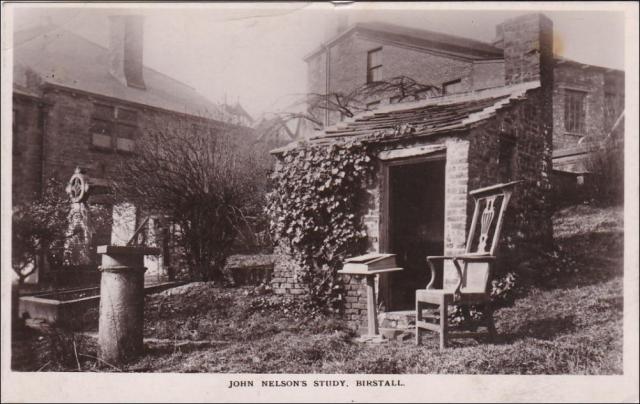
The cell-like study and retreat of the early Methodist preacher and holy man John Nelson, whose autobiography is featured below.

In what follows, I have juxtaposed accounts taken from one end of Eurasia (here including North Africa) to the other, each of which dates from the seventeenth or eighteenth century: we begin with an account by an early English Methodist, next hear from a Moroccan sufi shaykh and saint, followed by an Ottoman Syrian self-taught shaykh, finally ending with an Edo-period Japanese Zen master- lives I doubt have ever been placed in such proximity before! Yet they are all united by at least two major common themes in addition to their chronological proximity: one, each is autobiographical, either as part of a stand-alone account, or embedded in some larger biographical project. Two, each has to do with narrating a moment or period of conversion from one way of life to another. We might be tempted to call all of these religious conversions, but I think it’s best to avoid the term ‘religious’ here since while it’s accurate in some ways it does not really quite reflect how these various writers or those around them thought about the world and the nature of the experiences and lives we might label ‘religious.’

There are other shared features that I think are significant and which might point to some of the shared, interconnecting features of early modern life on a global scale. Each of these accounts reveals not just a sense of subjectivity and inwardness, but a surprisingly assertive sense of subjectivity- reflected in, to begin with, the very act of writing and circulating in some fashion an autobiographical account. Related to this subjectivity and self-fashioning is the stress laid on reading and encountering books, often through one’s individual act of reading. This is significant given the emphasis placed in many cultural contexts in medieval Eurasia upon the oral, face-to-face, hand-in-hand transmission of knowledge and religious practice. Yet most of these figures not only were shaped by their own personal readings and encounters with texts, they in turn produced texts for others to encounter in a similar fashion. That is not to say that these authors were ‘individualists,’ and certainly none of them would have embraced the idea of the ‘autonomous’ self. Each in his own way was a part of religious communities, textual genealogies, and shared collectivities of practice and worship and belief.

I encourage you to read these excerpts in sequence and to think about commonalities or differences and the possible reasons for them, as well as what they may or may not say about shared early modern histories beyond my brief comments above. For each excerpt I have given a minimal introductory note, followed by the account and the citation (of the four not originally in English, I have translated one, while the others are translations by other scholars).

1. John Nelson (1707-1770): A stone-mason by trade, John Nelson would become an early convert to the Methodist movement within the English Anglican Church led by John and Charles Wesley. I have selected two sections from his Journal, an autobiographical rendering of his spiritual journey and labors on behalf of the Wesleys’ pietistic movement. In the first, Nelson describes a formative childhood experience, while in the second he narrates the pivotal moment of his adult conversion from a state of emotional insecurity and distance from God to that of being ‘saved.’

When I was between nine and ten years old, I was horribly terrified with the thoughts of death and judgment, whenever I was alone. One Sunday night, as I sat on the ground by the side of my father’s chair, when he was reading the twentieth chapter of the Revelation, the word came with such light and power to my soul, that it made me tremble, as if a dart were shot in my heart. I fell with my face on the floor, and wept till the place was as wet, where I lay, as if water had been poured thereon. As my father proceeded, I thought I saw everything he read about, though my eyes were shut; and the sight was so terrible, I was about to stop my ears, that I might not hear, but I durst not: as soon as I put my fingers in my ears, I pulled them back again. When he came to the eleventh verse, the words made me cringe, and my flesh seemed to creep on my bones while he read… Continue reading “Conversion Stories From Across Early Modern Eurasia”

Devotion to Muhammad in Medieval and Early Modern Islam: An Introduction

Hilye triptych
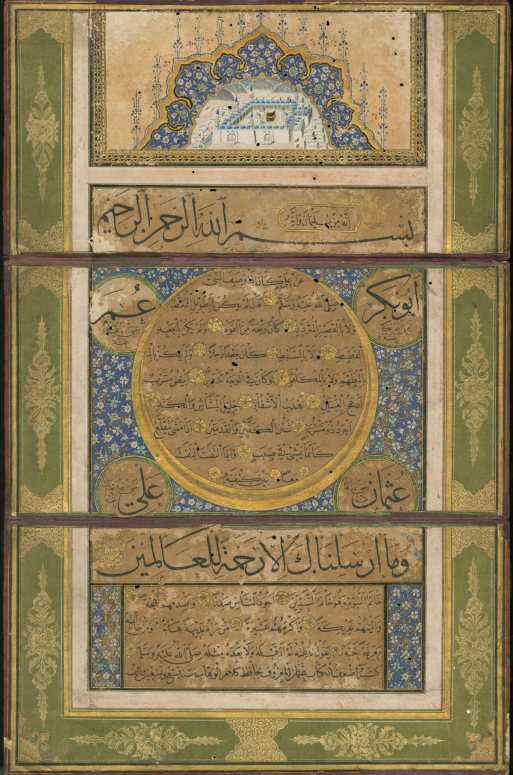
A three-panel Ottoman ḥilye-i şerîf-  a description of Muhammad’s physical attributes, or ‘verbal icon’- by Ḥafîẓ Osmân Efendî (d. 1698). Note the miniature depiction of Mecca in the top panel. Special Collections Library, University of Michigan, Ann Arbor, Isl. Ms. 238.

There are a number of aspects of medieval and early modern Islam (and contemporary living Islam too, for that matter) that tend to surprise, even shock, many modern-day observers, especially non-Muslims who nonetheless have some degree of knowledge about the ‘basics’ of Islam. Because of the wide-spread and often quite profound changes that have transformed Islam in many places throughout the world over the last century and a half or so, there is a great deal in pre-modern ‘mainstream’ Islam that many contemporary Muslims might find odd, unexpected, or even heretical. One such source of surprise and even shock is the history of the image and meaning of Muhammad in Islamic theologies and devotional practices. If, like me, in your initial exposure to Islam you learned that Muslims—throughout time, perhaps?—viewed Muhammad as ‘only’ a prophet, and no more, then Islamic theology that talks about the Muhammadan light, the cosmic role of Muhammad within God’s creative plan, and the intercessory power of the Prophet, and so on, must all sound quite strange and even ‘un-Islamic.’ Indeed, I remember thinking, as I delved into the vastness of ‘Muhammadology,’ that much of the theology I was discovering bore a marked resemblance to Christology, in particular to Logos theology, in Christianity.

Yet far from being aberrant or peripheral, the theological ‘elevation’ of Muhammad that took place in the course of the Islamic medieval period was a transformation that occurred and impacted Islam across the board. It was not just a ‘Sufi’ thing or a matter of ‘popular’ religion. Devotion to Muhammad, alongside theological renderings of the ‘cosmic Muhammad,’ coursed through the very veins of Islam from the middle ages into early modernity and beyond. The person and role of the Prophet Continue reading “Devotion to Muhammad in Medieval and Early Modern Islam: An Introduction”

Tobacco and the Syrian Majdhūb

One of the great transformations that Ottoman society- and many other societies across the world- underwent in the course of the early modern period was the introduction of new (to most markets at least) ‘social’ commodities such as coffee, tobacco, tea, and sugar. Driven by new technologies of transportation, by the European discovery and colonization of the Americas, and by changing dynamics of personal wealth and consumption patterns, across the world people’s lives began to be shaped by the use of coffee and tobacco, both substances with addictive properties, and which lend themselves to use in social, often public, contexts (I am writing this from a coffeehouse, for instance- a direct descendant of these early modern transformations!). In the Ottoman world, as in many other places, both tobacco and coffee stirred up controversy, tobacco most of all.

Yet despite strenuous objections, including sultanic attempts to prohibit smoking, tobacco use flourished in the Ottoman lands, and soon permeated society and culture at many levels. The following anecdote, which dates from the early part of the 18th century and is set in Damascus, illustrates this permeation, which reached even to the karamāt (miracles or signs of sanctity) of Muslim saints, in particular, it seems, the majādhīb, the divinely drawn ones, whom I have introduced elsewhere and who will continue to appear in these digital pages. In this story we see both the continued ambiguity surrounding tobacco, as well as the possibility for its use by a saint, and even being miraculously transformed through the saint’s baraka (divine grace or power).

2006BK4224_jpg_l

Shaykh Muṣtafā related to me [Muṣtafī al-Bakrī], saying: ‘I came to visit you once but didn’t find you at home. [Aḥmad the majdhūb] was sitting in front of the iwān, so I greeted him. He said to me: “You only come to visit Ibn al-Bakrī, you never come to visit me, not even once!” I replied, “Your place is exalted and I am weak!” So he said to me, “Come out to my khalwa, I’ll host you!” I wasn’t able to oppose him in that, so I went with him, fearing that the smell of tobacco would harm me due to the closeness of his khalwa. He set to with his pipe, talking with it [in his mouth], but I did not smell the scent of the tobacco nor did anything of it come to my face—and I knew that this was a mark of sanctity (karāma) of his!’

Muṣṭafā al-Bakrī, al-Bayān al-ghanī ʻan al-tahdhīb fī suná aḥwāl al-majādhīb (Cairo: Dārat al-Karaz, 2011), 75.

Pious Graffiti at the Church of the Holy Sepulchre: Pilgrims’ Prayers and Traces of the Self

A Visual Essay

The Church of the Holy Sepulchre in Jerusalem, as any pilgrim or tourist visiting it quickly discovers, is a massive, maze-like structure, or, really, assemblage of structures, including the Tomb of Christ and of Golgotha but also numerous other chapels, rooms, and other elements. Somewhat closer investigation starts to reveal the multiple layers of construction and use, going all the way back the first century AD (and probably further, since the Tomb was located in the side of an already old quarry outside of the Herodian walls of the city). While the names of prominent men and women are often attached to these various architectural layers, beginning with Constantine and his mother Helena, the traces of far humbler pilgrims to the great church are also visible, if one knows where to look. Yet, as I observed on my visits to the church earlier this year, the steady streams of pilgrims and tourists, clergy and tour guides, pass right by these fascinating reminders of the centuries of pious visitors who have traveled- often over great distances and in difficult circumstances- to venerate the empty Tomb of Christ.

IMG_4901
The largely Crusader-era main entrance to the church, with entrance and front facade giving little indication of the size of the church’s sprawling interior. The pious graffiti is most abundant around the doors near the center of the picture.

Covering the columned framing of the great doors to the main entrance to the church are perhaps hundreds of instances of ‘pious graffiti’- prayers, names, dates, and short texts carved into the stone by pilgrims. Deeper inside the church, in a stairwell leading down to the Chapel of St. Helena, sunk within the living rock, are hundreds of neatly carved crosses left by Crusaders, also as pious graffiti marking and memorializing their pilgrimage. While in the modern world such defacement is looked down on and even seen as criminal, Continue reading “Pious Graffiti at the Church of the Holy Sepulchre: Pilgrims’ Prayers and Traces of the Self”

Evliya Çelebi in the Marvelous Gardens of Diyarbakır

The great Ottoman traveler Evliya Çelebi traversed the vast lands of the Ottoman Empire and places beyond, recording both the mundane and the fantastic, from the number of public baths in a given town to tales of magic, wonder, and the machinations of dark and mysterious powers. In the especially charming selection below, he describes the unique lifestyle of the residents of Diyarbakır, a city in what is now southeast Turkey. The description- of the marvelous gardens and temporary summer dwellings therein, and the entertainments associated with them- speaks for itself, so I won’t elaborate further. While the particularities of the situation are perhaps unique to Diyarbakır and its geographic and ecological situation, other themes can be traced elsewhere in the Empire: the importance of sociability, especially in semi-public spaces like gardens, accompanied by music and drink, can be traced all through this period and the following century, despite the protests of the more puritanical-minded among the ‘ulama. The seamless integration of Sufi musical practice with the more ‘secular’ preceding night’s entertainment is also worth noting.

15.4-Isl.182-Flisepanel-med-kirsebaergrene
Fritware tile panel, painted in blue, turquoise, and moss green under a transparent glaze Ottoman Empire, Iznik; c. 1540. From the David Collection, Copenhagen.


But Diyarbekir’s basil gardens and regularly laid out vegetable plots on the bank of the Tigris have no equal in Rum or the Arab lands or Iran. When, in the spring season, the flood period of the Tigris has passed and its limpid waters begin to flow [again] in a stable current, all Diyarbekir’s inhabitants, rich and poor alike, move with their entire families to the bank of the Tigris. They settle down under tents and pavilions along this wide water, on the plots that they have inherited from their fathers and ancestors, and they sow and cultivate in their gardens melons, water melons, various vegetables and flowers. They cultivate here a special type of basil, which everyone plants along the borders of his plot. In a month’s time it becomes [dense] like a forest and as high as a spear’s length so that it is impossible to look through the basil and see what is inside. The doors and walls, the gates and roofs of all these make-shift habitations on the bank of the Tigris are entirely made out of basil…. These pavilions are so densely overgrown with basil that the nostrils of the men and women living in them are scented night and day with the fragrance of basil and the other flowers in these gardens, such as roses, Judas-trees, and hyacinth. The women’s quarters of each garden are also such open-air pavilions of basil. The ponds and fountains in each pavilion all receive their water from the river Tigris. Between all these gardens and vegetable plots run numerous canals and watercourses which people have diverted from the Tigris to their regularly laid-out vegetable gardens.

For a full seven months a merry tumult, with music and friendly talk, is so going on night and day here on the bank of the river Tigris, as in each pavilion people are passing their time with their beloved and close friends, in jollity and drinking, enjoying concert sessions [like those] of Huseyn Bayqara[‘s court]. All the artisans however remain busy with the crafts during this garden season; [so that] all sorts of food and drink are available. Thousands go to the city in the morning and pursue their respective jobs; and in the late afternoon they return in swarms to the gardens on the banks of the Tigris, to indulge in pleasure and enjoyment…

In short, the people of Diyarbekir arouse the envy of the whole world because of the pleasures and enjoyments that they have on the bank of the Tigris for seven or eight months [of the year], their nights being [like] the Night of Power, and their days [like] the Feast of Sacrifice. They hold banquets like Husayn Bayqara’s, thinking to snatch a bit of pleasure from this transitory world. Each night the banks of the Tigris are illuminated with oil lamps, lanterns, wind tapers and torches, and people arrange in thousands of artful ways oil lamps and wax candles on boards, [which they then put to float on the Tigris], so that the lights are drifting from one side to the other, and the darkest night becomes like a brilliant day. In each pavilion singers and musicians, clowns, minstrels and story-tellers perform, players of the lute, the çartar, the şeşetar, the berbut, the qanun, the çeng, the rebab, the musqar, the tanbur, the santur, the nefir, the balaban, the ney, and the dehenk, in short all sorts of musicians with string and wind instruments give performances like those at Bayqara’s court, continuing until the break of dawn, when the Muslim muezzins chant with their sorrowful voices the glories of God, as it to apologize, and all the followers of the [Sufi] path and faithful lovers [of God] begin their recitations in praise of Oneness, in the spirit of Pythagoras the Monotheist. For since the people of Diyarbekir all belong to the order of the Khwajagan and the Gülşeni order they do not miss the ecstatic joy and delight of ritual chantings. In conclusion [one may say that] while busy intercourse and buzzing conversation go on these Iram-like gardens, the people continually pray for the perpetuation of the imperial state (devlet). May God exalt their spiritual stations!

Evliya Çelebi, Seyahatname, translated by Martin Van Bruinessen and Hendrik Boeschoten, in Evliya Çelebi in Diyarbekir (Leiden: Brill, 1988), 177-181

A View of Constantinople, 1756

The following effusive description of Ottoman Constantinople/Istanbul is from the pen of Timothy Gabashvili, a Georgian cleric who embarked, in the mid 18th century, on a long journey across the Ottoman realms visiting sacred sites, various Orthodox communities, and other sights and places along the way, all of which he would later describe in his Georgian-language record of his pilgrimage. Timothy’s perspective is a somewhat unique one: Georgia in the mid 18th century was still within the Ottoman orbit, but was being aggressively courted by an expansive Russian empire. Timothy himself had previously visited Moscow and the new city of St. Petersburg. Yet in much of his narrative his treatment of the Ottomans is remarkably positive- all of his interactions with Ottoman officials were amiable and productive, and the relationships he managed to forge enabled the success of his pilgrimage. In a relatively few short years- unbeknownst to Timothy or anyone else- the Ottoman world would change a great deal, and a pilgrimage of this sort, and the relationships that made it possible, would be forever lost. In 1756, however, a pious Georgian pilgrim could still feast and drink with Muslim Ottoman notables, and wax poetic in praise of the the Ottoman incarnation of the City of cities.

Panorama of Istanbul, Ottoman, late 18th – early 19th century, 58 x 27.1 cm, SHM 12449 – İ.1285 / From the Sadberk Hanım Museum, Istanbul

*

Now, I’ll say something about the city of Constantinople. The lure of the city’s radiance has spread its beauty to distant parts of the world and even the capitals, because in no other place can one find Asia and Europe together. Among them, running down from the Black Sea, there flows a narrow sea like a river. It runs, with spouts of foam. Constantinople is founded on it and on the mountains by the hand of Sabaoth. The mountains are lavishly covered with spruce trees and Lebanese cypresses. The city has been built on both sides of the sea that flows in a narrow stream. The structure of the walls, the towers and the battlements are splendidly coloured. The windows of the palaces sparkling in different ways, resembled Eden.

Some of the palaces, vaults and bazaars of the city were covered with lead, the gilded roofs of the palaces and springs shone like the sun shining on the city, and the colour of other buildings in the city was scorched clay, or purple, a hue also like the sunset. The ships in the city stood erect like the trunks of poplar trees. Among the groves of selvinu, ghaji, and cypress trees, there was a glimpse of the royal palaces, and the buildings were veiled in the forest of pine and spruce groves. This capital seemed to me like the brightest among the stars, like a rose among the flowers of Eden, like a jacinth among the precious emeralds, like the rainbow in the clouds, and Augustus Caeser among the kings. I found it very difficult and sad to be leaving Constantinople, as I, who had come here after a great many sufferings and hardships, would never see it again. My eyes and my mind competed in emotion when viewing this marvelous city

Timothy Gabashvili, Pilgrimage to Mount Athos, Constantinople, and Jerusalem, 1755-1759, trans. by Mzia Ebanoidze and John Wilkinson


A Moving Experience

Sufism, particularly in its more ecstatic and speculative forms, was not universally admired in the Ottoman world (or in the contemporary world, for that matter). Opposition to particular Sufi practices and doctrines, or Sufism as a whole, could come from various quarters, whether from the ranks of the learned elite or from the pious masses. In the short story below, taken from Aḥmad ibn Muṣṭafá  Tāshkubrīʹzādah’s biographical dictionary (a frequent contributor to this blog in recent days, regular readers will notice), we see both the tenor this opposition could take, and an instance of a rather dramatic conversion from an anti-Sufi stance (or, at least, anti-ecstatic Sufism). The story mostly speaks for itself. A couple of things are a little less obvious perhaps: one, note that the Sufi shaykh featured here is described as only having a Turkish name, unlike the majority of people featured in Tāshkubrīʹzādah’s collection. Does this indicate a rural origin, or perhaps outsider status vis-a-vis the ‘learned hierarchy’ of Istanbul and the rest of the empire? Why does Tāshkubrīʹzādah give only this one anecdote for substantial content of this shaykh’s life? I’m not sure. Ottoman Sufism and religion in general is an area of study I’m still very much a novice in; I might also add, my transcription of the Turkish shaykh’s name is a contingent guess for now. I have but lately begun studying Ottoman Turkish, and will probably come back and modify my transcription in time to something more accurate.

Among them, the Knower of God, Shaykh Sūndīk known as Qūghejēdede: He was a master of great divine ecstasies, sunnaic states, and performed miracles.

It is related that he met with Mullah al-Karamāsī—the qāḍī of Constantinople[1]—along with Mullah Ḥamīd al-Dīn ibn Afḍal al-Dīn, who was at the time a mufti. Mullah al-Karamāsī complained to him regarding the Sufism of the age, in that they danced and entered trance-states during dhikr,[2] which was in disagreement with the shari’a. So Mullah ibn Afḍal al-Dīn said to Mullah al-Karamāsī that their leader was this shaykh, pointing to Qūghejēdede, and said: If you make him sound, all will be sound. At that Mullah al-Karamāsī stood up and took Qūghejēdede to his house and fetched his disciples [of Qūghejēdede], and prepared food for them. After finishing the food, he said to them: ‘Sit, and practice your remembrance (dhikr) of God in propriety, sobriety, and silence!’ They said: ‘We will do that.’ Then, when they began their dhikr, Qūghejēdede shouted very loudly in Mullah al-Karamāsī’s ear, so that the Mullah stood up, threw off his turban from his head[3] and his outer robe from his shoulders, and began dancing and entered a trance-state until an entire third of the day had passed. When the Mullah’s disturbance had stilled, Qūghejēdede sad: ‘For what were you so disturbed, O Mullah—and you had said it was evil?’ The Mullah replied: ‘I repent! And I revoke before God that rejection [of Sufism], and I will never return to it!’

The aforementioned shaykh died in the city of Constantinople and was buried in it—God hallow his mystery (sirrahu).

Aḥmad ibn Muṣṭafá  Ṭāshkubrīʹzādah, Al-Shaqāʼiq Al-Nuʻmānīyah Fī ʻulāmāʼ Al-Dawlah Al-ʻUthmānīyah (Bayrūt, Lubnān: Dār al-Kitāb al-ʻArabī, 1975), 220-1. Translation by Jonathan P. Allen, 2012. No rights reserved.


[1] That is, the chief judge of Constantinople/Istanbul.

[2] Dhikr—literally, ‘remembrance’—is a Sufi practice in which the name of God or certain short devotional phrases or prayers are uttered (either vocally or silently/mentally) in succession, over and over, sometimes leading up to a trance-like state (though not in all forms of dhikr).

[3] An action strongly indicating abandonment of propriety and self-control.

War, Travel, Commentary, Alchemy: An Ottoman Life

The following life is a marked departure from the two previous biographies from Ṭāshkubrīʹzādah’s Shaqa’iq that I’ve translated and posted here and here. Whereas the previous two figures are depicted as mystics and having an ambiguous, even conflicted relationship with both wider society and the Ottoman state structure, the subject of today’s biography does not seem to have had such problems, working in close company with first a Mamluk Sultan and then the Ottoman Sultan. His relationship with the Ottoman state, interestingly, is also different: rather than “official” posts such as judge, teacher, or mufti, Muhammad ibn ‘Amr ibn Hamza is what we might call a “popular preacher,” or at least that is the way he is depicted here. The “people” (ahl) love him, we are told; yet it isn’t just the people who love him; the holders of the highest political power in the lands he sojourns in also love him, and he seems to return the favor.

Ibn Hamza’s life trajectory is somewhat unusual: while being from a Transoxanian family is not particularly unusual, his birthplace of Antioch does stand out. While a major city of late antiquity and the middle ages, by the Ottoman period Antioch had declined greatly due to invasion and, more importantly, the silting up of the Orontes, which crippled Antioch’s port capacity and hence value as a trade entrepot. Leaving Antioch, ibn Hamza’s career would come to move in tandem with some of the central trends of his era: increasing Ottoman power and vastly widened territory, conflict between the Sunni Ottoman state and the Shi’i Safavid state, conflict that was itself part of a wider trend of state-formation across Eurasia, often in an atmosphere of inter-confessional conflict.

This inter-confessional conflict makes up the central element of ibn Hamza’s life: participating in and indeed encouraging the war against the “heretical” Shi’i Safavids, here refered to as the Qizilbāsh (literally, the “red-heads,” after their red turbans) in reference to the religio-military group that had facilitated the Safavid rise to power. Ibn Hamza’s fight against Shi’ism takes multiple forms, most virulently as a preacher in the service of Sultan Selīm; we may wonder to what extent this anti-Shi’i stance preceded ibn Hamza’s association with the Ottoman state, and to what extent it was simply precipitated by a commitment to Sunni orthodoxy. At any rate, anti-Shi’i activity would be central to Ottoman efforts within and without the empire, a situation somewhat analogous to the Cold War of the twentieth-century between the United States and the Soviet Union. People suspected of Shi’i leanings constituted, in the eyes of the Ottoman authorities, a central threat to the Ottoman state; Sufi groups could fall under suspicion, as we see in ibn Hamza’s life (although also note that Sufism per se is not condemned, at least not in Ṭāshkubrīʹzādah’s rendering, only a particular practice of some Sufis). But it should be noted that preaching holy war against heretics was not the only concern in ibn Hamza’s life—he also seems to have been deeply concerned with the wider social and religious welfare of Ottoman society, or at least this is the impression Ṭāshkubrīʹzādah wants to give us. In addition, while not exactly a conventional scholar, he did engage in book writing and other scholarly pursuits, alongside his preaching of holy war, acting as the companion of sultans, building mosques, preaching often, mastering alchemy, raising a massive family, and apparently engaging in commerce. It is perhaps not coincidental that the appellative that comes to mind is “Renaissance man,” but a discussion of the truth that lies behind such a thought is best saved for another time.

Finally, a note on the new format I have used here: having recently discovered how simple inserting endnotes into a WordPress post is, I have therefore included explanatory notes throughout the text, which I hope will make some of the technical language and historical references clearer.

Among them is the Knowledgeable, the Noble, the Virtuous Mulla Muhyi al-Din Muhammad ibn ‘Amr ibn Hamza:

His grandfather was from Transoxiana [1] and was among the disciples of Sa’ad al-Din al-Tuftazani. He then traveled and settled in Antioch, where this Muhammad was born. He memorized the Qur’an at an early age, then al-Kanz and al-Shatabi and others, then studied fiqh [2] under his paternal uncle Shaykh Hussayn and Shaykh Ahmad, virtuous men, studying under them the principles of jurisprudence (al-usul), Qur’an, and the Arabic language. He then journeyed to Hasn Kifa and Amada, then to Tabriz, learning from its ‘ulama, busying himself there for two years, studying in Tabriz under the learned, the virtuous Mulla Muzid. He then returned to Antioch and Aleppo and remained there for a time, preaching, teaching, and issuing fatwas, his virtues becoming well known. Then he went to Jerusalem and lived nearby, then to Mekka and performed the hajj, then to Egypt. There, he heard hadith from al-Siyuti and al-Shamani, both giving him ijāzas. [3] He preached, taught, and gave fatwas, having great reception for a time, until Sultan Qāʾitbāy [4] sought him out and he appeared before him, preached to him, and wrote a book for him on fiqh titled The Conclusion, so he loved him and honoured him with great honour and rewarded him well. [The Sultan] would not give him permission to travel, so [ibn Hamza] remained in [the Sultan’s] presence until King [sic] Qāʾitbāy passed away in the year 903 [1497].[5]

Then [ibn Hamza] traveled to Anatolia (al-Rum) by way of the sea, and then made his way to Bursa, whose people loved him greatly, so he stayed there and busied himself with preaching and forbidding the wrong.[6] Then he went to the city of Constantinople and its people loved him also, and Sultan Bāyazīd [7] heard his sermon and bestowed upon him all of his wealth, and he used to send rewards to him all the time. [Ibn Hamza] wrote for him a book titled Explication of the Excellent Qualities in the Life of Our Prophet (peace and prayers of God—exalted is He—be upon him), and another book on Sufism, and was present before him, exhorting him. Then the Sultan went out on the holy frontier campaign,[8] and [ibn Hamza] was with him. Together they conquered the fortress of Methoni, and this was their second or third entrance therein.[9] Then he returned to Constantinople and remained there, commanding the right and forbidding the wrong, for he did not fear the reproach of God, and he opposed the heretics and the Sufi practice of dancing. He next returned with his family to Aleppo the Protected, and Melik al-Amra’ Khayrbek honoured him greatly and studied under him, being responsible for all of his needs, so that [ibn Hamza] did not require anything else. So [ibn Hamza] stayed there eight years, occupied with tafsir, hadith, and refuting heretics and the Rāfiḍa bearing the name of the tyrant Ardabik.[10] This sect hated him, cursing him in their assembly while cursing the Companions of the Prophet.

[Ibn Hamza] then returned to Anatolia during the reign of Sultan Selīm Khan,[11] urging him on to holy war (jihād) against the Qizilbāsh,[12] writing a book for him on the conditions and virtues of holy frontier campaigns (it is a very fine book); [ibn Hamza] then went with him to the war against this sect, preaching to the army every day during the campaign, reminding them of the rewards of holy war, especially against this sect. The Sultan honoured him and was very generous towards him. When the two armies met, fierce fighting broke out, and as eyes were averted and hearts rose into throats, the Sultan commanded [ibn Hamza] to proclaim the call (al-dawa’a). So he occupied himself with proclaiming the call, and the Sultan cried, “Amen!” So the enemy was put to flight through the help of God—exalted is He—and he journeyed to Rumelia, preaching to its people, forbidding them disobedience [towards God] and commanding them to do the obligatory deeds. So many among them were [morally] improved because of him, and he built two Friday mosques in the town of Saray [Sarajevo], as well as a neighborhood mosque there and another neighborhood mosque in Uskub [Skopje], and remained there approximately twenty years, doing Qur’an interpretation every day, converting many unbelievers. In the year 932 [1525] he went on campaign with our magnificent Sultan [13] to Ankeros, and he called to him at the time of the fighting, and the glorious conquest came as before.[14] Then [ibn Hamza] went to Bursa and dwelled there and began to build a large mosque, but passed away before its completion, on Muharram 4, 938 [August 18, 1531]; he was close to seventy years old, and was buried in the precincts of the mosque.

He beget from his loins nearly a hundred souls; he had many books and treatises on numerous arts, especially on the science of alchemy (al-kīmiyāʾ), being among those who persevere in it. He traveled to many places, was beloved by many, many souls being attracted to him. He was greatly pious, and had perfect watchfulness in his manner of eating, dress, and ritual purity. His cost of living was covered by his commercial activity, while much of his time was expended in the betterment of people through preaching, teaching, and fatwa-giving. There are few hadith mentioned in books which he did not have committed to memory; he was perfect in his Qur’an commentary (tafsir), without recourse to study or books. He used to devote himself on Fridays to commentary (tafsir) on what the preacher had recited during prayers, with perfectly elegant style, variety of aspects, and abundant knowledge, which daily amazed those who thought on it. The common people and the elite among the ‘ulama and the Sufis learned from him: he was knowledgeable, lordly, always summoning to right-guidance and good conduct; putting to death many bad innovation and bringing to life many good traditions (sunnan). People beyond the count of any but God benefited through him; such would not be possible to anyone else unless there came the like of what was sent from the grace of God [through him]—may God breathe upon his face and enlighten his grave!

Aḥmad ibn Muṣṭafá  Ṭāshkubrīʹzādah, Al-Shaqāʼiq Al-Nuʻmānīyah Fī ʻulāmāʼ Al-Dawlah Al-ʻUthmānīyah (Bayrūt, Lubnān: Dār al-Kitāb al-ʻArabī, 1975), 247-249.


[1] Lit., “what lies beyond the river,” roughly modern-day Tajikistan, Uzbekistan, part of Kyrgyzstan, and Kazakhstan.

[2] Islamic jurisprudence.

[3] “License,” certification that one is qualified to transmit hadith (or a book or other text) from a given person via an authorized chain of transmitters.

[4] Important late Mamluk ruler, carried out extensive military campaigns and building projects; died a few years before the Ottoman conquest of Egypt. See M Sobernheim, “Ḳāʾit Bāy, al-Malik al-As̲h̲raf Abu ‘l-Naṣr Sayf al-dīn al-Maḥmūdī al-Ẓāhirī” in Encyclopaedia of Islam, Second Edition, edited by: P. Bearman; , Th. Bianquis; , C.E. Bosworth; , E. van Donzel; and W.P. Heinrichs (Leiden: Brill, 2011).

[5] Qāʾitbāy actually died in 901/1496.

[6]The second half of the phrase “commanding the right and forbidding the wrong,” a basic Islamic ethical injunction incumbent upon all believers; the exact dynamics and parameters were, however, widely debated. See Michael Cook, Commanding Right and Forbidding Wrong in Islamic Thought (Cambridge: Cambridge University Press, 2010).

[7] Sultan Bāyazīd II, ruled 886-918/1481-1512.

[8] Ghazu, literally a raid, but in this context a campaign on the Ottoman frontier, here given a sacred function (see below), hence my somewhat inelegant translation.

[9] Methoni (also known as Modon) is a heavily fortified town in Morea, Greece; it had been held by the Venetians for nearly three hundred years until its fall, mentioned here, on August 9, 1500. For photos of surviving fortifications and a plan of the town, see: Methoni.

[10] “Rāfiḍa” by this period had become a derogatory term for Shi’i Muslims in general; I have not been able to uncover to whom the name Ardabik refers.

[11] Ruled 918-926/1512-1520.

[12] That is, the Persian Safavids, relatively recently converted to Shi’a Islam.

[13] Sultan Süleymān I, ruled 926-74/1520-66.

[14] This must refer to either Süleymān’s conquest of Belgrade in 1521 or his 1525 Hungary campaign; I suspect the former, though that would mean Ṭāshkubrīʹzādah’s date is wrong.

Killing a Dragon

They told me that, in the district of Aghstev, there is a cavern in the fir forest. It is situated on a high ground, as high as the height of two persons. A monstrous dragon had made his lair in it. At midday he would crawl out of his lair and look around. The moment he saw an animal, he would leap on it; if he could, he would gobble him up; if he could not, he would return to his lair. No one could kill it, for the cavern was on a high ground.

One priest killed it by being cunning. He made a trident hook, bent the end of its shaft into a circle and tied a rope to it. He killed a baby goat, skinned it, prepared a water-skin, filled it with hay, and placed the hook in it. He then adroitly tied the legs and head of the goat to the skin and went at night to the cavern. He set the skin there, took the end of the rope, moved away, and sat under a tree. Another man lay in wait with him. At noon, the dragon crawled out of the cavern and saw the baby goat near its entrance. It slid down, swallowed the baby goat, and wanted to return to the cavern. The priest, however, pulled the rope and the hook cut into the body of the dragon. It began to whistle and its tail tried to grasp plants, grass, and everything else that was around. The priest dragged the rope, while the dragon pulled toward the cavern. It hissed terribly, coiled, and struck its tail to the right and left. It suffered thus until it croaked. The priest skinned it, salted it, and took it to their governor. They measured the skin and it was eighteen t’iz [a t’iz is nine inches] long and three t’iz wide. They then packed it with straw and sent it to the Shah. Together with the stuffed animal, they also sent an account of how they killed the dragon. The Shah exempted the priest from the taxes due to the treasury and made him the head of the village.

Deacon Zak’aria (1627-1699), The Chronicle of Deacon Zak’aria of K’anak’er, translated by George A. Bournoutian