The First Friday Night

From Questions and Answers of Isho bar Nun, an answer that I found particularly charming:

Question: Did God create the primordial Natures in the night or in the day-time?

Answer: He created both in the night and in the day-time; and in these at their beginning… But there are [expositors] who have said that He created the wild beasts, the cattle and the creeping things of the earth at the beginning of Friday night. And they have presented a plausible argument, [based] on the fact that the wild beasts and the creeping things of the earth see better at night. However, everyone agrees that man was created at the beginning of the daytime of the Friday.’

From The Selected Questions of Isho bar Nun on the Pentateuch, ed. and trans. by Ernest G Clarke (Leiden: Brill, 1962).

Hardcore Scholarliness

I have to apologize for so little writing- the last weeks of the semester (plus the end of Lent and the marathon of Holy Week and Pascha which are so close) leave little time for blogging, I’m afraid. However, my study habits are certainly nowhere near those described by Barhadbeshabba (‘son of Sunday’) in his Eclessiastical History, in which he described the scholastic-monastic life of Narsai, the apparent founder and first head of the School of Nisibis, who would have loved coffee:

‘Now he would take a simple nourishment regularly of one meal, and again he would do this at evening time, or once every two days. His bed was a mat of reed and palm, his bedding a patched cloak. He would work wholly in meditation upon the liturgy and meditation on the scriptures, not giving place for sleep to fall upon himself, but upon a common seat he would drive sleep from his brow, and if it happened that he was conquered to slumber from his vigil, either he would stand and walk or he would place in his nostrils materials which would excite and awake, like spicy and sour things, or hot and pleasing things, or he would lay a tome upon his face and in this way he would sleep upon his seat. Often the tome would be the cause of waking him, since it would tip from its weight and fall from his face to his hands. The holy one demonstrated all this diligence so that while he was fleshly and mortal he emulated the way of the angels.’

From Sources for the Study of the School of Nisibis, translated and with an introduction by Adam H. Becker (Liverpool: Liverpool University Press, 2008). Becker’s reassasment and interpretation of the School of Nisibis and its ‘scholastic’ culture, which this collection of sources supplements, is excellent and comes much recommended if you’re at all interested in the Church of the East, though the price tag is unfortunately rather steep…

Palimpsests, Contested Land, and Spring Comes to the Mountains

I love every season in the mountains, and if you asked me what my favorite season to be in the hills is my answer would probably be whatever season it is at the time. Spring is probably the most exhilarating season though, particularly after a harsh winter: you can feel the life springing up out of the ground, the woods and peaks starting to stir and throb with new life. This weekend the hills are just starting to show the signs of spring- the ice is almost all gone from the high country (just a few icicles and patches of frozen ground left in the shadows), wildflowers are blooming up almost to the high peaks, and down in the valleys the patches of new green and blooms are covering larger and larger spaces.

img_5846 img_5864

img_5903

Early spring is one of the best times of the year to trace out the vast array of palimpsests that lie under the forests of the Southern Appalachians, before the thick growth of summer temporarily buries them yet further under the resurgent forest. Up almost every little valley and cove, if you look hard enough, you can find the traces of the people who once dwelt here, who pushed into the mountains up from the Piedmont of the Carolinas or down from Virginia, and cut and slashed their way into the often harsh and unforgiving landscape. In the Smokies, and in many other ranges and valleys, there are no more people- none at all in the Smokies, thanks to Federal policy that bought up and ran off (or let die out) the land owners. In other parts of the Southern Appalachians there are few or no people thanks to the hardscrabble nature of this land- after a century or so, the attraction of outside work was too strong, and the valleys and coves emptied out.

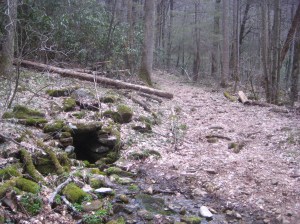
There are a variety of forms of writing, to continue my metaphor of the palimpsest, that still show up under the trees. Piles and rows of stones are the most obvious, usually- stone walls in various states of disrepair, disheveled stacks that mark old chimneys, disorganized piles along old fields, testaments to what had to have been back-breaking labour of digging up and clearing out the product these hills grow best. Occasionally bits of structures remain- spring coverings, foundations, less ambiguous signs than the often random-looking rows and piles of rock. Here and there are the stone marking graves, some of them still tended by the descendants of the people buried there, the names on the stones the last link of individual persons to the land in which they now lie waiting the Resurrection.

img_5907

img_5841

There are other signs- day-lilies and ivy, rose bushes and periwinkles, living markers descended from the plants brought with the people who once dwelt here. If there were no other records, we would know this much- whoever dwelt here cared about the appearance of their farmsteads, hardscrabble as they might be. You don’t eat ivy or day-lilies- they make your home more civilized, more settled. They are markers- though doubtless whoever planted them didn’t have this in mind- that persist, that have struggled against the return of the native forest: the day-lilies and roses have themselves become native, as the people who lived here had been, slowly, settling into the landscape. And like everything else in this landscape, they are in flux, rising and falling with the seasons, spreading and retracting, struggling, living.

The old fields and roads show up too, more subtly than the above signs, but clear enough if you’re looking for them. In cove after cove, even-aged tulip poplars grow like the corn stalks they’ve replaced; in some places the furrows of the fields are still visible under the fallen leafs and new humus. All through the hills old roads and paths still wind through the valleys and over ridges, appearing and disappearing; here and there modern trails lie on top of them, as people with very different lives and intentions follow them. But we leave eventually, returning to our homes elsewhere, in a different world, a different land.

img_5840 img_5839

img_5855

Finally, this is contested land. The signs of the Cherokee, and whoever might have come before them, are almost entirely invisible now. A few names of streams and mountains, mutated under the hand of English, survive on maps; in some of the lower valleys more tangible traces appear, or used to appear. But otherwise there is little left but the absence. The people who displaced the Cherokee are more visible, who wrested control of the land and gradually too became native to the place. The lumber companies who fought their way up the valleys- contesting the land perhaps most of all- still speak through the hills, but their traces are even more ephemeral than the settlers, now reduced mostly to railroad beds and bits of cable and a few scattered cinders; the forest is largely healed. The farmers themselves were challanged and driven out by the combined power of economic difficulties and the force of the Federal government; the transposition of old roads and modern National Park Service trails are testimony of this struggle. The signs of the Park Service often overlay the old signs- reused trails, place names, old cabins and houses marked by interpretive signs and tourist grafitti. One day, no doubt, these signs will also be subsumed by mountains, as the forest- enduring in its presence if not its form- swallows up this latest assembly of signs, and new ones- or perhaps none- replace them, and our contemporary presence recedes into the scattered memory of the hills.

Nothing But You Have I

ردوا علينا ليالينا التي سلفت و امحوا الذي قد جرا منا

Return to us the nights that have been lost to us,
And erase, by Your favour, that which has been issued from us.

فكم زللنا و انتم تصفحوا كرمآ و كم اسانا و نزجو حسب عفوكم

How much we have sinned, yet out of generosity You forgive!
How much we have erred, yet we still hope for Your good pardon!

ما لي سواكم و انتم حزني و قد جهلت و ما لي غير ستركم

Nothing but You have I- You are the recourse of my sorrow,
I have been ignorant, and possess nothing but Your indulgence.

لو كان الف لسان لي يبش بها شكرآ لم يقم يومآ بشكركم

Were to have a thousand tongues with which to express
Thanks to You, I would not stop thanking You for a single day.

Abu Madyan, Qasida in Mim

On Student Expectations and Grades, And Other Things

A rather brief article in the New York Times today addresses something my fellow graduate assistants and I have been learning this year: our students genuinely expect to receive a good grade (by which they mean an A), and are sometimes simply shocked when you assign them anything less. One common refrain we hear is, “But I get As in all my other classes!” Or the if-I-don’t-do-well-I’ll-lose-my-scholarship (or law school/medical school/etc chances) refrain. Or, as I’ve run into already a few times this semester, the pity card- everything from random tough luck to dead cell phone battery to terrible home life. That, and the complaint that the work is too much and the grading scale is too difficult.

What do I do about it? I’m a first year graduate student; I did a stint last school year subbing in high schools, and had the prerequisite half-day seminar our department requires. That, plus the teaching and mentoring I received last semester, is the extent of my teaching experience and training, so I can’t offer myself as any sort of expert on pedagogical techniques.

Instead, here are some things that I try to keep in mind when dealing with students: first, I genuinely want them to learn and do well. I wish I could do more, I wish I had greater control over things, but I don’t- I’m a teaching assistant. My jurisdiction in many ways ends as soon as it begins. But I do largely control the one thing my students care most about: their grade. That a lowly first-year M. A. student with his own heavy load of work outside of teaching responsibilities is the one in charge of determining whether the nearly sixty students under his tutelage pass or fail is itself somewhat disconcerting, isn’t it? If you’re reading this and are considering attending a large research university/have children you want to send to a large research university, well, caveat lector. But anyway, the possibilities open to me for assigning material and teaching style are very limited. I must follow the guidelines laid down by the professor; I cannot go off and do my own thing. This means I must follow the guidelines- this semester, very strict guidelines- for grading. And therein lies the struggle.

When my students complain of the difficulty of the work or protest for a better grade, part of me thinks: I never did this when I was an undergraduate. Granted, I usually made good grades, but when I made a poor one, I didn’t whine to the professor and demand a better one. I am terribly sorry if you worked hard and still came up short. I really am. But I am not grading you on how hard you worked- I am grading you on performance, on whether you apprehended the material, not just whether you read it.Yeah, I know everyone’s been telling you how special you are and how you deserve the best etc etc- it’s not true, ok? Be glad I didn’t grade you on your real merits.

That’s the nastier, be-glad-you-don’t-have-to-read-850-page-economic-history-tomes side of my internal dialogue. It has its merits, I suppose- it’s true that we’re faced with a culture that teaches our students that they deserve a good grade, that they deserve a college education, and that they are exceptionally smart, and so on. But at the same time, I feel- maybe dirty is the best word?- when I assign a bad grade to a student I know has in fact worked fairly hard, yet is still lagging far behind. I don’t want to assign him a bad grade. I know that the reason this student is probably in college is not because he wants to learn all about the Byzantines and Clovis and the rise of modern capitalism, but because he knows that the minimum benchmark for a decent job is a college degree- that’s the minimum benchmark. He’s been fed the absolute necessity of going to college his entire life, and he really does need to go to college- not because anyone cares about the values of a liberal education (it’s hard to type that phrase without an ironic snicker), but because a degree has become the function equivalent of a high school diploma, it’s the least an employer looks for so as to eliminate other applicants. My hard-working student needs good grades and a diploma because it’s just one more necessary marker in the system. He’s probably taking out loans, because the bait-and-hook “scholarship” he was awarded his freshman year ran out when he couldn’t pull a 3.5. Chances are he’ll end up dropping out, still carrying those loans, but without the degree- just debt. Here I am, a nice quiet cog in the system, happy to have my little stipend and my library card, knowing that I have neither the authority or the time and ability to change anything. It’s one of the most insidious things about the academic system- you very quickly learn your place and the advantages of not rocking the boat.

And then I think about what my students’ educational background is- I’ve done a little time in public high schools, I’ve an idea of things. I was privileged- I was homeschooled, then went to a nice little liberal arts college where I knew my professors and hung out in their offices talking history and politics and life. My average student here probably went to a ho-hum high school, maybe was able to get a few minutes in with his adviser, possibly spoke to the instructor of the present course once because he had a technical problem- that’s it. He’s only other point of contact with the discipline of history is a graduate student with fifty-plus other students he only sees once a week. I will assume a fairly similar experience in other classes- maybe I’m wrong. Still, where in all of this is he supposed to receive hands-on, intensive instruction in the life of the mind, in the skills necessary for really learning in the humanities? I expect my students to be able to read well enough to grasp the material and think about it- how do I know they have ever acquired that skill? What am I to do if they haven’t? Sure, it’s partially their fault- no one held my hand and made me learn- but I wasn’t continually in an anonymous, ho-hum educational environment either.

So. I make no claims in the above thoughts to originallity or great subtletly- nor do I pretend to have any particular answers. I didn’t come into academia expecting roses and candy, to be sure, and I had struggled with the whole idea of getting into academia at all- for the reasons above, and others. I still do. I wonder- should I get out while I can? Is this whole thing right? Is it worth it? I don’t spend much time thinking about these things- Friday evenings are a decent time, I suppose, but one tends to stay occupied (I guess that’s part of the genuis of the system…) with other things filling one’s mind. But those questions shall wait- I’ve ranted long enough as is.

Comparative Spaces, Sounds: Frogs, at Fes and at Seven Islands

img_1467

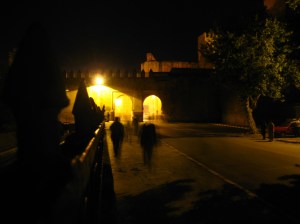
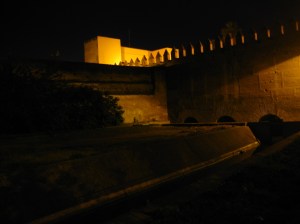
The road here passes alongside the big green liminal space that lies between Fes al-Bali- the oldest part of the Old Medina- and Fes al-Jedid, the rather newer (fourteenth century) construction that once housed the Sultan and Fes’ Jewish community. Today the King still has a residence but all that remains of the Jewish community are a couple synagogues and the white-washed cemetery.

The region between the two halves of the city is mostly covered in green space, with the old water channels- the restructured pieces of the streams that made Fes a desirable city in the beginning. Now they are home to at least a few frogs, who start to show up as spring evenings warm and lean towards summer. I passed through one evening as the crowds along the avenue were thinning out and the frogs starting up, down in the warm, mucky green water of the canals, fresh and vigorous against the late medieval bulwarks behind. I thought- here, at the edge of the desert (the dust was already starting to intrude, coming in through the open window of my bedroom, and the shopkeepers beginning their war upon dust in the streets), under the weight of the centuries of the city, are frogs, singing, as they have no doubt been singing under these walls for centuries, as the mulberries come into leaf. Kids run by, one chasing a ball (maybe they are the same kids I would see climbing the mulberries gathering fruit and leaves?); a single car mumbles by, the crowd moves along, laughing, calling, the snatches of Maghrebi Arabic ring in my ears. Frogs, children, the vigorous clip-clip of Maghrebi, spring over all- life, wonder, the ancient, the eternal, what I know, and what I can only listen to, and feel.

Frogs, near Fes al-Jedid. Spring, 2008.

img_1469

*

img_5672

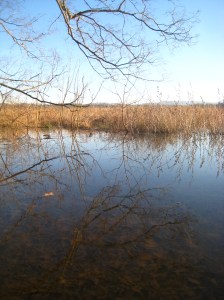
A few weeks ago the weather briefly- it’s now turned back cold- warmed, the sun came out, and the weeks of bitter cold passed into memory. It was warm enough that, for a few days at least, the frogs came out along the banks of the French Broad River at the Seven Islands Refuge, a Knox County park east of town. I was coming down the big limestone ridge towards the river when I heard the frogs singing, filling up the still wintry looking woods and fields. I scrambled down to the edge of the little flood-water pond, its quiet waters having swallowed up part of the trail and the clumps of weeds and brush. This also is a sort of liminal space, stuck between the wooded ridge behind and the river banks beyond, the pond precarious and temporary, the frogs unexpected- frogs in February? Where did they come from- I suppose frogs hide in the mud during the cold- what woke them?

The frogs seemed to be spread out in a line up and down the little pond, rising and falling in their song. I squatted beside the water and listened, closed my eyes, breathed the spring, the return to life, the womb of water and the song, all things bright and beautiful and alive.

Frogs, Seven Islands Wildlife Refuge. February 2009.

img_5671

More Compassion Than Anybody We Ever Saw

When we were at the ninth mile-post from Alexandria, we visited the monastery of Abba John the Eunuch for the benefit of our souls. There we found a very old man who had been at the monastery for about eighty years. He had more compassion than anybody we ever saw, not only for men, but also for animals. What did this elder do? No other work but this: he would rise early and feed all the dogs at the lavra. He would give flour to the small ants, grain to the bigger ones. He would dampen biscuits and throw them up on the roof-tops for the birds to eat. Living like this, he left nothing to the monastery when he died, neither door nor window nor spy-hole nor lamp nor table. In brief (not to say it all and make the story too long), he left nothing whatsoever of the world’s goods behind. Not even for one hour did he ever possess books, money or clothing. He gave everything to those in need, investing his entire concern in those things which were to come.

John Moshcos, The Spiritual Meadow (Story 184 in Wortley’s translation)

Occasional Vignettes; Week of Feb. 14

I keep telling myself, and am told by others, that I ought to write more, particularly as one of the principal parts of being a historian is the ability to write effectively. And to make progress in writing one must, as St. Augustine wrote in one of his letters, write, and write a lot, as the prolific Bishop of Hippo certainly did.

So as part of my attempt to write more I shall, insha’allah, begin writing weekly (possibly more but I dare not promise beyond that) installments of vignettes and anecdotal remarks from my week, perhaps brief commentary on whatever primary sources I’m reading in a given week (perhaps also secondary materials if it’s interesting enough). I find that blogging is a useful medium for collating and ever so slightly refining ideas that I would otherwise let flit off into space or consign to a Word file or a notebook; the public-ness of a blog compels me to give slightly more thought and attention to the things I write. Not a lot- blogging is, as advertised, push-button publishing, and like pretty much all the instant conveniences of modern life, quality suffers accordingly.

Still, the fact of writing in a public forum, and being somewhat conscious of it (but only somewhat: blogging still feels half-private, as I neither see the audience face-to-face- or very few members of the audience- nor the work itself in a physical, publicly accessible form) shapes how I write, and I think probably for the better. Then there is the whole interesting matter of one’s blog becoming part of one’s personal archive, here for all to see, alongside the stacks of books, papers, bits and pieces and odds and ends that you do not see.

But that’s a whole other matter.

*

1. While walking to my favorite café in our venerable Old City I was met, as I often am, by a homeless man. Knoxville has a large homeless/transient population, larger than anywhere in the ‘First World’ I’ve lived. This man struck up a conversation with me, seeing me carrying a couple heavy tomes under my arm: ‘What you studying?’

‘History’

‘Oh yeah, I love history. What part?’

‘Ah-’ I am immediately reminded at this point of a homeless person I gave a lift to a few months ago (yes, mum, if you’re reading, I occasionally pick up hitch-hikers etc., but you knew that already…); at this point in the what-do-you-do exchange, the homeless person asked quite pointblank, ‘What do historians do, anyway? Anything?’ Ah, yes, um…). I continued: ‘Medieval stuff mostly.’

‘Oh, my favorite is Ghengis Khan.’

‘My era is a little earlier, mainly.’

‘Oh.’

We proceeded to speak briefly of the joys and travails of history, and my new friend encouraged me to stick with it. He then asked me for a little change so as to buy himself a beer for St. Valentine’s Day. I admire honesty so I gave him, I think it was, a dollar fifty. Not having anyone else to buy a beer for on St. Valentine’s, I was actually glad this time to do so. We parted company.

There is a whole dialectic of do-I-give-money-to-homeless-people, but I will not engage it here, other than to say I usually do. Cf. St. John the Almsgiver. Caveat lector– he’s a bit radical, might make you a little uncomfortable. At least that’s how it is for me.

At any rate I had been in a rather bad nasty mood- long, dull story that only reveals my propensity for anger under frustration- and this particular man, somehow, helped relieve it.

2. Also seen today, first on Gay Street then later when she was walking along Chapman Highway across the river: a lady who wears red and black, in a sort of uniform that looks like a cross between a traffic attendant and a nineteenth century zouave. Very impressive. She also had a baton which she was swinging both times very deliberately.

3. Sitting in the coffee house studying I overheard the people next to me talking about the church shooting in Knoxville last fall. Turns out one of the women sitting there was in the church when it happened, and she proceeded to describe it in detail to her companions, and to me the unintentional voyeur listening at the table over.

One of her companions was very adamantly in favor the death penalty, swift and immediate; she wasn’t so sure. It was complicated, she said: being at the intersection of death and life (I paraphrase), in the moment when the bullets are- literally- flying and you are thinking about the most trivial things and the most serious things- that man has on a nice tie, is this women lying over there going to die right here should I help her where are the kids? I don’t know how I feel towards that man. Being there changes things.

What I wanted to say but did not say and probably it’s best that I didn’t, because after all I really know nothing: but if we condemn that man to death (as he surely deserves) we condemn ourselves to death, don’t we? There is blood on my hands and on yours; I silently participate in a deeply violent and bloody order of things and it almost never weighs on my conscience. And I myself know myself to have the murderous anger and rage inside of me; hell I felt it this very morning over the dumbest thing and then was angry at myself (angry again!) for my stupid brutish anger. It’s there in all our blood; it’s I who lashed out against God on the tree and cursed him and hoped to die- that will show them/Him! So all I can say and I have to say it over and over and over again is: Lord have mercy. Lord have mercy. What else can we say?

An Ineffable Transformation

Yesterday we remembered the two saints who are probably the most prominent representatives of the Syriac traditions in the Western churches- St. Ephrem and St. Isaac. A translation by Sebastian Brock of St. Ephrem’s Hymns on Paradise was the very first Patristic work I ever purchased; I don’t recall now why I bought that particular one out of all the Patristic translations I could have picked from.

I don’t recall the first time I came across St. Isaac, but I do know that his writings have impacted me greatly (not greatly enough of course- if I could really assimilate just a handful of his teachings on prayer, peace, silence, and the like- I’d probably not be blogging!). That St. Isaac was and is shared across not only his native Church of the East but also among the Miaphysites, the Eastern Orthodox, and Roman Catholicism (and I would imagine some Protestant as well) is encouraging and a hopeful sign of the possibilities that- still- inhere within Christianity. Granted, his reception into the Miaphysite and later Chalcedonian communions involved a little ‘fixing up,’ but that does not detract from the importance and significance of his cross-traditions reception.

St. Ephrem and St. Isaac, pray to God for us!

From St. Isaac:

An illustration of what is hidden in seedlings can be seen through the labours which the saints and other godly persons endure in themselves for the sake of God. For under ordinary appearance of seeds at the time when the land is tilled April’s own transformation keeps hidden the abundance of ineffable transformations and the beauty of the glorious variegated colours which it will (in due course) bring out and display, as a wonderful vesture and adornment for the earth that had been nurturing the seeds within herself.

This symbolic significance which can be recognized in tiny seeds holy people engrave spiritually in their minds at times when their ministry is depressing and darkened, as a demonstration that the Creator’s power will be made known in them, and they wait expectantly to see in themselves, as a result of the strength of these ordinary labours, an ineffable transformation which will become perceptible as a result of them, through the working of the Holy Spirit which they will receive subsequently in accordance with the progress of their ascetic conduct.

(From the CSCO translation by Brock, part ii, chapter xxiii.)

Who Is Like Unto You

Who is like unto You, for whom the depths are luminous,
You who is surrounded by whispered praises, source of miracles!

Suddenly He transformed nothing into something;
He drew near to hearts, and His image escaped the eyes;
Therefore do no ask, how and where!
The whole world is full of His presence.

If you keep evil desire at a distance,
You will find God in your bosom;
You only need to stroll peacefully-
He raises and lowers the wave of life.

And see the puzzle: the paths of the soul!
Serenely bask in this wisdom-
Therein you will find the grace of freedom:
You are a prisoner, your cell is the world.

Send thought to unite with Him!
Wipe out your own will and do His!
Where would His eye not reach?
His doings know no limits or threshold.

At the very first He lives prior to the specks of the world dust.
And He created. And He keeps. Like a flower
Which wilts, human fame passes:
As a wilted leaf, so it fades quickly.

Judah Ha-Levi (1075-1141)