Smashing Your Idols and Forgetting Your Prayers

These short texts are excerpts from two medieval Sufi texts, one by the important formative-period Sufi author and biographer al-Sulami; the other by an early-thirteenth century, and rather less known, Sufi writer named al-Ardabili. The poetry by al-Shibli is from al-Sulami’s biography (in his Tabaqat al-Sufiyya) of that early Sufi master; the second is from a brief work of al-Ardabili’s titled Kitab al-Futuwwa, the Book of Futuwwa (virtuous youngmanliness is one possible translation of this rather amorphous complex of values and practices). The second text especially struck me as an illuminating and succinct example of early Sufi ‘allegorical’ (or perhaps more aptly, ‘typological’) use of scripture.

*

Today I forget my prayers because of my impassioned love-
I do not know my morning from my evening-
Remembrance of You, my Lord, is my food, my drink,
And Your face, if I see, is the cure of my disease.

– al-Shibli

*

Ja’afar bin Nasīr al-Khladi said: The virtuous young man (al-fatā) is he who slays the enemy of the Beloved, for the sake of the Beloved, and on account of this He spoke of Ibrahim- upon him be peace- when he turned the idols into tiny pieces (ja’ala al-asnām jadhādhan) and broke them. They said: ‘We heard a young man (fatā) called Ibrahim mention them.’ (Q. 21.60) And the idol of every one is his nafs [the lower, passionate ‘self’] and his passions, and when he smashes his nafs and is at enmity with his passions, he is worthy of the name of futuwwa.

Al-Hārith al-Muhāsbī said: Futuwwa is that one acts justly yet does not demand justice [for himself], and expends freely yet does not take.

– al-Ardabili

Films & Music in Review

First, the music: if you’ve never heard of Lee Bozeman, well now you have, and you ought to go and listen to his work, all of which you will find linked to on his blog. His project from a few years back All Things Bright and Beautiful is one of the loveliest, lushest art-rock/post-rock albums to have come down the pike in a while. Besides being beautiful to listen to, Bozeman is a skillful lyricist, weaving the malaise of contemporary society, reflections from Western Christian thought and Orthodox theology and liturgy (Bozeman is currently attending St. Vladimir’s). It’s not a combination you get everyday in any genre of music, to be sure.

Next, two films, neither of which are especially recent, but I only lately got a chance to see them. First, Jafar Panahi’s 2006 film Offside works through a very straight-forward storyline: several Tehrani girls want to watch the World Cup qualifier game but are barred from the stadium by Iranian law. Their attempts to sneak in and blend into the all-male crowd fail, and they are placed in an impromptu holding pen just out of sight of the game. The rest of the film focuses a tight lens on their interactions with their guards. There is a lot of potential for straight-up propaganda here, and the film does engage in some rather obvious castigation of the quite ridiculous law and the young soldiers’ participation in it. However, what saves the film is its willingness to humanize the soldiers, revealing them to be more or less unwilling agents, drafted and stuck and not wanting to get stuck deeper in. The film’s final scene takes place in a police van with the girls being driven to the Vice Squad headquarters, accompanied by two of the soldiers. The journey is interrupted by the joyful anarchy of the post-victory celebration, and the film ends on a decided high-note.

Also hailing from an Iranian director, Majid Majidi’s Baran is in many ways a quite different creature: it is on one level an extended allegory of the path of the Sufi aspirant to the Divine, and is suffused with imagery taken from Rumi and others. The plot revolves around a young Iranian, Lateef, who is presented, ‘pre-repentance,’ as a hot-headed, vindictive kid who deeply resents Rahmat, the young man (or so he initially thinks) who replaces his position as tea-wallah on a Tehran construction site. Upon discovering the young man’s secret- he’s no young man at all, but a girl disguised as such in order to support her family, Afghani refugees from that country’s endless conflicts. Upon the discovery- the initial ‘tasting’ of the divine in the allegory- Lateef is transformed, and the rest of the film is devoted to his devotion to the Beloved, whom he does not truly ‘draw near’ to until the end of the film, and then only briefly. In between, Majidi paints a beautiful picture of the aspirant’s spiritual journey, concluding with Lateef’s losing of his identity for the sake of the Beloved (in this case, selling his precious ID card) and his transformation after the moment of fana’ in meeting the Beloved.

As you might have gathered, a prior knowledge of Sufi themes and practices (and, I ought to add, themes and practices also found in Shi’a Islam, whose relationship with Sufism is long and complicated), especially as revealed in Persian poetry, helps a lot in enjoying this movie. This is a philosophical, ‘mystical’ even film, and much of the pleasure of watching it comes from an awareness of the multiple layers of meaning and significance at work. That said, it is not as philosophically challenging as, say, an Abbas Kiarostami film. The story is straight-forward enough and can be appreciated on the external- zahir- level. Like Majidi’s other films, this one is visually beautiful, especially the scenes shot in the countryside around Tehran. There is also a political undertone- Afghan refugees and their struggle with immigration law (and anti-immigrant sentiments) is central to the film, and will strike American (or European or South African or Mexican or…) viewers as terribly familiar. While Majidi does not assault state power as head-on as Panahi, the critique is certainly still there, and quite effective. But at heart this is a film about something that transcends any particular political situation: the love of man for God, the love of one person for another, (the two having a way of mingling together and overlapping) love that both transforms and consumes, love that is not safe but all-consuming.

It Is Written

Where and how scripture shows up- literally, on what surfaces, in what media- is something that interests me as much as the question of how it is being used in ways we recognize more readily as ‘textual.’ These are some textual/architectural/public uses of scripture I’ve come across; their application of the scriptural voice is at once similar to and different from more ‘conventional’ employments of scripture, whether in sermon, commentary, theology, liturgy, etc. These sorts of public, ‘architectural’ inscriptions operate on different levels, speaking on different registers, depending on their surroundings while also penetrating their surroundings and forming them (much as sacred scriptures both shape the reader/exegete even as she shapes them). Where these texts appear works hand in hand with the texts’ significance within the wider tradition, as this sampling hopefully shows. As usual, I am very much thinking out loud here, and have only given this topic the briefest of thought, though it deserves a lot more.

*

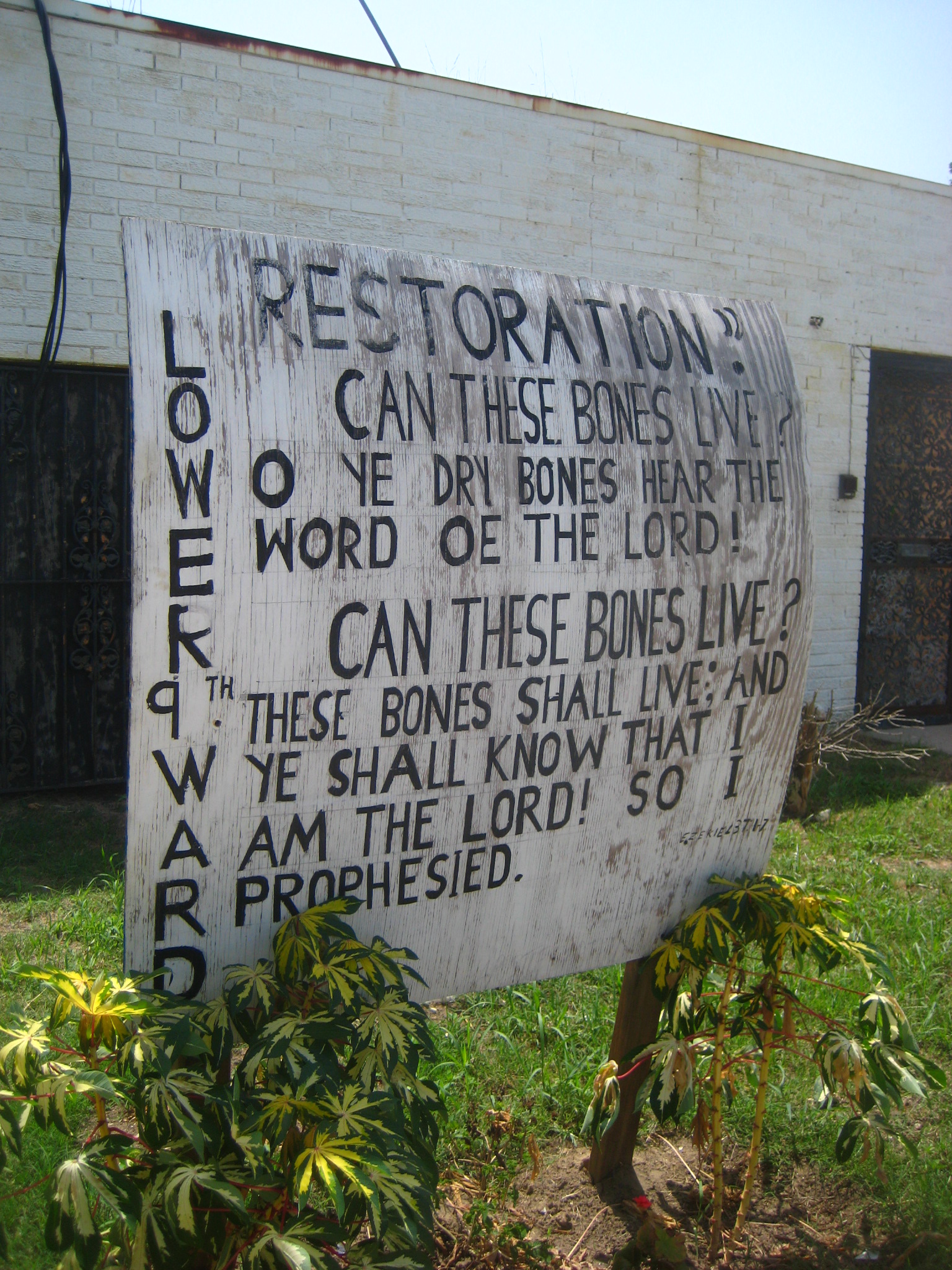
Lower Ninth Ward, New Orleans, Summer 2008: The scene: big swathes of empty green, where there used to be a neighborhood. There are hardly even bones here now, or if there are they lie beneath the switchgrass and caney reeds and brush. The air is thick, heavy, silent, except for a thudding hammer from one of the few centers of human habitation left here. The text is also crying out, even if its voice looks a little muffled, the vicious heat and humidity of the Deep South no friend to plywood and ink. No matter. The emotional power of the original passage is amplified here in this space of dry (or wet and humid perhaps) bones; it fits the place and fits the place to it.

Sihrij Madrasa, Fes, Spring 2009: This is a somewhat neglected Marinid madrasa (these madrasas being rather more like dorm complexes for the educational activities that took place in the neighboring mosques); but the calligraphy is still bright and compelling. It of course fits the space: besides the continual pre-eminence of the Qur’anic text in Islamic societies, the institutional setting makes the choice of Qur’anic text (operating both as edificational/educational material and edifying decoration) all the more apt. As the students- whose study would consist primarily of Qur’an and hadith- come in and out of the space of the madrasa, the selected texts of the Qur’an (which unfortunately cannot here identify- if anyone in Fes who might happen to read this would like to go by and transcribe, that would be truly wonderful) would become part of the architecture of the student’s daily life, daily perception, daily thought, action. Written on the wall, written on the heart…

Lower Ninth again. The text resilient, always speaking, in the midst of storm, decay. The flowers of the field may fade…

Moulay Idriss Shrine, Fes: This is one is rather different from the madrasa. The calligraphy is somewhat sparser, and the setting is not an enclosed, institutional- particular- space, but is on an external wall. Albeit still within the sacred precinct of the shrine, this now worse-for-the-wear (yet still holding on, like the battered scripture text of the Lower Ninth) slice of scripture shows itself to the passing crowds. It helps mark out the sacred space around and especially within it, and create it, and reflect it. Even to those passing by who are unable to literally read the text, it is readable as a particular thing, a sacralizing thing.  It is recognizable as being part of the sacred, even to those who do not know its literal, strictly textual meaning. It still works. This is, I think, one of the important parts of public scripture, of scripture made stone or wood or whatever and placed on display, grafted into signs and walls and amulets and so on. It blurs the line between literate and non-literate reception and what comes in between- all have some reception of this text, some access to its power, to its meanings, and themselves help construct the meaning.

Milk, Blood, Human Anatomy… and Qur’an Exegesis?

Last term I worked through a fairly prodigious stack of Qur’an commentaries (tafsir) dealing with vv. 66-69 of Surah al-Nahl (Q. 16):

66 And verily, you have a sign in the cattle: We give you to drink from what is in their bellies, from between stomach-refuse (farth) and blood, milk pure, palatable for the drinkers. 67 And from the fruits of the palm and the grape you take an intoxicant and wholesome sustenance; verily, in that is a sign for people who think. 68 And your Lord revealed to the bee: take from among the mountains houses, and from among the trees and from what [people] erect as trellises, 69 then eat from all the fruits, then travel on the easily treadable paths of your Lord. One takes from their bellies a drink, variegated of colour; in it is a medicine for the people. Verily, in that is a sign for people who understand.

I wrote some about my project here and here; I’m now working on a couple of new projects, one dealing with constructions and uses of the ideology/doctrine of futuwwa– literally, ‘youngmanliness,’ sometimes translated as ‘Islamic chivalry,’ a probably inapt term from what I know so far of futuwwa. My other project deals with mostly tenth and eleventh century Sufi approaches and embodiments of the doctrine/practice of tawakkul– also a difficult term to translate into English! It literally means ‘trust,’ but it conveys a very absolute trust in God, which can entail a sort of quietism and almost Dao or Zen-like avoidance of doing and being, in some ways.

Anyway, I realized that I have a great deal of translated material left over from last term, and some of it is really fun stuff (though, granted, I’ve an odd idea of fun I suppose). Some of it is in a more polished, presentable form than other passages. The one below, by Fakhr al-Din al-Razi (b. 543/1149, d. 606/1210) on part of the first verse in this passage, is definitely one of the more accessible for those not accustomed to the rather esoteric genre of tafsir, and was much easier to translate into a comprehensible form in English. Plus, al-Razi’s idea of how to do scripture exegesis is pretty entertaining- he pulls in material from all over the place, including, for this passage, long discussions of human and animal anatomy, which draw upon the conventions of good Galenic, Hellenistic medical theory and description. Al-Razi was obviously conversant in the science of his day, and draws upon in explicating the Qur’an- a process which also ties science into the Islamic scriptures, legitimizing both in a fashion. In so doing, he does come into conflict with previous exegetes- their description of the relation of the stomach-contents, blood, and milk in the stomach does not stand up to the test of science, so it has to be replaced something than does not contradict investigative observation (by which al-Razi likely has in mind the established Galenic tradition more than anything).

Besides helping to explain the verse- which task, one might argue, could have been done with rather less ink spilled!- al-Razi also induces in the reader a Qur’anically-keyed but scientifically developed appreciation for the wonders of God’s creative power and providence. Plus, I suspect, al-Razi enjoys these things and enjoys showing off his knowledge of them- a small vice, perhaps, but if so, one I and probably most of you, dear readers, are guilty of… Al-Razi concludes the passage with an interesting analogy between God’s creative transformation of food into blood into milk, and His creative transformation of the dead on the Day of Resurrection. This question of how the dead are raised is of course a very old question, going all the way back to St. Paul and his querying Corinthians. It becomes all the more pertinent for Muslims- and Christians and Jews- with the reception and valorization of Greek philosophy, especially Aristotle, which tended to cause difficulties for the doctrine of bodily resurrection. Al-Razi is aware of these problems, having been educated in philosophy and kalam (dialectical theology is one way to translate this term); his linking of scientific description and philosophical problems with bodily resurrection is, I think, quite clever. All in all, I found this a charming passage, and very revealing of how a well-educated, albeit pretty exceptional, thirteenth century Muslim could imagine both the physical world of creation and its intersection with the textual world of the Qur’an.

*

… [W]e say: The commentators say: the intention of His words: from between stomach-contents (farth) and blood: is that these three are produced in one place, the stomach-contents at the bottom of the stomach, the blood in the top, and the milk in the middle; we have indicated about that saying in regards to the difference of perception and investigative trial, because the blood, if it were produced in the top of the stomach (and in the ruminating-stomach [as well]) then it is necessary that whenever one vomits one would vomit blood- and that is certainly false! As for us, we say: The intended meaning in this verse is that milk is produced from a portion of the blood, and the blood is produced from a portion of the subtle stuff in the stomach-contents, which is the eaten stuff operative in the ruminating-stomach, and this milk is begotten from the portions which are produced in what is between the stomach-contents first, then produced from what is between the blood second, and God has clarified these thick, fatty portions, and created in them the attributes which are in view of becoming milk, beneficial for the body of the child, and this is what we have brought about on this matter, and God knows best.

The fourth issue: Know that the happening of milk in the breast and its attribution with attributes which are, in consideration of it, befitting for the nourishment of the child, consisting of wondrous wisdom and marvelous secrets, the soundness of the intellect seeing that it does not occur except by the direction of the Wise Doer, the Merciful Director, and He makes it clear in certain aspects:

First: that God created in the bottom of the stomach a ‘deliverer’ [so the literal meaning- I suppose this is some valve that I ought to recall from my undergraduate freshman year anatomy class but don’t…] from which departs the heavy stuff of food. When the person takes food or thin drink which is suitable to that ‘deliverer’ there does not depart from it a thing from that food and drink, so that its digestion is completed in the stomach, and it attracts what is made limpid in it to the liver, and the heavy stuff remains here. Then that ‘deliverer’ opens and expels the heavy stuff, and this is among the wonders which are not possible except by the direction of the Wise Doer, because whenever there is need of the retention of food in the stomach there is an occurrence which suits that ‘deliverer,’ and when the need to eject that matter from the body arises, it opens, and the happening of the application is one time, and the voiding another, by the reckoning of need, and the regulation of the ‘deliverer,’ from what does not arise except by the direction of the Wise Doer.

The second: That God placed in the liver a power [qūwat] which attracts the subtle portions occurring in that food or drink, and which does not attract the condensed portions, and He created in the bowel a power which attracts those condensed portions which are heavy, and which absolutely never attracts the subtle portions. And if the occasion on the contrary was for the differentiating of the wellbeing of the body then the order of the arrangement would be corrupt.

The third: that God placed in the liver a digestive power, so that these subtle portions would digest in the liver and turn into blood, then He placed in the gallbladder an attractive power towards yellow bile, and in the spleen an attractive power towards black bile, and in the kidney an attractive power for the increase of water, so that the blood remains limpid, befitting for the nourishment of the body. And He specified each one from among these members with that power and special quality, impossible but for the direction (tadbīr) of the Wise, the Knowing.

The fourth: that in the time in which the fetus is in the womb of the mother, there is directed from that blood a plentiful portion to [the womb], until raw matter becomes through growth members of that child and he increases in size, and when the fetus separates from the womb of the mother that portion is directed to the flank of the breast for the production of milk from it which is nourishment for the child. And when the child grows larger that portion is no longer directed to either the womb or to the breast; on the contrary, it is directed generally into the body of nourishment, and that blood flows, at all times, into other members beneficently for wellbeing- and the wisdom [of this] is not attributable except to the direction of the Free, the Wise Doer.

And the fifth: That at the production of milk in the teat, God has caused to occur in the nipple of the teat a slight keenness and a narrow pore, and for what is this pore is very narrow? For when there does not exit from it except what has the goal of purity and subtlety, and as for the condensed portions, it is not possible that they exit from this narrow regulator, so they remain inside, and the purpose in the occurrence of this slight keenness, and the narrow regulator in the head of the nipple of the breast is that, like [in the operation of] the strainer, everything that is subtle leaves, and everything that is thick remains inside and does not exit, and by this means the milk becomes pure, befitting for the body of the child, ‘palatable for the drinkers.’

The sixth: that God inspired the child to suckle; then verily the mother, whenever she feeds, bit by bit, the nipple of the breast in the mouth of the child, that child is in the state he takes in suckling, and if the Merciful, Free Doer did not inspire that small child that special state, then the sating of thirst would not occur by the production of that milk in the breast.

The seventh: we have made clear that God, however, created the milk from the remnant of the blood, and He created blood from the nourishment which the animal receives. The sheep, when it takes herbage and water, God creates blood from the subtle stuff of those portions, then He creates milk from some of the portions of that blood, then verily milk occurs in three states regarding differing natures: what is in it of oil is hot and wet, and what is in it of water is cold and wet, and what is in it of cheesiness is cold and dry, and these natures are what are potential in the herbage which the sheep eats. It is evident from this that these bodies do not cease transforming from attribute to attribute, from state to state, with some of them being incongruous with others, and some of them not resembling others, and in this you see that these states occur through the direction of a wise, merciful Doer who regulates the state of the world with regard to the suitable beneficence of the servants. So glory to Him who witnesses all of the minute particles of the world high and low in the perfection of His power and the ends of His wisdom and mercy, to Him is creating and command, God, the Blessed, Lord of the worlds!

Fakhr al-Dīn al-Rāzī, Mafatih al-Ghayb (al-Tafsir al-Kabir)

For the Good Turf. Digging.

Between my finger and my thumb
The squat pen rests; snug as a gun.

Under my window, a clean rasping sound
When the spade sinks into gravelly ground:
My father, digging. I look down

Till his straining rump among the flowerbeds
Bends low, comes up twenty years away
Stooping in rhythm through potato drills
Where he was digging.

The coarse boot nestled on the lug, the shaft
Against the inside knee was levered firmly.
He rooted out tall tops, buried the bright edge deep
To scatter new potatoes that we picked
Loving their cool hardness in our hands.

By God, the old man could handle a spade.
Just like his old man.

My grandfather cut more turf in a day
Than any other man on Toner’s bog.
Once I carried him milk in a bottle
Corked sloppily with paper. He straightened up
To drink it, then fell to right away

Nicking and slicing neatly, heaving sods
Over his shoulder, going down and down
For the good turf. Digging.

The cold smell of potato mould, the squelch and slap
Of soggy peat, the curt cuts of an edge
Through living roots awaken in my head.
But I’ve no spade to follow men like them.

Between my finger and my thumb
The squat pen rests.
I’ll dig with it.

Seamus Heaney, ‘Digging’

On Cultural Relativity, Scripture Exegesis, and the Rule of Love

Re-reading St. Augustine of Hippo’s On Christian Teaching, I have been struck- again- at just how much the great North African saint is able to cover in a relatively small space, and within what seems like a fairly circumscribed and particular topic- the proper technique of scripture exegesis. Yet St. Augustine covers everything, it seems like, and it’s a joy to read: he works through sign-theory of language, how to confront the Zeitgeist and come out the richer, the role of art and science in the life of the Christian, the healing power of Christ- along with the expected exegetical techniques. It’s a little breathless at times, as he weaves in and out of topics while continually drawing the conversation back to exegesis and scripture. He often times manages to feel remarkably contemporary to our own concerns, while also quite clearly transcending (well, transcending is obviously anachronistic) our usual categories for thinking about scripture, exegesis, epistemology, and so on. St. Augustine is neither a ‘fundamentalist’ nor a ‘liberal’ in thinking about scripture: scripture is inspired, inspired through the writing of the human authors, who are clearly agents and not mere autodidacts. Scripture can have multiple, simultaneous senses, and St. Augustine is remarkably comfortable with conflicting translations even, on some levels (some translations are just bad, he suggests, and easily enough corrected). The ultimate rule for exegesis is a little startling: whatever encourages love of God and other people, is the best- the true- interpretation. And if an exegete arrives at an edifying meaning not intended by the original author- well, that’s good too.

Over all is the rule of love, as exemplified in the passage I present below. Love of God is the centering point for human life, and when we love God we will love ourselves and others properly, not dominating and controlling them but embracing them in kindness and knowledge of our mutual places in God’s divine economy. There is, I think, an implicit critique of pretty much all forms of human authority and domination of each other going on here, even if St. Augustine does not fully articulate it. He envisions life lived under the sign, the rule of Love, in which human relationships are properly ordered, not through the pride and lust of the powerful and dominating (or ourselves attempting to be powerful and dominating), but through a love-centered orientation towards God. Even the task of exegesis, as he argues at the beginning of this work, is a love-centered task. The very existence of exegesis forms community, as we need each other to truly understand the sacred text; we are not to boast over our special knowledge of the text nor hoard it or lord it over others. Even commentary ought to be done under the rule of love- agaparchy, we might call it- though of course there is no ‘system’ here, since love is particular, is oriented first towards the Person of God, then to those we live with, our neighbors.

But anyway- one could spend pages (and plenty of people have!) on the many things St. Augustine is doing and saying in these pages and in others. I am always amazed at the scope, and the frequent bursts of beauty and sense of love, even as in other places St. Augustine’s fallibility and limitations are equally in sight. But throughout I find that he presents possibilities and points of thinking- and doing, loving, acting- that continue to be full of potential and possibility, and, I suspect, will be for years to come.

This example comes from Book Three, and in it we see a good instance of St. Augustine’s welding of seemingly extra-exegetical concerns- here, what we might identify as ‘cultural relativism’- with explicitly exegetical and theological concerns. The exegetical concern is to explain the seemingly odd or even shocking behavior of Old Testament figures; the theological concern, so far as it is separate from the exegetical, is to reconcile the apparent relativism of cultural convention with an over-arching moral order. Obviously, St. Augustine’s words do not fully sum up the issues we might raise here- but they’re remarkably deft and penetrating, and within a quite short space. There is lots to think about, and not just to think about- the rule of Love, St. Augustine would tell us, is not a political program or an abstract problem. It is a way of life, realized in the love of Christ, and lived out day-by-day, step-by-step.

*

‘Whatever accords with the social practices of those with whom we have to live this present life- whether this manner of life is imposed by necessity or undertaken in the course of duty- should be related by good and serious men to the aims of self-interest and kindness, either literally, as we ourselves should do, or also figuratively, as is allowed to the prophets. When those who are unfamiliar with different social practices come up against such actions in their reading, they think them wicked unless restrained by some explicit authority. They are incapable of realizing that their own sort of behavior patterns, whether in matters of marriage, or diet, or dress, or any other aspect of human life and culture, would seem wicked to other races or other ages. Some people have been struck by the enormous diversity of social practices and in a state of drowsiness, as I would put it- for they were neither sunk in the deep sleep of stupidity nor capable of staying awake to greet the light of wisdom- have concluded that justice has no absolute existence but that each race views its own practices as just. So since the practices of all races are diverse, whereas justice ought to remain unchangeable, there clearly is no such thing as justice anywhere.

To say no more, they have not realized that the injunction “do not do to another what you would not wish to be done to yourself” can in no way by modified by racial differences. When this injunction is related to the love of God, all wickedness dies; and when it is related to the love of one’s neighbor, all wrongdoing dies. For nobody wants his own dwelling to be wrecked, and so he should not wish to wreck God’s dwelling (which is himself). Nobody wants to be harmed by anybody; so he should not do harm to anybody. So when the tyranny of lust has been overthrown love rules with laws that are utterly just: to love God on his account, and to love oneself and one’s neighbor on God’s account. Therefore in dealing with figurative expressions we will observe a rule of this kind: the passage being read should be studied with careful consideration until its interpretation can be connected with the realm of love. If this point is made literally, the no kind of figurative expression need be considered.’

St. Augustine of Hippo, On Christian Teaching, Book Three, XII-XIV

Why Do We Usurp God’s Right To Judge?

Nothing is more serious, nothing more difficult to deal with, as I say repeatedly, than judging and despising our neighbor. Why do we not rather judge ourselves and our own wickedness whcih we know so accurately and about which we have to render an account to God? Why do we usurp God’s right to judge? Why should we demand a reckoning from his creature, his servant? Ought we not to be afraid when we hear about a brother falling into fornication said, ‘He has acted wickedly!’

….

Wherefore a man can know nothing about the judgments of God. He alone is the one who takes account of all and is able to judge the hearts of each one of us, as he alone is our Master. Truly it happens that a man may do a certain thing (which seems to be wrong) out of simplicity, and there may be something about it which makes more amends to God than your whole life; how are you going to sit in judgment and constrict your own soul? And should it happened that he has fallen away, how do you know how much and how well he fought, how much blood he sweated before he did it? Perhaps so little fault can be found in him that God can look on his action as if it were just, for God looks on his labor and all the struggle he had before he did it, and has pity on him. And you know this, and what God has spared him for, are you going to condemn him for, and ruin your own soul? And how do you know what tears he has shed about it before God? You may well know about the sin, but you do not know about the repentance.

St. Dorotheos of Gaza, On Refusal to Judge Our Neighbor

Blessed Is She

Blessed is she in whose small and barren womb dwelt the Great One by whom the heavens are filled and are too small for Him.

Blessed is she who bore that Ancient one who generated Adam, and by whom are made new all creatures who have become old.

Blessed is she who gave drops of milk from her members to that One at whose command the waves of the great sea gushed forth.

Blessed is that one who carried, embraced and caressed like a child God might for evermore, by whose hidden power the world is carried.

Blessed is she from whom the Savior appeared to the captives; in His zeal He bound the captor and reconciled the earth.

Blessed is she who placed her pure mouth on the lips of that One, from whose fire, the Seraphim of fire hide themselves.

Blessed is she who nourished as a babe with pure milk the great breast from which the worlds suck life.

Blessed is she whose Son calls blessed all the blessed!

Blessed is that One who solemnly appeared to us from your purity!

Jacob of Serug, Homily Concerning the Blessed Virgin Mother of God, Mary

End of the Year Music Review

It’s almost the end of the year, which means end of year best-of lists. It could also mean worst-of lists, but I’m a pretty nice guy, and besides, you can just turn on your television or radio to get plenty of rotten crap. I can get books and music out of the way quickly: the only books I’ve read that were published this year were highly specialized academic tones that only libraries could afford, and I can only think of four movies that I went to see in theatres: Waltz With Bashir, Up, the new Harry Potter movie, and District 9. The Harry Potter movie was blah, the others were excellent. I think technically Waltz With Bashir was released in Israel in 2008, but I wasn’t able to see it until this year. At any rate, seeing movies in the theatre has never been a huge priority for me: if I really want to see the film, I can wait until it comes out on DVD or the library gets it.

Music is another story. This year was pretty decent music-wise; below are some of my top picks for 2009’s music, live and recorded. As always, my music tastes are pretty eclectic, and I make no pretensions at having selected the best music of the year. In terms of live performances, several stand out. Numero uno was the final Silver Jews concert ever, held in the bowels of Cumberland Caverns, outside of McMinnville, TN; only three hundred tickets were sold. I only managed to snag mine because the coffee house I frequent had purchased a handful for resale. The show was a convergence of awesomeness: hundreds of feet underground in a grand room with a chandelier dangling overhead, it was David Berman’s last show which he played with great heart and verve. At the end he came down and mingled with the crowd; lots of us- myself included- got a picture with him. Then we all trundled out of the cavern to make long drives back to population centers, warm with the afterglow of what has to have been one of the more singular of musical events to have come down the pike in a while.

Other especially excellent live shows this year: a few months ago I had the immense pleasure of seeing Bela Fleck, Zakhir Hussein, and Edgar Meyers play at the Tennessee Theatre. I’d been listening to Fleck for a while, and had recently come across Hussein; Meyers I had not heard. The three together are amazing: it’s hard to describe the sounds produced by these three men. As the cliche goes, you had to be there. Hussein can tear up the tabla like nobody’s business- it was hard to believe that one man, two hands, were making so much music from such seemingly straight-forward instruments. If you’ve the opportunity to see any of these three musicians, you must must take it. You’ll be glad you did.

I also got to see two shows in a row by Grupo Fantasma, which is always really fun. They played in Hattiesburg, MS, at the dear to my heart Thirsty Hippo, on the last day I was down visiting my family; I drove back to Knoxville and saw them play again out on Market Square. At K’ville’s premier (is that the right word?) hipster dive, the Pilot Light, the best show of the year was easily A Hawk and a Hacksaw, who wear touring with a full band, right down to a bouzouki player. You can’t go wrong if your band includes a bouzouki. The show was gorgeous, marred only by the incessant jumping around (think hipster moshing, which is as pathetic and annoying as it sounds) and general obnoxiousness of a cluster of scenester kids at the front. The band stopped playing mid-show and politely- well, pretty politely- asked the obnoxious kids to kindly shut up and stop acting like animals. The band continued the show with instruments unplugged and down in the crowd. Maybe it’s a sign of my ingrained music snobbery and elitism, but the chastising of the obnoxious hipsters warmed my heart…

Not that, mind you, I imagine myself to occupy a position vastly removed from hipster-dom. I’ve got a couple scarfs and sort of trendy hats, and besides, I’ve just listed a Silver Jews concert as the highlight of my live musical experiences of the year. To top it off, I head off my favorite albums of the year with:

Dirty Projectors, Bitte Orca: A Pitchfork et al darling, this is a wonderful album even under all the buzz and hype; I’ve listened through it repeated times and continue to enjoy it. Production values are better than previous Dirty Projector projects, which makes for crisp lovely listening. Each track stands out and makes for scintillating, renewable listening pleasure; however, “Stillness is the Move” has to be my favorite, followed by “Two Doves,” an exploration/expansion of parts of the Song of Songs, which is pretty commendable.

The Avett Brothers: I and Love and You: After hearing the title single on Knoxville’s WDVX (best radio station ever, by the way) I went and picked up this wonderful album by the up-and-coming Avett Brothers. It is by turns mournful and exuberant, alternating between gently-paces and rolicking-tempos. There is no smug irony here, but rather well-crafted sincerity and emotional depth.

Bela Fleck: Throw Down Your Heart: Fleck collaborated with a number of African artists, working his awe-inspiring banjo music into a wide range of musical styles and forms, in a collaborative project that works really well, for the most part. On a few tracks Fleck is a little too intrusive, but for the most part, while his own music is in force, it is in a truly effective interweaving with the African musicians. My favorite track, which is fairly straightforward musically, is ‘Jesus is the Only Answer,’ a song by Fleck, Ruth Akello, and the Ateso Jazz Band, that is wonderfully, beautifully joyous, and has garnered many, many plays on my part.

Girls in Trouble: Girls in Trouble: A new band, fronted by Alica Jo Rabins and signed to the ever-wonderful JDub Records, Girls in Trouble draw the subject matter for their songs from the Bible, in a vein similar to the artists discussed here. Who would have thought Biblical exegesis could be a sub-genre of indie music? Rabins and her band mates surround their examinations of Biblical passages- usually involving women of the Bible- with lush instrumentals, including Rabin’s beautiful violin-work, often dividing each song into two or three distinct movements.

Phoenix: Wolfgang Amadeus Phoenix: Infectious stuff, this. You’ve probably already heard it- I’ve heard at least two tracks off this album used as commercial soundtracks (selling cars, I think?). It’s upbeat, fun music, that doesn’t rot your brain for being fun and infectious. Maybe not the most musically complex and sophisticated album on this list, and the lyrics can be rather odd and nonsensical- but English is a second language for the band, so it’s forgiveable.

Why Does It Exist, This Need For Sharing?

11 October

I wrote to you impelled by the need to share the emotion aroused in me by your talent, which affected me like the sound of sad, sublime music. Why does it exist, this need for sharing? I have no idea and neither have you, yet we both know perfectly well that in some way it is burned into the human heart, that there’s no life without it and that it contains a great mystery. After all, when you write your books you too are merely responding to this need, and what’s more- you abandon your whole self to it completely.

I’ve always read a great deal- and kept many diaries, in common with all those whose lives are unfulfilled- and I still read widely, I’ve read your work before, but not very often, I mostly knew you by reputation. And now this latest book of yours… How strange! Somewhere, somehow, a hand puts pen to paper, a soul reveals a tiny particle of its secret existence by the tiniest possible hint- for what can words express, even words such as yours!- and suddenly there’s no space, no time, no differences of fate or circumstance, and all your thoughts and feelings are mine, are both of ours. Truly, there is but one universal soul on earth. And doesn’t that make my impulse to write to you understandable- to communicate my feelings and share something and complain a little? Aren’t the works you create and the letters I write to you one and the same? For you too are trying to reach someone, to express some kind of feeling, when you send your lines through space towards some invisible person. You know, you too are complaining- more often than not, only complaining!- for our complaints are synonyous with that cry for understanding which is so fundamental to every human being: how often it occurs in songs and prayers, in poetry and outpourings of love!

Perhaps you’ll answer me, if only briefly? Please answer.

Ivan Bunin, “An Unknown Friend,” 1923, translated by Sophie Lund