Questions and Answers with the Elders of Gaza

Barsanuphe
Sts. Barsanuphius and John of Gaza (fl. first half of the 6th century).

Saints Barsanuphius and John (who was also known as John the Prophet) settled in the vicinity of Gaza, Palestine at some point during the reign of Justinian; the exact dates of their deaths are unknown though they are commemorated together in the Orthodox Church on February 6. Barsanuphius was of Coptic origin, having begun his monastic life in the fabled desert of Egypt, but, like many others in his time, he eventually traveled north into Palestine where he and his contemporaries developed a new form of embedded- quite literally in his case- monasticism in the well-populated countryside of Palestine. Barsanuphius and his disciple, John, who would come and settled alongside his master and live beside him for eighteen years, both practiced strict seclusion, communicating primarily through letters and intermediaries. However, their reputation drew other more conventional monsastics, and soon a thriving monastic community with handicraft production, medical services, a church, and other features grew up around them. Both Barsanuphius and John acted as spiritual counselors to not just the monastics around them but to ordinary laypeople in the nearby communities. Drawing upon years of spiritual practice and discernment, these two men provided careful and sympathetic, but frequently powerful and insightful, responses to the questions- some profound, some very quotidian- directed towards them. Below is a selection of these questions and answers, with an emphasis on matters pertaining to laypeople.

444. Question: If I am distracted during prayer, what should I do?

Response by Barsanuphius: If you are praying to God and become distracted, struggle until you begin to pray without distraction. And keep your intellect alert in order that it does not become too lofty. Nonetheless, should this occur, since we are weak, persist to the very end of your prayer; then prick your heart, and say with compunction, “Lord, have mercy on me and forgive me all of my offenses.” And, afterward, you will receive forgiveness of all your offenses as well as of the distraction that occurred at the beginning of your prayer.

463. A Christ-loving layperson asked the same Old Man [John] if one should reflect a great deal about the sacred mysteries, and whether a sinful person approaching these would be condemned as being unworthy.

Response by John: When you enter the holies, pay attention and have no doubt that you are about to receive the Body and Blood of Christ; indeed, this is the truth. As for how this is the case, do not reflect on it too much. According to him who said, “Take, eat; for this is my body and blood,” these were given to us for the forgiveness of our sins. One who believes this, we hope, will not be condemned.

Therefore, do not prevent yourself from approaching by judging yourself as being a sinner. Believe, rather, that a sinner who approaches the Savior is rendered worthy of the forgiveness of sins, in the manner that we encounter in Scripture those who approach him and hear the divine voice: “Your many sins are forgiven.” Had that person been worthy of approaching him, he would not have had any sins! Yet because he was a sinful man and a debtor, he received the forgiveness of his debts.

Again, listen to the words of the Lord: “I did not come to save the righteous, but sinners.” And again: “Those who are well have no need of a physician, but only those who are sick.” So regard yourself as being sinful and unwell, and approach him who alone can save the lost.

686. Another Christ-loving layperson asked the same Old Man: I want to press some Jewish wine in my presser. Is this a sin?

Response by John: If, when God rains, it rains in your field but not in that of the Jew, then do not press his wine. If he is loving-kind to all and rains upon the just and the unjust, then why do you want to be inhumane and not compassionate, rather, as he says: “Be merciful, even as your Father in heaven is merciful.”

763. A Christ-loving layperson asked the same Old Man: “God created the human person free, but he also says: ‘Without me, you are not able to do anything.’ How, then, is this freedom reconciled with not being able to do anything without God?

Response by John: God created the human person free in order that we may be able to incline toward good; yet, even while inclining out of freedom, we are incapable of accomplishing this without the assistance of God. For it is written: “It depends not on human will or exertion, but on God who shows mercy.”

Therefore, if we incline the heart toward good and invoke God to our assistance, God will pay attention to our good intention and bestow strength upon our work. In this way, both are developed, namely human freedom and God’s power. For this is how good comes about, but it is accomplished through his saints. Thus God is glorified in all and again glorifies them.

765: Question: I have a servant who is wounded with leprosy. Should I keep him or not?

Response by John: It is not necessary for you to keep him in your house; for not everyone will bear to live with him. If they could bear this, that would be a pious thing to do. Yet, you should not afflict others on his account. Instead, send him to a hospice for poor lepers, and provide for his meals and as many garments as he requires, as well as his bed, so that he is no way burdened.

Excerpted from Barsanuphius and John, Letters from the Desert: A Selection of Questions and Responses, translated by John Chryssavgis (Crestwood, New York: St. Vladimir’s Seminary Press, 2003)


Untamed, Eucharist and Eschaton

Offer the light piercing and the springmorning clouds
Over the grey backboned ridgelines gathering into early bloom.
Offer the salttaste of the marsh receding under early summer’s
Thunderheads larger than our toilsome systems, looming.
Offer this stone rolled down from the mountains rising,
Worn to round in years and years of river rise and fall.
Offer the moments that are not contained, offer the wind wet and cold
Off the sprucetreed highlands. Savage and beautiful is closeness
To the sacred, what in the last decree cannot be controlled. In the end all
This worn anthropocene too must give way, sedimented back into the holy,
Soil and stone of the world, bright and becoming from the hand of the Father—
Eucharist rung out still from the trampled earth, so take up and sing in offering,
What is not yours is that for which you must most give thanks.

Şeyh Hasan’s Momentous Trip to Üsküdar

IMG_2773
View of the dome of Eski/Atik Vâlide Mosque (the tekye mentioned in the story was a part of the larger complex, with the mosque in the center). Photo by the author, 2015.

As I noted in an earlier post, stories of conversion- to a new faith or to an intensified version of one’s faith- were common across early modern Eurasia, in diverse Christian, Islamic, and Buddhist environments. The following story is another example of a ‘conversion story,’ embedded within a hagiography (in this instance, a menâkıb (Ar. manāqib) the Islamic functional equivalent of the saint’s vitae in the Latinate world). Unlike the others, this one is told, not from the perspective of the individual doing the converting, but is instead described by someone who was there. Hasan Ünsî Halvetî (1643-1723), whose türbe (tomb-shrine) is near Istanbul’s Topkapı Palace and is today passed by a constant stream of tourists walking and riding the street-level tram (the Gülhane stop is a couple blocks from the saint’s tomb), was one of the foremost Islamic saints in early 18th century Istanbul. Born in the village of Taşköprü outside of the provincial center of Kastamonu, Hasan, like many academically-minded young men in Ottoman Anatolia, made his way to the big city, where he soon found a niche as an instructor in the (no longer extant) medrese attached to the Ayasofya (that is, the Hagia Sophia, converted to a mosque complex after the Ottoman conquest of Constantinople). The rooms mentioned here are small residential cells for teachers and students.

Several things of interest can be picked up on in this story: one, the role of Üsküdar- here conceptualized as a distinctly separate town or geographical entity from Istanbul- across the Bosporus as a sort of loci of sanctity that is close enough to be accessible yet far enough to be distinct and to have a certain aura about it (and in fact several other major early modern Islamic saints are buried in Üsküdar). Also in terms of place, note the importance that Alî Efendi places on the common regional original of everyone in the story- he learns about Karabaş Alî from another man from Kastamonu (which here means not just the town by the rural areas around the town), for instance. This alone tells us that regional identities continued to matter for Ottoman subjects who had settled in the imperial center.

It is also noteworthy that Şeyh Hasan is depicted as having not followed the usual protocol of venerating a saintly şeyh (the Turkish rendering of the Arabic shaykh), until his encounter with Karabaş Alî. We are not told why this was the case- perhaps Hasan had aligned himself with critics of such practices. Or perhaps it was merely a personal tic. Regardless, the hagiographic intent is clear: this encounter was divinely ordained, and it would set Hasan Ünsî on a trajectory for sainthood himself.

In terms of style and language, I have tried in my translation from the Ottoman Turkish to preserve the fairly colloquial feel of the original. Like many instances of the genre, there is little of the florid prose, heavy with Persian and Arabic genitive constructions, that was popular in many other genres during the period.

Atik Valide Inscription
Inscription above the main entrance to the Eski Vâlide Mosque. MIT Libraries, Aga Khan Visual Archive (IMG40234)

The cause of the holy şeyh’s coming under divine grace was that there was in a neighboring resident room [of the medrese in which Şeyh Hasan Ünsî lived] a member of the ‘ulemâ named Alî Efendi, who was from the same town as Hasan [that is, Kastamonu], and to whom this poor one [that is, the author, Ibrahim Hâs] also knew quite well. This Alî Efendi frequently came to visit the holy şeyh, and told the following story about him: ‘One day I was in Üsküdar, where I met with someone from my town [Kastamonu]. That person said to me, “There is a şeyh from our town, Şeyh Karabaş Alî Efendi, living in Üsküdar’s Eski Vâlide Tekye,” and he went on to describe his greatness. But when I went I did not get to see him. When I returned to Istanbul, I went to Şeyh Ünsî Hasan’s room, I told him, “A şeyh has come from Kastamonu to Üsküdar, one who is learned, virtuous, abstinent, and his ascetic exercise and struggles are without equal; he is a master of spiritual states (hâl) and of divinely-granted disposal (tasarruf), whom they call Karabaş Alî Efendi. His written works are many. Let’s go—I’d like to go and see him with you,” I said. “Sounds good!” said Hasan Efendi, so together we went to Üsküdar.

When we came to the Eski Vâlide Tekye we sought out Şeyh Karabaş Alî Efendi’s presence, and when he saw us the first thing he said was, “Hasan Efendi, I have often wished for you! Thanks be to the Guide [ie God] who has facilitated this meeting!” He then said, “Attendant, summon Osman Efendi!” One of his dervishes went and called, and when Osman Efendi came, [Şeyh Alî] said to him, “Osman, here is the one I talked to you about!” So saying, he pointed at Hasan Efendi and smiled broadly. Osman Efendi, having kissed the holy şeyh’s blessed knees, sat down. Then for a while we talked with the holy şeyh. Hasan Efendi remained silent. In such manner we sat in the presence of the şeyh for half an hour.’

Continue reading “Şeyh Hasan’s Momentous Trip to Üsküdar”

To Be Able to Give One Has to Possess

It would be useless to turn one’s back on the past in order simply to concentrate on the future. It is a dangerous illusion to believe that such a thing is even possible. The opposition of future to past or past to future is absurd. The future brings us nothing, gives us nothing; it is we who in order to build it have to give it everything, our very life. But to be able to give, one has to possess; and we possess no other life, no other living sap, than the treasures stored up from the past and digested, assimilated, and created afresh by us. Of all the human soul’s needs, none is more vital than this one of the past…

The past once destroyed never returns. The destruction of the past is perhaps the greatest of all crimes. Today the preservation of what little of it remains ought to become almost an obsession. We must put an end to the terrible uprootedness which European colonial methods always produce, even under their least cruel aspects. We must abstain, once victory [1] is ours, from punishing the conquered enemy by uprooting him still further; seeing that it is neither possible nor desirable to exterminate him, to aggravate his lunacy would be to show oneself more of a lunatic than he. We must also keep, above all, well to the fore any political, legal, or technical innovations likely to have social repercussions, some arrangement whereby human beings may once more be able to recover their roots.

[1] That is, over the Axis: Weil wrote the book this excerpted from in 1943.

Simone Weil, The Need for Roots: Prelude to a Declaration of Duties Toward Mankind, translated by Arthur Wills (New York: Octagon Books, 1979), 51-52.

Shaykh Abū al-Ḥasan Won’t Take ‘No’ For An Answer

Şeyh Gülşeni and Disciples
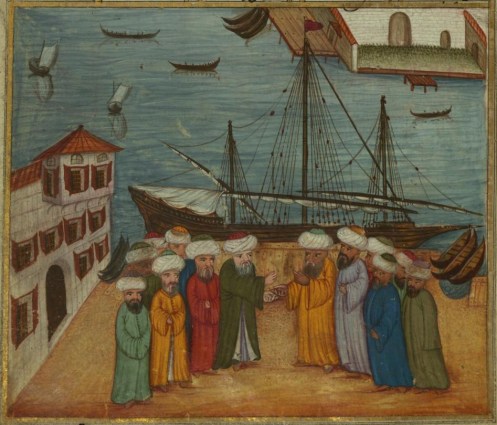
Şeyh Gülşenî (at center on the left), a 15th into 16th century Ottoman saint, bids some of his disciples and khalīfas farewell at a dock, illustrating the relationship between a saintly shaykh and his disciples also on display in the below story from another Ottoman context. From an 18th century illustrated copy of Ata’is Hamse (Walters 666.41A)

Shaykh Abū al-Wafā’ ibn Ma’rūf al-Ḥamawī—who was from among the pious ‘ulāmā and whose biography will come later—related to me that he had become a khalīfa to Shaykh [Aḥmad ibn ‘Abd al-Raḥman, (d. 1571), a Kurdish saint in the countryside north of Aleppo] after serving him for some time. He went to Cairo in order to study exoteric knowledge. He met with Shaykh Abū al-Ḥasan al-Bakrī, God sanctify his secret [1]. He treated him hospitably, but then Abū al-Ḥasan tried to get Abū al-Wafā’ to take the pledge of his ṭarīqa from him [2]. Abū al-Wafā’ refused out of regard for his shaykh [Aḥmad]. Abū al-Ḥasan kept asking, and Abū al-Wafā’ continued to refuse, until one night [Abū al-Ḥasan] entered his room and said: ‘Put your hand in mine!’ Suddenly a crack appeared in the wall, and Shaykh Aḥmad emerged and cried out, ‘Leave my disciple alone!’ [Abū al-Ḥasan] said, ‘Not possible!’ In that very moment, a fire came forth from Shaykh Aḥmad’s eye, and at that Shaykh Abū al-Ḥasan left Abū al-Wafā’ alone. Then al-Khiḍr emerged, and made peace between the two shaykhs [3]. The next morning Abū al-Wafā’s visit to Cairo was concluded so he returned home, and when he reached the village of al-Quṣayr, he entered the presence of Shaykh Aḥmad and kissed his hand, at which the shaykh smiled and said, ‘The chain of our ṭarīqa is unbroken!’

This poor one [ie the author al-‘Urḍī] had heard this story and had denied its truth, saying that people were making up lies about Shaykh al-Wafā’. But when I was young he came to Aleppo and I said to him, ‘This story, did it take place in waking life or dreaming?’ [4] He replied, ‘Waking life!’

_______________

[1] The Bakrī family was by the mid-16th century a well-established scholarly and saintly house, which would continue to be prominent all through the Ottoman period.

[2] Receiving a ṭarīqa- that is, initiation into a particular sufi lineage or path- from a shaykh could be a very personal matter of loyalty and prestige, particularly in this period, and especially in a Kurdish context- while receiving multiple affiliations was not uncommon in some contexts, and posed no problem for some shaykhs, this obviously was not universally true.

[3] Al-Khiḍr is an immortal, mysterious figure within Islam, and is often depicted appearing at opportune moments to convey knowledge or to solve a particular problem.

[4] In other words, did the ‘action’ take place in a dream-vision (which would be ‘real,’ just in a different way), or did the two shaykhs and al-Khiḍr bodily appear in poor Abū al-Wafā’s room? The former option would be rather unexceptional; the latter is a rather different and more spectacular scenario.

Muḥammad ibn ʻUmar al-ʻUrḍī, Maʻādin al-dhahab fī al-aʻyān al-musharrafa bi-him Ḥalab ʻAmman : Markaz al-Wathaʼiq wa-al-Makhtutat, 1992), 282.

Conversion Stories From Across Early Modern Eurasia

John Nelson's Khalwa
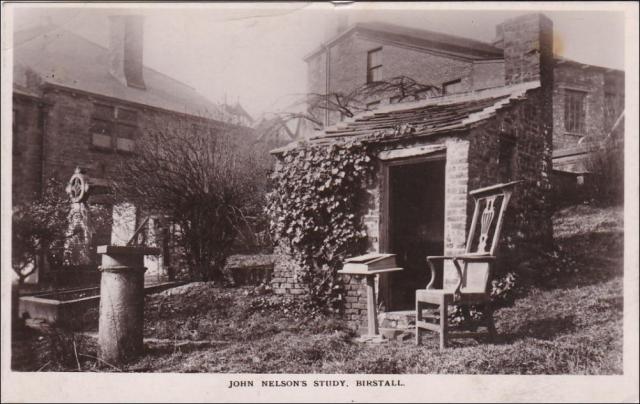
The cell-like study and retreat of the early Methodist preacher and holy man John Nelson, whose autobiography is featured below.

In what follows, I have juxtaposed accounts taken from one end of Eurasia (here including North Africa) to the other, each of which dates from the seventeenth or eighteenth century: we begin with an account by an early English Methodist, next hear from a Moroccan sufi shaykh and saint, followed by an Ottoman Syrian self-taught shaykh, finally ending with an Edo-period Japanese Zen master- lives I doubt have ever been placed in such proximity before! Yet they are all united by at least two major common themes in addition to their chronological proximity: one, each is autobiographical, either as part of a stand-alone account, or embedded in some larger biographical project. Two, each has to do with narrating a moment or period of conversion from one way of life to another. We might be tempted to call all of these religious conversions, but I think it’s best to avoid the term ‘religious’ here since while it’s accurate in some ways it does not really quite reflect how these various writers or those around them thought about the world and the nature of the experiences and lives we might label ‘religious.’

There are other shared features that I think are significant and which might point to some of the shared, interconnecting features of early modern life on a global scale. Each of these accounts reveals not just a sense of subjectivity and inwardness, but a surprisingly assertive sense of subjectivity- reflected in, to begin with, the very act of writing and circulating in some fashion an autobiographical account. Related to this subjectivity and self-fashioning is the stress laid on reading and encountering books, often through one’s individual act of reading. This is significant given the emphasis placed in many cultural contexts in medieval Eurasia upon the oral, face-to-face, hand-in-hand transmission of knowledge and religious practice. Yet most of these figures not only were shaped by their own personal readings and encounters with texts, they in turn produced texts for others to encounter in a similar fashion. That is not to say that these authors were ‘individualists,’ and certainly none of them would have embraced the idea of the ‘autonomous’ self. Each in his own way was a part of religious communities, textual genealogies, and shared collectivities of practice and worship and belief.

I encourage you to read these excerpts in sequence and to think about commonalities or differences and the possible reasons for them, as well as what they may or may not say about shared early modern histories beyond my brief comments above. For each excerpt I have given a minimal introductory note, followed by the account and the citation (of the four not originally in English, I have translated one, while the others are translations by other scholars).

1. John Nelson (1707-1770): A stone-mason by trade, John Nelson would become an early convert to the Methodist movement within the English Anglican Church led by John and Charles Wesley. I have selected two sections from his Journal, an autobiographical rendering of his spiritual journey and labors on behalf of the Wesleys’ pietistic movement. In the first, Nelson describes a formative childhood experience, while in the second he narrates the pivotal moment of his adult conversion from a state of emotional insecurity and distance from God to that of being ‘saved.’

When I was between nine and ten years old, I was horribly terrified with the thoughts of death and judgment, whenever I was alone. One Sunday night, as I sat on the ground by the side of my father’s chair, when he was reading the twentieth chapter of the Revelation, the word came with such light and power to my soul, that it made me tremble, as if a dart were shot in my heart. I fell with my face on the floor, and wept till the place was as wet, where I lay, as if water had been poured thereon. As my father proceeded, I thought I saw everything he read about, though my eyes were shut; and the sight was so terrible, I was about to stop my ears, that I might not hear, but I durst not: as soon as I put my fingers in my ears, I pulled them back again. When he came to the eleventh verse, the words made me cringe, and my flesh seemed to creep on my bones while he read… Continue reading “Conversion Stories From Across Early Modern Eurasia”

I Shall Treat Their Wounds

Byzantine Icon of the Crucifixion Met 17.190.44
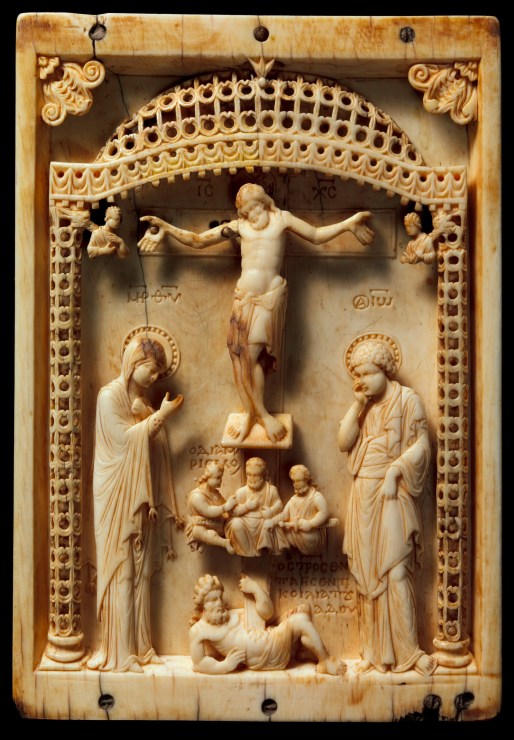
A mid-tenth century Byzantine (probably produced in Constantinople) depiction of the Crucifixion, relief icon in ivory (Metr. 17.190.44). Beside the bearded figure at the base of the Cross is an inscription which reads: ‘The Cross implanted in the stomach of Hades.’ The mood of this icon reflects the emotional, empathy-producing liturgical poetry of Romanos, in which identification with the (often female) other plays a major dramatic role.

7. Mary said: ‘My Son, see how I wipe the tears from my eyes.
I chafe my heart even harder,
but my mind cannot keep its silence.
Why, my Beloved, do you say “Unless I die, Adam will not be cured?”
Certainly you cured many people without suffering yourself.
You cleansed a leper, yet felt no pain- it was not your plan.
You unbound a paralytic, yet were gripped by no spasm.
With a word, Merciful One, you gave sight to a blind man,
yet remained free from suffering,
my Son and my God.’

8. ‘You raised the dead, but did not become a corpse.
You were not placed in a tomb, my Son and my Life.
Why do you say that you must suffer for Adam to be cured?
Give the command, my Savior, and he will rise and carry his bier.
Even if Adam was buried in a tomb,
you will raise him too, like Lazarus, with one word.
The entire universe serves you, the Creator of all things.
So why do you hurry, my Son? Do not rush to your sacrifice.
Do not embrace your death,
my Son and my God.’

9. ‘You do not understand, my Mother, you do not understand what I say.
So, open the gates of your mind, welcome what you hear,
and ponder within yourself what I say.
That man I mentioned, miserable Adam, so helpless,
not only physically, but also spiritually,
wanted to be sick. He did not obey me and pays the penalty.
You grasp what I mean. So, do not grieve, Mother,
but cry out, “Have mercy on Adam,
show pity to Eve,
my Son and my God!”

10. ‘Adam, helpless because of his lack of control
and his gluttony, has been carried down into the depths of Hell
and there he sobs over the agony in his soul.
Eve, who once tutored him in irresponsibility,
groans at his side. She is as helpless as he,
so that both may learn to obey the physician’s instructions.
You understand now, don’t you? You do grasp what I have said?
Shout out once more, Mother, “If you forgive Adam,
also be forgiving to Eve,
my Son and my God!”‘

11. When she heard these explanations,
the Ewe without blemish answered her Lamb: ‘My Lord,
if I ask another question, do not become angry with me.
I shall say what I feel, so I can learn from you all I want to know.
If you suffer, if you die, will you ever come back to me?
If you set out to heal Adam and Eve, shall I see you again?
I fear that you will never return from the tomb, my Son.
I am afraid and, anxious to see you,
I shall weep and cry out, “Where is
my Son and my God?”‘

12. When he heard these questions, the Lord who knows everything
even before it happens, replied to Mary: ‘Mother, be certain
that you will be the first to see me when I come from the tomb.
I shall return to reveal to you the terrible agonies
from which I freed Adam, the terrible pains I endured for him.
I shall show my loyal comrades the marks of nails in my hands.
And then, Mother, you will behold Eve,
alive, as in Eden, and you will shout with joy,
“He has redeemed my primeval parents,
my Son and my God!”

13. Be strong for a little while, Mother, and you will see how,
just like a surgeon, I strip and rush to where my patients lie.
I shall treat their wounds:
I shall cut away solid tumors with the soldier’s spear.
I shall use gall and vinegar to staunch the incision;
nails, a lancet to probe the tumor; a seamless robe to wrap it.
The cross itself I shall use as a splint.
By this you will understand and sing,
“By suffering himself, he has destroyed suffering,
my Son and my God!”

14. ‘Cast your pain aside, Mother, cast it away,
and rush out with joy. Now I am eager to bring my mission
to its end and complete the plan of the one who sent me.
From the very first, this was agreed by me and by my Father,
with the full assent of the Holy Spirit:
I would become man and suffer to redeem that who had fallen.
So, my Mother, go and deliver this proclamation to everyone:
“By suffering he shatters the one who hates Adam-
and he returns triumphant,
my Son and my God!”‘

17. Son of the Virgin, God of the Virgin, Creator of the Universe,
you suffered and you revealed the depths of your wisdom.
You know what you were and what you became.
You wished to suffer, for you judged it glorious to save mankind.
As a Lamb, you took away our sins.
Your sacrifice, our Savior, redeemed all those who were dead.
You are the one who suffers and who cannot suffer.
You save by dying! You gave your holy Mother
the privilege of faith: to cry out to,
‘My Son and my God!’

St. Romanos the Melodist (d. after 555), ‘Mary at the Cross,’ translated by R. J. Schork, in Sacred Song from the Byzantine Pulpit: Romanos the Melodist (Gainesville: University Press of Florida, 1995), 110-113, 114

Indeed Grace Will Be The Judge

Mar Isaac
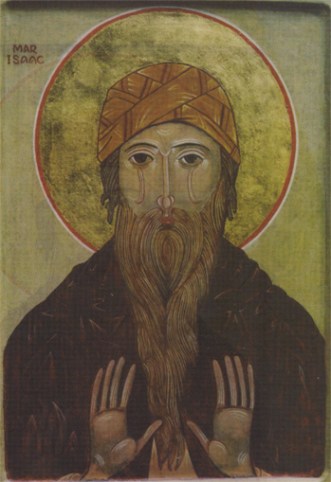
St. Isaac of Nineveh (c. 613 – c. 700) ܡܪܝ ܐܝܣܚܩ ܕܢܝܢܘ

Who, then, understands this and faithfully discerns is not able to rejoice in works but only in the goodness of God. And the one who truly recognizes that God’s goodness is the cause of his joy, does not hold that his joy be only for himself but rejoices for all creatures. His joy comes to be more abundant than the sea, because it is the goodness of the God of the universe affording such joy, and all creation is a partaker in it, even sinners share in this.

So then, he is quick to rejoice even for sinners. He says in fact: ‘They are not far from mercy because of the goodness of the Lord of the universe by which righteousness has been given even to me without works.’ And again he says: ‘All like me share in this great good because God is good: He only requires a little will then He gives His grace abundantly and remits sins.’

This is the grace which strengthens the righteous, preserving them by its being near and removing their faults. It is also near to those who have perished, reducing their torments and in their punishment deals with compassion. In the world to come, indeed grace will be the judge, not justice. God reduces the length of time of sufferings, and by means of His grace, makes all worthy of His Kingdom. For there is no one even among the righteous who is able to conform his way of life to the Kingdom.

But if human realities are to be judged and examined according to justice, yet in listening to the word of Scripture one investigates according to exterior knowledge, not entering into the meaning- where is justice here? As it is said, He is merciful in all His works. However, even when He chastises here below or in the life beyond, it is not correct to consider this as justice, but rather fatherly wisdom.

Nor do I call ‘exacting punishment’ even those times when God visits one with a severe aspect, either here or in the life beyond, but rather ‘instruction,’ because they have a good end. On that account, as I said, no one is able to make his way of life resemble the Kingdom and that way of life which is granted only by mercy.

So then I have explained what was already said, that we inherit heaven by what is His and not by what is ours. And this grace is given every day, not just from time to time. If we all receive this grace, let us rejoice in Him who gives it and the greater will be our joy! Let us adore and give thanks for it, and an even greater gift will be given.

Whoever then has joy by reason of his way of life, this joy is false, or rather, his joy is wretched. And not only in his joy is he wretched but also in his understanding. Whoever rejoices because he has truly understood that God is good, is consoled with a consolation that does not pass away, and his joy is true joy. This is because, as was just said his soul has considered and perceived that truly the goodness of God is without measure.

St. Isaac of Nineveh, ‘The Third Part,’ in Isaac the Syrian’s Spiritual Works, ed. and trans. by Mary T. Hansbury (Piscataway, NJ: Gorgias Press, 2016), 102-104.

On Landscapes

A Brazilian Landscape
‘A Brazilian Landscape,’ by the Dutch painter Frans Post (1612–1680). (Met. 1981.318)


The landscape has its own sound, an idiom, a dialect, a particular light and temperature and their changes with the seasons. The landscape is the median, the densest synthesis, the ordinary reality. Most people grow up not in countries or towns but in what occupies the middle ground between them: in landscapes. “We are the children of our landscape; it dictates behavior and even thought in the measure to which we are responsive to it. I can think of no better identification.” The landscape is the center, the focus of our lives, and so it is also what is most contentious, contested, embattled, and susceptible to myth-making and ideological construction. There are near-equivalent terms: region, scenery, homeland. The landscape is more important than the political-administrative district; it means more to us than the state, and its meanings reach deeper. People define themselves by the landscape in which they have their roots no less than by the nation whose citizens they are. That is why landscape paintings are not just depictions but our world en miniature: microcosms. Because the landscape designates a totality, the history of the landscape, and of the cultural landscape in particular, has come to stand for efforts to reunite divided and isolated disciplines, to recover the conviction that history can, and should be, narrated as an integral whole, as histoire totale. “Landscape” is a highly malleable term, but its core meaning is inalienable, whether we speak of ruined landscapes or the landscapes of memory, of human or urban landscapes. It always designates the cohesive form, the ensemble. All its various meanings are anchored in its primary signification, the physical landscape.

We walk or travel through landscapes. Their changing appearances and the distinctions that let us tell them apart reveal the richness of our world. The landscape is the consummate result of human labor and human genuis. It is the greatest work of art imaginable, the supreme human achievement, and when our endeavors in it come to grief, it is the greatest conceivable calamity. The landscape is the most solid substance in which man has ever wrought the objective reality of his existence—geography, Robert A. Dodgshon has written, is about the “materiality of social life”—and at once his subtlest and most atmospheric creation, to which poets, philosophers, architects, and the entire human community have each contributed their shares. So to read and decipher landscapes is to unlock a door to the history of a people, of the nations, of humanity. Because “virgin” landscapes do not—or not longer—exist, all history of the landscape is a history of cultural landscapes. Hugo Hassinger has argued that anthropogeography is simply the “morphology of the cultural landscape,” the study of the tectonics of the social sphere, the inertia of the built world, the visible distribution of power and powerlessness, to mention only a few aspects. Historians are experts in matters of cultural forms: (cultural) morphologists. They take an interest in surfaces, and so they must be good phenomenologists and physiognomists if they hope to detect essential processes. They read the landscape like a text, carefully peeling off layer upon layer as though it were a palimpsest.

Karl Schlögel, In Space We Read Time: On the History of Civilization and Geopolitics, translated by Gerrit Jackson (New York City: Bard Graduate Center, 2016), 235-237.