Concerning the Prayer-Rug, Matters Mystical and Practical

The translation below comes from a text I have previously written about here, the Futuvvatʹnāmah-ʼi Sultānī of Ḥusayn ibn ‘Alī Wāʻiẓ Kāshifī (c.1420-1504/5). For more information on the text and on the content of futuwwa/futuvva, see the above post. In this excerpt, Kāshifī deals with a topic that is not exclusively futuwwa or Sufi-oriented: the prayer-rug (sajjāda), a piece of liturgical equipment often emphasized by Sufis and Sufi-oriented futuwwa brotherhoods and guilds, but also by many other Muslims, both then and now. Kāshifī’s discussion of the prayer-rug is two-fold: one, he lays out the proper practice and behavior associated with the use of the prayer-rug; I have included a partial excerpt of these instructions. Second, he develops the prayer-rug as a mystical symbol, and spins practice-based implications out of those mystical symbols. The prayer-rug, already featuring a sort of cartography in its very design (see the illustration below and note 1), is given a further sacred cartography.

Kāshifī’s treatment of the prayer-rug, with his mix of practical regulation, mystical interpretation, and multiple layers of meaning (right down to mystical significances for the letters of words), is not unique to this one item. Rather, in previous chapters he explores the proper practice, mystical meanings, sacred origins, and scriptural justifications for all sorts of items: Sufi cloaks, futuwwa-belts, various types of clothing, headgear, and so on. As throughout the treatise, his language is generally quite accessible, with simple sentences and frequent translations of Qur’an and hadith texts (though not in this passage, curiously). Granted, as seen here, some of the language is deliberately esoteric, and might well have stumped some initiates (though perhaps also delighting them). The sources of mystical interpretations are diverse: here, for instance, religious legend, scripture, hadith, and Akbarian philosophic theology are all in evidence. The result is a text that contains an intersection of material culture, ‘popular’ religion, and ‘elite’ religious and mystical thought and practice: a text that we can reasonably imagine ‘ordinary’ Persian-speaking craftsmen and other workers, as well as more well-to-do people, reading and thinking about, perhaps in the course of their every-day prayers.
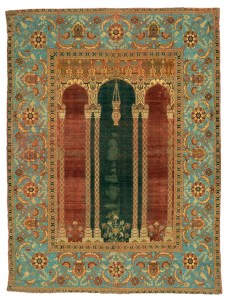
An example, from the late 1500s, of a prayer-rug, not unlike the sort our author would have used and had in mind in writing this passage.
A particularly fine example, from the late sixteenth century Ottoman Empire, of a prayer-rug, not unlike the sort our author would have used and had in mind in writing this passage. From the Metropolitan Museum of Art.

_______________

If one asks, What are the judgments regarding the prayer-rug and the mosque? Say to him: four: first, just as when one enters the mosque he puts enters with his right foot first, so, he puts his right foot on the prayer-rug first. Second, just as when one leaves the mosque he puts his left foot out first, so, when getting up from the prayer-rug one puts out his left foot first. Third, just as one does not speak of worldly things in the mosque, upon the prayer rug one also should not speak of worldly things save under necessity. Fourth, just as one should be continued occupied with remembrance [of God] in the mosque, so upon the prayer-rug one should be continually attached to remembrance, and speak words having to do with God and the Prophet.

If one asks, What are the pious customs regarding sitting upon the prayer-rug? Say to him: three: first, upon coming to the prayer-rug, one prays two raka’a, just as in performing prayer in the mosque. Second, sitting facing the qibla. Third, paying attention to proper practice.

If one asks, How many are the proper practices (ādāb) of prayer-rug sitting? Say to him: four: first, that one sit on two [bent] knees on the prayer-rug, though if necessary, the right leg can be brought up and the left leg stuck out. Second, that it not come to pass that his feet become barefooted. Third, that he not blow his nose or spit. Fourth, in like manner he should be prepared in regards to whatever comes into existence from him, be it in word or in deed.

If one asks, To what do the four corners of the prayer-rug symbolically point? Say to him: the right-hand miḥrab-corner[1] symbolically points to Gabriel, and the protected land and Mount Ḥira that is in it. And the left-hand miḥrab-corner symbolically points to Michael and to the Mount of the Fig. And the right-hand corner that is across from the miḥrab-corner symbolically points to Israfil and to the Mount of Olives. And the left-hand corner that is across from the miḥrab-corner symbolically points to ‘Azrael and to Mount Sina. God has brought together these places in this verse: By the fig, the olive, Mount Sina, and this protected land (Q. 95.1-3). For in each place one of the divine books was sent down. The Torah of Moses was sent down on Mount Sina, on the Mount of the Fig the Gospel descended to Jesus, on the Mount of Olives the Psalms of David were sent down, and on Mount Ḥira that is in the protect land the greater part of the Qur’an was sent down to our master [Muhammad].[2]

Thus, the four corners of the prayer-rug symbolically point to the four archangels, the four sacred books, and the four blessed places. Thus whoever sits upon the prayer-rug it is incumbent that he be steadfast like a firmly rooted mountain, not attracting the wayward breeze of the soul, until the effluence of the divine Book and Word comes to him, and he find the rank of divine proximity. Also: the bearers of the divine throne are the four angels to which the four corners of the prayer-rug symbolically point, meaning that upon the possessor of the prayer-rug it is incumbent that the throne of his own heart, that is [as described in the following verse]: the heart of the believer is the throne of God and the heart of the believer is the house of God,[3] must be stretched out by possessing the four attributes [see below] until he finds a portion of the cry of the throne-bearer, as God says: Those who bear the throne and from around Him they worship with praise of their Lord, believing in Him and seeking forgiveness for those who believe (Q.30.7).

If one asks, What are the four attributes by which the heart can become a bearer of the Throne? Say to him: first, faith in the various parts of the shari’ah; second, belief in the mysteries of the Way; third, turning to the mystical traces of God; fourth, being illumined by the lights of divine knowledge.

If one asks, To what do the letters [in the word] prayer-rug (sajjādeh) symbolically point?[4] Say to him: the letter sīn is for the traveling and wayfaring of the possessor of the prayer-rug in the world of ruling (malakūt). The letter jīm is for his striving and struggle in the observation of the lights of divine power. The alif is for the instruction in the manifestations of the degrees of divinity. The letter dāl is for the remembrance (dhikr, sic.) of the [divine] presence living, not dying. The letter is for the destruction of the lower-self attributes and the satanic ones in the straitening of the temporal world.

Futuvvat-nāmah-i sultānī, Ḥusayn Vāʻiẓ Kāshifī Sabzivārī, 197-9. Trans. Jonathan P. Allen, 2012. No rights reserved.


[1] A prayer rug (sajjāda, P. sajjādeh) of this period (and previous and later ones as well) would have a stylized miḥrab (prayer niche) on it; the top of the miḥrab (which I have translated here as the miḥrab-corner) would face the qibla. See the illustration above.

[2] This is a curious bit of exegesis. In a brief survey of Arabic exegetical literature I made in preparing this post I found many opinions corroborating the identification of the protected land as that around Mecca (and perhaps also Medina), however, the rest of our author’s interpretation seems to be idiosyncratic to him. However, I did not survey any Persian exegetical literature (a somewhat more laborious task, as little of it is online, unlike Arabic tafsir), which would perhaps be the place to look. I suspect some legendary material lies behind these significations.

[3] A hadith, not a Qur’an citation; it is given, however, in Arabic, without an accompanying Persian translation as is often Kāshifī’s wont.

[4] Our author frequently finds mystical signification in the letters of words, often, as here, by linking each letter to relatively complex concepts of post-Akbarian Sufism. I am not sure if the practice should be interpreted as mnemonic device (I somewhat doubt it) or simply as another way of layering mystical and religious meaning upon material and ideational objects—even if the meanings are not necessarily comprehended by everyone in the targeted audience.

A Beginner’s Guide to Futuwwat

Upon reading the title of this post, you may be wondering, right off, what is futuwwat? You may be forgiven a lack of familiarity with the term; while once an ethical, spiritual, and organizational concept that animated communities across the Middle East and beyond, futuwwat (also known by its Persian translational equivalent, javānmardi) is not exactly in common currency anymore- though it is not extinct, either. Literally it could be translated ‘youngmanliness’; some scholars have suggested ‘chivalry’ or ‘Islamic chivalry’ as translations. Both of those get at some of the aspects of this term, but hardly explain it. To put it briefly (see the works cited at the end of this post for more information), the concept of futuwwat embodies a social ethic and set of practices informed by a rigorous morality, Sufic ascetic and mystical concepts and practices, and ideas on appropriate social behavior. While seemingly first developed by Sufi writers (though its origins are rather obscure, like the origins of many, perhaps most things), the ethics of futuwwat eventually became the ideological foundation for futuwwat-brotherhoods and futuwwat-influenced guilds, replete with distinctive rituals, mutual aid, group solidarity, and occasionally armed action on behalf of members or political causes. By the fifteenth century, the period from which the treatise below hails, futuwwat was firmly integrated and developed within both Sufi orders and urban workmen’s guilds, as well as groups devoted simply to futuwwat. The concept and associated practices would survive through those entities for a long time- in Egypt, for instance, futuwwat organizations were only ended through the drive for centralized state power after World War II. In the contemporary Persianate world (Iran, Tajikistan, Afghanistan, etc.), the futuwwat/javānmardi ethos lives on in the Zurkhaneh tradition and its associated athletic practices and ethos. At any rate, medieval and early modern futuwwat is still often something of a mystery, in part because expressions of futuwwat were so diverse and ranged across social classes. A primary source of information is the futuwwat-handbook genre, as represented by the translation below.

The author of the treatise excerpted from here was one Ḥusayn ibn ‘Alī Wāʻiẓ Kāshifī (c.1420-1504/5), a scholar and writer who spent much of his life in and around the Timurid court in Herat. Kāshifī was a prolific author, writing everything from Qur’an commentaries (all in Persian) to a treatise on epistolography to a book on magic. Two of his shorter treatises, Anwār-i Suhaylī and Rawḍat al-shuhadāʾ, have had a long and vigorous historical afterlife. The first is a Persian translation of the long-popular story Kalīla wa-Dimna, itself transmitted into Arabic from Indian sources. Kāshifī’s version continues to be reprinted, and made its ways into Ottoman Turkish and, via that route, French, influencing the composition of La Fontaine’s Fables. As for the Rawḍat al-shuhadāʾ, a poetic work dealing with ‘Ali and his family (the title translates as Garden of the Martyrs), it continues in use among Shīʿīs as part of Muḥarram commemorations.

Kāshifī himself cannot be described as being simply either Sunnī or Shīʿī, as his work- including the one treated here- displays ideas and sentiments that could be classified in either theological camp; his work stands as an example of the ways in which even in the fifteenth century sectarian positions and affiliations were not absolutely fixed or determined. Indeed, futuwwat works historically had expressed strong pro-‘Alid sentiments; ‘Ali is frequently praised as the true exemplar of futuwwat, for instance. In Kāshifī’s treatment of futuwwat, devotion to the ‘house’ (that is, family) of Muhammad is front-and-center; at the same time, Sufism is also strongly on display and deliberately called upon. Kāshifī was affiliated, for a while at least, with the Naqshbandī order, a resolutely Sunni branch of Sufism; at the same time, he was perfectly capable of expressing ‘Shīʿī’ sentiments and doctrines. At any rate, his treatise on futuwwat is a significant one, given its length and depth: he tackles the issue from all its angles, from its Sufic, ethical aspect to its integration with guilds and other occupational groupings.

The excerpt below represents my first public attempt at translating from Persian into English; as such, I must present it provisionally, with the caveat that a couple of points in the text eluded my full comprehension, though I believe that I have conveyed the meaning accurately. In the handful of spots in this excerpt where the author writes in Arabic I have marked it in italics, for instance when Kāshifī quotes the Qur’an. I have not tried to rework the text to soften the edge of its insistence on lists; this ‘listing mentality’ is part of the utility and purpose of the text, and represents what was by Kāshifī’s time a pretty well established tradition in futuwwat texts, among other genres. Fortunately for me as a novice in Persian, the text as a whole is pretty straightforward and written in an accessible manner- while Kāshifī treats some ‘lofty’ themes and includes plenty of Sufi-inflected material, the work as a whole seems to be aimed at instructing the beginner in futuwwat, the proverbial man on the street who might wish to join a futuwwat-brotherhood or guild. As a result, we get a nice cross-section of social values- at least as expressed by the learned classes of which Kāshifī is a representative- that, while primarily located in those learned classes, can also be assumed to have had cachet among a wider body of the population. After all, as the composition and intended audience of this text make clear, futuwwat was not intended just for the learned elite or mystics: it was very often directed at, and a product of, the masses.

If one asks: how many are the conditions (shura’īṭ) of futuwwat? Say: Seventy-one: forty-eight are positive, and twenty-three are negative. As for those that are positive: first, Islam; second, faith; third, rationality; fourth, knowledge; fifth, gentleness; sixth, asceticism; seventh, piety; eight, truthfulness; ninth, nobility; tenth, marūwat; eleventh, compassion; twelfth, good deeds; thirteenth, fidelity; fourteenth, humility; fifteenth, trust in God; sixteenth, courage; seventeenth, zeal; eighteenth, patience; nineteenth, uprightness; twentieth, giving good advice; twenty-first, purity of soul; twenty-second, exalted intention; twenty-third, keeping secrets; twenty-fourth, visiting one’s kin; twenty-fifth, following the sharī’a; twenty-sixth, commanding the good; twenty-seventh, forbidding the wrong; twenty-eighth, respecting parents; twenty-ninth, service to one’s teacher; thirtieth, respecting the rights of all; thirty-first, speaking accurately; thirty-second, discretion with what one knows; thirty-third, seeking [only] the permitted things; thirty-fourth, giving greetings; thirty-fifth, keeping company with the good and the pure; thirty-sixth, keeping company with the reasonable; thirty-seventh, being thankful; thirty-eighth, aiding the oppressed; thirty-ninth, visiting the friendless; fortieth, thinking and weeping [over one’s sin]; forty-first, acting with sincerity; forty-second, keeping trust; forty-third, resisting the lower self and the passions; forty-fourth, being just; forty-fifth, satisfaction with [God’s] decree; forty-sixth, visiting the sick; forty-seventh, desisting from the rude; and forty-eighth, persisting in remembrance of God.

As for those that one ought to guard against doing, the first is differing with the sharī’a; second, speaking with corrupt language; third, slandering good people; fourth, too much jesting; fifth, empty words; sixth; too much laughter; seventh, breaking a promise; eighth, carrying out trickery and deceit with people of livelihood; ninth, being envious; tenth, being oppressive; eleventh, acting as an accuser; twelfth, laboring in love of this world; thirteenth, desiring acquisition of the things of this world; fourteenth, expecting things in advance; fifteenth, seeking out and talking about people’s faults; sixteenth, making false oaths; seventeenth, desiring the property of other people; eighteenth, exerting oneself with treachery; nineteenth, telling lies and reporting what one has not seen; twentieth, wine-drinking; twenty-first, eating the fruit of usury; twenty-second, practicing sodomy and adultery; and twenty-third, displaying bad conduct and bad trust with companions. Whoever is not familiar with these seventy-one conditions, futuwwat has not arrived with him. And God knows best.

If one asks: the letters of [the word] futuwwat—what do they signify? Say [to him]: the of futuwwat is an indication of annihilation (dalīl fanā-ast). So long as the attributes of the wayfarer himself are not annihilated, the attributes of the Friend cannot subsist.[1] The first is an indication of divestment (tajrīd). The wāw of futuwwa is an indication of fidelity (wafā), meaning, keeping a watch on one’s behavior (ādab) both exteriorly and interiorly. The second is an indication of the abandonment (tarikat) of all that is other than God.

If one asks: how many are the covenants of futuwwat? Say: two: one is essential, the other is merely verbal. The essential is for the sake of divine reality; the merely verbal is for the sake of seeking a blessing –just as on the [spiritual, or Sufi] Path (ṭarīqat) there is the khirqa of blessing-seeking and the khirqa of divine reality.[2]

If one asks: how many are the characteristics of the people of futuwwat? Say: there are ten characteristics that the people of futuwwat cannot dispense with. First: being truthful with God (ḥaqq). Second: equity with people. Third: overcoming one’s lower self. Fourth: service towards the great. Fifth: compassion towards the less fortunate. Sixth: good advice to one’s friends. Seventh: Humility towards the learned. Eighth: gentleness with the wise. Ninth: liberality towards enemies. Tenth: silence among the ignorant.

If one asks: with what do people compare futuwwat? Say: with the tree, that is, the good tree pointed out [in His words] God the exalted said: [A good word is] like a good tree—its roots are firmly established, and its branches are in heaven (Q. 14.24). If ones asks: what is the similarity and relation between a tree and futuwwat? Say: Just as a tree has roots, bark, branches, trunk, leaves, flowers, and fruit, so does futuwwat have brances, leaves, trunk, bark, flowers, fruits, and roots. If one asks: what is each one [of these]? Say: the root (bīkh) of the tree of futuwwat is its foundation (aṣl), and without it, the tree does not possess growth and increase (nushū ū namā nadārad) nor put forth fruit or leaves. Love of his eminence the Prophet of God, peace and prayer of God be upon him, and his pure family—that is [the root]. If someone worshiped for years and expended wealth and gold in measure to Mount Uḥud[3] upon the path of God, but every year he left off going on the ḥajj,  because in his heart there is no love for the family of his eminence the Prophet, peace and prayer of God be upon and his house, not even a whiff of heaven will he find. For as it is well-known that the root of the tree of futuwwat is love for the family of the Prophet, then it is necessary to know that its root is humility, its branch is brotherliness, its leaves are control over the passions, its bark is proper behavior and modesty, its flowers are good character and kindness, and its fruit is liberality and nobility.

If one asks: What is marūwat? Say: marūwat is a part of futuwwat, just as futuwwat is a part of the [Sufi] path.[4]

If one asks: because the foundation is the [spiritual] Path, why is this branch of knowledge (‘ilm) called the knowledge of futuwwat and not [simply of] the Path? Say: for everyone’s alloted sustenance is established upon a path of the Path. For instance, the path, step by step, of his eminence the Chosen One [Muhammad], peace and prayer of God be upon him, and that of the Approved [‘Ali], peace be upon him, is established [once and for all]. The allotted sustenance of that [path] is without descendants [i.e., has no further examples, is unique]. Regarding this matter of theirs they have said in a hemistich: ‘The first then the last, and the last then the first.’ As for everyone who strives in accordance with his own inclination and alloted sustenance, finds from futuwwat profit, and because of the things acquired from investigation into the aforementioned futuwwat, he becomes after these through the significations of the Path, of right behavior, and its supports, mystically knowledgeable, as we will make clear, with God’s help.

Ḥusayn ibn ‘Alī Wāʻiẓ Kāshifī, Futuvvatʹnāmah-ʼi Sultānī (Tehran: Intishārāt-i Bunyād-i Farhang-i Īrān, 1350/1971), 25-29.

[1] ‘Annihilation’ here is the Sufi concept of ‘passing away’ into God, in which the ego is stripped of itself and only God is witnessed.

[2]  A khirqa is a patched robe worn as a marker of one’s affiliation with a Sufi order; there were (and are) varying degrees of affiliation, from the truly committed initiate- the ‘essential’- to someone merely seeking the blessing or grace expected through affiliation with an order or a well-known Sufi saint or master. The traveler ibn Battuta, for instance, was affiliated with a number of Sufi orders in the course of his travels, but was hardly a full initiate of many, or any, of them.

[3] A prominent mountain near Mecca.

[4] Marūwat, treated only briefly in this excerpt, is another difficult-to-translate term; it is close to the English ‘virtue,’ with its historical links to ideas of manliness and strength. Likewise, the Persian term (itself a loan from Arabic) conveys the idea of manly strength or vigour, but also hospitality, proper social deportment, and so on. ‘Masculinity’ is one possible translation, but only with the caveat that what is meant by masculinity is not necessarily what Western, contemporary cultures mean by it.

_______________________

Select Bibliography

In addition to the selected works below, see the quite good (and freely available) Encyclopdia Iranica article, which has a much more extensive bibliography: Javanmardi.

Breebart, D.A. ‘The Fütüvvet-nāme-i kebīr. A Manual on Turkish Guilds.’ In Journal of the Economic and Social History of the Orient. Vol. 15, No. 1/2 (Jun., 1972).

Cahen, Claude and Franz Taeschner. “Futuwwa.” In Encyclopaedia of Islam, Second Edition, edited by P. Bearman, Th. Bianquis, C.E. Bosworth, E. van Donzel and W.P. Heinrichs. Leiden: Brill, 2010: Brill Online.

Cahen, Claude. “Mouvements Populares et Autonomisme Urbain dans l’Asie Musulmane du Moyen Age, III.” In Arabica, T. 6, Fasc. 3 (Sept., 1959).

Hosein Yousofi, G̲h̲olam. ” Kās̲h̲ifī.” Encyclopaedia of Islam, Second Edition. Brill Online , 2012.

Ridgeon, Lloyd V. J. Morals and Mysticism in Persian Sufism: A History of Sufi-Futuwwat in Iran. Routledge Sufi Series 10. Milton Park, Abingdon, Oxon ; New York, N.Y: Routledge, 2010.

Ridgeon, Lloyd V. J. Jawanmardi: a Sufi Code of Honour. Edinburgh: Edinburgh University Press, 2011.

Taeschner, Franz. Zunfte und Bruderschaften im Islam : Texte zur Geschichte der futuwwa. Zürich: Artemis-Verlag, 1979.

Tor, D. G. Violent order: religious warfare, chivalry, and the ‘ayyār phenomenon in the medieval Islamic world. Würzburg: Ergon,, 2007.