Fragments

Two fragments from the cover of a notebook of mine. First, a short verse on the scholarly life, lifted from the epigraph of Makdisi’s Rise of Colleges:

ذكا و حرص و افتقار و غربة
و تلقين استذ و طول زمان

Intelligence, longing; poverty and a foreign land
A teacher’s instruction; the long stretch of time

Jawaini of Nishapur

And one that is, I think, from the Moroccan Sufi Abu Madyan; it’s scrawled on the cover of one of my notebooks without an ascription:

النفس عزت و لكن فيك ابذلها
و القتل مر ولكن في رضاك حلا

The self* is dear, yet I slay it in You
And being killed is bitter; but in Your pleasure, sweet

*(An-nafs conveys both the sense of ‘soul’ and of ‘self,’ anima and ego; in Sufi thought and practice, overcoming the ‘lower soul’ or self in the apprehension of God is a primary goal. The dying of the self is obviously a term deeply resonant in Christian practice; likewise, the studied ambiguity about one’s relation to the self/soul exists in both traditions. St. Augustine is, I suppose, the most marked exponent of this tension, in which there is a proper ‘self-love’ and an improper one, so that loving one’s self is, for St. Augustine, a necessity, yet only in so far as it is properly directed. Paradoxically, the highest love of self would be the abnegation of the self in a Christ-like self-humbling and self-offering to God. In a similar manner, Sufism seeks a self-destroying abnegation in God, yet one in which the self is still there- even for someone like al-Hallaj, the nafs remains even in the closest union with God. Still, it is always an ambiguous thing in Sufi texts, as the soul/self is consumed utterly while the author still maintains a self-existence (if not self-awareness) and distinction between Creator/creation.)
Al-Ghazali on Funerals

As I was reading today the last section of al-Ghazali’s Ihya ‘Ulum al-Din (The Revivification of the Religious Sciences)- Book XL, Kitab Dhikr al-Mawt wa-ma Ba’dahu (The Remembrance of Death and What is After It), I was struck by how apropros the following two passages seemed in light of the past couple weeks’ spate of well-publicized deaths and funerals:

1. ‘Know that funerals are a lesson to the man possessed of insight, and a reminder and a counsel to all save the people of heedlessness. For these latter are increased only in hardness of heart by witnessing them, as they imagine that for all time they will be watching the funerals of others, and never reckon that they themselves must needs be carried in a funeral cortege. Even if they do so reckon, they do not deem this to be something near at hand. They do not consider that those who are carried now in funeral processions thought likewise. Vain, then, are their imaginings, and soon their allotted lifespans will be done.

‘Therefore let no bondsman watch a funeral without considering that he himself is the one being borne aloft, for so he will be before long: on the morrow, or on the day that follows: it is as if the event had already occurred.’

2. ‘The properties of attending funerals include meditation, heedfulness, preparedness, and walking before the pall in humility… One of these proprieties is to have a good opinion of the deceased even if one he had been corrupt, and to have a poor opinion of oneself even if one may outwardly be pious. This is because the last moment is a perilous thing the true nature of which is unknown.

‘It is told of ‘Umar ibn Dharr that one of his neighbours once died. He had been extravagant with himself, and for this reason many people refused to attend his funeral. However, Ibn Dharr attended it and took part in the prayers. When he [the neighbour] had been lowered into the grave he [Ibn Dharr] stood beside it and said, “May God show you mercy, O father of So-and-so! For throughout your life you kept with you the testimony to Divine Unity, and begrimed your face with prostration. Although they called you a sinner and a transgressor, which one of us is not a sinner and has no transgressions to his account?”‘

Abu Hamid Muhammad ibn Muhammad al-Ghazali, in The Remembrance of Death and the Afterlife (Islamic Texts Society, 1989), 97, 98.

The Light and the Fish

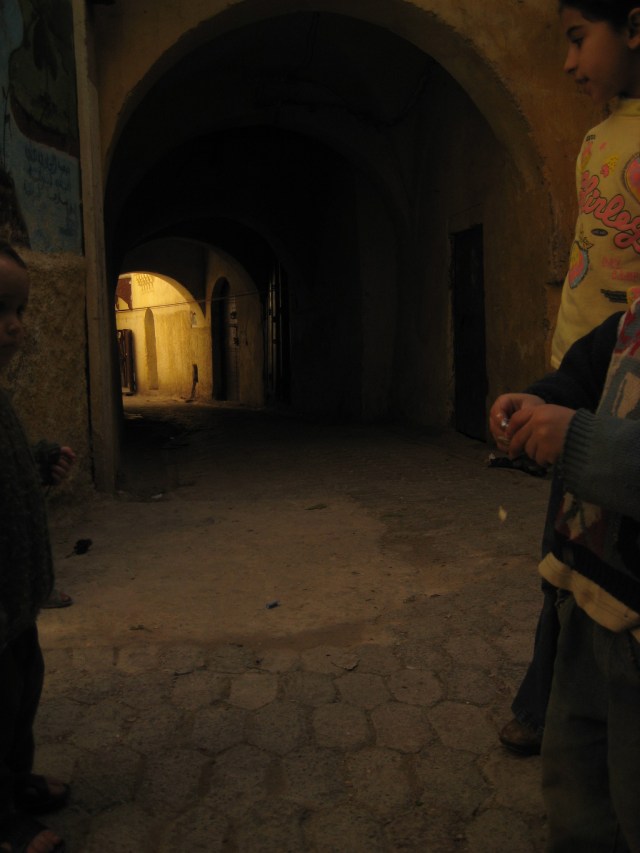
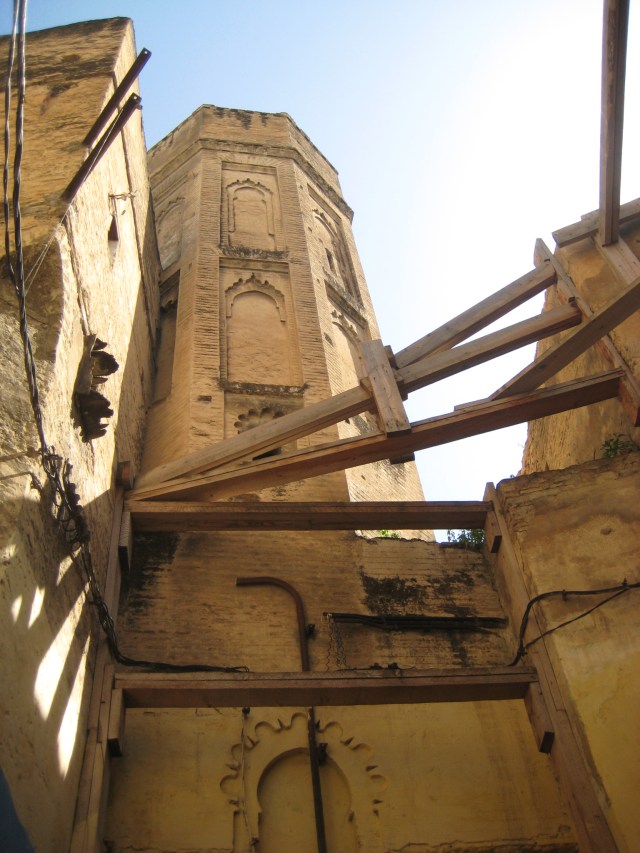
Down a dark, narrow little side street in the Fes medina there is a tunnel, old solid cedar beams straddling overhead holding up whatever structure stands above- what exactly is not clear when coming down the street from Tella Kabira, the main drag through the medina. Upon emerging on the other side, if you look back and up, you can see one of the most remarkable little architectural gems in Morocco, in my opinion, the Ayn al-Khayl Mosque, which dates back at least to the time of the 12th-13th century Muslim mystic and esoteric philosopher Ibn ‘Arabi, and is presumably older than that. While I know of at least one other mosque in Fes that straddles a street- it’s way across the valley in the Andalusian quarter- this little mosque also stands out for its octagonal minaret (I only saw one other in the rest of Morocco), and the evocative flame-shaped moldings around the tiny windows that march up the minaret towards the sky. That, and it was in this mosque, its tiny prayer hall perched above the street, that Ibn ‘Arabi spent much of his time while sojourning in Fes, and where he experienced repeated mystical visions. It is also home, within its elevated courtyard, to a spring- the Ayn of the name- in which, it is said, a mysteriously large fish appeared one day, some thirty years ago. And while there’s no word of al-Khidr having shown up in the area, there is a wonderful vegetable and fruit market a couple blocks over.

IMG_1066

IMG_1067

IMG_1068

Enforce the Law and Beat Yourself Up First!

A man whose job it was to keep the peace
Beat up a drunk, who fought for his release
And cried: ‘It’s you who’s tippled too much wine;
Your rowdiness is ten times worse than mine-
Who’s causing this disturbance, you or me?
But yours is drunkeness that men can’t see;
Leave me alone! Let justice do its worst-
Enforce the law and beat yourself up first!’

Farid ud-Din Attar, The Conference of the Birds (Mantiq al-Tayr)

Nothing But You Have I

ردوا علينا ليالينا التي سلفت و امحوا الذي قد جرا منا

Return to us the nights that have been lost to us,
And erase, by Your favour, that which has been issued from us.

فكم زللنا و انتم تصفحوا كرمآ و كم اسانا و نزجو حسب عفوكم

How much we have sinned, yet out of generosity You forgive!
How much we have erred, yet we still hope for Your good pardon!

ما لي سواكم و انتم حزني و قد جهلت و ما لي غير ستركم

Nothing but You have I- You are the recourse of my sorrow,
I have been ignorant, and possess nothing but Your indulgence.

لو كان الف لسان لي يبش بها شكرآ لم يقم يومآ بشكركم

Were to have a thousand tongues with which to express
Thanks to You, I would not stop thanking You for a single day.

Abu Madyan, Qasida in Mim

Contestation and Intertextuality

{The following is a paper I wrote last semester, that I thought might be of interest to some readers, even with the particular constraints I had to fashion the paper within. The first half, as you will notice, is mostly a review of some selected secondary works, but I think provides a decent overview of the- very important- subject of Scripture in the Christian-Islamic-Jewish conversation/debate. While I am obviously dealing here with the past, these questions are still very much live ones, and, insha’allah, one of these days I will try to write a little on my views and experience with the question.

Please forgive my non-designatin of emphatic letters in the Arabic transliterations; I’ve not figured out how to mark them on Works- I know, probably something I should have figured out… Also, since I do not know of a way to include footnotes on WordPress, I have simply included a bibliography of the works used; however, if anyone would like a copy of the full paper with notes and all, just e-mail me (jonathan.jallen8460 at gmail.com) and let me know.}

*

Contestation and Intertextuality: Scripture and Symbol Between Islam and Christianity during the ‘Abbāsid Period (750-1258)

1. Christianity in the ‘Abbāsid Milieu: With the triumph of the ‘Abbāsid Revolution and the many political, religious, and cultural changes that followed in its wake, Christian communities under Islamic rule were faced with an increasing number of challenges from Islam. They were confronted with not only the doctrinal claims and political pressures of Islam, but also an intellectual and cultural environment that was both open to Christian participation (within limits) and deeply challenging in its articulation of pluriform Islamic thought, particularly through the rational theology of kalām. The increasing dominance of Arabic posed its own unique challenge: The Arabic language was and is a distinctively Qur’ānic idiom, with syntax, concepts, and so many of the words themselves being drawn directly from the Qur’ān; the entire language- spoken and literary- resonates with an inescapable Qur’ānic ethos. Christian communities, as they became more and more integrated into burgeoning Islamic culture that expanded rapidly in the wake of the ‘Abbāsid revolution, were forced to deal with this “linguistic hegemony” of Qur’ānic Arabic. While Christians possessed ground upon which to engage Islam, they were also continually on the defensive within and without- not least of all against the slow but ever increasing attrition from conversion. Christians sought to meet direct challenges to their inherited complex of symbols and attendant meanings that were threatened and destabilized by Islamic culture; at the same time, and as part of the process of reply, they also engaged in a creative process of intertextuality with the new religion and culture, integrating themselves into the Islamic milieu on one level, while still marking themselves off as different from the Islamic community. Keeping in mind this dual, interpenetrating existence of resistance and integration, in this paper I will consider, first, the role of the Bible in the world of ‘Abbāsid society through an examination of relevant scholarly works. Second, I will look at the contested symbol of the cross and Christian attempts to situate and defend the complex of meanings and practices oriented around the cross.

2. Scripture Reimagined: Foremost in the field of contested symbols and meanings challenged by Islam was the Bible. Faced with Qur’ānic language and the issue of the Qur’ān itself and Muslim claims for it as the Book to supersede all other Books, the ahl al-kitāb adapted their scriptural discourse in a variety of ways. At the same time, Muslims dealt with the other holy Books and their conflicts with the Qur’ān through a similar plurality of responses.

One of the most immediate questions concerns when and where the Bible was first translated into Arabic. Sydney Griffith addresses the reception of the Gospel in Arabic in “The Gospel in Arabic: An Inquiry into its Appearance in the First Abbasid Century,” while Hava Lazarus-Yafeh looks for evidence of Old Testament translations in his study Intertwined Worlds; their conclusions are similar. According to Griffith, the earliest documented evidence of Gospel translations into Arabic dates to the early ninth century. The first known dated manuscript of an entire Gospel translation comes from Stephen of Ramla, a Palestinian Melkite monk, in 897, while the earliest extended quotation- of John 15:24-16:1, with modifications- by a Muslim writer of a Gospel is in Abū ‘Abd Allāh Muhammad ibn Ishāq (d. 767).

Outside of the province of Palestinian Melkites (who represent a special case due to their particular linguistic vulnerability as Greek speakers cut off from the wider Greek world with the Arab conquests) Griffith contends that there are no indications of complete or even partial Gospel translations until well into the ‘Abbāsid period. Contrary to earlier arguments, there is no evidence of a pre-Islamic translation of any of the Bible; Christians in the Arab world would have used Syriac as their ecclesiastical and liturgical language. Thus the echoes and references to Torah and Gospel in the Qur’ān were likely by way of translations by Christians from the Syriac. This situation apparently continued well into the Islamic period, as Christians translated from Syriac into Arabic as the situation required, whether in texts (such as the testimonia considered below) or orally in arguments and discussions with Muslim neighbors. Muslims, Griffith argues, “learned of the contents of the Torah or Gospel from Jews or Christians viva voce, without reference to an Arabic text, against which to measure the accuracy of their reference to them.”

Lazarus-Yafeh comes to a similar conclusion as Griffith in examining the use of the Old Testament in Islam. Again, contrary to suggestions by some writers, he contends that there is no evidence of written translations of the Old Testament until well into the thirteenth and fourteenth centuries. Instead, as Griffith also argues, Muslim reception of the Old Testament can be explained by oral translations or piecemeal translations in apologetic works. This reception was gradual; only from the mid to late ‘Abbāsid period do Muslim writers engage the Bible in an in-depth manner.

Such piecemeal translations, David Bertaina argues, are evidence of testimonia collections similar to those first compiled in the early Patristic period for apologetic and theological works. Bertaina cites the work of recent scholars suggesting that many early Christian writers, instead of resorting to a complete Bible, employed collections of scripture extracts, sometime extended passages, other times combinations of verses drawn from throughout the Bible. Bertaina argues that not only did Christians in the early medieval Islamic world compile and use testimonia collections, but that their compilation of testimonia was influenced deeply by the presence of Islam: “Since the biblical verses typically used for debating with Islam are rarely found in pre-Islamic testimony collections, it seems to indicate there was a progressive reliance on qur’anic language for extract collection…” Bertaina proceeds to examine three different texts and their use of testimonia collections.

In the Nestorian “The Apology of the Patriarch Timothy I” (c. 781), Bertaina notes Timothy’s extensive use of coordinated blocks of scripture, particularly quotations from the Old Testament prophets as proof of Christ, a common feature of Patristic testimonia. He also cites blocks of scripture to deal with issues brought up by Muslims, such as that “the Spirit is not Muhammad.” Further, Timothy employs selected verses from the Qur’ān alongside his use of testimonies from the Old and New Testaments; Bertaina interprets both aspects of Timothy’s work as examples of reworking of the Patristic testimonia tradition. In a contemporary Melkite work, Fī tathlīth Allāh al-wahīd, Bertaina sees a similar use of testimonia collections in the anonymous author’s insertion of Qur’ānic text into scriptural “prooftext” blocks. Of particular interest for Bertaina is the manner in which the author inserts multiple verses (often in a format similar to that of testimonia) from the Qur’ān, considerably more so than in Timothy. In the final work he considers- the record of a disputation attributed to Abū Qurrah- he sees the culmination of this process, as the author of the work employs only a handful of Biblical references, instead depending largely upon Qur’ānic references. Bertaina concludes that the Arabic Christian testimonia tradition developed as a way to reinterpret not only passages from the Old and New Testament contested by Muslims, but also to “reinterpret” the Qur’ān to coincide with Christian doctrine. He also argues, reinforcing Griffith and Lazarus, that the variety within Christian scriptural citations reveals Christians working from Syriac into Arabic in lieu of a settled Arabic translation of the Bible.

Turning to the still largely neglected field of Christian Arabic commentary on the Bible, Stephen Davis presents an Arabic commentary on the Apocalypse by Ibn Kātib Qaysar, a Coptic author from the mid-thirteenth century (later than but in the literary and cultural continuum of earlier Christian Arabic writers in Iraq and Syria). As he notes, the Apocalypse suffered from an ambiguous reception in the Christian East; in the Coptic Church, there are no known commentaries before the thirteenth century, the so-called “Golden Age” of Coptic Arabic writing. Ibn Kātib’s commentary drew upon a number of sources, from Hippolytus of Rome to Maimonides to earlier Arabic Christian writers, including Iraqi Nestorians and the other Coptic commentator on the Apocalypse, Būlus al-Būshī. However, as Davis emphasizes, Ibn Kātib seems more attuned to Islamic sensibilities: where, for example, al-Būshī interprets the number 666 as a reference to Muhammad, Ibn Kātib says more judiciously: “The attempt to solve the true identity [of the beast] cannot be realized apart from divine inspiration, seeing as there have already been many inventive solutions proposed.”

Davis spends the remainder of the paper examining aspects of how the text interacts with the broader Arabic world. Ibn Kātib understands there to be three categories of prophecy: “1. Prophecy (al-nubūwah): experienced in a state of sleep. 2. Revelatory vision (al-ru’yā): experienced in a state of semi-wakefulness or light slumber. 3. A divine manifestation (al-tajallī) or message (al-khitāb): experienced in a state of full wakefulness.” While similar schematics can be found in late antique Greek and Latin writers, Davis points to the existence of a whole genre of Arabic writings dealing with prophecy and dreams drawing upon the classical heritage, and argues that Ibn Kātib not only worked out of this tradition but also modified it. For example, where the Muslim tradition tended to interpret the prophecy of Muhammad as ru’hā sent to the Prophet during his deep sleep; in Ibn Kātib’s scheme, while ru’hā is still prophecy, it is the lowest sort, and is beneath that of “semi-wakefulness” in which John received the Apocalypse.

As evident from Bertaina’s treatment of Arabic testimonia, Christians early on began employing the Qur’ān directly in their writings, though their deployment operated on multiple levels. Mark Swanson explores the adoptive use of the Qur’ān in depth in “Beyond Prooftexting.” He considers several early Christian Arabic works and their use of the Qur’ān, pointing “to the fact that the early Arabic Christian literature is not merely literature of translation, in close relationship to Greek and Syriac exemplars; it is also a literature in some intertextual relationship with the Qur’ān…” How then does this intertextuality work? On the one hand, he points out, much early Arabic Christian literature employs the Qur’ān for simple “prooftexting,” often by taking the material out of context and providing an “arbitrary, tendentious interpretation.” In the example Swanson gives, from a very early polemical tract, the Christian author cites sūrāt that, in the original context, are meant to refute Christian belief in Christ as the Son of God. Though the author does not change the words, he manipulates phrases outside of their original context in such a way that the negative sense of the original becomes a positive affirmation of Christian doctrine.

However, Swanson contends, “prooftexting” is not the only method of Christian intertextuality. He then presents several categories of intertextuality with the Qur’ān that he argues reveal a much deeper and subtler Christian approach to the Muslim Book. Christians recast their language of prayer and praise in a deeply Qur’ānic idiom, as in the work Fī Tathlīth Allāh al-Wahīd, in which the introductory poetic prayer resounds continually with Qur’ānic language- in a way, Swanson argues, reveals a much deeper appreciation and appropriation of the Qur’ān than mere “prooftexting.” Further, Christians replot traditional stories along an Islamic line, using the chronology of the Qur’ān and even elements of its stories, when speaking about the lives and missions of the prophets; however, where the Qur’ān posits Muhammad as the apex of the prophetic line, the Christian texts posit Christ. Finally, Swanson sees throughout Christian writers numerous examples of “echoes” of the Qur’ān, allusions and fragments of sūra that would only carry their rhetorical weight for people with considerably cognizance of and appreciation for the Qur’ān.

How are we to interpret this phenomenon of Christian intertextuality? Swanson deploys categories used by Thomas Greene, in his Imitation and Discovery in Renaissance Poetry , for dealing with the relation of Renaissance texts to the classics. Under the heading of “reproductive” or “sacramental” use of the subtext, Swanson interprets such writings as the opening of Fī Tathlīth Allāh al-Wahīd and its creative appropriation of Qur’ānic prayer language. Under the category “eclectic” or “exploitive” Swanson suggests incidental uses of the Qur’ān, as when an author simply employs a particular term or part of a sūra without any other seeming desire to reference the text of the Qur’ān. This category could also include the decidedly “exploitive” use of “prooftexting” as well, though Swanson suggests this pushes the boundaries of Greene’s category. In the “heuristic” mode, in which the author “singles out one text as its putative genesis and. .. defines itself through its rewriting, its ‘modernizing,’ its aggiornamento of that text,” the Christian prophetic narratives within the story-arc (with the one important modification) can be seen. Finally, in the category of “dialectical” language, in which the text and subtext are in a dynamic engagement, Swanson, with qualifications suggests this also appears in the material: “…we may perhaps see something approaching a ‘dialectical’ approach to the Quranic subtext when Christian writers deal with it allusively, allowing it to speak with some freedom from afar rather than constraining or censoring its speech at close range.”

While it is important to keep in mind- as Swanson in fact does at one point in his study- that much Christian engagement with Islam and the Qur’ān (and likewise from the Islamic side) was purely polemical and even manipulative and exploitive in the extreme such an approach does not represent the sum of things. How much though can these texts tell us about actual Christian attitudes, and their prevalence? Swanson does not address this question directly; it might be suggested that the more “positive” engagements with Islam and the Qur’ān are only defensive moves on Christians’ parts, and that the “true” sentiments of Christians (and Muslims) are simply adversarial. However, Swanson would likely argue that the deeply set adaptation of Islamic language in many of our authors- reflections of the “reproductive” mode- reveals writers who are not writing out of pure polemic or even apologetic stances, but have genuinely absorbed not merely Qur’ānic language but the Qur’ān itself, finding within it “a world of prayer and praise which they could happily visit, even if they would not settle there permanently.”

The early Islamic reception of the Bible both differs from and reflects Christian conflict and appropriation of the Qur’ān. In his study Intertwined Worlds, Lazarus-Yafeh examines the various ways in which Muslim authors dealt with the Bible. He lists and examines the various Islamic arguments used against Christian and Jewish scripture: tahrīf (falsification or corruption), naskh (abrogation), lack of reliable chains of witnesses, and the use of exegesis. Under the first heading, Lazarus sees tahrīf as being primarily interpreted as Christian and Jewish corruption, modification, of the sacred text; thus the Bible could not be trusted due to the changes wrought in it by non-Muslims. Yet, as Lazarus notes, the fact that the Qur’ān sometimes speaks positively of the other Books led Muslims to an ambivalent position, in which they at once sought to employ these other Books yet mark them off against the Qur’ān- a situation not unlike, as Swanson notes, that of Christian authors dealing with the Muslim holy Book. As knowledge of the Bible increased in the Islamic world, some Muslims sought to explicate just what things were tahrīf- according to one author, the geographical inaccuracies, numerical problems, examples of preposterous behavior, and theological impossibilities were all signs of corruption.

Under naskh, Lazarus discusses the idea that the Qur’ān supersedes previous scriptures, which developed alongside the idea of naskh within the Qur’ān itself, as one verse was seen abrogating another. This argument was of particular use against Christianity, since Christians were placed, Lazarus argues, in a difficult spot arguing for the abrogation of the New Testament over the old, yet resisting the claims of the Qur’ān.

Of the remaining two claims, lack of reliable chains was fairly straightforward- Christians and Jews could not provide lists of reliable witnesses passing the texts on, which opened room for corruption somewhere along the line. As for the final element, the use of exegesis, Lazarus demonstrates how this opened the way for ambiguity and negotiation over the status of the Bible. In the figure of Ezra, Muslims sometimes found a likely corrupter of the Bible, yet at other times a praiseworthy figure rediscovering for the Jews the Torah (presumably in an uncorrupted state). Muslim attempts to interpret the Bible in order to find proof of Muhammad also reveal levels of intertextuality beyond mere polemic, though sometimes the allegation of corruption was raised- prophecies could not be found because they had been edited out. Other times Muslims found in existing passages proof of Muhammad, raising the question of the validity of the text as-is.

3. The Sign of the Cross Under the Shadow of the Mosque: Like the scriptures, Christian doctrine concerning the cross and crucifixion of Christ came under the pressure of Islam and the Arabic milieu. And just as with scripture, Christian responses to Muslim critiques (and in this case occasional physical assaults) upon the cross of Christ were met with a variety of traditional and innovative arguments and recontextualization specifically geared for the Arabic, Qur’ānic environment. In this section I will examine, first, Muslim challenges to the cross; second, Mark Swanson’s evaluation of early Melkite writings on the cross and crucifixion; finally, I will briefly consider the Jacobite theologian Abū Ra’itah’s defense of veneration of the cross and examine how his arguments seek to contextualize the cross in an Islamic milieu.

Muslims almost universally denied the very historicity of the crucifixion, as the Qur’ān explicitly states that Christ was neither killed nor crucified in Sūrat al-Nisā’ (Q.4:157). Indeed, one of the reasons often advanced to prove tahrīf in the Gospels was their description of Jesus’ death on the cross which meant shameful humiliation for Jesus and, by extension, God who had sent him. That Christians went much further and claimed divinity for Christ, then portrayed him as dying on the cross went from being scandalous to blasphemous, making the cross a sign of the impious folly of the Christian doctrine of the Incarnation- and hence death- of God, one of the greatest points of conflict between Islam and Christianity.

Muslims would also accuse Christians of idolatry for their veneration of crosses and icons. However as King argues in discussing the infamous iconoclastic decree of Yazid II, Islamic iconoclasm is best seen as a manifestation of Muslim rejection, not of images or symbols primarily, but of what those images and symbols represent. Christian veneration of the cross was to be rejected not simply for or even necessarily because of implications of idolatry- after all, as Christian authors pointed out, Muslims venerated the Ka’ba in Mecca- but because of the scandalous doctrine that lay behind it. Nonetheless, as the material below reveals, the charge of idolatry remained a pressing concern for many Muslims and Christians, with or without attention to the broader doctrinal implications.

Besides the afore-mentioned edict of Yazid II ordering the destruction of all imagery in the Islamic empire, there were other occasional outbreaks of outright violence against Christian icons and crosses. According to the “Covenant of ‘Umar,” Christians are prohibited from displaying crosses in public, carrying them in procession. Such regulations in reality usually carried little actual prescriptive power; Christians continued to display their crosses, even in public, with Yazid’s decree being something of an anomaly.

More common than the occasional outbreaks of anti-Christian and iconoclastic violence was Muslim challenging of Christian doctrine and practice, as described by Theodore Abū Qurrah in his treatise on icons: “Anti-Christians, especially ones claiming to have in hand a scripture sent down from God, are reprimanding them [Christians] for their prostration to these icons… and they sneer at them.” Abū Qurrah and other Christian theologians of this period had to deal with a world in which Christians and Muslims mixed freely and exchanged theological barbs and arguments. Muslim attacks and outright mockery on the cross and icons no doubt contributed to the slow but steady attrition of Christians to Islam through the ‘Abbāsid period. In this light, Christian defenses of the cross are best understood as primarily directed at their fellow Christians as a means of shoring up beleaguered practice and beliefs.

In the first ‘Abbāsid century a number of Christian writers offered defenses of the crucifixion of Christ and veneration of the cross; Mark Swanson presents an overview and analysis of some of these early defenses. After briefly examining the pre-Islamic Christian conception of the cross and the Islamic reaction, he turns to two bodies of writing from the early ‘Abbasid period: the works of the Bishop of Harran Abū Qurrah and a treatise, authorship unknown, titled Jāmi’ wujūh al-īmām. Abū Qurrah argues for the necessity of the cross on the grounds of the conflict between God’s mercy and justice; only Christ’s offering of himself to the Father solves the dilemma. Swanson notes that Abū Qurrah’s “cross-soteriology” is central to his apologetic treatises, and hinges upon Abū Qurrah’s insistence on the true humanity of Christ. For the author of the Jami’, however, while including the argument from God’s justice and Christ’s satisfaction of it, hinges his argument upon the crucifixion and subsequent resurrection of Christ as public signs and assurances from God of the general resurrection. In so doing, Swanson suggests, the author implies to possible Muslim readers that only in Christ can one find certainty of the resurrection, a belief shared between Christians and Muslims.

Swanson then notes that neither author explicitly addresses Sūrat al-Nisā’ (Q.4.157) or Muslim disavowal of the reality of the crucifixion. He suggests that this is because for the authors “the reality of the cross of Christ is placed beyond question by the densely-woven coherence of the writers’ entire scriptural/theological fabric, which would be unraveled by the denial of the historicity to the crucifixion…” They do however offer scriptural proof texts, though obviously this method is problematic when writing to Muslims; Swanson suggests that Abū Qurrah’s explicit appeal to the books of Moses may be in hopes of maintaining Muslim attention.

Finally, Swanson takes up Abū Qurrah’s innovative approach to dealing with the “scandal of the cross”: for the bishop of Harran, “the scandalous nature of Christianity’s teaching is, paradoxically, an indication of Christianity’s truth… Christianity, however, with its paradoxical and scandalous teaching has no appeal whatsoever for the common mind; quite the opposite.” The scandalous nature of the cross gives proof of the veracity of Christianity; only through the enlightenment of the Holy Spirit would men accept this faith, which offers no earthly rewards and is so hard to accept rationally. Not only that, but the cross, particularly as represented in churches in depictions of Christ crucified- presents, in Swanson’s words, “a demand for a response which must be Yes or No, faith or rejection, loyalty or shame.” The “outsider” must choose to accept or reject Christ when confronted with the cross; the Christian shows loyalty with his humiliated King by being humiliated for his belief, and thus identifies with the sufferings of Christ. Thus, for Abū Qurrah, it is a virtuous thing that Muslims enter churches and mock believers; without the icons of Christ crucified, “it would not occur to most of them to react in the way we have mentioned.”

This scandal of the cross is reflected in the Christian’s life “under the sign of the cross”; not only should the Christian venerate the cross (which, the author of the Jāmi’ argues, is comparable to Muslim veneration of the Ka’ba), but the cross is a sign and an encouragement (and possibly even a direct means!) of the Christian’s ascetic struggle, even martyrdom. Swanson reminds the reader that this was not merely theoretical: martyrs from the ‘Abbāsid period demonstrated the very real possibility of dying for the cross.

The ninth-century Jacobite theologian Habīb ibn Khidmah Abū Ra’itah al-Takrītī faced a situation similar to that of his Melkite contemporaries. In his capacity as a teacher/lay theologian (similar to an Armenian vardapet) he sought to offer his fellow miaphysite Christians tools for debate with their Muslim neighbors; it is likely he also engaged Muslims directly and certainly wrote apologetics directed to them. In one of his four surviving treatises answering Islamic objections, On the Proof of the Christian Religion and the Proof of the Holy Trinity, he presents a defense of Christian veneration of the cross, along with a defense of Christian prayer facing the east. In this short passage his engagement of contested practices and doctrines and use of Islamic language alongside traditional explanations provides a succinct example of what Stephen Davis describes as the “dual function” of apologetics in the Islamic context: “…on the one hand, it seeks to assimilate itself to the language of the dominant culture; and on the other hand, it seeks to distance itself from unpalatable viewpoints within that culture (and thereby to define the boundaries of its own communal identity).”

The passage on the cross comes after a long discussion of the miaphysite understanding of the Trinity and Incarnation and multiple points of defense against Muslim attacks on it. Having treated the vital and hotly contested issues of Incarnation and Trinity he turns to certain Christian practices that were contested by Muslims, including the veneration of the cross:

“As for their statement concerning our exaltation of the Cross (ta’zīmihum al-sabīli), while we forbid the worship of idols, out exaltation of it, O my brother, [even though] it is especially contemptible, is a clear indication of our rejection of the worship of idols, and our repudiation of the veneration (sujudnah) of graven images.”

He then argues that if Christians were in fact idolaters, surely they would worship things more beautiful and noble than the cross- “this despised form”- which form, as both Muslims and Christians would agree, stands for a particularly contemptible instrument of execution. He suggests that Christians do not fashion crosses from “the finest and most beautiful things,” a somewhat odd comment- did Christians in Abū Ra’itah’s area avoid the use of expensive materials in their crosses (perhaps seeking to avoid rapacious “iconoclastic” programs)?

Instead of turning to idols, then, Christians turn (samada) to the cross, and it “has become for us a qiblah, and something particular apart from all things.” At this point the text is unfortunately briefly corrupt, but picks back up with the idea of the cross-as-qiblah: “For how is it possible that the one who turns his toward worship of his Lord be oriented to a quiblah other than His qibla? …who takes up this qibla, apart from all other things, is saved. We, the Christian community, worship our Lord and our God, and do not worship another god from among creatures.”

Continuing the qibla theme, he explains why Christians face east in their prayers, employing two traditional explanations: east is the direction of paradise, and Christians expect Christ to return in the east. Thus the Christian community (ma’sharu al-nasārī) turns their “faces at the time of our prayers toward it.” Finally, Abū Ra’itah addresses the common Muslim objection that “all of the prophets and all of the forefathers did not take the east as the qiblah.” He agrees: instead, the prophets faced Jerusalem for prayer- because, he writes, it was the place Christ lived, bore the “cross of salvation,” died, and rose again. Christ’s work in Jerusalem is the sirr, the secret or mystery, of the ancient qibla, and it is for this reason that Christians turn to the east. The seeming non-sequitor here should probably be understood as suggesting that since Christ has fulfilled the sirr of his mission, Christians now await his coming in the east, as the prophets of old awaited his coming in Jerusalem.

In this brief passage, Abū Ra’itah first deals with the charge of idolatry- an impossible charge, he suggests, in tones reminiscent of Abū Qurrah, because of the despised nature of the cross. If Christians were worshipping creation, they would not worship something as despicable as a cross! It is suggestive, however, that Abū Ra’itah does not continue with the likely objection a Muslim would have then raised: yes, the cross is despicable, because the Christians say God died on it. In fact, in none of his apologetic works does Abū Ra’itah go to the lengths that his Melkite contemporary goes in embracing the “scandal of the cross.” Even in the work under consideration- clearly meant for his fellow Christians as a handbook for disputations- his primary objective is defending the Trinity and Incarnation; his approach- here, anyway- could hardly be considered one of “cross-soteriology.”

If then for Abū Qurrah the cross marks out the Christian and his community through its scandalous demand for a Yes or No, and as a way for the Christian to share in the humiliation of Christ, for Abū Ra’itah, the cross marks out the Christian, first, through his open avowal of it as the true sign of God: “…one who intends to worship Him manifestly believes in [it]”; second, as the true qibla that the community orients itself toward in worship. Just as the Muslim qibla is a key identifying marker for that community- indeed, one term for the Islamic community was ahl al-qibla, people of the qibla – the cross is a locus of Christian identification, in contradistinction to the Muslim qibla. By employing a Qur’ānic concept and its attendant meaning in contemporary Muslim practice, Abū Qurrah at once challenges Muslim practice- the cross of Christ is the true qiblah, not the Ka’bah in Mecca- and also provides a defense for Christian practice that Muslims might be expected to grudgingly accept. If venerating the Black Stone, and facing it in prayer, is allowable, surely the “cross of salvation” is worthy of veneration?

He thus turns the contestation of the cross by Muslims into a contestation of the qibla by Christians- which is reinforced by his answer to the question regarding Jerusalem. No doubt aware that Islamic tradition recognized Jerusalem as the first qibla of the Muslim community, he agrees that it was the proper direction- because of the cross of Christ! Not only that, but it was the original qibla, contrary to a Muslim tradition stating that Mecca was the qibla of Ibrahīm. There is a level of intertexuality going on here, but it should probably be described as primarily “exploitive”: the wresting of Qur’ānic terms into the explicit service of Christian doctrine. While Abū Ra’itah employs Islamic preoccupations, they are carefully aligned within a web of Christian meanings, largely in contradistinction to Islamic meanings. His deployment of traditional and innovative arguments provides a concise instance of the complex process of contestation and intertextuality that Christian writers were forced to deal with in the diverse Arabic-speaking world of ‘Abbāsid Islam.

Bibliography

Albl, M. C. “And Scripture Cannot Be Broken”: The Form and Function of the Early Christian Testimonia Collections. Leiden: Brill. 1999.

Abū Qurrah, Theodore. A Treatise on the Veneration of the Holy Icons Written in Arabic By Theodore Abū Qurrah, Bishop of Harran (C. 755-C.830 A.D.). Translated by Sidney H. Griffith. Louvain: Peeters Louvain. 1997.

Theodore Abū Qurrah. Translated by John C. Lamoreux. Provo: Brigham Young University Press. 2005.

Beaumont, I. Mark. Christology in Dialogue with Muslims: A Critical Analysis of Christian Presentations of Christ for Muslims from the Ninth and Twentieth Centuries. Carlisle: Paternoster. 2005.

Bertaina, David. “Testimony Collections in Early Christian Apologetics.” In The Bible in Arab Christianity, ed. David Thomas. Leiden: Brill. 2007.

Bulliet, Richard W. Conversion to Islam in the Medieval Period: An Essay in Quantitative History. (Cambridge: Harvard University Press.) 1979.

Cook, M. A. “The Origins of ‘Kalām.’” In Bulletin of the School of Oriental and African Studies, University of London, Vol. 43, No. 1 (1980).

Davis, Stephen J. Coptic Christology in Practice: Incarnation and Divine Participation in Late Antique and Medieval Egypt. Oxford: Oxford University Press. 2008.

“Introducing an Arabic Commentary on the Apocalypse: Ibn Kātib Qaysar on Revelation.” In Harvard Theological Review Vol. 101, No. 1 (2008).

Dennett, Dainel C, Jr. Conversion and the Poll Tax in Early Islam. Cambridge: Harvard University Press. 1950

Faultless, Julian. “The two recensions of the Prologue to John in Ibn al-Tayyib’s Commentary on the Gospels.” In Christians at the Heart of Islamic Rule: Church Life and Scholarship in ‘Abbasid Iraq. Ed. David Thomas. Leiden: Brill. 2003.

Geertz, Clifford. Islam Observed: Religious Development in Morocco and Indonesia. New Haven: Yale University Press. 1968.

Meaning and Order in Moroccan Society. Cambridge: Cambridge University Press. 1979.

Gervers, Michael; Bikhazi, Ramzi Jibran, editors. Conversion and Continuity: Indigenous Christian Communities in Islamic Lands Eighth to Eighteenth Centuries. Toronto: Pontifical Institute of Medieval Studies. 1990.

Greene, Thomas M. The Light in Troy: Imitation and Discovery in Renaissance Poetry. New Haven: Yale University Press. 1982.

Griffith, Sidney. “Eutychius of Alexandria on the Emperor Theophilus.” In Arabic Christianity in the Monasteries of Ninth Century Palestine. Ed. Sydney Griffith. Aldershot: Ashgate Publishing Limited. 1992.

“Greek into Arabic: life and letters in the monasteries of Palestine in the 9th century; the example of the Summa Theologiae Arabica.” In Arabic Christianity in the Monasteries of Ninth-Century Palestine. Ed. Sidney Griffith. Aldershot: Variorum. 1992.

The Church in the Shadow of the Mosque: Christians and Muslims in the World of Islam. Princeton: Princeton University Press. 2008.

“The Gospel in Arabic: An Inquiry into its Appearance in the First Abbasid Century.” In Arabic Christianity in the Monasteries of Ninth-Century Palestine. Ed. Sidney Griffith. Aldershot: Variorum. 1992.

Gutas, Dimitri. Greek Thought, Arabic Culture: The Graeco-Arabic Translation Movement in Baghdad and Early ‘Abbāsid Society (2nd-4th/8th-10th Centuries). (London: Routledge.) 1998.

Hoyland, Robert. Seeing Islam as Others Saw It: A Survey and Evaluation of Christian, Jewish and Zoroastrian Writings on Early Islam. Princeton: Darwin Press. 1997.

Keating, Sandra Toenies. Defending the ‘People of Truth’ in the Early Islamic Period: The Christian Apologetics of Abū Rā’itah. Leiden: Brill. 2006.

“The Use and Translation of Scripture in the Apologetic Writings of Abū Ra’itah al-Takrītī.” In The Bible in Arab Christianity. Ed. David Thomas. Leiden: Brill. 2007.

King, G. R. D. “Islam, Iconoclasm, and the Declaration of Doctrine.” In Bulletin of the School of Oriental and African Studies, University of London, Vol. 48, No. 2 (1985).

Lazarus-Yafeh, Hava. Intertwined Worlds: Medieval Islam and Bible Criticism. Princeton: Princeton University Press. 1992.

“Some Neglected Aspects of Medieval Muslim Polemics against Christianity.” In The Harvard Theological Review, Vol. 89, No. 1 (January 1996).

Majid, Fakhry. A History of Islamic Philosophy. New York: Columbia University Press. 1970.

Muriel, Debie. “Muslim-Christian Controversy in an Unedited Syriac Text.” In The Encounter of Eastern Christianity with Early Islam. Ed. Emmanouela Grypeou and Mark Swanson, David Thomas. Leiden: Brill. 2006.

Roggema, Barbara. “Muslims as Crypto-Idolaters- A Theme of Christian Portrayal of Islam in the Near East.” In Christians at the Heart of Islamic Rule: Church Life and Scholarship in ‘Abbasid Iraq. Ed. David Thomas. Leiden: Brill. 2003.

Samir, Samir Khalil. “The earliest Arab apology for Christianity (c. 750).” In Christian Arabic Apologetics During the ‘Abbasid Period (750-1258). Ed. Samir Khalil Samir and Jorgen S. Nielsen. Leiden: Brill. 1994

Shaban, M. A. The ‘Abbāsid Revolution. Cambridge: Cambridge University Press. 1970.

Swanson, Mark. “Beyond Prooftexting: Some Approaches to the Qur’an in Some Early Arabic Christian Texts.” In The Muslim World, Vol. 83, No. 3-4, (July-October 1998).

“The Cross of Christ in the Earliest Arabic Melkite Apologies.” In Christian Arabic Apologetics During the Abbasid Period (750-1258). Ed. Samir Khalil Samir and Jorgen Nielsen. Leiden: E. J. Brill. 1994.

Thomas, David. Early Muslim Polemic against Christianity: Abu Isa al-Warraq’s “Against the Incarnation.” Cambridge: Cambridge University Press. 2002.

“The Bible and the Kalām.” In The Bible in Arab Christianity. Ed. David Thomas. Leiden: Brill. 2007.

Tritton, A. S. The Caliphs and Their Non-Muslim Subjects: A Critical Study of the Covenant of ‘Umar. London: Frank Cass and Company. 1970.

Vasiliev, A. A. “The Iconoclastic Edict of the Caliph Yazid II, A. D. 721.” In Dumbarton Oaks Papers, Vol. 9 , 1956. 23-47.

Wensinck, A. J. “Ḳibla.” In Encyclopaedia of Islam, Second Edition. Ed. P. Bearman, Th. Bianquis , C.E. Bosworth , E. van Donzel and W.P. Heinrichs. Brill 2008: Brill Online, University of Tennessee; accessed: 29 November 2008 http://www.brillonline.nl/subscriber/entry?entry=islam_COM-0513.

Strangeness in the Stacks, And On Seeing (And Refusing to Hate)

This afternoon I made a quick run from my office to the library to retrieve a couple books on early Islamic historiography. Normally this sort of book retrival is as uneventful as one would probably imagine it to be. Not this afternoon. I come to the correct section- the DS38s- an area I’ve been in and out of this semester, and remove a volume. I notice that a piece of paper is stuck in it, which I remove (one time I found five dollars in a library book and often hope I will find some more, though so far no more luck, though I did find 200 dirhams on a dirt road outside of Fes in March…). I open the folded paper, and am greeted with the words (I promise you none of this is made up): ‘Attention Muslim Visitors to America! Here are rules for getting along in America.’

The paper then proceeds to list, um, rules for Muslims in America, which include such enlightening things as: ‘You do not have the right to enslave anyone at any time for any reason [shoot!]. This is going on in Mauritania, in Darfur, in Sudan [somewhere between Darfur and Mauritania, right?] and elsewhere in the Moslem world. Muslims must approve, since they don’t even protest against it.’

‘You do not have the right to riot or pillage…’

‘You come here to expecting to practice your religion, yet your home country persecutes other religions. You should be grateful to this country instead of hostile. Until your country [the Moslem one, I guess- that really big one you know] cleans its own house, it has no business criticizing America for anything. Respect other people’s rights in every way or leave.’

Etc. After recovering from the shock that we’re apparently not allowed to riot and pillage, and therefore having to immediately adjust my evening plans, I looked around in the DS38s, and found more of these fliers stuck in books. In one book (a translations of the early Islamic historian al-Tabari’s work on the ‘Abbasids) there were two copies (everyone knows terrorists are really into those crazy cat ‘Abbasid caliphs). However, there were no fliers in books outside of the DS38s, which was perhaps the most bizarre part of it. I didn’t think at the time to look in the section of the stacks with the books on Islamic theology, jurisprudence, etc., so I’ve no idea if these fliers were more widely distributed. Why the DS38s- did our zealous defender of America suppose those horrid foreign Muslims mainly read historiographical work? One can only speculate. At any rate, it was an all around strange experience, not least for the reminder that my particular field of study- medieval Islam and Eastern Christianity- has all sorts of very immediate inroads in everyday life, even here in East Tennessee. It was also a reminder- not that one is needed- that for many people in this country, their only image of Muslims is the violent fundamentalist, the crazy bearded man in a cave, the zealot gunman in Mumbai, or some vague (heavily bearded and turbaned) figure flitting about a madrasa. This is the image they project on all Muslims, everywhere, including those who live and work and worship here.

I don’t know what it’s like for Muslim immigrants here in East Tennessee; a few weeks ago I talked with a young man from Bulgaria who had been working in Pigeon Forge on a temporary visa. While not Muslim, he had an accent and looked ‘Eastern’; he said that occasionally people would come in and speak in their most affected local accent and in general try to yank his chain, knowing that English was his second language. I had a roommate earlier in the year who was working at a JiffyLube out in North Knoxville; he is from Maine and sounds like it. His co-workers constantly harrased him over his origins, until he finally left the place. Feelings towards Latinos here seem to be strained at the least, which is strange since there are so few Latinos around. So I wonder- with just the evidence of my library propogandist to go on- if the same sentiments flow towards people from the Islamic world. Probably, if I had to guess. And let’s be clear- the sentiments that lay behind my anonymous writer are at the least racist: all Muslims are, secretly if not openly, party to the worst of crimes, are part of the Problem. You may be tolerated here, but only barely, and we don’t really trust you, or want you here. Maybe it’s too much to call the web of anti-Arab and anti-Muslim feelings (some of which lie just under the surface and only show up in public from time to time, maybe over a secretly Muslim Presidential candidate…) hatred, but I’m pretty sure parsing it that way is all too often accurate.

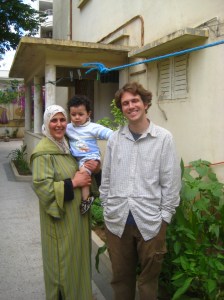
Hatred of the brown-skinned peoples of the dar al-islam has been both facilitated by and fostered by our wars in the Middle East. Being able to reduce all Muslims and Arabs to that image of barbarian bloodthirsty (or secretly restrained for purposes of infiltration) savages lets one think about the war in Iraq or Afghanistan or wherever else without associating the deaths incurred with real humans; those people are not my neighbor, are not even really human. Muslim people are people who are either shooting and blowing up things or getting blown up and shot; that is what they are there for and nothing can change it (‘they’ve always been like that’). Of course this is nonsense, and many of us know that it’s nonsense. But it’s powerful nonsense, and it infiltrates our minds and hearts, even when we recognize it for what it is. Way back in the spring while in Morocco I had been reading the news out of Iraq online, and I recall reading some particularly troubling stuff. I took a walk down towards the old city, and as I walked I looked at the people- men, women, kids- I was passing, and thought: people who look like this are the ones dying every —- day in Iraq, with my tax money, my unspoken acceptance. People like this, like the family I’m living with [see the photos below], like the people I am seeing now, living alongside. Real human beings. Of course I’ve long known all that- but for some reason it just clicked, and I nearly broke down with emotion, there on the sidewalk between the Hotel Zalagh and the McDonalds… These ‘bloodthirsty savages’ that we are conditioned to throw all together in one horrible image and hate- they have lives, dreams, children, flesh, blood, souls, voices, faces.

So. That leaves me a long ways from a bizarre occurrence in the library stacks.

Lord have mercy.

img_2127

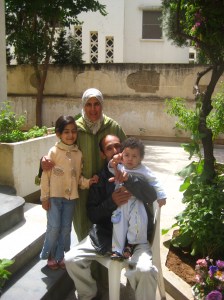
Said Muhammad, Saida Fatima, and their two kids, Maryam and Yusef.

img_2111

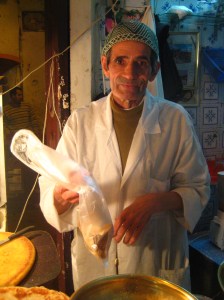
This man, whose name I have unfortunately forgotten, makes excellent fried bread. He also helped me practice my fusha Arabic (though one of his friends suggested I ought to drop the classical stuff and just do ‘street Arabic’!)

img_1090

A zellij craftsman over in the Andalusian quarter.

img_2131

Islamic Iconography From Fes

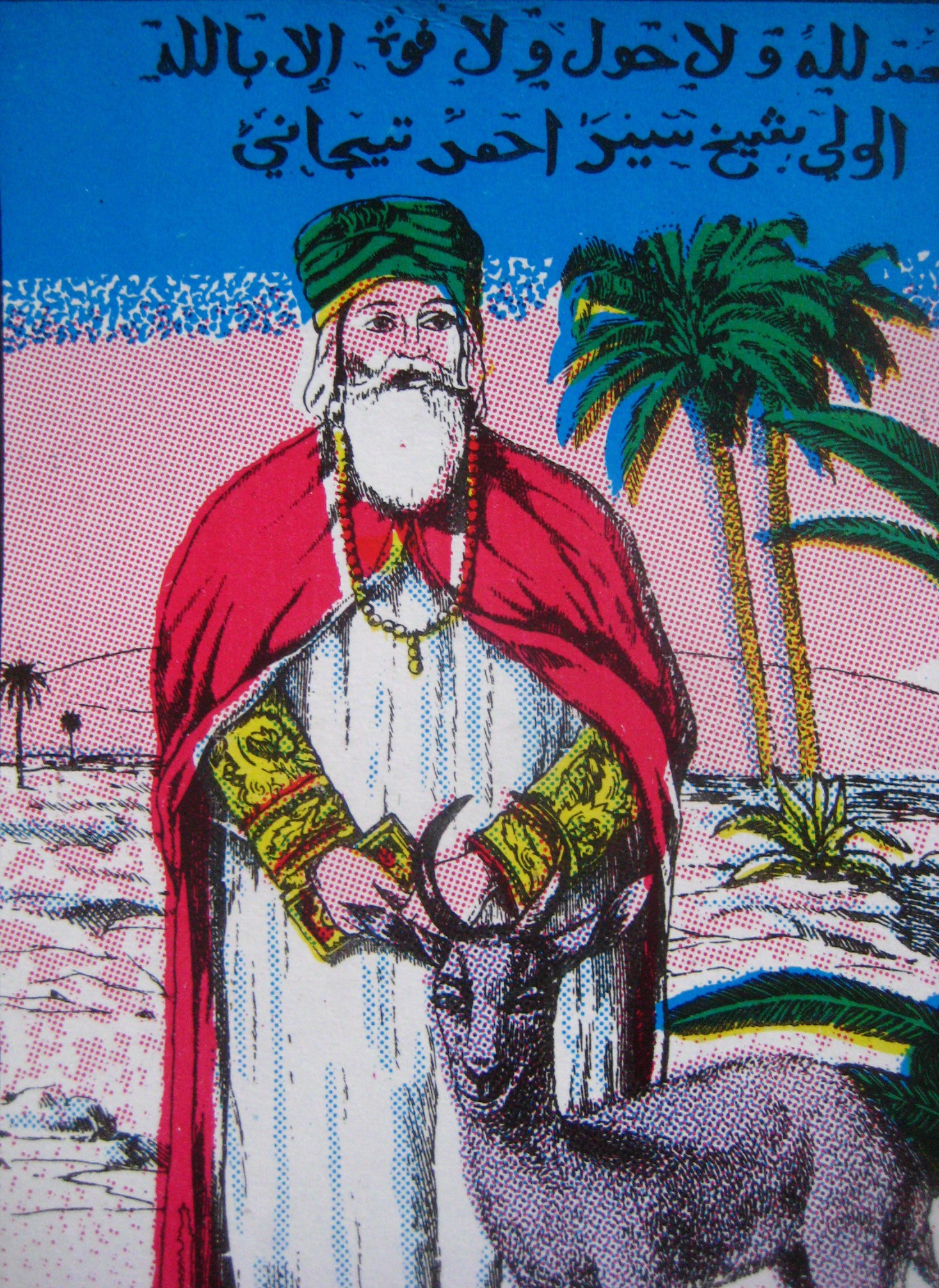
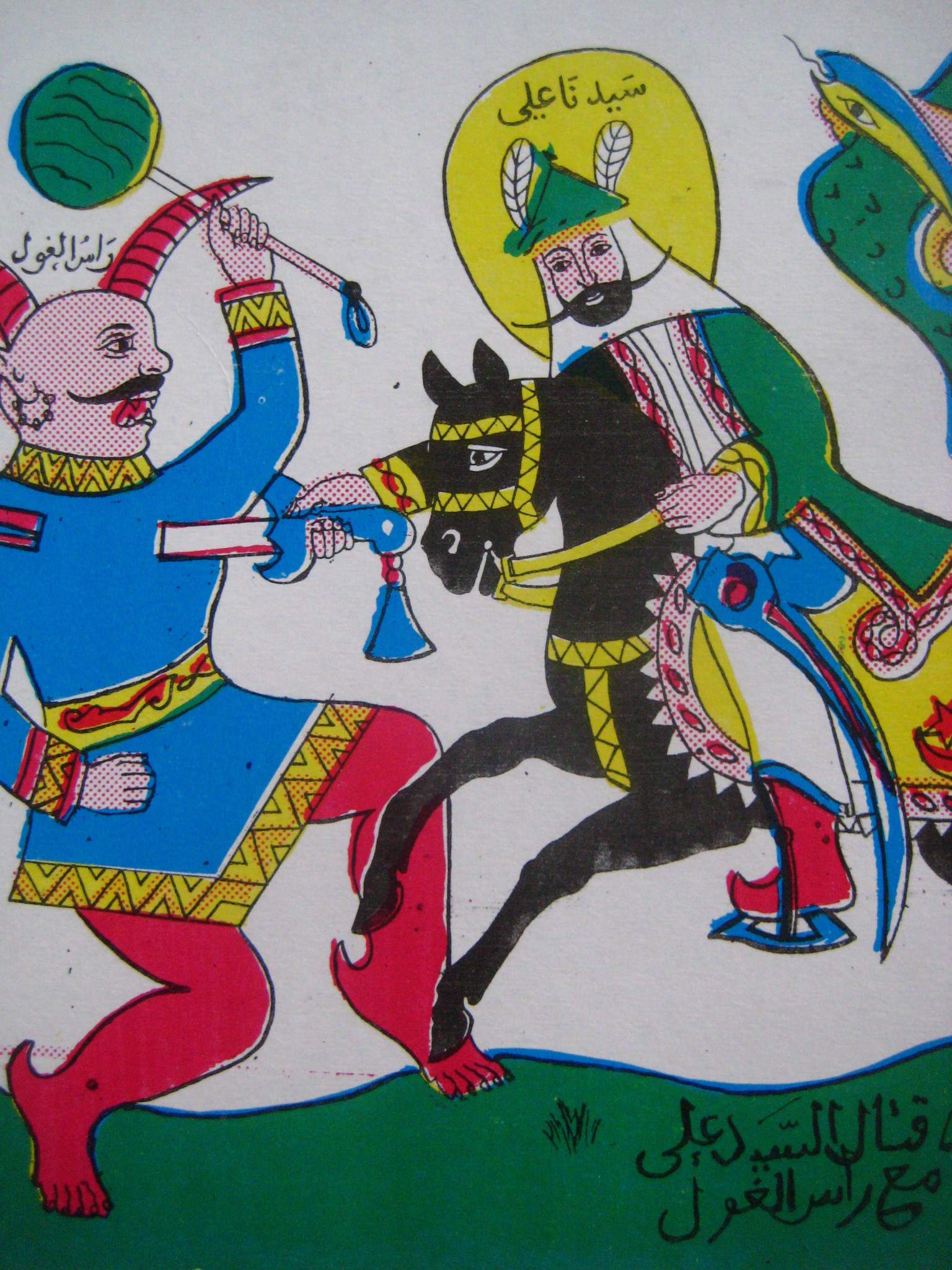
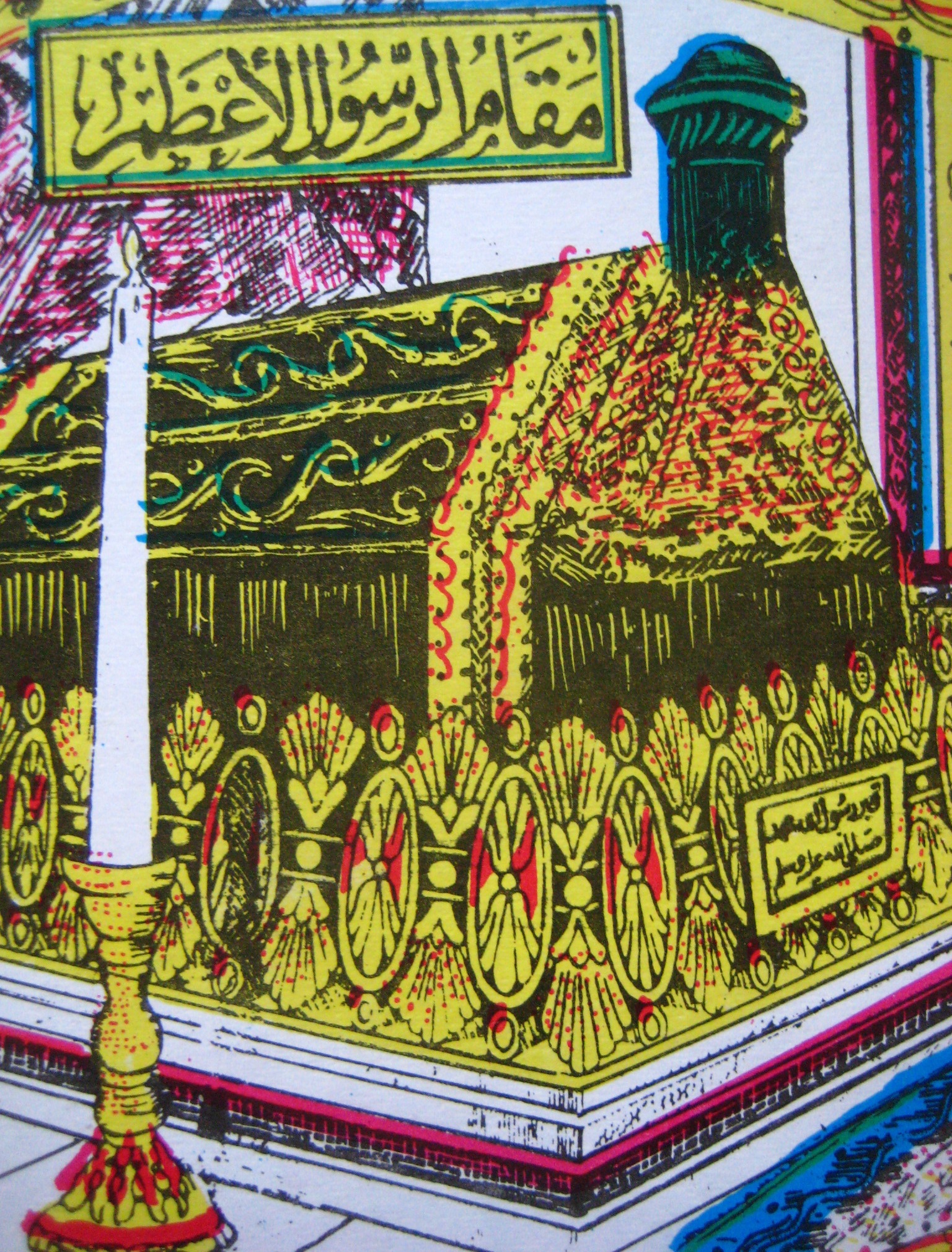
The images below come from a card-stock poster I found at a miniature flea-market of sorts an elderly Fassi would hold pretty regularly on the north side of the Qarawiyyin Mosque. He had, among other things, a couple other similar posters, along with random booklets, magazines, spoons and forks, and various trinkets and odds and ends. The iconography is what caught my eye- while iconography of various kinds is common enough in Morocco, this particular example stood out for its colorfulness and the sheer volume of visual activity in one piece of card-stock. I don’t know the origin or the history of this document, other than that it was probably produced in Fes, as one of the scenes is of Ahmad al-Tijani, whose zaouia is only a few streets over from al-Qarawiyyin.

Ahmad al-Tijani, on of the most prominent saints in Fes these days. His zaouia is particularly popular with pilgrims making the Hajj coming from West Africa. The Arabic text next to the picture- not pictured here- reads: ‘The sheik Saint Ahmad al-Tijani was a man virtuous, pious and (qūran– not sure of this word), a Sufi and the sheik of the brotherhood (ţariqa) that traces its origin to him.  Originally from Algeria, he immigrated to the city of Fes and adopted it as his residence. Many followed after him in Morocco and in black Africa. Finally, he died in the city of Fes around the year 1165 of the Hajira and was buried in it; God have mercy on him.’

A scene depicting ‘The battle of Said ‘Ali with Ra’s al-Ghul (the demon’s head, al-ghul being the source of the English word ghoul, incidentally).’ The caption inside of Ali’s halo reads ‘our master (saiduna) ‘Ali.’  John Renard writes concerning this particular iconographic subject: ‘Pictures of ‘Ali engaged in combat against the demon of woeful countenance known as Ra’s al-Ghul are among the most prominent North African examples of this first type [images of religious heroes]. Here Muhammad’s son-in-law displays the essential trait of the religious hero, willingness to engage the forces of evil and injustice. ‘Ali usually dispatches the demon with a stroke of his forked sword, Dhu ‘l-Faqar (the cleaver), which he inherited from Muhammad. The sword provides a natural iconographic clue to the hero’s identity.’ (Seven Doors to Islam, pp. 97-8)

‘Ali, along with his two sons, is also featured in another panel on the poster, with ‘Ali seated and his sons standing next to him- not nearly as exciting as the one above. If you are at all familiar with Islam you will probably be aware that veneration of ‘Ali is most often associated with Shia Islam; however, Sufism in general from its initial stages had a high place for ‘Ali, and continues to do so in various forms. This is especially true in North Africa: ‘North African tradition, particularly in Tunisia, regards ‘Ali as a high exemplar for youth. He was “the first adolescent to have embraced the new religion without ever having previously bowed down to any idol or worshipped a deity other than God.” ‘Ali is morever the father of two sons who model ideal behavior for young people. Before they were martyrs, Hasan and Husayn were children of a heroic father. And as youthful martyrs, the two embody innocence and purity standing firm in the face of evil.’ (Ibid.)

Here we have a picture of the tomb of Muhammad, ‘the exalted prophet’ according to the text above the tomb. Obviously, this an image that would resonate all across the Islamic world, though I suspect it has a special resonance in North Africa where the tombs of saints are particularly important as sources of baraka, blessing/grace/power.

One more- the famous Buraq, the winged creature that features in the story of Muhammad’s Night Journey.

Theodore Abū Qurrah on the Veneration of Icons

Theodore Abū Qurrah was the first Christian writer whose name has come down to us to write in Arabic. As such, he is particularly interesting for his early approach to presenting Christian theology and praxis in an environment that had already become heavily Islamicized by his lifetime (755-830 AD) a hundred years after the Arab conquest and the establishment of the Umayyid state in Syria. One of the changes Abū Qurrah dealt with in his writings was the change in Christian attitude towards icons, or, more specifically, the public veneration of icons in church. In early Islam particularly, depictions of humans was, if not completely proscribed, considered with extreme suspicion if not outright declaration of being forbidden. While this attitude has hardly ever really been universal, and is by no means universal now (while in Fes I purchased a wonderful poster of scenes from the Qu’ran and Islamic legend, plus a local saint, which I will eventually get around to scanning onto my computer and posting one of these days, ان شاء الله), the iconoclastic current of Islam has always been strong, and was particularly hostile to Christian iconography in Abū Qurrah’s day.

More specifically, Christians were being mocked by their Muslim neighbors, and accused of being idolatrous, because of their veneration of icons. Now, granted, being mocked and insulted is a hardly out and out persecution, but in a miliue that had become heavily Islamicized, and with Muslims occupying the highest positions, this sort of mockery had a deep impact. Plus, Christianity had already undergone the massive shock of Islamic conquest, which by itself tended to weaken the hold of Christian dogma on the masses. Mocking icons and calling them idols was only one more element in the weakening and dissolution of Christianity as a popular religion (something Abū Qurrah states in his defense of icons in fact). Not only were icons themselves mocked, but the depiction of Christ crucified was a particular object of scorn, as the Qur’an states very explicitly that Christ was not crucified, and for Sunni Islam the crucifixion is very incongruous with the way God is expected to act (Shia Islam, on the other hand, very much embraces the idea of redemptive suffering and shame, but that is another story).

How Abū Qurrah responds to the charges regarding Christ and the seeming foolishness and weakness evidenced in the Christian account is fascinating- he embraces the seeming absurdity of Christian doctrine- but here I would like to draw attention to a passage from his work ‘A Treatise on the Veneration of the Holy Icons’ (translated by Sidney Griffith) in which he deals with icons, and, more specifically, the veneration offered to them. The passage is noteworthy because he seeks to establish analogies within both Judaism (his preferred, and generally safer, debate partner throughout this particular polemic) and Islam for Christian practice. After establishing Jewish and Islamic parallels or analogies he goes on to describe Christian practice, thereby attempting to remove some of the distance between the three faiths- and hence somewhat reduce the polemical sting and weight of arguments against Christianity (since he is hardly attempting some sort of ecumenical unity or agreement). However, in this brief passage there is a good example of what Abū Qurrah is doing- reproducing earlier arguments (St. John of Damascus is continually in the background) and re-contextualizing them in the new Islamic environment.

From Chapter XI: ‘It is inevitable that the act of prostration goes to what the intention has in mind in the flexing of the knees, putting down the forehead, and the direction one faces. Since this is so, anyone with a question should understand that Jacob made a prostration on Joseph’s staff, intending thereby to honor Joseph… So too we Christians, when we make prostration in front of an icon of Christ or of the saints, our prostration is certainly not to the panels or to the colors. Rather, it is only to Christ, to whom every kind of act of prostration is due, and to the saints to whom it is due by way of honor.

‘One should also recall what we said about everyone who makes a prostration to God; his two knees touch but the ground or a carpet, yet his prostration is conveyed only according to what he intends- to make an act of prostration to God.

‘It is the same with the Christians; their touching the icon in the process of their making the act of prostration is in accordance with what they want to do- to honor Christ, their God, or his saints, or the prophets, or the apostles, or the martyrs, or someone else.’

A second, more direct reference to Islam comes a little earlier in the text, in Chapter IX, in which Abū Qurrah quotes from the Qur’an and employs at the conclusion a distinctly Qur’anic sounding phrase.

‘Understand that performing the act of prostration is sometimes by way of worship, and sometimes by way of something other than worship. There are people other than you, O Jew, among those who say that it is not permissible to make an act of prostration except to God. They too mock the Christians for their practice of making prostration to the icons and to people. They maintain that making the act of prostration is worship, all the while having it in mind that “God commanded all the angels to prostrate themselves to Adam, and they prostrated themselves, except Iblis refused, and came to be among the unbelievers” (al-Baqara II:34). If prostration is an act of worship, then without a doubt, according to what you say, God in that case commanded the angels to worship Adam! Far be it from God to do that!’