Milk, Blood, and Devotion

Pardon the paucity of posting- it goes without saying that I’m keeping busy here at the mid-point of the semester, though that’s not really a good excuse for not writing, since I manage to find time to waste on less productive things on-line…

One of my projects that’s keeping me busy involves looking at various Qur’anic tafsir– commentaries- on verses 67-69 from Surah al-Nahl, the Surah of the Bee. The verses in question deal with, among other things, the eponymous bee, which brings up a surprising range of questions for the various commentators I’ve looked at so far. The most exhaustively covered aspect regarding the bees seems to be a phrase that describes honey as a medicine for people (or at least the commentators all suppose that honey is what’s being referred to- like much of the Qur’an, there is a great deal left unsaid. Qur’anic commentators were exploiting the silences in the text long before it was cool to do things like that…). Before the bit about the bee, however, there is a description of milk and where it comes from: ‘Truly, you have in grazing beasts a sign- we give you to drink from their bellies what is between blood and stomach-contents (farth, a rather difficult word to convey into English): milk pure, palatable for drinkers.’

This gives rise to all sorts of questions for commentators, who tackle their material in a surprisingly wide-ranging manner. This is one of the things that has struck me in learning to read tafsir: that while there is indeed a remarkable continuity and stability in these writings, there is also great diversity, especially in how the material is arranged, and what sorts of ‘standard’ questions the author picks, and even more importantly, what he chooses to say about those questions. The following is a nice example of some of the issues one finds in tafsir, and how they might matter in working out what all these authors are doing with the text of the Qur’an, its interpretative tradition, and its devotional use:

‘The second question/disputed matter: God pointed out the greatness of His power in the pure issuing out of milk from between the stomach-contents and the blood, from between the red of the blood and the filthiness of the stomach-contents (al-farth). And though the two had been joined together in one receptacle, when you look to its colour you find it white, plainly pure from the filth of its neighbor. And when you drink it, you find it palatable (sā’igan), against the disgustingness of the stomach-contents- meaning, then, [milk’s] deliciousness. And some say sā’igan to mean no one chokes on it, and truly it has this attribute. However, the notation [above] still holds regarding the deliciousness and pleasantness of the taste, [as opposed to] the odiousness of the neighbor from which it is separated while in the stomach, that is, the disgusting stomach-contents.

‘This is a power that is impossible except to the Regulator of all things for [their] benefit.’

Ibn ‘Arabi, Ahkam al-Qur’an, 1145.

This brief excerpt comes from an eleventh to twelfth century commentator, Ibn ‘Arabi of Seville (not that Ibn ‘Arabi from al-Andalus, but a different, far less well-known, and much easier to read and decipher Ibn ‘Arabi), in his Ahkam al-Qur’an, which is a selective tafsir: he only deals with ayah that, ostensibly, have a legal importance.

But as you might have noticed, there’s not really any legal matters at play here. This excerpt follows a long grammatical excursion, and is followed by a legal/hermeneutical question. While I’ve just started this particular tafsir, I would suggest that we see in this small example that even a seemingly narrowly focused work is not in fact so narrow. Nor, I might suggest, should we understand legal matters in general as being carefully divided off from things we might rather label ‘devotional.’ Rather, things seemingly as mundane as legal matters and grammar and vocabulary explanation can provide opportunities for expanding the text’s devotional and contemplative possibilities. Here, Ibn ‘Arabi is dealing with a question of word meaning: the proper connotation of sā’igan. Ibn ‘Arabi resolves it by offering two possibilities, and indicating which he thinks is preferable. Like any grammatical explanation, the commentator is here guiding the reader into a new understanding of the text, creating a new text. But why? Obviously one of the primary reasons one employs a tafsir is to simply understand the often eliptical and opaque words of the Qur’an- otherwise, one ends up confused in many places. The text calls out for an interpreter, if only on the grammatical and syntactic level. How a given commentator reshapes the text depends on all sorts of factors- what elements he chooses to emphasize, which authorities he draws upon, even how he organizes his material. Each commentator arrives at a somewhat different text, a text that can, from then on, be experienced through the lens he has created for us.

Among the concerns of commentators, and the one I want to focus on here, is that of guiding the reader into the ‘devotional’ meaning of the text, a meaning that will guide him as he reads the Qur’an for himself, whether in a contemplative setting or in a public-liturgical one or as part of further study. As al-Ghazali argues in Volume 1, Book 8 of the Ihya, proper recitation of the Qur’an- recitation that becomes ‘present’ (hudur) to the heart- depends upon a good understanding of the text itself. This involves, obviously, understanding grammar, syntax, and vocabulary, but I would suggest that it also involves being guided into the ‘worshipful’ junctures of the Qur’an, some of which may not be immediately obvious. In the case of the passage above, the text itself indicates that the giving of milk is a ‘sign,’ an ‘indication,’ (‘ibratan); in this case, Ibn ‘Arabi points out again what has already been ‘pointed out’ (nabah) in the text. If the reader missed the significance, the commentator reiterates and expands it, and directs him to the proper response: wonder and praise over the power of God.

The vocabulary question, then, becomes a textual fissure from which Ibn ‘Arabi can direct the reader, not simply to a better understanding of a given word, but to a better understanding of the power of God in the natural world. By unpacking the text, he deepens the reader’s awe and reverence associated with this single ayah, which the reader can then retain when he comes back to this ayah in any other context. It also has the function, I think, of not only explicating the potentially hairy syntax of the Qur’an, but also of more closely linking the textual ‘sign’ to the physically perceived world of cows and milk. By emphasizing the process of milk-production, the commentator can perhaps guide his reader to recollection of the ‘sign’ even when the reader is outside of the text itself- say, drinking milk or seeing a cow. Either within or outside the text, the intent, I think, is to evoke in the reader worship, devotion towards the Creator. While textual explication on a very straightforward level is important, obviously, it is not necessarily the only or even primary concern.

This is also true, I think, for both Eastern and Western Christian commentators: even the long lines of often times dry grammatical explanation ultimately direct back to a devotional- for lack of a better word- use of the scriptures. This is in fact a rather important point that cannot be stressed too often: for medieval users of scripture- Christian, Jewish, Muslim- the text is not simply an artefact to be examined. It is always the words of God speaking and offering a means to approach the Divine. Text does not exist for text’s sake; even the driest of commentators (and trust me, they can be terribly dull, across confessional lines…) is working towards a deeper and more knowledgable experience and understanding of God through his exegesis. Even in, say, the ‘Antiochian’ tradition of exegesis, there is a very marked difference between the ‘historio-critical’ and what a late antique or medieval exegete is doing, though the external forms may on first glance appear similar.

Academic Labors

‘Similarly, we know from our own experience that one who is wise does burden himself with late hours and hard work, reading books, taxing his mental powers and discernment, to understand. But this is no injustice and not wrong in the least on his part. As the prophet said, “Out of the toil of his soul shall he see and be sated.'”

Saadiah, The Book of Theodicy

‘I know that very often I understand many things in the sacred writings when I am with my brethren, which, when alone, I could not understand… Clearly, as this understanding is given me in their presence, it must be given to me for their sakes. Hence God grants that understand increases and pride decreases, while I learn, on your behalf, that which I teach you. For, really, very often I hear what I am saying for the first time, just as you do.’

St. Gregory the Great, Homily on Ezechiel

Lost in Translation

An author I’d not heard of and whose write-up in the Guardian does little to impress me (cock-tails! handsome! witty! with-it! Great Novel of Our Time!) interjects in the write-up his opinion (almost admittedly un-informed) on the Qur’an, Islam, and Muslims of the present day and the past. Mr Faulks- the author in question- is rebutted by Ziauddin Sardar, who does a decent job. However, as the comments section to Mr Sardar’s article reveals in greater, and quite distressing, depth, the problem lies not merely in Mr Faulks’s ignorance of the Qur’an and Islamic history (though anyone who is unable to find an ethical message in the Qur’an has some reading comprehension problems, frankly), or in the ignorance of the aforementioned commentators. Some of them do seem to have a greater grasp of both the Qur’an and Islamic history, but still miss the point, not only of the Qur’an, but of all sacred scripture. But they all miss the point of scripture in, not only the tradition of Islam, but also Christianity and Judaism. Scripture does not exist in a vacuum, not even in the practice of Protestant traditions whose official doctrines might suggest as much. Scripture only exists, only signifies, within the shared practice of a community. Scriptures comes to signify only within the community, within the tradition of shared life, practice, ritual, whatever you wish to call the complex- religious life is too weak, becaue it entails a division between times, when the scriptures of the Peoples of the Books permeate all of life, all of imagination and activity, though especially what we label specifically “religious” ones.

The befuddlement of Mr Faulks and the like-minded commentators- and many non-religious or vehemently anti-religious people in the modern West- is like the befuddlement of someone faced with a deeply foreign language. Unable to understand the language, they conclude that it must be nonsense, lacking in art, lacking in real meaning- dry and arid, to use Mr Faulks description.

It’s not a new reaction (what is really new?). St. Augustine tells us that when he first started reading the Bible, he didn’t like it too much. Compared to the classics of Greece and Rome, the Bible, especially the Old Testament, was vulgar and dull by turns, and just didn’t do it for St. Augustine, at first anyway. His reaction wasn’t original, either- there were plenty of people in the world of ancient Christianity who felt the same way. But St. Augustine, obviously, would over time come to not only understand and participate in the language of the Bible, but it would permeate him, grip his imagination, serve as the constantly recurring seed blossoming into new interpretations and permutations. It took time- his early work as a Christian shows signs that his grasp of the language of Scripture was young and not deeply set. For in order to enter into the language, the rhythm of scripture, one must enter into the lived participation of it.

The contours of this lived participation vary within the traditions of the Peoples of the Books, but I increasingly find that they mirror each other considerably. Not, I suspect, primarily through borrowings and direct influences, but rather through a shared sense of commitment to a given text (or rather, canonical assembly of texts) that is spoken and interpreted and embedded in the life of a self-aware community. To illustrate, let me offer some very inadequately fleshed-out examples from the scriptural traditions I am most familiar with. As a disclaimer, my knowledge of Orthodox Christianity comes from both the lived (and still quite fresh and in some ways novel, in some ways quite familiar) experience and my more academic studies. My commentary on Islam does not have the lived participation, obviously, but, I think, is informed by my experience in the scriptural tradition and experience of Christianity.

To begin with, in Orthodox Christianity, the Divine Liturgy is the central location of the Bible; its phrases, words, chapters and verses permeate the Liturgy (and every other service), which the worshiper hears and speaks day after day after day, and, even if she does not practice much attentiveness, the language of the Liturgy works into her imagination, her practices, becomes a language, a way of life. From the shared experience of scripture in Liturgy, the Church draws upon the commentaries (both explicit and implicit) of the Fathers and Mothers of the Church, who, even when they are not writing what we would identify as commentary proper, write and think in a language that is built from scripture. The words and lives of the Church’s saints, in turn, fold back into her liturgical life and experience of the scriptures; no part can really be divided off from another. The words of the Fathers and Mothers are organically fused, impregnated, with scripture, the well of all knowledge as St. Isaac says of the Bible. The knowledge of scripture that they seek and that they live is not a mere knowledge of grammar and syntax, historical context and critical apparatus (even if those things are not ignored), but a living knowledge, the knowledge of the heart, so that the text comes to shape them, to direct their desires and thoughts and actions. And in all of these permutations of scripture, the person of Christ is woven through and through: the Church speaks Christ through scripture, and speaks scripture through Christ. Hence the importance of encountering scripture in the Divine Liturgy, in the embracing enclosure of the Eucharist- scripture itself is gathered into Christ and out of Him, as it were, truly begins to signify, to live. Outside of Christ, outside of the Church and her life, the Bible is a confused jumble of texts; “for the letter killeth, but the Spirit giveth life.” The letter does not cease, but is transformed.

In Islam, scripture is the central axis of all practice; the Qur’an is understood as the actual, living words of God. Yet, even as the Qur’an stands in Islam as the direct mediation of God’s language, it does not exist in a vacuum either. In fact, the content and form of the Qur’an even more than the Bible demands an ummah, a community to receive it and understand it. As various Western critics have rightly noted, the Qur’an does not explain itself; with the exception of Surah 12, the story of Joseph, there are no fully developed narratives. The text often jumps rather abruptly from one point to another, without any seeming interlude or reason. (Incidentally, when modern writers do this, we are expected to hail them as brilliant and unbound by convention, but that’s another tale…) But it is this very form that entails its embedded nature in the Muslim community: in the first place, the Qur’an becomes, from the very beginning, the language of the Islamic ummah, obviously within the formal salaat, and within the practice of recitation. Qara’a, the root of al-Qur’an, includes, among its valences, the meaning ‘to recite,’ and this is of course how the early Qur’anic recensions were preserved, and continued to be experienced, up to the present. Qur’anic recitation- in the various possible forms and manners of reciting- are crucial to the assimilation of the text into the worshipers heart and mind. The goal, al-Ghazali tells us in the Ihya, is to so attune oneself to the text that as one recites, at the sound of the threats of God against sin, one becomes as a dead man, and at the sound of God’s promises and mercy, one soars aloft like a bird. The text is ‘unbound’ through its penetration of the heart and its permutation of one’s very language. The dis-junctures of the text keep one in motion, alert; the repetitiveness helps to inscribe it and make it present.

Further, the text comes to exist in the Islamic ummah through the work of the commentators, whose tafsir- interpretation, commentary is a decent enough translation- ‘flesh out’ the semi-narratives of the Qur’an and seek to solve its syntactical and lexical difficulties, and to correlate its often cryptic allusions and references to the sunnah of Muhammad. In so doing, they situate the text of the Qur’an within the life of Muhammad and more broadly the life of the ummah. The tafsir tradition, in its general stability, provides a consistent framework for the wider community to receive the Qur’an and assimilate and understand it- both on an ‘exterior’ (zahir) level, and, increasingly as Islam develops, the ‘interior’ (batin) level. With its situation in a fairly stable commentary tradition the text can be opened up to multiple meanings (such as the Sufi emphasis upon personal movement from maqam to maqam in the apprehension of the Qur’an) while still remaining an integrally whole text. Out of the whole complex of the Qur’an’s situation in Islamic life- and I have just touched on two aspects- it becomes the language of the community, not simply a rule-book (the Qur’an is in fact rather short on that sort of thing) or a reference guide, but a site of prayer, of self-knowledge and self-formation under the text.

All of this is to say that Mr Faulks, and a great many other people in the modern world, fail to grasp the scriptures of the Peoples of the Books because they do not grasp their function, and they do not even seek to enter into the scriptural ‘world’ of these communities. Their approach to a scriptural text is like their approach to any other text- it is an object to be dissected and laid out to dry and then pronounced upon. If upon doing so they find only a rather uninteresting or even disgusting corpse, it should come as little surprise.

Al-Ghazali on Funerals

As I was reading today the last section of al-Ghazali’s Ihya ‘Ulum al-Din (The Revivification of the Religious Sciences)- Book XL, Kitab Dhikr al-Mawt wa-ma Ba’dahu (The Remembrance of Death and What is After It), I was struck by how apropros the following two passages seemed in light of the past couple weeks’ spate of well-publicized deaths and funerals:

1. ‘Know that funerals are a lesson to the man possessed of insight, and a reminder and a counsel to all save the people of heedlessness. For these latter are increased only in hardness of heart by witnessing them, as they imagine that for all time they will be watching the funerals of others, and never reckon that they themselves must needs be carried in a funeral cortege. Even if they do so reckon, they do not deem this to be something near at hand. They do not consider that those who are carried now in funeral processions thought likewise. Vain, then, are their imaginings, and soon their allotted lifespans will be done.

‘Therefore let no bondsman watch a funeral without considering that he himself is the one being borne aloft, for so he will be before long: on the morrow, or on the day that follows: it is as if the event had already occurred.’

2. ‘The properties of attending funerals include meditation, heedfulness, preparedness, and walking before the pall in humility… One of these proprieties is to have a good opinion of the deceased even if one he had been corrupt, and to have a poor opinion of oneself even if one may outwardly be pious. This is because the last moment is a perilous thing the true nature of which is unknown.

‘It is told of ‘Umar ibn Dharr that one of his neighbours once died. He had been extravagant with himself, and for this reason many people refused to attend his funeral. However, Ibn Dharr attended it and took part in the prayers. When he [the neighbour] had been lowered into the grave he [Ibn Dharr] stood beside it and said, “May God show you mercy, O father of So-and-so! For throughout your life you kept with you the testimony to Divine Unity, and begrimed your face with prostration. Although they called you a sinner and a transgressor, which one of us is not a sinner and has no transgressions to his account?”‘

Abu Hamid Muhammad ibn Muhammad al-Ghazali, in The Remembrance of Death and the Afterlife (Islamic Texts Society, 1989), 97, 98.

A Kind of Hurt in His Spirit

Song of Solomon 5.6: I opened to my Nephew; my Nephew had gone, and my soul went out with his word.*

‘See how, as she opened, He had gone. This means that once I had lifted the eyes of my mind to the meaning of Scripture, to behold the inexaminable depths of the knowledge of His grace, once I had opened my heart to embrace that fleeting glimpse, and to examine and become informed of and comprehend the depths of his knowledge, what eluded my weak mind’s grasp so awed me that for desire of it I would have forgotten that knowledge which I had received when I opened.

‘For that reason she says, my Nephew had gone; it is as if no sooner was He seen that He at once withdrew, swift as the lightening. And my soul went out with his word; that is, “having obtained a small glimmering of his words my soul left me and pursed His words.” To put it another way, I recognized Him, and I was united to His love, and I was ebullient with His commandments. And thinking that I had attained something, I recognized myself to be all the more distant from attainment; seeing the true Sun, I recognized by His light how distant I am from knowledge.

‘I brought to mind that which this same divine Solomon said in another place: “Whoever increases knowledge, increases pain.” By saying this, he does not discourage one from gaining knowledge of Holy Writ, lest one’s pain increase; rather, he exhorts one to grow yet more in knowledge, and by that amount of knowledge to understand that the knowledge of what eludes one is knowledge unfathomable. For as a drunkard but thirsts the more, no matter how much he drinks, so also is the person who yearns after the meaning of the divinely inspired Scriptures: no matter how much he learns, he desires to learn yet more, knowing that he will never uncover the full understanding of the sacred Scriptures. Once his desire for its meaning has been kindled, it becomes a kind of hurt in his spirit, for by means of a little understanding he recognizes the boundlessness of what eludes him, and the desire for that knowledge infects him like a pain, albeit that pain and solicitude increase his healing discoveries.’

St. Gregory of Narek, Commentary on Solomon’s Song of Songs, trans. by Roberta Ervine (Kalamazoo: Cistercian Publications, 2007)

* Note: you will notice even from this excerpt that St. Gregory’s text is somewhat different from either the Septuagint or Masoretic recensions; in lieu of ‘beloved’ this Armenian recension has ‘nephew,’ among other differences.

Rising From the Ashes

I spent part of this week in and around Atlanta, the ever-expanding capital of the ‘New South.’ I’d not been to Atlanta in years, other than in passing while traveling; this week I wandered around the city some, both intentionally and unintentionally, since I didn’t get a hold of a decent map until the last day of my visit. It’s a big city; most of my experience in urban navigation has been in ‘Old World’ cities where my means of transport was my own two feet, and in New Orleans, a city set apart from pretty much every other North American city I’ve visited. Atlanta is, I suppose, the South’s paradigmatic example of the modern city- big, ever-expanding, new and shiny (in the up-scale parts anyway, never mind the poor parts for the moment), with precious little of any considerable age, even for North America. Of course, General Sherman bears some blame for that, but not very much; there wasn’t a whole lot there back when my unfortunate ancestors were getting shot up at Kennesaw Mountain and Peachtree Creek.

There are of course some sections of the city that are fairly old and historic, and feel it. Auburn Avenue, which was the center of African-American life and commerce after the imposition of segregation in the early twentieth century, has some wonderful old and funky buildings; the Episcopal Methodist Church with its hodge-podgy neo-Gothic and big blue neon ‘Jesus Saves’ sign on the steeple is singularly wonderful, and is still in good shape. Further up the street, the Park Service has purchased and renovated a whole neighborhood worth of old buildings associated with Martin Luther King Jr., who was born and spent his boyhood in one of the old houses. But the stretch of street running back from the historic site is, with all its lovely old structures and venerable history, pretty decrepit. As my friend and I walked up from downtown towards the MLK site, we were approached by a homeless man offering an impromptu tour, followed by a request for donations. The whole area is now run-down, boarded up buildings and heavily armoured likker and mini grocery stores here and there; our homeless tour-guide told us he lived back up under an overpass of the interstate which now dissects the area.

The historic site is quite nice itself however, a sudden imposition in the immediate landscape, neatly trimmed shrubs, a rose garden, a fairly new looking museum, as well as a new Ebeneezer Baptist Church (the old one is still there, though it is at present closed up for renovations). There are signs up in the National Historic Site warning visitors against giving anything to ‘panhandlers,’ reminding one of signs in less urban Park Service sites prohibiting the feeding of bears.

The area went down, as we say, in the late sixties; before it had been a thriving center of African-American businesses, churches, and residences, with it’s own economy and tradition of mutual aid. If the segregationist regime rejected their money, the entrepreneurs of Auburn Avenue reasoned, it was their loss- so they built up their own economy, and thrived. Dr. King’s family came out of this milieu, and the determination and communal (but deeply personalist) sense of mutual aid and support would go a long ways towards the successful challenging of the segregationist regime and its systematic but ultimately untenable oppression. This was one of the things that struck me most as I looked at the exhibits in the museum, and has always struck me about the civil rights movement, particularly in its early stages- it was community-based, and broad-based, with people of many cultural and socio-economic backgrounds and standings coming together in a truly powerful movement. The men and women who challenged the segregationist State did not have to resort to bombs and guns; they had built up lives and communities powerful enough to take on even a violent and deeply entrenched regime and succeed, without turning to violence and oppression themselves.

Returning to the gritty shot-up feeling streets of which Auburn Avenue is only one, one has to ask- what happened, and what can anybody do about it? Auburn Avenue itself is an icon of what has been happening in our cities and towns for years now, what is happening right now as I write. Desegregation had its part, of course- African-Americans were no longer restricted to their own self-contained economy, and could take part in the wider economy and succeed there- leaving behind in many cases places like Auburn Avenue. But this is hardly the only explanation, or even the primary one. At the same time as desegregation was going into affect other programs, Federal and otherwise, were coming on-line, many under the title ‘urban renewal.’ As one line was erased new ones were laid down, often with the best of intentions, but often resulting in Federally-supported ghettos. The drug war has only escalated and grown more violent and more deeply entrenched; the ever expanding field of operations of the Mexican drug cartels only harbours more violence and destruction, and it’s not up-scale gated communities suffering the brunt of the violence and the corruption and rot.

There are other problems as well- job losses, poor education, and so on- but they all share the quality that few of them are exactly intentional. Much ‘urban renewal’ was meant to help the poor, at least ostensibly, or was at least supported by people who wanted to do good. Of course, plenty of it was deliberate in partionining off the poor, especially but not exclusively minority poor, from the elite enclaves. There is ridiculous highway a few blocks from my neighborhood here in Knoxville that, I am pretty sure, was built primarily to separate downtown from the much poorer, and darker-skinned, east-side neighborhoods; maybe there were no such intentions, but the effect is the same. The drug war is supported by well-meaning people, and I am sure at least some of those carrying it out have only good intentions and genuinely desire to do good. The damage is the same though.

The problem is further presented though- the evils and problems afflicting places like Auburn Avenue are so various that they are hard to fight against. There is no segregationist regime that we can unite against and battle; there are no straight-forward targets, as much as we would like for there to be. There is less ground, too, for people to stand on, as so many urban- and otherwise- communities are shot-up and worn out. The work that is needed- and here I start to really preach to myself as much as anyone else- is personal, is on the ground, and is probably not going to yeild immediate or impressive results any time soon, maybe ever. The great failing of the American elite- who are often very well-intentioned people- is to generally stay safely away from the poor and the decimated places, while sympathizing for them, in the abstract, and proposing solutions that are sure to work in theory, in principal. But while there are some genuine general policy solutions no doubt- the drug war comes to mind- they are only a part of the solution, probably not a terribly important part.

When it comes down to it we have to stop thinking in terms of helping the poor, or saving the inner city, as if the poor were a different species or something (albeit an endangered and valorized one), capable of being saved through the right policy enactments or a sufficiently large charity pay-out. In the end, working to end the violence and destruction of our cities is a struggle for ourselves; it is not a case of our aiding the poor and downtrodden in their struggle; we are all in this together, my struggle is your struggle. I cannot cut myself off from the rest of the world; my sin afflicts my neighbor and it afflicts me, just as the violence and deprivation of endless war and seeping poverty are part of my struggle, against the violence and evil in my heart and the violence and evil that come from outside my heart.

Our Auburn Avenues are not going to be magically transformed overnight; if there is going to be change, it must begin in our hearts- my heart- and work outward, person by person, community by community, in knowledge of each person and place’s particulars, and with love for them, love that, in imitation of the love of God, offers itself in becoming one with the sufferer, by becoming a co-sufferer, from the inside, with all the danger and dirt and darkness that comes with being inside of a suffering world, a suffering humanity.

The First Friday Night

From Questions and Answers of Isho bar Nun, an answer that I found particularly charming:

Question: Did God create the primordial Natures in the night or in the day-time?

Answer: He created both in the night and in the day-time; and in these at their beginning… But there are [expositors] who have said that He created the wild beasts, the cattle and the creeping things of the earth at the beginning of Friday night. And they have presented a plausible argument, [based] on the fact that the wild beasts and the creeping things of the earth see better at night. However, everyone agrees that man was created at the beginning of the daytime of the Friday.’

From The Selected Questions of Isho bar Nun on the Pentateuch, ed. and trans. by Ernest G Clarke (Leiden: Brill, 1962).

Hardcore Scholarliness

I have to apologize for so little writing- the last weeks of the semester (plus the end of Lent and the marathon of Holy Week and Pascha which are so close) leave little time for blogging, I’m afraid. However, my study habits are certainly nowhere near those described by Barhadbeshabba (‘son of Sunday’) in his Eclessiastical History, in which he described the scholastic-monastic life of Narsai, the apparent founder and first head of the School of Nisibis, who would have loved coffee:

‘Now he would take a simple nourishment regularly of one meal, and again he would do this at evening time, or once every two days. His bed was a mat of reed and palm, his bedding a patched cloak. He would work wholly in meditation upon the liturgy and meditation on the scriptures, not giving place for sleep to fall upon himself, but upon a common seat he would drive sleep from his brow, and if it happened that he was conquered to slumber from his vigil, either he would stand and walk or he would place in his nostrils materials which would excite and awake, like spicy and sour things, or hot and pleasing things, or he would lay a tome upon his face and in this way he would sleep upon his seat. Often the tome would be the cause of waking him, since it would tip from its weight and fall from his face to his hands. The holy one demonstrated all this diligence so that while he was fleshly and mortal he emulated the way of the angels.’

From Sources for the Study of the School of Nisibis, translated and with an introduction by Adam H. Becker (Liverpool: Liverpool University Press, 2008). Becker’s reassasment and interpretation of the School of Nisibis and its ‘scholastic’ culture, which this collection of sources supplements, is excellent and comes much recommended if you’re at all interested in the Church of the East, though the price tag is unfortunately rather steep…

Palimpsests, Contested Land, and Spring Comes to the Mountains

I love every season in the mountains, and if you asked me what my favorite season to be in the hills is my answer would probably be whatever season it is at the time. Spring is probably the most exhilarating season though, particularly after a harsh winter: you can feel the life springing up out of the ground, the woods and peaks starting to stir and throb with new life. This weekend the hills are just starting to show the signs of spring- the ice is almost all gone from the high country (just a few icicles and patches of frozen ground left in the shadows), wildflowers are blooming up almost to the high peaks, and down in the valleys the patches of new green and blooms are covering larger and larger spaces.

img_5846 img_5864

img_5903

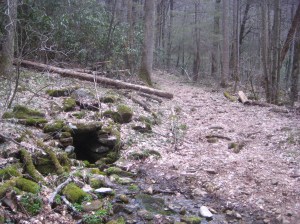
Early spring is one of the best times of the year to trace out the vast array of palimpsests that lie under the forests of the Southern Appalachians, before the thick growth of summer temporarily buries them yet further under the resurgent forest. Up almost every little valley and cove, if you look hard enough, you can find the traces of the people who once dwelt here, who pushed into the mountains up from the Piedmont of the Carolinas or down from Virginia, and cut and slashed their way into the often harsh and unforgiving landscape. In the Smokies, and in many other ranges and valleys, there are no more people- none at all in the Smokies, thanks to Federal policy that bought up and ran off (or let die out) the land owners. In other parts of the Southern Appalachians there are few or no people thanks to the hardscrabble nature of this land- after a century or so, the attraction of outside work was too strong, and the valleys and coves emptied out.

There are a variety of forms of writing, to continue my metaphor of the palimpsest, that still show up under the trees. Piles and rows of stones are the most obvious, usually- stone walls in various states of disrepair, disheveled stacks that mark old chimneys, disorganized piles along old fields, testaments to what had to have been back-breaking labour of digging up and clearing out the product these hills grow best. Occasionally bits of structures remain- spring coverings, foundations, less ambiguous signs than the often random-looking rows and piles of rock. Here and there are the stone marking graves, some of them still tended by the descendants of the people buried there, the names on the stones the last link of individual persons to the land in which they now lie waiting the Resurrection.

img_5907

img_5841

There are other signs- day-lilies and ivy, rose bushes and periwinkles, living markers descended from the plants brought with the people who once dwelt here. If there were no other records, we would know this much- whoever dwelt here cared about the appearance of their farmsteads, hardscrabble as they might be. You don’t eat ivy or day-lilies- they make your home more civilized, more settled. They are markers- though doubtless whoever planted them didn’t have this in mind- that persist, that have struggled against the return of the native forest: the day-lilies and roses have themselves become native, as the people who lived here had been, slowly, settling into the landscape. And like everything else in this landscape, they are in flux, rising and falling with the seasons, spreading and retracting, struggling, living.

The old fields and roads show up too, more subtly than the above signs, but clear enough if you’re looking for them. In cove after cove, even-aged tulip poplars grow like the corn stalks they’ve replaced; in some places the furrows of the fields are still visible under the fallen leafs and new humus. All through the hills old roads and paths still wind through the valleys and over ridges, appearing and disappearing; here and there modern trails lie on top of them, as people with very different lives and intentions follow them. But we leave eventually, returning to our homes elsewhere, in a different world, a different land.

img_5840 img_5839

img_5855

Finally, this is contested land. The signs of the Cherokee, and whoever might have come before them, are almost entirely invisible now. A few names of streams and mountains, mutated under the hand of English, survive on maps; in some of the lower valleys more tangible traces appear, or used to appear. But otherwise there is little left but the absence. The people who displaced the Cherokee are more visible, who wrested control of the land and gradually too became native to the place. The lumber companies who fought their way up the valleys- contesting the land perhaps most of all- still speak through the hills, but their traces are even more ephemeral than the settlers, now reduced mostly to railroad beds and bits of cable and a few scattered cinders; the forest is largely healed. The farmers themselves were challanged and driven out by the combined power of economic difficulties and the force of the Federal government; the transposition of old roads and modern National Park Service trails are testimony of this struggle. The signs of the Park Service often overlay the old signs- reused trails, place names, old cabins and houses marked by interpretive signs and tourist grafitti. One day, no doubt, these signs will also be subsumed by mountains, as the forest- enduring in its presence if not its form- swallows up this latest assembly of signs, and new ones- or perhaps none- replace them, and our contemporary presence recedes into the scattered memory of the hills.