Two Brothers

The following is an excerpt from a seminal Moroccan hagiographic work, the Dawḥat al-Nāshr of Muhammad ibn ‘Askar al-Ḥassanī al-Shafshāwanī. In it, ibn ‘Askar presents biographies of various saintly figures from the course of the tenth century (A.H.), many of whom lived in Fes or in the Rif region, including Chefchaouen, the author’s hometown. This text would be followed with numerous other such literary works, many of which reference the Dawḥat al-Nāshr.

The stories that fill this work provide a fascinating glimpse into the life of sixteenth-cenutry Morocco, both in the cities and in the countryside, as exempified in this short excerpt. It is also a display of the seemingly ever increasing importance saints, living and dead, played in pre-modern Moroccan society (something that has endured, in fact, into the modern age, despite many contrary forces). The power deployed by the saint can be manifest in a variety of ways, in both the natural realm and within the social and political realm. Sometimes that power is subtle, dependent upon the spiritual capital the saint has accumulated and how he chooses to deploy it. Othertimes, it is more spectacular, as in the story below of the interconnection between one anchorite saint and the raw energy of nature. Saintly practice is not monolithic: in this entry, we see two brothers, both powerful saints, living very different sorts of pious, ascetic lives. One is very urban in orientation, both before and after his conversion to the ascetic life; the other is a seeming Islamic analogue of the anchorites of late medieval Europe. How they relate to wider social and political life thus varies: our anchorite rejects marriage and cuts himself off from normal social relations; his brother’s effacious prophecy, however, is driven by a concern for familial honour, a fundamental—and very public—basis of social relations.

This variety, and the variety of responses to saints, both within and without the hagiographic text, run throughout ibn ‘Askar’s work, and indeed in the larger world of Moroccan hagiography and saint-veneration, itself subject, not to stasis and homogeneity, but diversity, divergence, and important changes over time.

The Brothers ‘Abd al-Raḥman and ‘Alī ibn Raysūn

Among them, the two sublime shaykhs, Abū Zayd ‘Abd al-Raḥman and Abū Ḥassan, fathered by Abū Mahdī ‘Īsa al-Sharīf al-‘Alamī, from among the descendants of the Pole of the West, Shaykh Abū Muhammad ‘Abd al-Salām ibn Mashīsh, God be pleased with him.

As for Abū Zayd, he was devout, ascetic, and learned, austerity and reclusion from the world being predominant in him, and miraculous signs were manifest in him. The men of the Banū Rāshid present their daughters to him for marriage without obligation, but he did not accept one of them, but rather abandoned the people, and [abandoned] his possessions in the open space before his house, not resisting those who took and bore them away. His way was the heavens, and perhaps the heavens raised him up until oneness was bestowed upon him, and he became estranged from normal relations with the people until he saw neither closeness nor distance, and his house was always locked upon him, and his bedding was the rinds of oaks.

I saw him once when I was young, and he called out a greeting to me; my father was among his companions.

No one knew about his passing away until the wind whipped up that night in the summer, the darkness deepened, the thunder roared, the lightning flashed from every direction, and lightning  bolts struck, so that the people of Tazroute were frightened, and went out to the mosque, saying, ‘Let us seek this shaykh quickly that he might tell us what is going on!’ They then went to the house and it was locked, so they called out and he did not answer them at all, so they tried to open it but were not able until they smashed up the door. Then they found him, dead, lying upon his right side, facing the qibla, as if he were sleeping, God me merciful to him. When they entered his house, the winds calmed and the thunder ceased.

He passed away at some point in the ‘fifties of this century, and was buried in the cemetery of Tazroute around Jbel al-‘Alm, in the land of the Ghumāra.

As for Shaykh Abū Ḥassan, he had, during his brother’s lifetime, worked as a merchant buying and selling goods in the markets, but when his brother passed away he swore off the world, embarked upon pious devotion, and clung to the holy. He was joyful, outstanding, naturally inclined to have a happy countenance, noble virtues, and peace of heart. He was always immersed in litanies—his was a tongue that did not cease from recitation and remembrance for even an hour.

When Sultan Abū Ḥassūn al-Murīnī entered Fes in the ‘sixties, he seized hold of the Qā’id Muhammad ibn Rāsid al-Idrīsī. Fervent respect for kinship compelled Shaykh Abū Ḥassan to go and intercede on his behalf, but Abū Ḥassūn was not to be interceded with. So [Shaykh Abū Ḥassan] went to the Kairouan Mosque [in Fes], uncovered his head, and said: ‘By God! Abū Ḥassūn shall on no account remain in [Fes], and ibn Rāshi shall go forth safe and sound, through the effacious blessing (baraka) of the People of the House (ahl al-bayt).’ And it was as he said: Abū Ḥassūn died after a month, and ibn Rāshid was related and returned to his former state. [Shaykh Abū Ḥassan] passed away around the year 963, and was buried beside the grave of his brother. I accompanied him, God be merciful to him, for a long time, and I took the way of the people and benefited by him, God be merciful to him.

Muhammad ibn ‘Askar al-Ḥassanī al-Shafshāwanī, Dawḥat al-Nāshr

On the Poor Ones and Why They Are Called Sufis

While later medieval Sufism is represented in some extremely subtle, sophisticated, and often very complex texts, produced by and for the intellectual elite, writings intended for a less rarified milieu were also very common. Indeed, many prominent Sufis wrote treatises and commentaries designed to make esoteric, philosophical tenets of mystic though and practice more accessible and more widely dissimulated. Treatises and pamphlet from less prominent and indeed unknown writers were also common, often attached to and advocating a particular Sufi ‘order’ (ṭarīqa), with its particular rites, canon, saints, and chain of authorities often stretching back to a semi-legendary eponym. The text I have excerpted and translated below is an example of this less ‘sophisticated’ and generally more accessible strain of Sufi writing, writing that was intended for, if not the masses, at least a relatively broad audience. Furthermore, as the text below especially demonstrates, we can get a better idea of the actual reception of the often difficult, even impenetrable, ideas of mystico-philosophic Sufism, and the ways in which rituals and ritualized behavior and dress (among other things) were perceived and practiced.

This text, entitled the Sirr al-Asrār—‘Secret of Secrets’ is a workable, if imperfect, English translation—is also an excellent example of another phenomenon common in the medieval world: the automatic verification of a text by attaching it to the name of a prominent, respected figure in the past. In this case, at some point in its history (either at the hands of the original author or a later redactor) the Sirr al-Asrār was attributed to none other than the great Sufi-Hanbali preacher of eleventh-century Baghdad, ‘Abd al-Qadir al-Jīlānī. This attribution continues to this day, and is almost certainly the reason an otherwise rather unremarkable introductory text can today be found in numerous printed editions and in various translations, including a couple into English (which should be considered devotional paraphrases, not translations, I might add). That it simply cannot in fact be from the Baghdadian preacher’s pen is obvious from even a cursory comparison between the established authentic writings of al-Jīlānī and this text: not only is the Arabic much choppier and less rhetorically powerful, but the ideas and practices expressed here are often derived from a quite different, and chronologically later, mystical milieu than that of al-Jīlānī. That is to say nothing of the now anonymous author’s occasional citation of Persian poetry, including Rumi, who lived long after ‘Abd al-Qadir’s death. Rather, it is likely that the text was either composed by a now anymous author, perhaps a member of the Qadiriyya order (which claimed ‘Abd al-Qadir as its eponym), and then later attributed to the famous Eponym accidentally or otherwise; or it was labeled with ‘Abd al-Qadir’s name from the beginning. The former seems more likely, as other than the initial attribution—an easy thing to modify—the text does not make any further effort to identify with ‘Abd al-Qadir.

As for the content translated and presented here, there are several interesting points. First, our author presents a simplified Sufi cosmology, which curiously emerges as a result of the question of the much debated etymological origins of the term ‘Sufi.’ After establishing a mystical cosmology, our author then continues his discussion of Sufi ‘poverty’ and how the true inner nature of Sufism is reflected in both the practices and clothing of the Sufis. As is often the case with handbooks and introductory treatises such as this, objects and rituals provide an easy locus for allegorical explication and theological teaching. Here, clothing is our author’s springboard for laying out the inner meaning of Sufism. Yet we should not imagine that such connections are incidental for our author: rather, as is indicated by the opening discussion of cosmology, and the constant reference to Qur’an and hadith (especially hadith), the world and all its parts are part of the things symbolized. Allegorical connections are not accidental, but reflective of essential properties, of an essential divine economy linking things together and providing the world with divine significance. Hence while the objects discussed might be mundane, and the language of this treatise not exactly representative of high-style, our anonymous author sought to introduce his readers to a truly rarefied, and wondrous world indeed, one in which they also could participate and partially, at least, understand.


The Twelfth Chapter, On the Poor Ones and Why They are Called Sufis

Some of them say because they used to dress in wool (al-ṣūf) or because they purified (ṣafū) their hearts from worldly worrisome affairs or because they purified their hearts from all other than God. And some say because they will stand on the Day of the Resurrection in the first row (al-ṣaff al-awwal) in the World of Proximity (‘ālam al-qurba). For the world is four:[1] the World of Kingship, the World of Sovereignty, the World of Divine Omnipotence, and the World of the Divine Essence, and it is the world of reality. And likewise the knowledges are four: the knowledge of the Shari’ah, the knowledge of the Mystical Way, the knowledge of Gnosis and [the knowledge of] Reality. And likewise the spirits are four: bodily spirit, luminescent spirit, governing spirit, and holy spirit. And likewise the divine manifestations are four: the manifestation of the subtle traces, the manifestations of the acts, the manifestation of the attributes, and the manifestation of the essence. And likewise the intellect is four: the basic intellect, the customary intellect, the spiritual intellect, and the universal intellect.[2]

And in the reception of the four aforementioned worlds, knowledges, spirits, manifestations, and intellects, some of the people are bound to the first knowledge, the first spirit, the first manifestation, the first intellect, in the first Garden, which is the Garden of refuge. And some of them are bound in the second and they are in the second Garden, the Garden of beneficence. And some of them are bound to the third, and they are in the third Garden, the Garden of paradise. And they are heedless of the reality of those things, while the people of the Truth from among the gnostic renunciants flee from all of it and are united to the reality and the proximity; they are not bound to anything other than God, exalted is He, and the follow after His word, exalted is He. So they flee to God, and as he—the most perfect of prayers and peace be upon him—said, ‘This world and the next are ḥarām for the people of God.’ And the intended meaning of ẖarām here is not that the two things are prohibited to them, but rather they have prohibited them from themselves that they would seek them and be attached to love of them. For they say: ‘Verily, we are sinners [?], while those two things are temporally originate—so how can one temporal being seek after another temporal thing? On the contrary, it is incumbent on such a one that he seek the originator.’

And He says in the sacred hadith[3]: ‘My love is the love of the poor ones.’ And he said, peace and prayer be upon him, ‘Poverty is my pride, and I take pride in it.’ The intended meaning of poverty here is not the common meaning of poverty, rather, the meaning of poverty here is dependence upon God, mighty and glorious is He, and abandoning what is other than Him, from the benefits of this world and the next. The [ultimate] meaning from it is is annihilation (al-fanā’) in God, such that nothing remains in the self for the self, and nothing is encompassed within the heart other than God, as God, exalted is He said: ‘Neither My earth nor My heavens encompass me, but the heart of My believing servant encompasses Me.’ The intended meaning of ‘believing’ is he who has purified his heart from human attributes and has emptied [it] of alterities, so the Truth encompasses his heart in reflection. Abū Yazīd al-Bisṭāmī,[4] God be merciful to him, said:’If the Throne and what is around it were cast in a corner among the corners of the heart of the gnostic, he would not sense it.’ So He who loves those beloved ones, He is with them in the Other World. The sign of their love is their companionship and yearning for God, exalted is He, and encountering Him, as He said in the sacred hadith: ‘The desire of the pious stretches out towards encountering Me, and I strengthen desire toward [sic.] them.’

As for their clothing:[5] it is in three types, as we mentioned in chapter three. As for their works: the work of the novice is variegated with the praise-worthy and the blame-worthy. The work of the intermediate is variegated with praiseworthy colours like the light of the Shari’ah, the Mystical Path, and gnosis. Their clothing is variegated likewise, like white, blue, and green. The work of the realized one is emptied of colours entirely like the light of the sun—its light does not receive colours; likewise, his clothing does not receive colours, just as black does not receive colours. It is the sign of annihilation (al-fanā’), and it is the veil of the light of their gnosis, as the night is the veil of the light of the sun. And God, exalted is He, has said: ‘We made the night a garment, and we made the day as livelihood.’ Therein is a subtle indication for one who possesses the inner kernel of the intellect and of knowledge.

And also: the people of proximity are in this world in prison, homesickness, sorrow, distress, trial, testing, and oppression, as he—the best of prayer and the noblest of peace be upon him—said: ‘This world is the prison of the believer.’ So darkness [of clothing] is befitting. The saying of the Prophet, peace and prayer be upon him, has been shown to be true in this regard: ‘Tribulation is entrusted to the prophets and the saints, then those most like [them], then those most like [them].’ And the wearing of black clothes and the putting on of a black turban—this clothing is the clothing of tribulation and of those mourning the affliction of the escape of the reception [of divine things], such as unveiling, witnessing, and realization. And [it is for] the death of the life of eternity, and the like—of desire, tasting, passionate love, the holy spirit, and the degrees of closeness and union. Those [so afflicted] are among the greatest of the afflicted. Without doubt, whoever wears the clothing of mourning for the length of his life, it is because benefit of the Other World escapes him. It is like a woman who, when he husband dies, God commands her to wear the clothing of mourning for four months and ten days due the escape of benefit of this world below. As for the temporal extent of the mourning of the Other World, it is without limits, as he said, peace be upon him: ‘The sincerely purehearted are in possession of a matter of truly grave seriousness.’

So all of this is from the attribute of poverty and annihilation. And in the report (al-khabr), ‘Poverty is black of face in the two Houses,’ meaning, it does not receive colours save the light of the face of God. The descent of blackness totally makes empty the face and increases in it beauty and grace. And if the people of proximity look to the beauty of God, their eyes do not receive afterwards anything other than God, and they do not look with desirious love towards anything else. Rather, their object of love and their object of seeking is God, in the two Houses, not intending anything other than God, because God, exalted and blessed is He, created the human person for true knowledge of Him and union with Him. So it is incumbent upon the person that he seek what he was created for in the two Houses together, lest he waste his life with what will not aid him, and lest he forever rue after his death the wasting of his life.

Pseudo-‘Abd al-Qadir al-Jīlānī, Sirr al-Asrār, Chapter 12.


[1] The four-fold world scheme was, by the time this text was written, a pretty-well established trope in mystical cosmology. Like so many things, it was enumerated in the greatest depth and sophistication by ibn ‘Arabī, but the various ‘spheres’ or ‘levels’ of existence have a much older and broader pedigree. In some ways they can be traced back to Neoplatonic thought, and perhaps elsewhere. Their exact meanings and connotations vary, and anyway are not the issue here: here they simply appear as rather mysterious, esoteric signifiers.

[2] Lists of things, especially corresponding things, are of course a popular pedagogical device, and not just in the Middle Ages. Numerical symmetry is also a rather enduring trope.

[3] Sacred hadith: ḥadith qudsī, a saying attributed directly to God. While never a huge portion of canonical hadith collections, and often seen as dubious in nature, several such hadith attained prominence in formative Sufism. For instance, ‘I was a treasure and longed to be known…’ appears continuously in Sufi writings; it would become a particularly important text for ibn ‘Arabi and his followers.

[4] An important early Sufi, often described as belong to the ‘intoxicated’ ‘school’ of Sufism along with al-Ḥallāj—a description that while obscuring of much, does indicate the often ecstatic and somewhat radical nature of many of Bisṭāmī’s sayings.

[5] Our anonymous author here rather abruptly shifts gears, entering into a discussion of the mystical significance of the garb of particular Sufi orders and ranks: yet another indication that the author is writing during a period of proliferating Sufi orders, not during the period of ‘Abd al-Qadir al-Jīlānī.

Different Diseases, Different Cures

Medieval Sufis were extremely diverse in terms of doctrine, practice, style, social status, and manner of life. As a result, establishing a common thread or unifying theme can be difficult. The  author of the work excerpted below, ʿAbd Allāh b. Muḥammad b. ʿAlī ʿAyn al-Quḍāt Hamadānī (d. 525/1133), is no exception. Educated in all of the ‘classical’ courses of study of his time, from law to tafsīr to literature, Hamadānī came to embrace a rather idiosyncratic form of Sufism, resulting in accusations of Ismai’ali ‘heresy’ from his political enemies. Perhaps in part due to such accusations, coupled with political and social conflict Hamadānī found himself embroiled in, our author was executed in 1133 at a relatively young age (some sources give his age as thirty-three, others a somewhat older age). Before his execution—which had echoes of the execution of the famous martyr of Baghdad, al-Ḥallaj—Hamadānī wrote numerous treatises, poems, and letters. While some have not come down to us (for instance, he was said to have partially completed a Qur’an tafsīr, which has not survived), a considerable portion of his corpus has been passed down, including a trove of letters, a lengthy philosophical-theological treatise in Arabic, and his Persian handbook of Sufism, the Tamhīdāt, which I have excerpted from and translated here.

Hamadānī deals with two important themes in medieval Sufism: the question of personal epistemology, as it were, and the importance of the spiritual shaykh. His answers to these questions, while drawing upon an already well-established tradition within Sufism, also display his own interpretations and ideas. Certainly Hamadānī is eager to root his arguments in both Qur’an and hadith, while giving both a decidedly different interpretation than would be likely be found among more ‘exoteric’ interpreters. Indeed, the arguments put forward here—for the epistemological veracity of the illumined, properly disposed heart, and the absolute vitality and power of the spiritual master—found resistance and even violent condemnation among some of the non-Sufi ‘ulama of Hamadānī’s era, and afterwards; nor did all Sufis accept positions such as these, either. That is to say nothing of some of Hamadānī’s quite radical and even transgressive positions enumerated elsewhere in this treatise; he is quite comfortable with neo-Platonic philosophy and its theological implications, for instance. However, this work does not seem to have been primarily intended as an apologetic; it seems to have been aimed at initiates or potential initiates into the mystical path of Islam. It is ostensibly addressed to one ‘Aziz, an enquirer into Sufism; implicitly, it is directed to all who are sympathetically interested in the esoteric dimensions of religion. It is written in Persian, not Arabic, thus representing a relatively early vernacular work of Sufism; the language is clear and eloquent, without being overly obscure or excessively Arabicizing. That said, this text is still aimed at possessors of at least a middling education, people capable of reading and more or less understanding the Arabic of the Qur’an and hadith (italicized in my translation).

For more on Hamadānī, his life and works, see Hermann Landolt, ‘‘Ayn al-Qudat Al-Hamadani,’ in The Encyclopaedia of Islam (Third Edition), 2009, Brill Online, ed. Gudrun Krämer, Denis Matringe, John Nawas and Everett Rowson. (E.J. Brill), available (for free!) here; and Carl W. Ernst, Words of Ecstasy in Sufism. SUNY Press, 1985.

Do you understand, O ‘Aziz? The scent from this hadith—The believer is the mirror of the believer—adheres to this subject. For everything that one does not know but wishes to know, there are to ways available [to come to know it]. The first is that by one’s own heart (dil) one ascend, through contemplation and deliberation, until he attains to the right knowledge of the matter. Muhammad—upon him peace—said about this: Consult your heart for legal opinions (istafti qalbaka), verily, your seeking of legal opinion are the muftis. He said: all that is brought before it, the place and mufti of that ought to be sincerity of heart. If the heart gives a fatwa, it is the command of God—do it; if it does not give a fatwa—leave it off.  It is manifest that Verily, the angel has a portion, and the satan has a portion. Whatever the heart gives as a fatwa is divine, and whatever it rebuts is satanic, and the occurrence of these two portions (dū lamma) is in all bodies, among both believers and unbelievers. Our deeds become difficult in that regard when our mufti is the commanding lower self (nafs-i amare) that is the soul commanding evil (Q. 12.53). Everyone whose mufti is the heart is God-fearing and happy, while everyone whose mufti is the lower self (nafs) is a loser and unhappy. If someone does not have the aptitude or predisposition to know [religious knowledge] by means of his own heart, he must seek the heart of someone else and ask of someone with this aptitude—So ask of the people of remembrance if you do not know (Q. 16.43), so that someone else’s heart becomes your mirror.

O friend, hearts are divided into two divisions: the first is that which stands facing what the Pen of God has written upon it: God wrote in their hearts faith (Q. 58.22), and the right hand of God is the scribe. Then whatever he does not know by means of the elevation of his own heart he will come to know. The second division, however, neither attains nor has aptitude to stand facing the Pen of God. When such a one seeks out and comes to know from one whose heart is a mirror and tablet for the Pen of God, he knows from this that it is God who is seen in the mirror of the  soul of the spiritual master (pīr). The spiritual master sees himself in the mirror of the soul of the disciple (murīd), while the disciple sees God in the mirror of the spiritual master’s soul.

And it is like all that we said: all who are sick arise and go to a physician each one seeking a cure. The physician gives them different prescriptions in view of the assuaging of different diseases. If someone says, ‘These different prescriptions are due to the ignorance of the physician,’ he has spoken in error, and this speaker is ignorant of the fact that the difference of prescriptions occurs due to the difference of diseases. For diseases are of various sorts, and prescribing for all diseases with one disease in mind would be ignorance and error. Those who understand what has been said understand the matter. For the formal cause of religion and of the Islam of form is of one sort. Islam is built upon five. The essential prescriptions [of Islam] are fixed, which are the five prescriptions that are the healing and curing of all believers. As for internal works and the illumination of the heart, they are unbound and innumerable. Without doubt, every spiritual master must act as an adroit physician who treats the disciple, and for every different disease command a different medicine. For all those who have abandoned cure and physician it is better that they go under the disease, for If God knew of any good in them, He would have made them hear (Q. 8.23). So it is necessary to travel the Path with an adroit physician; in accordance with the consensus of the shaykhs—God have mercy on their souls—it is a legal obligation. Because of his they say: Whoever has no shaykh has no religion. The shaykh also has obligations, to accept successorship (khilāfat) and to teach disciples the obligations of the Path. If you desire from God the best of perfection, listen to His words: It is He Who made you khalifs on the earth and raised some of you over some of you in ranks. And in proof of internal successorship (khilāfat-i bāṭin) in another place He says: He will make them succeed them as He made those before them to succeed (Q. 24.55).

ʿAbd Allāh b. Muḥammad b. ʿAlī ʿAyn al-Quḍāt Hamadānī

These Low, Old Places

The ceilings are five feet high, house crowded
by history and rotting rafters he’ll have to tear out-
the tall, young man who just bought it.
Beside a stooped old apple
(too long un-pruned to be bowed by fruit),
while the day backs down
behind the ridge, he makes plans.
He wonders, for a moment, what it would have been
like to be born here, though he is hearing
the answer when peepers in the boggy places below
send up their little staggered songs
and let them fall down. If you have had
spring evenings, then you know
how it has always been here: Love always shot
with the feeling this is the last of it.
Always told to outgrow
the mountains that would block your view,
these serious, sad playhouses, these low, old places
where you want to hunker, where you can’t
stand up straight.

Rose McLarney, ‘Living Up,’ in The Always Broken Plates of Mountains (New York: Four Ways Books, 2012).

Drip the Oil of Your Grace, My God

_____________

I have removed to a distance, Benevolent One, I dwelt in the desert
and I was hidden from You, the sweet Master.
I came under the night of life’s worry,
and there I sustained many stings and wounds,
having gone up I bear many blows in my soul,
and I cry out amid the suffering and trouble of my heart:
have mercy, have pity on me the transgressor!
O soul-loving doctor Who alone loves mercy,
Who heals the weak and wounded as a gift,
cure my bruises and wounds!
Drip the oil of Your grace, my God,
and anoint my injuries, wipe out my infections,
form scar tissues and bind up my severed
members, and remove all the scars, Savior,
and heal the whole of me completely as before
when I did not have defilement, when I did not have any bruise,
nor infected injury, nor stain, O my God,
but calm and joy, peace and meekness,
and holy humility, and patience,
the illumination of long-suffering and excellent works,
long-suffering and utterly unconquerable power.
Hence much comfort from tears each day,
hence the exultation of my heart
gushed forth like a spring, flowed everlastingly,
and was a stream dripping honey, and a drink of merriment,
continuously turning in the mouth of my mind.
Hence all health, hence purity,
hence cleansing of my passions and vain thoughts,
hence dispassion was with me like lightening,
and always associated with me. Understand me spiritually,
I who say these things, be not wretched, defiled!
The dispassion produced in me is the unutterable pleasure of communion,
and boundless desire for the wedding feast, for union full of God,
partaking of which I also became dispassionate,
I was burned up with pleasure, blazing with desire for it,
and I shared in the light, yes, I became light,
higher than all passion, outside all wickedness.
For passion does not touch the light of dispassion,
just as the shadow or darkness of night cannot touch the sun.
And so having become such, and being such a kind,
I was relaxed, Master, as I took confidence in myself.
I was dragged down by worry about perceptible matters,
I fell down, wretched, to the concern of life’s problems,
and I become cold like black iron,
and lying around for a long time I took on rust.
Because of this I shout to You asking to purified anew,
Benevolent One, and to be lifted up to the first
beauty, and to enjoy fully Your light
now and always unto all ages. Amen.

St. Symeon the New Theologian (949-1022), Hymn 46. Trans. Daniel Griggs

Concerning the Prayer-Rug, Matters Mystical and Practical

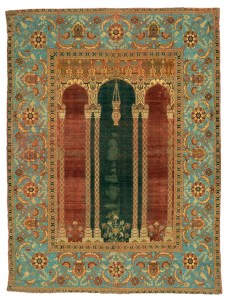
The translation below comes from a text I have previously written about here, the Futuvvatʹnāmah-ʼi Sultānī of Ḥusayn ibn ‘Alī Wāʻiẓ Kāshifī (c.1420-1504/5). For more information on the text and on the content of futuwwa/futuvva, see the above post. In this excerpt, Kāshifī deals with a topic that is not exclusively futuwwa or Sufi-oriented: the prayer-rug (sajjāda), a piece of liturgical equipment often emphasized by Sufis and Sufi-oriented futuwwa brotherhoods and guilds, but also by many other Muslims, both then and now. Kāshifī’s discussion of the prayer-rug is two-fold: one, he lays out the proper practice and behavior associated with the use of the prayer-rug; I have included a partial excerpt of these instructions. Second, he develops the prayer-rug as a mystical symbol, and spins practice-based implications out of those mystical symbols. The prayer-rug, already featuring a sort of cartography in its very design (see the illustration below and note 1), is given a further sacred cartography.

Kāshifī’s treatment of the prayer-rug, with his mix of practical regulation, mystical interpretation, and multiple layers of meaning (right down to mystical significances for the letters of words), is not unique to this one item. Rather, in previous chapters he explores the proper practice, mystical meanings, sacred origins, and scriptural justifications for all sorts of items: Sufi cloaks, futuwwa-belts, various types of clothing, headgear, and so on. As throughout the treatise, his language is generally quite accessible, with simple sentences and frequent translations of Qur’an and hadith texts (though not in this passage, curiously). Granted, as seen here, some of the language is deliberately esoteric, and might well have stumped some initiates (though perhaps also delighting them). The sources of mystical interpretations are diverse: here, for instance, religious legend, scripture, hadith, and Akbarian philosophic theology are all in evidence. The result is a text that contains an intersection of material culture, ‘popular’ religion, and ‘elite’ religious and mystical thought and practice: a text that we can reasonably imagine ‘ordinary’ Persian-speaking craftsmen and other workers, as well as more well-to-do people, reading and thinking about, perhaps in the course of their every-day prayers.

An example, from the late 1500s, of a prayer-rug, not unlike the sort our author would have used and had in mind in writing this passage.
A particularly fine example, from the late sixteenth century Ottoman Empire, of a prayer-rug, not unlike the sort our author would have used and had in mind in writing this passage. From the Metropolitan Museum of Art.

_______________

If one asks, What are the judgments regarding the prayer-rug and the mosque? Say to him: four: first, just as when one enters the mosque he puts enters with his right foot first, so, he puts his right foot on the prayer-rug first. Second, just as when one leaves the mosque he puts his left foot out first, so, when getting up from the prayer-rug one puts out his left foot first. Third, just as one does not speak of worldly things in the mosque, upon the prayer rug one also should not speak of worldly things save under necessity. Fourth, just as one should be continued occupied with remembrance [of God] in the mosque, so upon the prayer-rug one should be continually attached to remembrance, and speak words having to do with God and the Prophet.

If one asks, What are the pious customs regarding sitting upon the prayer-rug? Say to him: three: first, upon coming to the prayer-rug, one prays two raka’a, just as in performing prayer in the mosque. Second, sitting facing the qibla. Third, paying attention to proper practice.

If one asks, How many are the proper practices (ādāb) of prayer-rug sitting? Say to him: four: first, that one sit on two [bent] knees on the prayer-rug, though if necessary, the right leg can be brought up and the left leg stuck out. Second, that it not come to pass that his feet become barefooted. Third, that he not blow his nose or spit. Fourth, in like manner he should be prepared in regards to whatever comes into existence from him, be it in word or in deed.

If one asks, To what do the four corners of the prayer-rug symbolically point? Say to him: the right-hand miḥrab-corner[1] symbolically points to Gabriel, and the protected land and Mount Ḥira that is in it. And the left-hand miḥrab-corner symbolically points to Michael and to the Mount of the Fig. And the right-hand corner that is across from the miḥrab-corner symbolically points to Israfil and to the Mount of Olives. And the left-hand corner that is across from the miḥrab-corner symbolically points to ‘Azrael and to Mount Sina. God has brought together these places in this verse: By the fig, the olive, Mount Sina, and this protected land (Q. 95.1-3). For in each place one of the divine books was sent down. The Torah of Moses was sent down on Mount Sina, on the Mount of the Fig the Gospel descended to Jesus, on the Mount of Olives the Psalms of David were sent down, and on Mount Ḥira that is in the protect land the greater part of the Qur’an was sent down to our master [Muhammad].[2]

Thus, the four corners of the prayer-rug symbolically point to the four archangels, the four sacred books, and the four blessed places. Thus whoever sits upon the prayer-rug it is incumbent that he be steadfast like a firmly rooted mountain, not attracting the wayward breeze of the soul, until the effluence of the divine Book and Word comes to him, and he find the rank of divine proximity. Also: the bearers of the divine throne are the four angels to which the four corners of the prayer-rug symbolically point, meaning that upon the possessor of the prayer-rug it is incumbent that the throne of his own heart, that is [as described in the following verse]: the heart of the believer is the throne of God and the heart of the believer is the house of God,[3] must be stretched out by possessing the four attributes [see below] until he finds a portion of the cry of the throne-bearer, as God says: Those who bear the throne and from around Him they worship with praise of their Lord, believing in Him and seeking forgiveness for those who believe (Q.30.7).

If one asks, What are the four attributes by which the heart can become a bearer of the Throne? Say to him: first, faith in the various parts of the shari’ah; second, belief in the mysteries of the Way; third, turning to the mystical traces of God; fourth, being illumined by the lights of divine knowledge.

If one asks, To what do the letters [in the word] prayer-rug (sajjādeh) symbolically point?[4] Say to him: the letter sīn is for the traveling and wayfaring of the possessor of the prayer-rug in the world of ruling (malakūt). The letter jīm is for his striving and struggle in the observation of the lights of divine power. The alif is for the instruction in the manifestations of the degrees of divinity. The letter dāl is for the remembrance (dhikr, sic.) of the [divine] presence living, not dying. The letter is for the destruction of the lower-self attributes and the satanic ones in the straitening of the temporal world.

Futuvvat-nāmah-i sultānī, Ḥusayn Vāʻiẓ Kāshifī Sabzivārī, 197-9. Trans. Jonathan P. Allen, 2012. No rights reserved.


[1] A prayer rug (sajjāda, P. sajjādeh) of this period (and previous and later ones as well) would have a stylized miḥrab (prayer niche) on it; the top of the miḥrab (which I have translated here as the miḥrab-corner) would face the qibla. See the illustration above.

[2] This is a curious bit of exegesis. In a brief survey of Arabic exegetical literature I made in preparing this post I found many opinions corroborating the identification of the protected land as that around Mecca (and perhaps also Medina), however, the rest of our author’s interpretation seems to be idiosyncratic to him. However, I did not survey any Persian exegetical literature (a somewhat more laborious task, as little of it is online, unlike Arabic tafsir), which would perhaps be the place to look. I suspect some legendary material lies behind these significations.

[3] A hadith, not a Qur’an citation; it is given, however, in Arabic, without an accompanying Persian translation as is often Kāshifī’s wont.

[4] Our author frequently finds mystical signification in the letters of words, often, as here, by linking each letter to relatively complex concepts of post-Akbarian Sufism. I am not sure if the practice should be interpreted as mnemonic device (I somewhat doubt it) or simply as another way of layering mystical and religious meaning upon material and ideational objects—even if the meanings are not necessarily comprehended by everyone in the targeted audience.

The Beauty and the Sublimity, Winter and Summer

The following is a single discourse from a collection of discourses by the seventeenth century Ottoman Sufi mystic and scholar Ismāʿīl Ḥaḳḳī, featured previously on this blog here: Sufi Concision. It is a rather dense little piece, despite only being a couple paragraphs. I will keep my explication short, in part because I am reluctant to put words in the author’s mouth, and do not fully understand the lineaments and depths of his particularly cosmology and symbolic apparatus.

The central motif of this discourse is the contrast between manifestations of God’s beauty (al-jamāl) and His sublimity (aljalāl), a word that might also be translated as ‘majesty’ or ‘magnificence.’ The concept of a sort of dualism in God’s nature or manifestation of Himself had existed for some time in Sufi thought before Ibn ‘Arabi developed the idea into the form upon which our author here is drawing. The most explicit development of Ibn ‘Arabi’s thought on the beauty and the sublimity can be found in, not surprisingly, a short treatise titled Kitāb alJalāl wal-Jamāl, available in an English translation from the Ibn ‘Arabi Society. Therein Ibn ‘Arabi complicates previous ideas of God’s manifestations of beauty and majesty, arguing against a rather simplistic interpretation of those attributes and the ways in which they might be experienced by humans. Ismāʿīl Ḥaḳḳī picks up this ‘complication’ of the attributes, and extends Ibn ‘Arabi’s original conception into the cosmological interactions of humans, nature, revelation, and God.

There appeared to me regarding [Muhammad’s] words, Winter is the spoils of the believer, that the most important of affairs for the perfect among the believers is the matter of religion, not the matter of this world. And winter aids in the realization of the latter matter, in that days are shorter and nights longer. For the shortening of nights makes fasting easier, while the lengthening of nights makes standing [in prayer] easier—in variance with summer, as the days are longer and the heat stronger, forbidding the aforementioned benefits. Sleep has the ascendency during summer nights due to their shortness and the languor of bodies [due to summer heat].

So know that summer is the site of the manifestation of God’s Beauty (al-jamāl) in deed in regards to outward form (min ḥaythu al-ṣūrah), however, in it is God’s Sublimity (jalāl) in potency in regards to inner meaning (alma’inā). But when earthquakes, violent storms, lightning strikes, and their like, occur in the summer, and as for winter in general, then it is the opposite: the Sublimity is manifest exteriorly, while the Beauty is manifest interiorly. Therefore, there does not occur in it what occurs in the summer as aforementioned. And in the nature of winter is a advantageous benefit which points to the fact that the perfect believer, whenever trial or trouble befalls him in regards to himself, to his possessions, or to his family, he takes advantage of that situation and recoups benefit. For if under every misfortune is another misfortune, on the contrary, the perfect one is he who finds sweetness in the Sublimity like that which he finds in the Beauty. And if not, then he is incomplete [in his mystical realization], because all that occurs is from God, and what is from God is not bitter to the true enraptured lover of God. It is the custom (sunnah) of God to first instruct someone through the Beauty, and if the person does not thus become aware of Him, He instructs him through the Sublimity. And if he does then become aware of Him, He uproots him—we take refuge in God from that and from all which is merely exterior.

The one who seeks ascension finds it in repentance and in the manifestation of his incapacity, not elsewhere. God possesses people who serve Him in hardship and ease equally—so look into what leads to Him: their perfect knowledge and complete tranquility of soul.

Ismāʿīl Ḥaḳḳī (1063/1652-1137/1725)

A Moving Experience

Sufism, particularly in its more ecstatic and speculative forms, was not universally admired in the Ottoman world (or in the contemporary world, for that matter). Opposition to particular Sufi practices and doctrines, or Sufism as a whole, could come from various quarters, whether from the ranks of the learned elite or from the pious masses. In the short story below, taken from Aḥmad ibn Muṣṭafá  Tāshkubrīʹzādah’s biographical dictionary (a frequent contributor to this blog in recent days, regular readers will notice), we see both the tenor this opposition could take, and an instance of a rather dramatic conversion from an anti-Sufi stance (or, at least, anti-ecstatic Sufism). The story mostly speaks for itself. A couple of things are a little less obvious perhaps: one, note that the Sufi shaykh featured here is described as only having a Turkish name, unlike the majority of people featured in Tāshkubrīʹzādah’s collection. Does this indicate a rural origin, or perhaps outsider status vis-a-vis the ‘learned hierarchy’ of Istanbul and the rest of the empire? Why does Tāshkubrīʹzādah give only this one anecdote for substantial content of this shaykh’s life? I’m not sure. Ottoman Sufism and religion in general is an area of study I’m still very much a novice in; I might also add, my transcription of the Turkish shaykh’s name is a contingent guess for now. I have but lately begun studying Ottoman Turkish, and will probably come back and modify my transcription in time to something more accurate.

Among them, the Knower of God, Shaykh Sūndīk known as Qūghejēdede: He was a master of great divine ecstasies, sunnaic states, and performed miracles.

It is related that he met with Mullah al-Karamāsī—the qāḍī of Constantinople[1]—along with Mullah Ḥamīd al-Dīn ibn Afḍal al-Dīn, who was at the time a mufti. Mullah al-Karamāsī complained to him regarding the Sufism of the age, in that they danced and entered trance-states during dhikr,[2] which was in disagreement with the shari’a. So Mullah ibn Afḍal al-Dīn said to Mullah al-Karamāsī that their leader was this shaykh, pointing to Qūghejēdede, and said: If you make him sound, all will be sound. At that Mullah al-Karamāsī stood up and took Qūghejēdede to his house and fetched his disciples [of Qūghejēdede], and prepared food for them. After finishing the food, he said to them: ‘Sit, and practice your remembrance (dhikr) of God in propriety, sobriety, and silence!’ They said: ‘We will do that.’ Then, when they began their dhikr, Qūghejēdede shouted very loudly in Mullah al-Karamāsī’s ear, so that the Mullah stood up, threw off his turban from his head[3] and his outer robe from his shoulders, and began dancing and entered a trance-state until an entire third of the day had passed. When the Mullah’s disturbance had stilled, Qūghejēdede sad: ‘For what were you so disturbed, O Mullah—and you had said it was evil?’ The Mullah replied: ‘I repent! And I revoke before God that rejection [of Sufism], and I will never return to it!’

The aforementioned shaykh died in the city of Constantinople and was buried in it—God hallow his mystery (sirrahu).

Aḥmad ibn Muṣṭafá  Ṭāshkubrīʹzādah, Al-Shaqāʼiq Al-Nuʻmānīyah Fī ʻulāmāʼ Al-Dawlah Al-ʻUthmānīyah (Bayrūt, Lubnān: Dār al-Kitāb al-ʻArabī, 1975), 220-1. Translation by Jonathan P. Allen, 2012. No rights reserved.


[1] That is, the chief judge of Constantinople/Istanbul.

[2] Dhikr—literally, ‘remembrance’—is a Sufi practice in which the name of God or certain short devotional phrases or prayers are uttered (either vocally or silently/mentally) in succession, over and over, sometimes leading up to a trance-like state (though not in all forms of dhikr).

[3] An action strongly indicating abandonment of propriety and self-control.

Sufi Concision

One of the most prolific Sufi masters and authors to live in the Ottoman Empire was a Turkish mystic and scholar named Ismāʿīl Ḥaqqī (1063-1133/1652-1725), who spent his childhood near Edirne, then received his education in Edirne and Istanbul. After several years of traveling to various corners of the empire, he settled down in Bursa, where he lived as a Sufi master and teacher and eventually head of the Jilwatiyya order. Besides his training in the Sufi path, Ismāʿīl Ḥaqqī received, and deployed in the course of his career, a broad education, from philosophy and music to Qur’anic exegesis and Persian poetry. He wrote a great deal- some 104 works, a majority in Turkish, though with a sizeable number in Arabic. The excerpt below comes from his primarily Arabic (with a little Persian mixed in) Qur’an tafsīr, the Rūḥ al-bayān, a multi-volume work that stands out as a quite original and often creative endeavor. Philosophy, mysticism, grammatical science, hadith, and many other components all make up this major work, which, so far as I know, has received little notice from Western scholars.

The excerpt below represents an aspect of Ismāʿīl Ḥaqqī’s tafsīr that I think might well be unique to him (though of course I could be quite wrong on that, so don’t quote me on this!); if not unique, it still stands out as unusual and rare. After providing a somewhat eclectic but largely ‘exoteric’ interpretation of the first few verse of Sura al-Hūd, Ismāʿīl Ḥaqqī presents a lemma-by-lemma ‘mystical’ commentary that is highly abbreviated, similar to the concise, abbreviated ‘exoteric’ commentaries that were especially popular in the Ottoman realms (see Bayḍawī’s relatively short commentary, the Tafsīr Anwār al-Tanzīl wa Asrār al-Ta’wīl, for an example). He titles these sections Stellar Interpretations, a phrase which immediately calls to mind mystical modes of exegesis (see note one below). Whereas most Sufi commentaries dealt with particular verses or blocks of verses, our author works through each lemma and line, integrating the whole of the text into a concise Sufic interpretation. What is the logic of such an approach? Perhaps Ismāʿīl Ḥaqqī wishes to demonstrate the complete compatibility of the Qur’anic text with the Sufi path and Sufi doctrine. Against naysayers who might wish to contest the Qur’anic quality of Sufism (and especially the ibn ‘Arabi influenced Sufism someone like Ismāʿīl Ḥaqqī espoused), our author presents a lemma-by-lemma reading of the scriptural text that uncovers Sufi belief and practice consistently and clearly, with little metaphysical or rhetorical maneuvering.

Alif-Lam-Ra: A Book whose verses were established, then were set forth in detail, from the Presence, Wise, Knowing. Serve none save God; I am to you from Him a warning, and good news. And you that seek forvgiveness of your Lord, then turn to Him, He gives you enjoyable provision to an appointed term. And there comes to every possessor of grace His grace. And if you turn back, then I fear for you the punishment of a great Day. To God you return, and He is over everything powerful.

And in the Stellar Interpretation [1] (al-ta’wīlāt al-najmiyya): Alif-lam-ra: the alif points to God (Allāh), the lam, to Gabriel, and the ra, to the Prophet (al-rasūl). A Book whose verses were established: meaning the Qur’an, a book whose verse are established by wise ordinance, as His words say: He makes you to know the Book and wisdom. So the Book is the Qur’an, and the wisdom is the realities, the meanings, and the mysteries that are incorporated in its verses. Then were set forth in detail: that is, these realities and wisdoms were made evident to the hearts of the gnostics. From the presence of [the] Wise: He deposited in [the Qur’an] the overwhelming wisdom which no one else is capable of depositing in it, and this is a mystery from among the mysteries of the inimitability (i’jāz) of the Qur’an. Knowing: over the instruction of those things from His presence to whomever He wills among His servants, as His words say: Then they found one of Our servants, unto whom We had brought mercy from Us and had taught him knowledge from Our Presence (Q. 18.65). Pointing out that the Qur’an has an exterior which the grammarians (ahl al-lugha) know about, and an interior which only the lords of hearts whom God has graced with knowledge from the Presence know about. And the summit of wisdom and its mystery is that you say: O Muhammad, what relates to you will not perish [?]. Serve none save God: that is, do not serve Satan, the world, the passions, nor what is other than God. I am to you from Him a warning: I warn you against being cut off from God, you that serve, obey, or love other than God; and the punishment of the servant is in Gehenna. And good news: I give you good news of mystical union and the graces of reunion [with God] in the house of magnificence, you that you serve Him and obey Him and love Him.

And the Prophet is specified by the call to God from among the prophets and the messengers, as indicated by His words: O Prophet, We sent you as a witness, a herald, a warning, and a caller to God by His permission (Q. 33.45). And you that seek forgiveness of your Lord: from what causes you to slip during the days of your lives into seeking other than God and the abandonment of seeking Him, and the occurrence of veiling [from God] and the vanities of people’s natural dispositions—for the seeking of of forgiveness is purification for your souls and cleansing for your hearts. Then turn to Him: return by preceding along the practice of wayfaring to God, so that repentance be a ornamentation for you after the purification of seeking forgiveness, per His words: He gives you enjoyable provision: the raising in stations from the low to the high, and from the high to the presence of the Exalted, the Great. To an appointed time: the termination of the stations of wayfaring (sulūk) and the beginning of the degrees of union. And there comes to every possessor of grace: possessor of truthfulness and struggle in the seeking. His grace: in the degrees of union; the witnessings are in accordance with the measure of the struggles. And if you turn back: to turn away from the seeking and the journey to God. Then (fa-): Say: I fear for you punishment of a great Day: the punishment of the Day of the cutting off from God, the Great—He is the greatest of the great, and His punishment is the hardest of strikings. To God you return: voluntarily or with detestation. If voluntarily, He will draw near to you with the utmost of attractions, as He said [in a ḥadīth qudsī: Whoever draws near to Me an inch, I will draw near to him a cubit. If with detestation, you deserve to be in the fire upon your faces. And He is over every thing: in both kindness and victorious might: powerful.

Ismāʿīl Ḥaqqī, Rūḥ al-bayān, Volume 4, 93-94.


[1] Ta’wīlāt is a somewhat ambiguous word: it can mean simply ‘commentary’ or ‘intepretation’; it can mean ‘commentary by personal opinion,’ with a negative sense attached to it; or it can stand for ‘mystical’ interpretation. Here it would seem to entail aspects of all three meanings, though without any negative sense attached to it.

The Traces of Reverent Fear

The sixteenth-century Ottoman scholar Aḥmad ibn Muṣṭafá Ṭāshkubrīʹzādah‘s biographical work, Al-Shaqāʼiq Al-Nuʻmānīyah Fī ʻulāmāʼ Al-Dawlah Al-ʻUthmānīyah, is full of fascinating lives and vignettes, dealing with all sorts of people within the Ottoman realms, from powerful judges to humble rural mystics. While many of his entries are perfunctory, giving only basic data and usually some nice words about the subject’s piety, other entries include short stories, relate sayings or teachings of the person under discussion, and sometimes include observations from the author’s own personal experience. In the case of the following short life, we get most of those things, albeit in a short space. We see, among other things, the sort of spiritual and social capital and cache a single Sufi could draw upon, touching everyone from a young Ṭāshkubrīʹzādah to a burnt-out scholar to the Sultan himself.

Among them, the Knower of God the Exalted, Shaykh Muṣlaḥ al-Dīn al-Ṭawīl:

He was from the rural district of Naḥḥās in the province of Kastamonu. At first, he busied himself with exalted knowledge (al-‘ilm ash-sharīf)[1] and was well-known by virtue of his reception among the learned men of his time. Then love for Sufism arose in him, and he made the rounds among the shaykhs of his time, until he settled upon Shaykh al-Alhī, and persisted in his service until [the shaykh] died. In his presence he joined the Sufi path and achieved the furthest perfection. He was cut off from the people, stripped of the states of the world, without inclination towards the customs of the people. One saw in his outward visage the traces of reverent fear and sublimity, though he was in companionship kind and beautiful. As a child I saw him, and he brought about in me great reverent fear, and this reverent fear is in my heart up to the present.

He wrote an epistle in the time of the Sultan Bayazīd Khān and sent it to him, mentioning therein relinquishment from the throne and the chair. He mentioned in its conclusion that if there befell injustice in any region among the various regions, the upright people of that region would see in their dreams the Prophet, peace and prayer of God be upon him, sorrowing. And the upright people of the rural district of Naḥḥās saw the Prophet, peace and prayer of God be upon him, sorrowing, so they kept watch and found in that region great injustice. That injustice was described, and Sultan Bayazīd Khān lifted that injustice from the people of that region.

And it is related about one of the members of the learned class, that he said: I went into his [Shaykh Muṣlaḥ al-Dīn al-Ṭawīl] service once, and said: I want to abandon this path. He said: Which path? I replied: [That of] knowledge (‘ilm). He replied: Have you found a better path? Then he was silent. Then he said to those present: Do you know Sinān Jalabī al-Karmiyya’ī? They replied, Yes, we know him. He said: How do you know him? They replied, He’s an excellent judge. He said: He is a most perfect person of the Sufi path—but none of you know this his state! The one who has exalted intention perfects the path, be he a judge or a professor, though no one is aware of it, but he who does not have exalted intention, his lower self spurs him on to abandoning the path of knowledge, but that will not be made possible for him, and he is forbidden from the Path.

Among his many mystical states was [the following occurrence]: he unrolled his mat in a place close to the grave of Shaykh Tāj al-Dīn in the city of Bursa, and he recited Surah Ya-Sin every morning for forty days, and when those forty days were completed, he died, and was in buried in the place of that mat, his secret be sanctified.

Aḥmad ibn Muṣṭafá  Ṭāshkubrīʹzādah, Al-Shaqāʼiq Al-Nuʻmānīyah Fī ʻulāmāʼ Al-Dawlah Al-ʻUthmānīyah (Bayrūt, Lubnān: Dār al-Kitāb al-ʻArabī, 1975), 217-218. Trans. Jonathan Allen, 2012. No rights reserved.


[1] ‘Ilm here means the study of things such as jurisprudence (primarily), hadith, grammar, rhetoric, and so on- the standard curriculum of an Ottoman madrasa; it might most accurately be translated ‘exoteric knoweldge.’It is commonly contrasted with ma’rifa, or esoteric knowledge, also, perhaps most accurately, translated as ‘gnosis,’ which focuses on the personal, experiential nature of this knowledge, as opposed to ‘ilm, which is transmitted and standardized.