Agrarian Indie Music & A Couple Other Items

You might want to give a listen to this guy, who sounds like I would imagine a younger Wendell Berry if he played indie folk: Chris Dorman.

Also, while not agrarianish exactly, but still producers of the sort of music that befits a genuine culture of life, one of my perennially favorite bands, Anathallo, has a new album out next week that will no doubt be really wonderful and everyone should give a listen to.

And while I’m on the subject of music, this album, new(ish) to me, is one of the most beautiful albums of any sort I have listened to in some time. It’s a recording of a collaboration, in Terhan, between Hossein Alizadeh of Iran and Djivan Gasparyan of Armenia, and both musicians are world-class masters.

At the Time of Prayer

O Christ who are covered with light as though with garment, who for my sake stood naked in front of Pilate, clothe me with that might which you caused to overshadow the saints, whereby they conquered this world of struggle. May your Divinity, Lord, take pleasure in me, and lead me above the world to be with you. O Christ, upon you the many-eyed Cherubim are unable to look because of the glory of your countenance, yet out of your love you recieved spit upon your face: remove the shame from my face and grant an open face before you at the time of prayer.

St. Isaac the Syrian

Rainy Day in Sefrou

Sefrou is a fairly small town south of Fes, placed between the grand valley of Fes and the Middle Atlas. One approaches Sefrou from Fes through rolling groves of olives, mostly, the citadel-shaped mountain that stands guard over the town drawing closer and closer. The town itself sits in a little valley, with the rolling expanse of the Middle Atlas spreading behind; a stream drops down from the hills alongside, over a lovely little (and much locally celebrated) waterfall, and through the Old Medina (where it serves pretty much as a garbage chute, unfortunately). The entire time I was in Morocco this little river was full of water, and Sefrou and its surronding countryside was incredibly green. Walking around the edge of town I was always struck by how incongrous all the greenery- oaks and ivy even!- was in comparison to the usual image of North Africa as all desert and barren mountains: a far cry from reality.

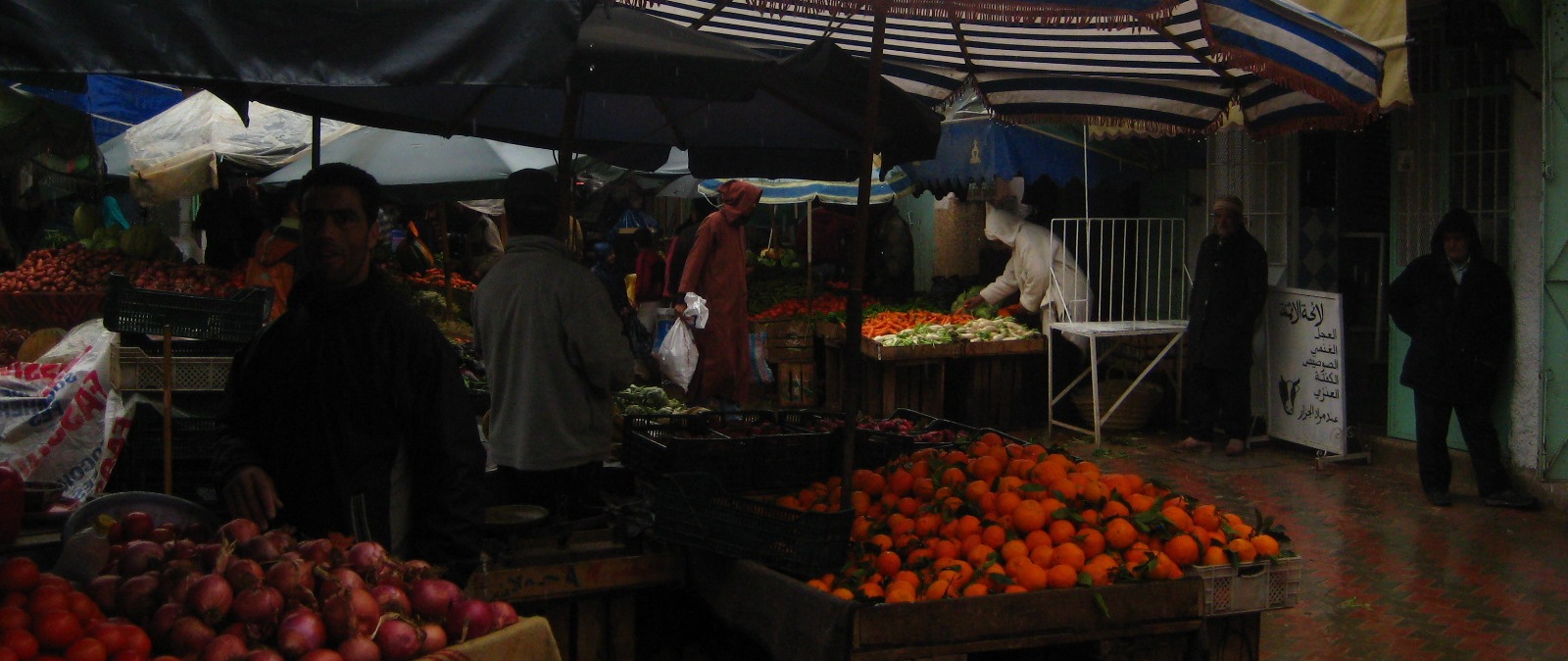
Nor is it all sunshine and heat, as this set of photos relates. I took them on my first full day in Morocco- a wet, cold, and continually rainy day. I had spent the night in Fes after taking a plane to Tangier and then train to Fes; after checking in with the Arabic institute in the morning I trudged through the rain, down the street past Fes’ regal McDonalds, and confidently got in a grand-taxi bound for Sefrou. When I arrived, the rain that had harried me on my trek to the grand-taxi stand in Fes was still pouring down, so I sat in my little hotel room and looked out the window, wondering if had in fact ended up not in North Africa but perhaps England or Ireland. After a while I could stand no more sitting about, so I put on my raincoat and set out into the little medina, where I got lost (not for long- it’s hard to stay lost in Sefrou’s diminutive medina) and thoroughly drenched. In the meanwhile I took these photos, which are a bit drab, thanks to the rain, and work-a-day in their subject matter, I suppose. However, as I was looking back over this set today- inspired by the advent of cool, rainy weather here in Tennessee- I thought that they give a nice snapshot of ordinary medina life, and all the wonderful colours and shapes you can see, and perhaps a hint of the sounds and tastes and smells and feelings attendent to the seen things: the marvelously rich- moreso than any other urban place I’ve visited in the world- sensory experience of the Moroccan medina.

This is probably in the Mellah, the Jewish Quarter- Sefrou’s old Mellah takes up nearly half the Medina, though only a handful, if any Jews, now live there.

The robes some of the men in the photos have on are jellabas, the traditional, and quite functional, Moroccan outerwear.

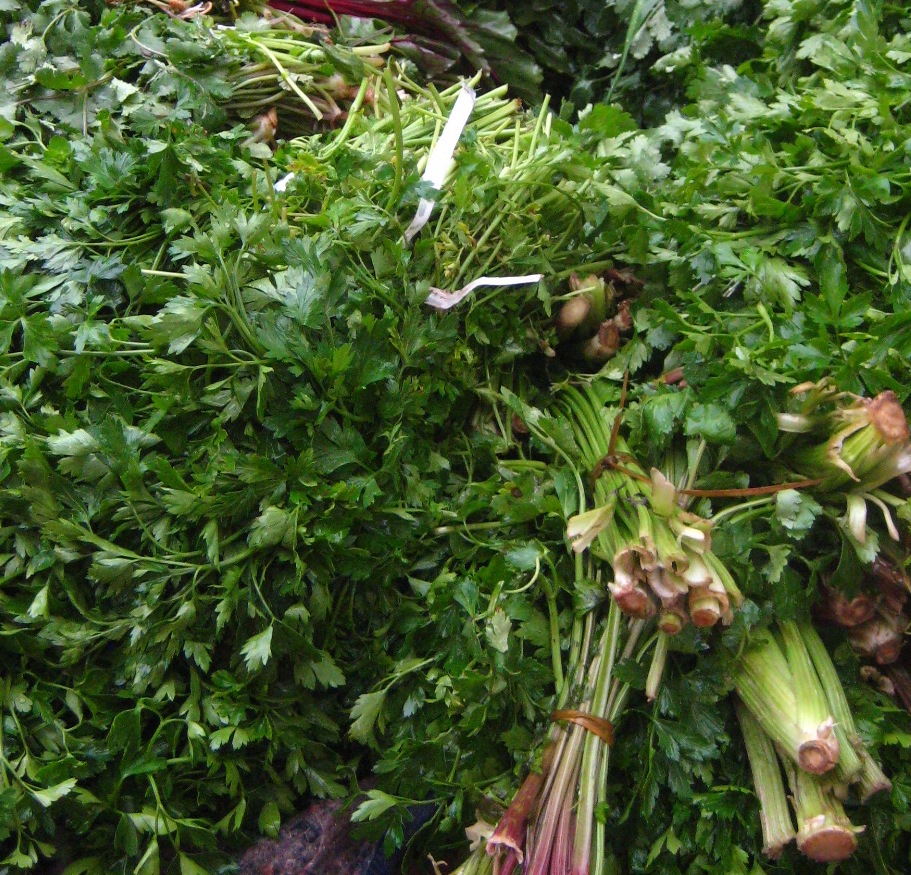
In the always wonderful and aromatic (particularly compared to the meat sellers stalls…) vegetable and herb section of the suqs.

Along the outside of the walls, on the north side of the Medina.

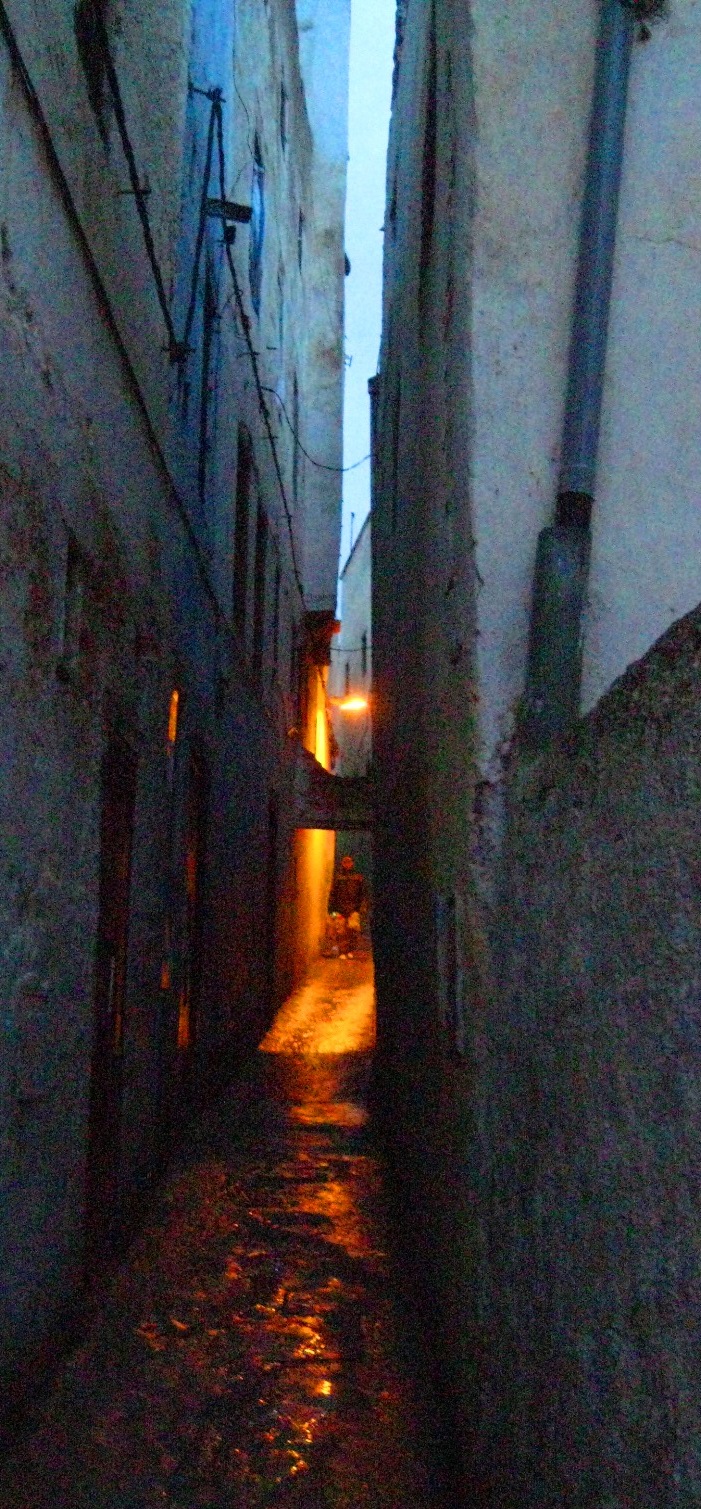
In the evening, in one of the ridiculously narrow streets of the Mellah part of the Medina. It was rather cold by now, and I did not, alas, possess.

Islamic Iconography From Fes

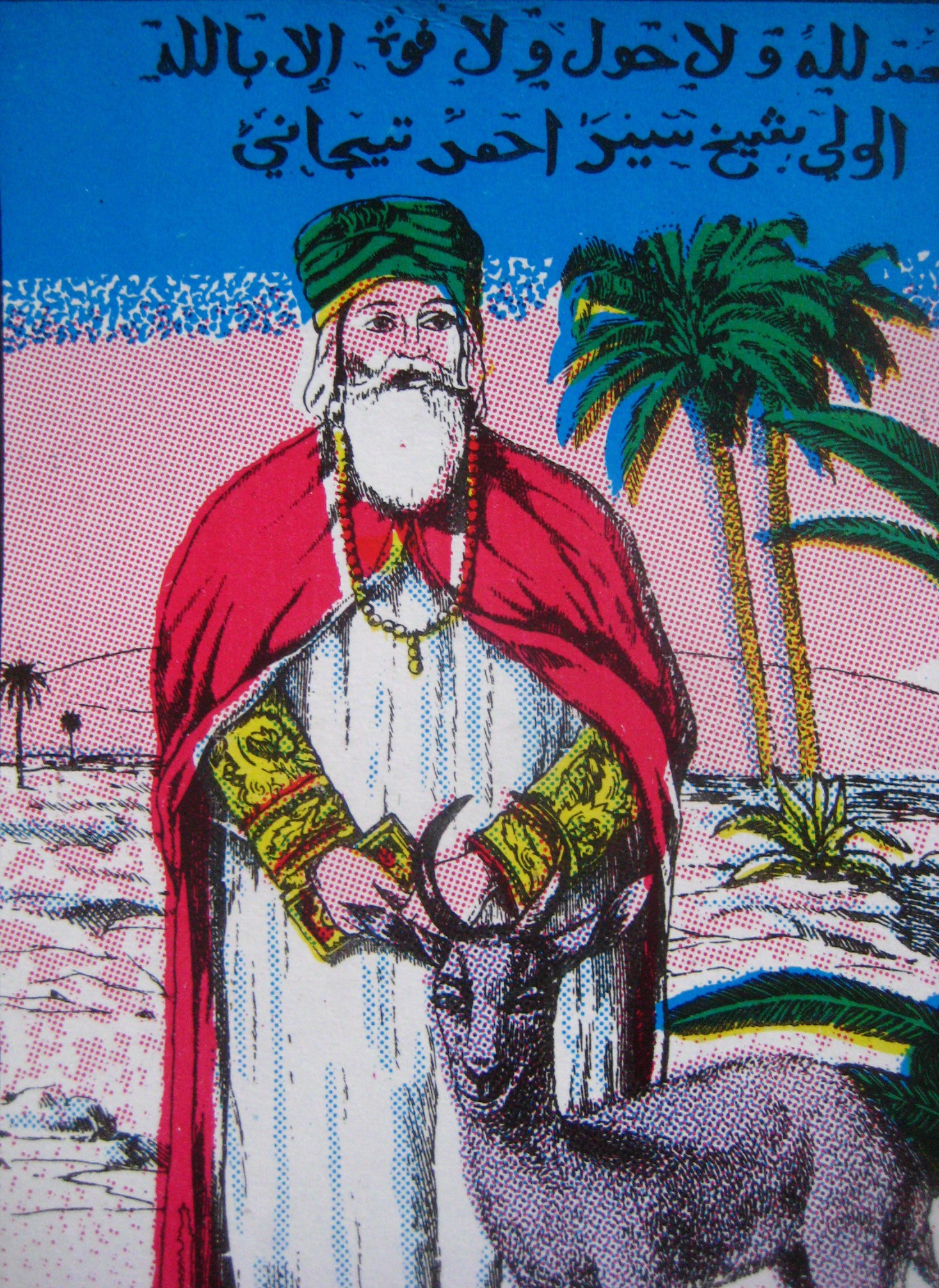
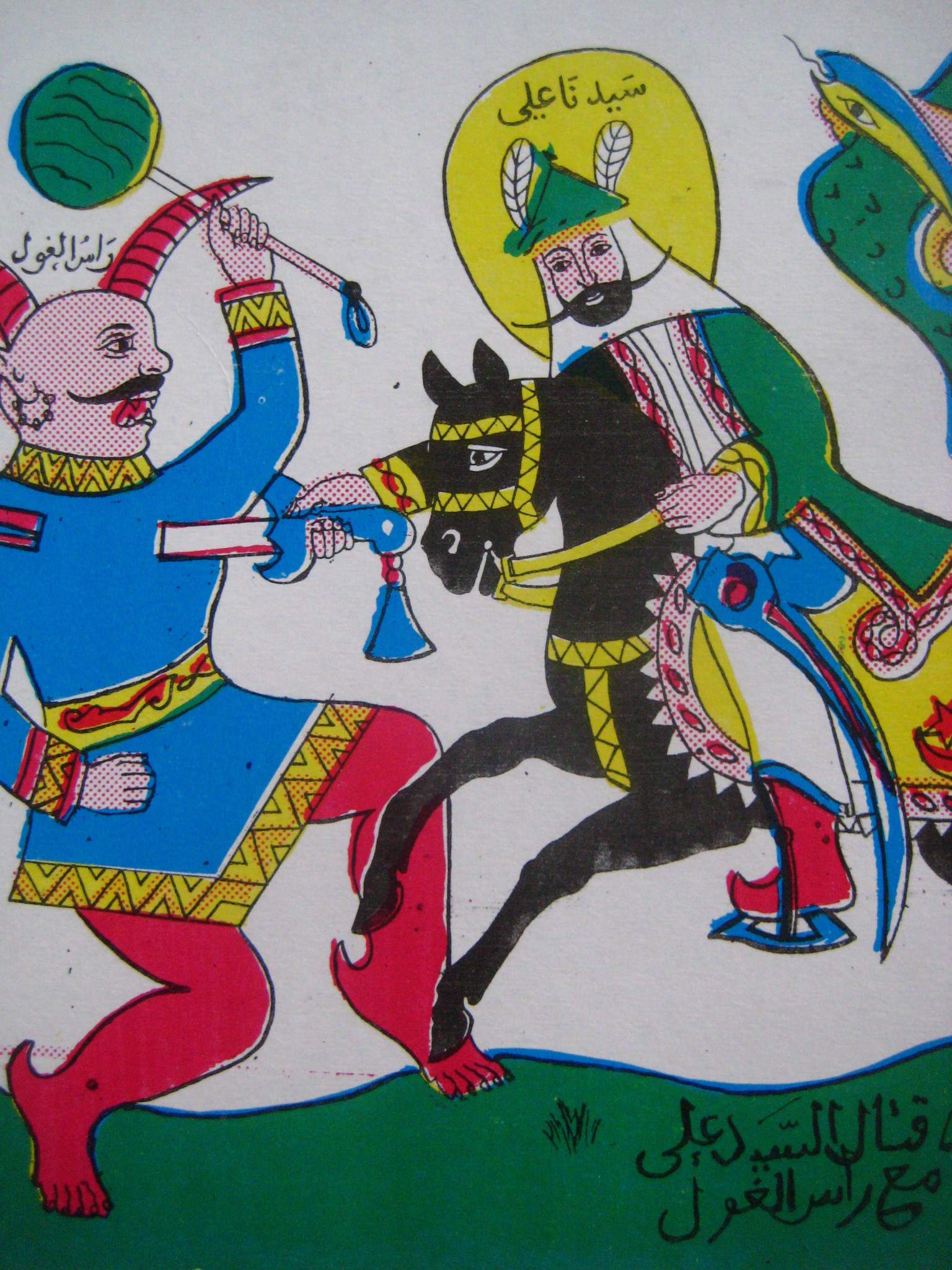
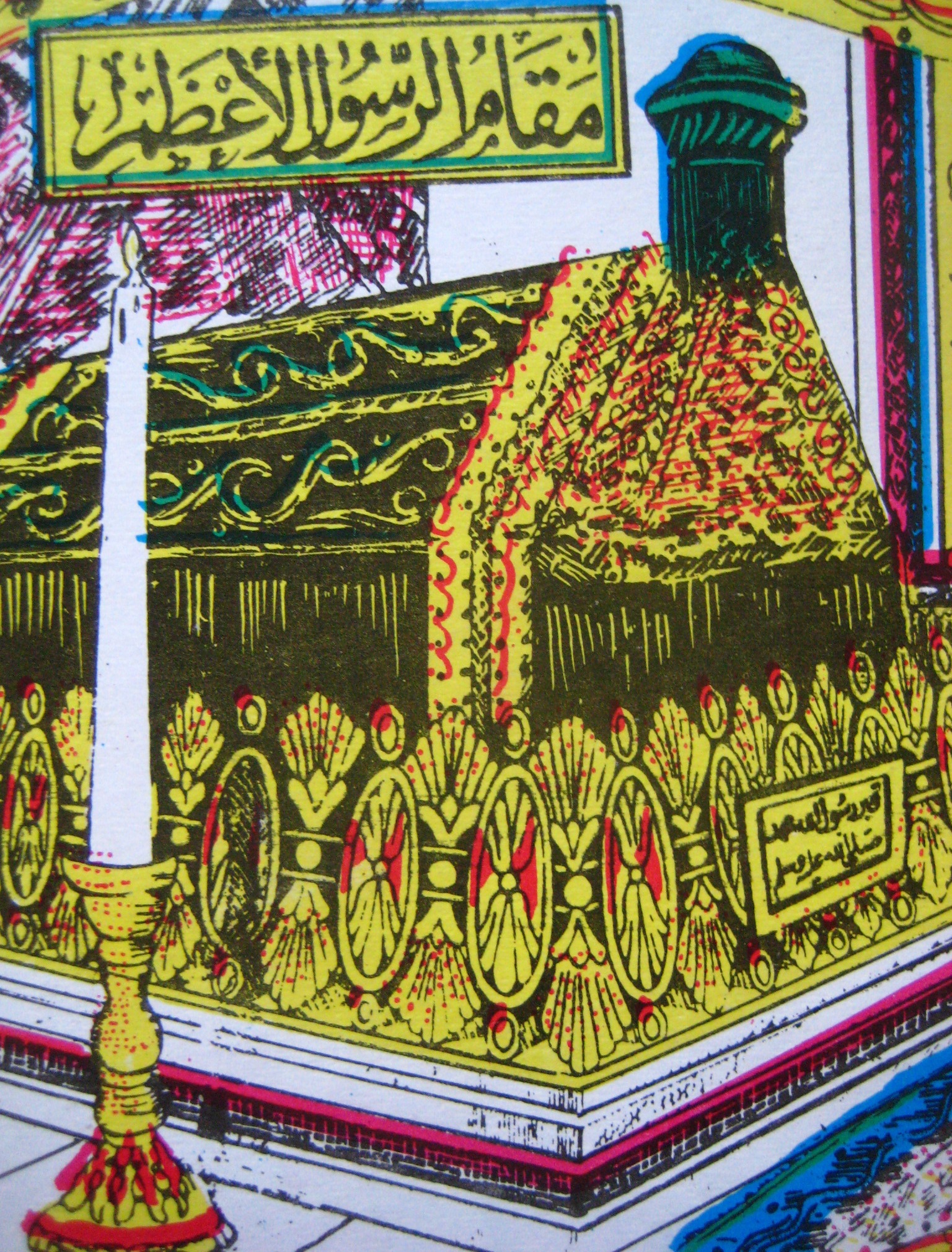
The images below come from a card-stock poster I found at a miniature flea-market of sorts an elderly Fassi would hold pretty regularly on the north side of the Qarawiyyin Mosque. He had, among other things, a couple other similar posters, along with random booklets, magazines, spoons and forks, and various trinkets and odds and ends. The iconography is what caught my eye- while iconography of various kinds is common enough in Morocco, this particular example stood out for its colorfulness and the sheer volume of visual activity in one piece of card-stock. I don’t know the origin or the history of this document, other than that it was probably produced in Fes, as one of the scenes is of Ahmad al-Tijani, whose zaouia is only a few streets over from al-Qarawiyyin.

Ahmad al-Tijani, on of the most prominent saints in Fes these days. His zaouia is particularly popular with pilgrims making the Hajj coming from West Africa. The Arabic text next to the picture- not pictured here- reads: ‘The sheik Saint Ahmad al-Tijani was a man virtuous, pious and (qūran– not sure of this word), a Sufi and the sheik of the brotherhood (ţariqa) that traces its origin to him.  Originally from Algeria, he immigrated to the city of Fes and adopted it as his residence. Many followed after him in Morocco and in black Africa. Finally, he died in the city of Fes around the year 1165 of the Hajira and was buried in it; God have mercy on him.’

A scene depicting ‘The battle of Said ‘Ali with Ra’s al-Ghul (the demon’s head, al-ghul being the source of the English word ghoul, incidentally).’ The caption inside of Ali’s halo reads ‘our master (saiduna) ‘Ali.’  John Renard writes concerning this particular iconographic subject: ‘Pictures of ‘Ali engaged in combat against the demon of woeful countenance known as Ra’s al-Ghul are among the most prominent North African examples of this first type [images of religious heroes]. Here Muhammad’s son-in-law displays the essential trait of the religious hero, willingness to engage the forces of evil and injustice. ‘Ali usually dispatches the demon with a stroke of his forked sword, Dhu ‘l-Faqar (the cleaver), which he inherited from Muhammad. The sword provides a natural iconographic clue to the hero’s identity.’ (Seven Doors to Islam, pp. 97-8)

‘Ali, along with his two sons, is also featured in another panel on the poster, with ‘Ali seated and his sons standing next to him- not nearly as exciting as the one above. If you are at all familiar with Islam you will probably be aware that veneration of ‘Ali is most often associated with Shia Islam; however, Sufism in general from its initial stages had a high place for ‘Ali, and continues to do so in various forms. This is especially true in North Africa: ‘North African tradition, particularly in Tunisia, regards ‘Ali as a high exemplar for youth. He was “the first adolescent to have embraced the new religion without ever having previously bowed down to any idol or worshipped a deity other than God.” ‘Ali is morever the father of two sons who model ideal behavior for young people. Before they were martyrs, Hasan and Husayn were children of a heroic father. And as youthful martyrs, the two embody innocence and purity standing firm in the face of evil.’ (Ibid.)

Here we have a picture of the tomb of Muhammad, ‘the exalted prophet’ according to the text above the tomb. Obviously, this an image that would resonate all across the Islamic world, though I suspect it has a special resonance in North Africa where the tombs of saints are particularly important as sources of baraka, blessing/grace/power.

One more- the famous Buraq, the winged creature that features in the story of Muhammad’s Night Journey.

St. Moses the Ethiopian

Today is the feast-day of St. Moses, who had led a life of crime and violence before renouncing the sword and entering a monastery in the Egyptian wilderness. Thinking about his story and his example makes me wonder- how do we renounce the violence and injustice in our lives? Sure, I might not be going around beating people up and stealing their money literally, but what am I doing- or not doing- that perpetuates violence, whether it is through my unforgiveness, or resentment, or my lack of concern and love. That, and how much are we culpable for participating in the unjust structures we live in? The other night I was re-reading the book of Revelations, as part of a class assignment actually, and in doing so I was struck by how incredibly political the book is. God judges the systems and ways of the world- a world that is bloated with injustice, with greed and consumption, not just of goods and capital, but of humans. The saints are called out of that system, out of that world- they refuse to participate in it, and for that they suffer. Those who refuse the mark of the beast- participation in the evil and injustice of the world- suffer for it.

I thought while reading, how do we refuse that injustice, how do we refuse to take the mark of the beast, as it were, while living lives in the world? How do we reject the callous and bloodthirsty ways of the world- what is the correct path? Does the fact that I pay taxes, for example, make me complicit in the wars and intrigues of the government I thereby support? What I am going to tell Christ when He asks about the homeless living a mile from my house, the panhandlers I meet on the sidewalks and do my best to get away from? Sorry, Lord, they were the wrong sort of poor? I’m sorry, God, I disagreed intellectually with the evil I ignored/was complicit in. Will that cut it? For St. Moses, living a life of Christ’s peace in the world was, in some ways, very straightforward- he put down the sword, literally. In a less obvious way, he taught and modeled forgiveness, the root of the peace of Christ. There is a story in which a brother is brought before the community for judgment; St. Moses comes to the church carrying a jar of water with holes in it. The brothers ask about it, and he replies, my sins are like water- they run out behind me and I cannot number them. How am I to judge my brother here then?

He lived the life of Christ’s peace and forgiveness, of his rejection of the methods and systems of the world. He, like Christ, died- not just the death to the flesh, to the ways of the world, but literally. What are we called to? What am I called to in this place I live, in this city, now, to live in a concrete, painful if need be, the life of Christ, the Prince of Peace, in a world of war and hate and violence? That is the struggle- and it is the most important thing, to live-in-Christ, here, now. St. Moses, pray for us who live in a world of drawn swords and angry hearts- pray that we would be blessed with the wisdom and the peace of Christ, our God.

Troparion (Tone 1)

You made the wilderness your dwelling, O our Father Moses, the Bearer of God; you became an angel in the flesh and a wonderworker. Through fasts, vigils, and prayers, you obtained from God special graces to heal the sick and sanctify the souls of those who come to you with trust. Glory to the one who gave you strength! Glory to the one who crowned you! Glory to the one who, through your intercession, grants healing to all!

Theodore Abū Qurrah on the Veneration of Icons

Theodore Abū Qurrah was the first Christian writer whose name has come down to us to write in Arabic. As such, he is particularly interesting for his early approach to presenting Christian theology and praxis in an environment that had already become heavily Islamicized by his lifetime (755-830 AD) a hundred years after the Arab conquest and the establishment of the Umayyid state in Syria. One of the changes Abū Qurrah dealt with in his writings was the change in Christian attitude towards icons, or, more specifically, the public veneration of icons in church. In early Islam particularly, depictions of humans was, if not completely proscribed, considered with extreme suspicion if not outright declaration of being forbidden. While this attitude has hardly ever really been universal, and is by no means universal now (while in Fes I purchased a wonderful poster of scenes from the Qu’ran and Islamic legend, plus a local saint, which I will eventually get around to scanning onto my computer and posting one of these days, ان شاء الله), the iconoclastic current of Islam has always been strong, and was particularly hostile to Christian iconography in Abū Qurrah’s day.

More specifically, Christians were being mocked by their Muslim neighbors, and accused of being idolatrous, because of their veneration of icons. Now, granted, being mocked and insulted is a hardly out and out persecution, but in a miliue that had become heavily Islamicized, and with Muslims occupying the highest positions, this sort of mockery had a deep impact. Plus, Christianity had already undergone the massive shock of Islamic conquest, which by itself tended to weaken the hold of Christian dogma on the masses. Mocking icons and calling them idols was only one more element in the weakening and dissolution of Christianity as a popular religion (something Abū Qurrah states in his defense of icons in fact). Not only were icons themselves mocked, but the depiction of Christ crucified was a particular object of scorn, as the Qur’an states very explicitly that Christ was not crucified, and for Sunni Islam the crucifixion is very incongruous with the way God is expected to act (Shia Islam, on the other hand, very much embraces the idea of redemptive suffering and shame, but that is another story).

How Abū Qurrah responds to the charges regarding Christ and the seeming foolishness and weakness evidenced in the Christian account is fascinating- he embraces the seeming absurdity of Christian doctrine- but here I would like to draw attention to a passage from his work ‘A Treatise on the Veneration of the Holy Icons’ (translated by Sidney Griffith) in which he deals with icons, and, more specifically, the veneration offered to them. The passage is noteworthy because he seeks to establish analogies within both Judaism (his preferred, and generally safer, debate partner throughout this particular polemic) and Islam for Christian practice. After establishing Jewish and Islamic parallels or analogies he goes on to describe Christian practice, thereby attempting to remove some of the distance between the three faiths- and hence somewhat reduce the polemical sting and weight of arguments against Christianity (since he is hardly attempting some sort of ecumenical unity or agreement). However, in this brief passage there is a good example of what Abū Qurrah is doing- reproducing earlier arguments (St. John of Damascus is continually in the background) and re-contextualizing them in the new Islamic environment.

From Chapter XI: ‘It is inevitable that the act of prostration goes to what the intention has in mind in the flexing of the knees, putting down the forehead, and the direction one faces. Since this is so, anyone with a question should understand that Jacob made a prostration on Joseph’s staff, intending thereby to honor Joseph… So too we Christians, when we make prostration in front of an icon of Christ or of the saints, our prostration is certainly not to the panels or to the colors. Rather, it is only to Christ, to whom every kind of act of prostration is due, and to the saints to whom it is due by way of honor.

‘One should also recall what we said about everyone who makes a prostration to God; his two knees touch but the ground or a carpet, yet his prostration is conveyed only according to what he intends- to make an act of prostration to God.

‘It is the same with the Christians; their touching the icon in the process of their making the act of prostration is in accordance with what they want to do- to honor Christ, their God, or his saints, or the prophets, or the apostles, or the martyrs, or someone else.’

A second, more direct reference to Islam comes a little earlier in the text, in Chapter IX, in which Abū Qurrah quotes from the Qur’an and employs at the conclusion a distinctly Qur’anic sounding phrase.

‘Understand that performing the act of prostration is sometimes by way of worship, and sometimes by way of something other than worship. There are people other than you, O Jew, among those who say that it is not permissible to make an act of prostration except to God. They too mock the Christians for their practice of making prostration to the icons and to people. They maintain that making the act of prostration is worship, all the while having it in mind that “God commanded all the angels to prostrate themselves to Adam, and they prostrated themselves, except Iblis refused, and came to be among the unbelievers” (al-Baqara II:34). If prostration is an act of worship, then without a doubt, according to what you say, God in that case commanded the angels to worship Adam! Far be it from God to do that!’

The Peace is God, Who Came to Us and Became Flesh

1.

Gabriel flew
From the height on the wings of the wind
And brought an epistle from his Lord
To bring Mary the salutation.
He opened it and read it and said to her:
“My Lord is with you and rises from you;
I left him behind up above
And here with you I find him.”
Praise be to him, before whom in the height and in the depth
The angels sing praise.

2.

“Peace, peace
To the far and the near!”
The prophet in the Holy Spirit called out
To the whole race of the house of Adam.
The peace is God,
Who came to us and became flesh.
Praise to him, who humiliated so much
His majesty on our behalf.
And he rose from us after our likeness
And (yet) he did not leave his Father’s side.

3.

Grant, o our Lord,
Peace to your church in all four corners of the globe
And take from her the quarrels
And the divisions and the evil schisms
And gather her children in her fold
In the true faith
And appoint shepherds over her
Who put her to pasture after your will.
And may she rejoice with you in the kingdom
To the right of Him who sent you.

Simeon the Potter of Gesir, Potter Songs

Swept Under the Rug

I was changing trains on the Madrid Metro when I noticed a large advertisement splashed across the tiled walls of the subway tube. There are, of course, numerous ads of all sorts on the Madrid Metro, but this particular one caught my eye: it portrayed a European- Spanish perhaps- woman reclining on a couch, with a look of contented pleasure on her face. Well she would be- her couch was set in an airy-looking room of a vaguely oriental feel, with a view of the ocean out the windows, palm trees and sand dunes leading out to the azure sea. Coming from under the rug, behind the furnishings, and from the edge of the scene were brown hands, holding food, a telephone, clothes, and so on- all the comforts, I suppose, a well-heeled person needs whilst on vacation. The sign was advertising tourism to Morocco, the country I had only recently departed from. While I’ve forgotten the exact words that were splayed across the top of the picture, their gist was to describe an enchanting, comfortable Morocco- that is, not only exotic, but accessible, unlikely to jar or in any way disturb the average Western visitor. Finally, the ad was produced by a Moroccan tourism board- a government agency, if I remember correctly.

I reflected further on the ad’s message as I made my way south from the airport to the bus station, passing several more copies along the way. Perhaps my conclusion reads too much into the ad, but I don’t think so- rather, as so often happens, advertising and art (which seem to merge into one these days anyway) reflect the popular image, by defining and re-offering it in order to sell a product- in this case, a whole country. But here’s what I saw in the image:

There were Moroccans in the picture, to be sure- they were vital to the ad’s message- but they were utterly invisible, at least as real people. Each of the Moroccans depicted in the ad was nothing but an extended arm, offering a service to the wealthy tourist- services that merely existed as services, delivered by ‘natives’ hovering out of sight, who need not interfere with their particular personalities- all that was swept under the exotic-looking rug. Their existence is necessary, the ad implied, for without them Morocco would merely be exotic and not comfortable- but only so far as the natives both existed and were faceless, unobtrusive, offering whatever was needed. They were not even allowed to be a part of the scenery- not even as quaint natives in turbans or head scarves, dancing and playing music. Even this stereotyped role was denied the nameless, faceless servants. Not even bodies were allowed- only arms protruding from the dark. The message was clear: come to Morocco, and no native will disturb your experience. No threatening Other need disrupt your exotic vacation by intruding his presence. Our natives are only here to please, and only in a very particular and completely non-threatening, comfortable way. There is no room for, say, sexual tension, for cultural tension, of any sort- bodies, souls, all, are removed from the scene.

Is this image ‘true’? That is, does it represent the actual experience of the Western tourist to Morocco? I don’t know, to be honest- my traveling in Morocco was of the ‘budget’ sort, which meant I traveled and stayed, as a general rule, with Moroccans. Even if I had wanted to, I could not escape experiencing Morocco and its people, on some level, on the terms of the place and its inhabitants. I was- thankfully- hard up against the ‘real’ Morocco quite often, which was, as in any country, at times deeply satisfying and enriching, and at other times frustrating and wearisome. But Morocco never appeared faceless to me; the ‘natives’ were not background filler- and nor would I desire (or be able to afford!) such a thing. But perhaps for the tourist with greater financial leeway, the image has a good deal of truth: from the vantage point of the tour bus and the five star hotel behind walls and gates, Morocco- the flesh-and-blood Morocco- becomes a mere backdrop, a barely existent thing, that flashes by in a two-week tour of tourist sites and fancy hotels, flitting from airport to beach to Marrakech to Fez and back to the airport. The goal, perhaps, is to avoid unnecessary contact with ‘natives,’ except those few who are ‘presentable.’ Whether or not the individual tourist wants this, it is the pre-packaged experience, no doubt genuinely desired by many.

Perhaps this is an inevitable process for all places that are so deluged with the tourist industry: the ‘local’ is squeezed further and further into a proper role, or, as in the ad- and I daresay in all to many tourists’ actual experience in Morocco, and elsewhere- out of the picture altogether, except as a completely anonymous provider of services, and a blur out the window or at the edge of the tour group in the Medina. And if tourism tends to begin by making the native a part of the scenery, perhaps its culmination is to push him out of the scenery altogether. This has been the process in the creation of many a game preserve or national park, here in the United States and across the planet: the local must in the end be reduced to the background, non-existent at the centre, relegated- if at all- to the edge of the preserve, selling handicrafts and t-shirts, lest he spoil the view we pay to come and see.

That brings up one final, disturbing aspect of the ad in question: it was produced by Moroccans, albeit from an official agency of some sort. Indeed, all over the world, the imaginative and often times literal marginalization and exclusion of the ‘native’ is carried out, not by foreign conquerors or even business interests, but by the compatriots of the ‘natives.’ Why is this? Part of it, no doubt, is in fact a reflection of the ‘colonization of the mind’ spoken of by post-colonial theorists: the assimilation and application of European stereotypes and mentalities by the colonized themselves. But perhaps more often, it is simply an outworking of the realization by the powerful that this sort of marginalization can work to the benefit of pre-existing powerful interests, both in business and in the State. And it is defensible, particularly to the very Westerners one is courting: the guilty Western’s conscience can be salved by telling him that his tourism is somehow aiding the poor, developing the economy (lining tax coffers and supporting the bureaucracies as well, of course). Sure, the government ran poor farmers off of their land to build a national park for rich Westerners to admire endangered species in, but in so doing they’re protecting the Earth, preventing global warming no doubt. And besides, there is plenty of land elsewhere- what are a few disenfranchised poor people? With time they will disappear from the scenery anyway. If the State, as it does in Fez, seizes common ground in the Medina and uses its citizens money to host high-brow ‘cultural events,’ well, the common ‘native’ can’t appreciate such things anyway. And for many States, they would prefer that foreign visitors not pay much attention to the locals anyway, and certainly not listen to them- they might hear too much. Adopting and reinforcing the stereotypes of the West can be quite beneficial for the powerful few.

But coming back to the ad in the Metro: I think the faceless servers are ultimately indicative of the whole sweep of our globalized world. We managed to avoid so many faces: the worker who puts together our cheap goods, the high-school kid taking our order at Wendy’s, the telemarketer trying to sell us insurance, the commuter in the car next to us on the way home. It’s easier that way, Lord knows- less messy, as dealing with people to their face, even in our own comfortable cultural space, is difficult. How much more difficult in those exotic countries that we’d like to vacation in, if only the natives would be unobtrusive. Our neighbor at home is nearly invisible- it only follows that we would truly reduce our neighbor across the sea to invisibility. We avoid, mostly unconsciously, the faces of our neighbors, whether at home or abroad: and if do not even see our neighbor’s face, how are we to fulfill the command to love our neighbor?

Be A Proclaimer of the Gospel At All Times

50. Rebuke hatred by your deeds rather than by your words.

51. Honour peace more than anything else. But strive first of all to be at peace in yourself: in this way you will find it easy to be at peace with others. How can someone whose eyes are blind heal others?

56. Be a proclaimer of the Gospel at all times. You will become a proclaimer of the Gospel when you lay upon yourself the Gospel’s way of life.

St. John of Apamea, Letter to Hesychius

We live in a world- as did St. John of Apamea, and all the other saints who have come before us- that does not value peace, is filled with various hatreds and all sorts of strife, and in which the Gospel is, if proclaimed at all, often muted by the very actions of we who proclaim it. It is very tempting to face such a situation with nothing but righteous polemical rage- and there is plenty to get angry about. I do not have to go far to find war and hatred, racism and oppression. In fact, I don’t have to leave my house. For, as St. John implies, the root of war and hatred lies, not in some other person or system or State, but in each one of our hearts. In my heart- that is where the violence and hatred, the spurning of the Gospel begins, and unless I deal with it, I cannot do anything about the outside world.

If I desire peace in the world, then I must cultivate peace in my own life, in my own heart. St. James writes in his epistle that the root of our fighting and sparing is that we are, first of all, greedy, wanting this and that, and when we don’t get it, we go to war, sometimes literally. And when we do get what we want, we spend it all on ourselves, having set ourselves off against other persons, as if we each had our own little fortress set up against our neighbors. It is a fundamental lack of peace- of contentment with our own state- within the heart that spurs on strife and violence. If we were at peace with ourselves and at peace with God- fully cognizant of the true nature of our own selves and of God and His love- we would hardly be concerned with whatever it was that drove us to hatred and violence in the first place. When we recognize the love and grace of Christ, we find peace, and once in Christ we recognize the true nature of our brother and sister- and hatred must die.

Once we ourselves have begun to acquire peace and remove the hatreds that have built up in us- as the Gospel becomes active in us- if we want to resist the hatreds and wars on the outside, we must labour with love, and not the easy path of mere polemic. I can spend all day telling anyone who comes within earshot how bad it is to hate your brother. I can preach against the evils of war and racism, and bemoan the oppression and injustice of the world. But unless I am actively loving people, unless I am going to the oppressed- and the oppressor- and showing, in concrete terms, the love of God, all my polemic does no good, and can be easily dismissed by those meant to hear it. We rebuke hatred- against ourselves and against others- by countering it with love, as Jesus commanded. We counter war and violence with the peace of Christ, lived out in our love for all the combatants in a given battle. It is not enough for me to spout slogans, no matter how noble, unless I am putting actions behind them- indeed, much of the time it’s best to leave the slogans and preaching behind entirely.

To bring it closer to my own experience, living in the American South I encounter the old racial hatreds with considerable regularity. The old intercommunal tensions of blacks and whites has expanded with the addition of Latino people to our society; I don’t have to go far to find strife and hatred. It would be easy enough- and I’ve done it- to lash out in anger and disgust at the attitudes I encounter in my community, in my own family. But does my anger and indignation really achieve anything? Do I even remove the latent racism and hatred in my own heart? Instead, the right- and so much harder- path is one of engagement with all sides of the strife, of active love towards all those involved. By my love I can show an alternative to hatred; by active, involved love I can give some small evidence of the Gospel and its impact on human relations.

‘When you lay upon yourself the Gospel’s way of life’: this is a task so much harder and more involved than shouting slogans or pushing fliers. The call is for a fundamental shift in the way we live, in the way we exist in the world. To live in love, to live in peace, requires not merely intellectual assent or adoption of some new political or social principles, but an entire restructuring of life. I must leave behind entirely the war and violence and hatred of the old life, and embrace a way of life that runs in an entirely different direction, from a whole different perspective, with an entirely different goal. This is the Resurrected Life, a life that incarnates peace and love. And when we live such a life, the world around is transformed, just as the Resurrected Christ so vividly transformed those around Him. What the world needs now is not merely the idea of love, but the love of Christ, the Prince of Peace, incarnated in flesh-and-blood people, people willing to embrace His life, and live it in the world. Only then can we rebuke hatred, embody peace, and truly proclaim the Gospel.