On Student Expectations and Grades, And Other Things

A rather brief article in the New York Times today addresses something my fellow graduate assistants and I have been learning this year: our students genuinely expect to receive a good grade (by which they mean an A), and are sometimes simply shocked when you assign them anything less. One common refrain we hear is, “But I get As in all my other classes!” Or the if-I-don’t-do-well-I’ll-lose-my-scholarship (or law school/medical school/etc chances) refrain. Or, as I’ve run into already a few times this semester, the pity card- everything from random tough luck to dead cell phone battery to terrible home life. That, and the complaint that the work is too much and the grading scale is too difficult.

What do I do about it? I’m a first year graduate student; I did a stint last school year subbing in high schools, and had the prerequisite half-day seminar our department requires. That, plus the teaching and mentoring I received last semester, is the extent of my teaching experience and training, so I can’t offer myself as any sort of expert on pedagogical techniques.

Instead, here are some things that I try to keep in mind when dealing with students: first, I genuinely want them to learn and do well. I wish I could do more, I wish I had greater control over things, but I don’t- I’m a teaching assistant. My jurisdiction in many ways ends as soon as it begins. But I do largely control the one thing my students care most about: their grade. That a lowly first-year M. A. student with his own heavy load of work outside of teaching responsibilities is the one in charge of determining whether the nearly sixty students under his tutelage pass or fail is itself somewhat disconcerting, isn’t it? If you’re reading this and are considering attending a large research university/have children you want to send to a large research university, well, caveat lector. But anyway, the possibilities open to me for assigning material and teaching style are very limited. I must follow the guidelines laid down by the professor; I cannot go off and do my own thing. This means I must follow the guidelines- this semester, very strict guidelines- for grading. And therein lies the struggle.

When my students complain of the difficulty of the work or protest for a better grade, part of me thinks: I never did this when I was an undergraduate. Granted, I usually made good grades, but when I made a poor one, I didn’t whine to the professor and demand a better one. I am terribly sorry if you worked hard and still came up short. I really am. But I am not grading you on how hard you worked- I am grading you on performance, on whether you apprehended the material, not just whether you read it.Yeah, I know everyone’s been telling you how special you are and how you deserve the best etc etc- it’s not true, ok? Be glad I didn’t grade you on your real merits.

That’s the nastier, be-glad-you-don’t-have-to-read-850-page-economic-history-tomes side of my internal dialogue. It has its merits, I suppose- it’s true that we’re faced with a culture that teaches our students that they deserve a good grade, that they deserve a college education, and that they are exceptionally smart, and so on. But at the same time, I feel- maybe dirty is the best word?- when I assign a bad grade to a student I know has in fact worked fairly hard, yet is still lagging far behind. I don’t want to assign him a bad grade. I know that the reason this student is probably in college is not because he wants to learn all about the Byzantines and Clovis and the rise of modern capitalism, but because he knows that the minimum benchmark for a decent job is a college degree- that’s the minimum benchmark. He’s been fed the absolute necessity of going to college his entire life, and he really does need to go to college- not because anyone cares about the values of a liberal education (it’s hard to type that phrase without an ironic snicker), but because a degree has become the function equivalent of a high school diploma, it’s the least an employer looks for so as to eliminate other applicants. My hard-working student needs good grades and a diploma because it’s just one more necessary marker in the system. He’s probably taking out loans, because the bait-and-hook “scholarship” he was awarded his freshman year ran out when he couldn’t pull a 3.5. Chances are he’ll end up dropping out, still carrying those loans, but without the degree- just debt. Here I am, a nice quiet cog in the system, happy to have my little stipend and my library card, knowing that I have neither the authority or the time and ability to change anything. It’s one of the most insidious things about the academic system- you very quickly learn your place and the advantages of not rocking the boat.

And then I think about what my students’ educational background is- I’ve done a little time in public high schools, I’ve an idea of things. I was privileged- I was homeschooled, then went to a nice little liberal arts college where I knew my professors and hung out in their offices talking history and politics and life. My average student here probably went to a ho-hum high school, maybe was able to get a few minutes in with his adviser, possibly spoke to the instructor of the present course once because he had a technical problem- that’s it. He’s only other point of contact with the discipline of history is a graduate student with fifty-plus other students he only sees once a week. I will assume a fairly similar experience in other classes- maybe I’m wrong. Still, where in all of this is he supposed to receive hands-on, intensive instruction in the life of the mind, in the skills necessary for really learning in the humanities? I expect my students to be able to read well enough to grasp the material and think about it- how do I know they have ever acquired that skill? What am I to do if they haven’t? Sure, it’s partially their fault- no one held my hand and made me learn- but I wasn’t continually in an anonymous, ho-hum educational environment either.

So. I make no claims in the above thoughts to originallity or great subtletly- nor do I pretend to have any particular answers. I didn’t come into academia expecting roses and candy, to be sure, and I had struggled with the whole idea of getting into academia at all- for the reasons above, and others. I still do. I wonder- should I get out while I can? Is this whole thing right? Is it worth it? I don’t spend much time thinking about these things- Friday evenings are a decent time, I suppose, but one tends to stay occupied (I guess that’s part of the genuis of the system…) with other things filling one’s mind. But those questions shall wait- I’ve ranted long enough as is.

Occasional Vignettes; Week of Feb. 14

I keep telling myself, and am told by others, that I ought to write more, particularly as one of the principal parts of being a historian is the ability to write effectively. And to make progress in writing one must, as St. Augustine wrote in one of his letters, write, and write a lot, as the prolific Bishop of Hippo certainly did.

So as part of my attempt to write more I shall, insha’allah, begin writing weekly (possibly more but I dare not promise beyond that) installments of vignettes and anecdotal remarks from my week, perhaps brief commentary on whatever primary sources I’m reading in a given week (perhaps also secondary materials if it’s interesting enough). I find that blogging is a useful medium for collating and ever so slightly refining ideas that I would otherwise let flit off into space or consign to a Word file or a notebook; the public-ness of a blog compels me to give slightly more thought and attention to the things I write. Not a lot- blogging is, as advertised, push-button publishing, and like pretty much all the instant conveniences of modern life, quality suffers accordingly.

Still, the fact of writing in a public forum, and being somewhat conscious of it (but only somewhat: blogging still feels half-private, as I neither see the audience face-to-face- or very few members of the audience- nor the work itself in a physical, publicly accessible form) shapes how I write, and I think probably for the better. Then there is the whole interesting matter of one’s blog becoming part of one’s personal archive, here for all to see, alongside the stacks of books, papers, bits and pieces and odds and ends that you do not see.

But that’s a whole other matter.

*

1. While walking to my favorite café in our venerable Old City I was met, as I often am, by a homeless man. Knoxville has a large homeless/transient population, larger than anywhere in the ‘First World’ I’ve lived. This man struck up a conversation with me, seeing me carrying a couple heavy tomes under my arm: ‘What you studying?’

‘History’

‘Oh yeah, I love history. What part?’

‘Ah-’ I am immediately reminded at this point of a homeless person I gave a lift to a few months ago (yes, mum, if you’re reading, I occasionally pick up hitch-hikers etc., but you knew that already…); at this point in the what-do-you-do exchange, the homeless person asked quite pointblank, ‘What do historians do, anyway? Anything?’ Ah, yes, um…). I continued: ‘Medieval stuff mostly.’

‘Oh, my favorite is Ghengis Khan.’

‘My era is a little earlier, mainly.’

‘Oh.’

We proceeded to speak briefly of the joys and travails of history, and my new friend encouraged me to stick with it. He then asked me for a little change so as to buy himself a beer for St. Valentine’s Day. I admire honesty so I gave him, I think it was, a dollar fifty. Not having anyone else to buy a beer for on St. Valentine’s, I was actually glad this time to do so. We parted company.

There is a whole dialectic of do-I-give-money-to-homeless-people, but I will not engage it here, other than to say I usually do. Cf. St. John the Almsgiver. Caveat lector– he’s a bit radical, might make you a little uncomfortable. At least that’s how it is for me.

At any rate I had been in a rather bad nasty mood- long, dull story that only reveals my propensity for anger under frustration- and this particular man, somehow, helped relieve it.

2. Also seen today, first on Gay Street then later when she was walking along Chapman Highway across the river: a lady who wears red and black, in a sort of uniform that looks like a cross between a traffic attendant and a nineteenth century zouave. Very impressive. She also had a baton which she was swinging both times very deliberately.

3. Sitting in the coffee house studying I overheard the people next to me talking about the church shooting in Knoxville last fall. Turns out one of the women sitting there was in the church when it happened, and she proceeded to describe it in detail to her companions, and to me the unintentional voyeur listening at the table over.

One of her companions was very adamantly in favor the death penalty, swift and immediate; she wasn’t so sure. It was complicated, she said: being at the intersection of death and life (I paraphrase), in the moment when the bullets are- literally- flying and you are thinking about the most trivial things and the most serious things- that man has on a nice tie, is this women lying over there going to die right here should I help her where are the kids? I don’t know how I feel towards that man. Being there changes things.

What I wanted to say but did not say and probably it’s best that I didn’t, because after all I really know nothing: but if we condemn that man to death (as he surely deserves) we condemn ourselves to death, don’t we? There is blood on my hands and on yours; I silently participate in a deeply violent and bloody order of things and it almost never weighs on my conscience. And I myself know myself to have the murderous anger and rage inside of me; hell I felt it this very morning over the dumbest thing and then was angry at myself (angry again!) for my stupid brutish anger. It’s there in all our blood; it’s I who lashed out against God on the tree and cursed him and hoped to die- that will show them/Him! So all I can say and I have to say it over and over and over again is: Lord have mercy. Lord have mercy. What else can we say?

Moral Clarity on Gaza

Steve has a good post on a the ‘war’ in Gaza (the conflict is so one-sided it’s difficult to refer to as a war): Moral clarity, moral ambiguity, moral confusion.

US mainstream media coverage of this conflict is an almost case-book example of war propaganda: part of this is due to the IDF’s ban on foreign journalists entering Gaza, but it’s also very much reflective of American media attitudes and willing compliance with the ideology of American foreign policy, of which the Palestinian conflict is but one- very public- facet. After all, as bears repeating, many of the weapons Israel is unleashing on the people of Gaza are courtesy of Uncle Sam, by way of the compliant American tax-payer.

God have mercy on us all.

O Tempora

Two articles with contents one would be hard pressed to make up, and both of which I could image being the content of Wendell Berry’s nightmares.

First, the editors of the Oxford Junior Dictionary decided to take out lots of old, good, pleasant-sounding words having to do with God, the countryside, and history, and replace them with horrible nasty words having to do with technology, pop culture, and colourless academic/policy hack speak. One need hardly look further for a snapshot of the destructiveness of post-industrial capitalist culture, really.

Some of the words removed: mistletoe, goblin, altar, bishop, monastery, monk, psalm, saint, sin, duchess, duke, decade, heron, kingfisher, lark, ox, oyster, thrush, weasel, apricot, ash, county, cowslip, fern, hazelnut, primrose, sheaf, walnut, willow.

And some included: Blog, voicemail, attachment, database, cut and paste, celebrity, creep, citizenship, EU, brainy, boisterous, bungee jumping, committee, compulsory, biodegradable, dyslexic, food chain, trapezium, alliteration, curriculum, classify, block graph.

Of course, I doubt very much the editors have any particular animosity towards God or saint or trees or countryside. Rather, for them, those things, being impractical, have no place in a child’s vocabulary. They defend the removals by arguing that Britain is now a multifaith, multiculture society- but then why not include words having to do with other faiths and cultures? And why remove the countryside words? No, rather, what they meant is Britain is a society in which either no goes to church or into the countrside, or rather, they ought not, and they certainly aren’t to be expected to read or write about it.

Second, it turns out that big government ‘conservatism’ (what are we conserving, again? Oh, right, big capital!) is a jolly fine idea, really, writes Bill Kristol. Small isn’t beautiful– it’s not very practical nor very likely, not unlike those outdated words the wise Oxford editors jettisoned.  Of course, not just any big-government is meant- no, while silly ‘liberals’ want to repair roads and bridges and schools, what we need are bigger and better bombs and bullets. Why bother about building bridges when you could be blowing up bridges in other people’s countries? Yes, Mr Kristol tells us, government should be limited- limited to war, destroying domestic freedom, and saving corporate capitalism.

Strangeness in the Stacks, And On Seeing (And Refusing to Hate)

This afternoon I made a quick run from my office to the library to retrieve a couple books on early Islamic historiography. Normally this sort of book retrival is as uneventful as one would probably imagine it to be. Not this afternoon. I come to the correct section- the DS38s- an area I’ve been in and out of this semester, and remove a volume. I notice that a piece of paper is stuck in it, which I remove (one time I found five dollars in a library book and often hope I will find some more, though so far no more luck, though I did find 200 dirhams on a dirt road outside of Fes in March…). I open the folded paper, and am greeted with the words (I promise you none of this is made up): ‘Attention Muslim Visitors to America! Here are rules for getting along in America.’

The paper then proceeds to list, um, rules for Muslims in America, which include such enlightening things as: ‘You do not have the right to enslave anyone at any time for any reason [shoot!]. This is going on in Mauritania, in Darfur, in Sudan [somewhere between Darfur and Mauritania, right?] and elsewhere in the Moslem world. Muslims must approve, since they don’t even protest against it.’

‘You do not have the right to riot or pillage…’

‘You come here to expecting to practice your religion, yet your home country persecutes other religions. You should be grateful to this country instead of hostile. Until your country [the Moslem one, I guess- that really big one you know] cleans its own house, it has no business criticizing America for anything. Respect other people’s rights in every way or leave.’

Etc. After recovering from the shock that we’re apparently not allowed to riot and pillage, and therefore having to immediately adjust my evening plans, I looked around in the DS38s, and found more of these fliers stuck in books. In one book (a translations of the early Islamic historian al-Tabari’s work on the ‘Abbasids) there were two copies (everyone knows terrorists are really into those crazy cat ‘Abbasid caliphs). However, there were no fliers in books outside of the DS38s, which was perhaps the most bizarre part of it. I didn’t think at the time to look in the section of the stacks with the books on Islamic theology, jurisprudence, etc., so I’ve no idea if these fliers were more widely distributed. Why the DS38s- did our zealous defender of America suppose those horrid foreign Muslims mainly read historiographical work? One can only speculate. At any rate, it was an all around strange experience, not least for the reminder that my particular field of study- medieval Islam and Eastern Christianity- has all sorts of very immediate inroads in everyday life, even here in East Tennessee. It was also a reminder- not that one is needed- that for many people in this country, their only image of Muslims is the violent fundamentalist, the crazy bearded man in a cave, the zealot gunman in Mumbai, or some vague (heavily bearded and turbaned) figure flitting about a madrasa. This is the image they project on all Muslims, everywhere, including those who live and work and worship here.

I don’t know what it’s like for Muslim immigrants here in East Tennessee; a few weeks ago I talked with a young man from Bulgaria who had been working in Pigeon Forge on a temporary visa. While not Muslim, he had an accent and looked ‘Eastern’; he said that occasionally people would come in and speak in their most affected local accent and in general try to yank his chain, knowing that English was his second language. I had a roommate earlier in the year who was working at a JiffyLube out in North Knoxville; he is from Maine and sounds like it. His co-workers constantly harrased him over his origins, until he finally left the place. Feelings towards Latinos here seem to be strained at the least, which is strange since there are so few Latinos around. So I wonder- with just the evidence of my library propogandist to go on- if the same sentiments flow towards people from the Islamic world. Probably, if I had to guess. And let’s be clear- the sentiments that lay behind my anonymous writer are at the least racist: all Muslims are, secretly if not openly, party to the worst of crimes, are part of the Problem. You may be tolerated here, but only barely, and we don’t really trust you, or want you here. Maybe it’s too much to call the web of anti-Arab and anti-Muslim feelings (some of which lie just under the surface and only show up in public from time to time, maybe over a secretly Muslim Presidential candidate…) hatred, but I’m pretty sure parsing it that way is all too often accurate.

Hatred of the brown-skinned peoples of the dar al-islam has been both facilitated by and fostered by our wars in the Middle East. Being able to reduce all Muslims and Arabs to that image of barbarian bloodthirsty (or secretly restrained for purposes of infiltration) savages lets one think about the war in Iraq or Afghanistan or wherever else without associating the deaths incurred with real humans; those people are not my neighbor, are not even really human. Muslim people are people who are either shooting and blowing up things or getting blown up and shot; that is what they are there for and nothing can change it (‘they’ve always been like that’). Of course this is nonsense, and many of us know that it’s nonsense. But it’s powerful nonsense, and it infiltrates our minds and hearts, even when we recognize it for what it is. Way back in the spring while in Morocco I had been reading the news out of Iraq online, and I recall reading some particularly troubling stuff. I took a walk down towards the old city, and as I walked I looked at the people- men, women, kids- I was passing, and thought: people who look like this are the ones dying every —- day in Iraq, with my tax money, my unspoken acceptance. People like this, like the family I’m living with [see the photos below], like the people I am seeing now, living alongside. Real human beings. Of course I’ve long known all that- but for some reason it just clicked, and I nearly broke down with emotion, there on the sidewalk between the Hotel Zalagh and the McDonalds… These ‘bloodthirsty savages’ that we are conditioned to throw all together in one horrible image and hate- they have lives, dreams, children, flesh, blood, souls, voices, faces.

So. That leaves me a long ways from a bizarre occurrence in the library stacks.

Lord have mercy.

img_2127

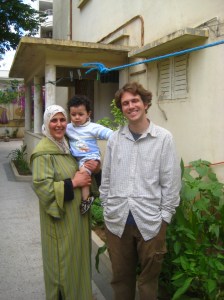
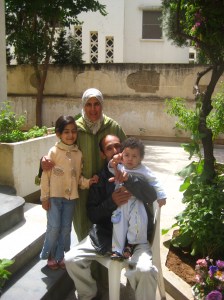
Said Muhammad, Saida Fatima, and their two kids, Maryam and Yusef.

img_2111

This man, whose name I have unfortunately forgotten, makes excellent fried bread. He also helped me practice my fusha Arabic (though one of his friends suggested I ought to drop the classical stuff and just do ‘street Arabic’!)

img_1090

A zellij craftsman over in the Andalusian quarter.

img_2131

You Think the Police State Only Targets Brown People?

Think again, comrade. And you thought it was bad when they stuck political dissenters in “free speech” zones- ie cages. Now, at least in St. Paul, they’re not even bothering to give lip-service to such out-moded concepts as free speech- just bust down the doors and arrest the dissenters. I mean, it’s worked for other states, why not here? Don’t you know there’s a war on, comrade?

From Glen Greenwald’s article:

Jane Hamsher and I were at two of those homes this morning — one which had just been raided and one which was in the process of being raided. Each of the raided houses is known by neighbors as a “hippie house,” where 5-10 college-aged individuals live in a communal setting, and everyone we spoke with said that there had never been any problems of any kind in those houses, that they were filled with “peaceful kids” who are politically active but entirely unthreatening and friendly.

In the house that had just been raided, those inside described how a team of roughly 25 officers had barged into their homes with masks and black swat gear, holding large semi-automatic rifles, and ordered them to lie on the floor, where they were handcuffed and ordered not to move. The officers refused to state why they were there and, until the very end, refused to show whether they had a search warrant. They were forced to remain on the floor for 45 minutes while the officers took away the laptops, computers, individual journals, and political materials kept in the house.

Good Counsel

Hattiesburg, MS, August, 2008.

Please pray for the Gulf Coast region, especially New Orleans, as yet another hurricane bears down, maybe worse than the last one. I only moved from South Mississippi a few weeks ago, and in the intervening space it seems like my home region can’t stay out of the news, and it’s not been good news.

Lord have mercy, Lord have mercy, Lord have mercy.