Surah al-Kawthar, Part Two, i.

The tafsir of al-Tabrisi, continued, this time from the largest section, dealing with the overall ‘meaning’ of the surah. Below is his interpretation of the first verse; the next two will follow in a few days.

On the Meaning (al-ma’anā)

[v. 1]

God addressed His Prophet regarding the enumeration of His benefit upon him, saying, ‘We gave to you al-kawthar.’ They [the exegetes] differ regarding the interpretation of al-kawthar: it is said, it is a river in Paradise. On the authority of ‘Aisha and ibn ‘Umar, ibn ‘Abās said: ‘When [the surah] ‘We gave you al-kawthar’ descended (nazalat), the Prophet of God, peace and prayers of God be upon him, ascended the minbar and recited it to the people. When he descended (nazala), the people asked: “O Prophet of God, what is that God gave you?” He replied: “A river in Paradise, whiter than milk, straighter than an arrow shaft, its brim is [made of] domes of pearl and sapphire. A green bird returns to it which possesses necks like the necks of the long-necked camel.” They said: “O Prophet of God, what are the benefits of this bird?” He replied: “Have its benefits not been reported?” They replied: “Nay.” He said: “Whoever eats this bird and drinks the waters, he attains the good will of God.”’ And it is related, on the authority of Abū ‘Abd Allāh, that he said: ‘A river in Paradise, He gave His Prophet, peace and prayers of God be upon him, as compensation for his son.’ And it is said: it is the basin of the Prophet, peace and prayers of God be upon him, upon which the people on the day of the Resurrection are more numerous than a gift.

And ’Ans said: ‘One day the Prophet of God, peace and prayers be upon him, provided for us a clear and certain proof which he manifested to us when he was taking a nap then lifted his head smiling. So I said: “What made you laugh, O Prophet of God?” He replied: “There just now descended to me a surah,” then he recited Surah al-Kawthar, then said, “Do you understand what al-kawthar is? We replied: “God and His Prophet know!” He said: “It is a river which my Lord has promised to us, upon it is goodness in abundance; it is my basin to which my community will return on the day of the Resurrection. Its vessels are of the number of the stars of heaven. Then the horn [of the angel of the Resurrection] will stir them, and I will say: O Lord! Verily they are my community. He will say: ‘You do not know what they brought about after you.’” [This hadīth] is related by Muslim in the Sahīh.

And it is said that al-kawthar is abundance of good things, according to ibn ‘Abās, ibn Jabīr, and Mujāhid. And it is said that it is prophecy and the Book, according to ‘Ikrama. It is said it is the Qur’an, according to al-Hasan. It is said it is abundance of companions and adherents according to Abū Bakr ibn A’īsha. It is said it is abundance of descendents and progeny; that is, the abudance of his progeny is manifested from the sons of Fātima, so that their number is without reckoning, and He joined to the day of the Resurrection the prolongation of them. And it is said it is intercession, as related by al-Sādiq and al-Lafaz. And all [of what has been mentioned] is possible, so it is incumbent that one tolerate all that is mentioned from the various opinions (al-aqwāl)- so God, exalted and glorified is He- has given him abundance of good (al-khayr al-kathīr) in this world and promised him abundance of good in the Other World, and all of these opinions are an elaboration of this summation- that it is abudance of good things in the two worlds.

Surah al-Kawthar, Part One

Introduction

Surah al-Kawthar is one of the short, somewhat enigmatic final surahs of the Qur’an. Despite its brevity, it contains several matters that proved to be of abiding interest to medieval exegetes: curious vocabulary (including two hapax legomenons), somewhat odd syntax, and the common Qur’anic problem of what feels like a background narrative informing the surah. However, as is so often the case in the Qur’an, no narrative is actually supplied by the text; no context at all is forthcoming in the text itself. It was the task of medieval exegetes to supply an informing narrative to explain the ambiguity of these short verses. Thus within a short space the exegesis of Surah al-Kawthar provides an excellent example of many of the concerns and techniques of medieval Muslim commentators. It also presents a concise introduction to the problems of translating and interpreting the Qur’an, and how those two concerns intersect. I will be presenting here, over the next few weeks, several samples of medieval exegesis dealing with this surah, drawn from a wide range of commentary styles. My hope is that this selection of material will provide interested readers with a taste of some of the many ways in which medieval Muslims interacted with their sacred text. And while I am not as conversant with contemporary Muslim approaches to the Qur’an as I am with medieval approaches, modern Islamic commentary on the Qur’an tends to be much more in continuity and in conversation with the medieval tradition than, say, most contemporary Christian approaches to the Bible. Hence an understanding and appreciation of medieval Islamic exegesis is arguably key for better understanding between contemporary Muslims and non-Muslims, particularly between those of us who also have sacred scripture and its community-based interpretation at the center of our faith and practice.

My choice for an introduction comes from the Qur’an tafsīr (commentary) of Fadl ibn al-Hasan al-Tabrisī (b. 470/1077-8, d. 548/1154), the Majma’ al-Bayān fī al-Tafsīr al-Qur’ān. Al-Tabrisī (sometimes vocalized al-Tabarsī) was an Imani Shi’a, but his tafsīr drew extensively upon ‘mainstream’ Sunni traditions, and represents a culmination of the classical Sunni tafsīr tradition that had been taking shape for several centuries before. His tafsīr makes for a good introductory text due to both its mid-point location in the medieval exegetical tradition, and because of his acute sense of organization. Helpfully, al-Tabrisī divides his material into sections according to the exegetical content. Hence particular grammatical or syntactical issues are given their own section; differences in voweling of the text are assigned a section; and the overall ‘meaning’ of the text is given the (usually) longest section. I have done my best at rendering the grammatical explanations into English; these are, for me, more difficult both to understand and even more so to translate. Nonetheless, these somewhat obtruse matters are vital parts of Qur’an tafsir. Indeed, grammatical exegesis was, for some medieval exegetes, the chief function of tafsīr, a concern that becomes more understandable in light of the emerging doctrine of the inimitability of the Qur’an. In contrast, in some ways, to the concerns of many medieval Christian exegetes, the specific linguistic content and nature of the Qur’an was generally of extremely high importance to Muslim commentators, resulting in very close attention to the intricacies and obscurities of the text’s grammatical and syntactical workings. The fact of the Qur’an’s being in Arabic was not incidental for the Muslim exegete; rather, it was fundamental to his understanding and interpretation of the text.

Closely related to concerns of grammar and syntax, issues of vocabulary are somewhat easier to convey in English, but still present a challenge. For instance, in this surah, the stand-out word is the eponymous term al-kawthar, which I have left untranslated everywhere it appears. My reason for doing so should become clear: there is no consensus what this Qur’anic hapax logomen means. According to some authorities, it means ‘abundance [of good]’; for others, it is a place in paradise- either a river, or a basin of water. And then there are more interpretations: by the fifteenth century, al-kawthar had been assigned almost every imaginable signifaction from the conceptual world of Islam. Al-Tabrisī provides the reader with many of them, instead of trying to reduce the tradition to a manageable homogeny, he presents the somewhat over-grown feeling diversity of interpretations. This ‘decentralized,’ multivalenced quality is in fact central to the nature of the tafsīr tradition, and is not simply due to editorial timidity on the part of a given exegete.

As for the other issues that arise in the context of this sample of tafsīr, I will address them point-by-point in my ‘super-commentary’ on the tafsīr. My comments appear in {brackets}. I have divided al-Tabrisī’s exegesis into two halves, the first of which is below, the second of which I will post in the next day or two. Also, in conjunction with this project, I am developing a bibliography and a glossary of terms, both of which will address the history of Qur’an interpretation and wider issues of medieval exegesis, Muslim, Christian, and Jewish. And as always, if you have a question, comment, or correction, please let me know.

Fadl ibn al-Hasan al-Tabrisī. Majma’ al-Bayān fī al-Tafsīr al-Qur’ān. Volume 4. Qum: Maktabat Āyat allāh al-‘uzma al-Mar’ashī al-Najafī, [1983]. 548-550.

Surah al-Kawthar

[This surah is] Mekkan, according to ibn ‘Abās and al-Kalbī. [It is] Medinan according to ‘Akrima and al-Dahāk, and it is three verses in toto.

{Surahs, fairly early on, came to be grouped according to their reputed place of revelation: either Mekka or Medina. However, as evident from what al-Tabrisī tells us, there was often lack of agreement on the correct provenance.}

On Its Virtue (fadluhā):

According to the hadīth of my father, whoever recites it [the surah], God will give him to drink from the rivers of Paradise, and He gives of the wage according to the number of each sacrifice the servant presents Him in the day of ‘Eid, and they draw near to the people of the Book and the associators. Abū Basīr, on the authority of Abū ‘Abd Allāh, said: whowever recites ‘Verily, we gave you al-kawthar…’ in his obligatory prayers and in his superogatory prayers, God will give him to drink on the day of resurrection from al-Kawthar, and his spokesman is Muhammad.

{The ‘virute’ of a surah is a relatively late component of the tafsīr tradition that seems to have become ‘mainstream’ in the eleventh century, though not without dispute. The shorter surahs especially would come to be associated with all sorts of gracious benefits that God would bestow upon whoever recited them. Some of the benefits, as here, are directly related to the content of the verse; others, particularly the final very short surahs, would convey the same spiritual (and perhaps temporal) benefits as reciting the entire Qur’an. This somewhat magical use of the Qur’an was not limited to recitation: amulets and other incantational devices were prescribed by quite orthodox ‘ulama, including as rigorous a man as ibn Kathīr, disciple of the hardline reformist ibn Taymiyya.}

On Its Interpretation (tafsīruhā)

God condemns in this surah the one who abandons ritual prayer and forbids almsgiving, and He mentions in this surah that those who did that lied to him [Muhammad], so He gave to [Muhammad] plenteous good things and commanded him with the observance of the ritual prayer, saying: ‘In the name of God the compassion, the merciful: Verily, we gave to you al-kawthar, so pray to your Lord and offer sacrifice; verily, the one who hates you- he is cut off.’

On the Vocabulary (al-lugha)

Al-kawthar is [of the pattern] fū’al from [the word] al-kathira, and it is the thing which is, in this matter, in abudance- al-kawthar is abudance of good things and gifts, in two aspects: the gift of conveyance of property, and the gift of other than the conveyance of property. So He gave him al-kawthar, [that is] He gave him conveyance of property just as He gave the wage, and it originated in a gift which one gives when one receives [something]. And the one who hates (al-shānī’) is the hateful one, and the ‘one cut off’ (al-abtar), it originated from the ‘cut-off’ donkey. And he is cut off, sinful. And in the hadīth of Zīyād: he delivered a cut-off address, because he did not praise God in it and did not pray for the Prophet, peace and prayers be upon him.

On the Expression (al-a’rāb)

And [the imperative verb] ‘sacrifice,’ its object is omitted, that is, [it would be] ‘Sacrifice your animal intended for sacrifice,’ just as the pronoun is omitted in his saying ‘They are the clan that envy slows down,’ that is, envy slows them down, that is, that they are connected to slowness. As for the His saying: ‘The one who hates you, he is cut-off’: the missing syntactical element is ‘not you,’ that is, ‘he is the one cut off, not you,’ because he mentioned you, significantly, in the nominative. ‘I mentioned:’ I mentioned with me [?] and ‘divided, cut-off,’ are predicates of a nominative clause.

{I am unclear on the final sentence of this passage; however, the basic gist of this passage should be clear. Al-Tabrisī senses that for some of the surah’s clauses certain elements seem to be missing, a common occurrence in the Qur’an. Hence supplying missing syntactical elements (taqdīr) would become a central concern of most exegetes; sometimes the missing elements are fairly obvious and unproblematic. Elsewhere the exegete can considerably modify the sense of the text by supplying what he deems to be missing- which may or not be the case here.}

On the Sending Down (al-nazūl)

It is said that this verse descended regarding al-‘As ibn Wā’al al-Sahmī, that he saw the Prophet of God, peace and prayers be upon him, leaving the mosque (al-masjid), then the two encountered each other at the door of the Banu Sahm and spoke with each other. And people of Quraysh were sitting in the mosque and when al-‘As entered they said, ‘Who were you talking with?’ He replied, ‘The cut-off one (al-abtar).’ Before this, ‘Abd Allāh, the son of the Propeht of God, peace and prayers be upon him, had died (and he was the offspring of Khadīja). And they used to call whoever did not have a son ‘cut-off’ (abtar), so Quraysh called him ‘cut-off’ and ‘one who cuts off’ due to the death of his son, according to ibn ‘Abās.

{As I mentioned above, many verses of the Qur’an seem to have a story of some sort behind them, either as part of the structure of the verses, or as a story lurking behind them, as here. Medieval exegetes sensed a need for narrative in both the narrative absences and elipses, and in the seeming narrative behind a verse’s revelation. The latter- the ‘why’ of a verse’s revelation- fits in a particular category, asbāb al-nuzūl, ‘causes of revelation.’ In this case, the story about Muhammad’s mocker al-‘As explains why the enigmatic third verse was revealed: as a clever rebuke. Not all verses, or even most verses, have asbāb al-nuzūl, and as we will see in the next installment, there are other ways a verse can be inserted in a narrative.}

Itching for an Answer

The following are two fatwas- legal opinions issued by a mufti, a Muslim jurist qualified in both knowledge and application of Islamic law- from a multi-volume collection of fatwas of Maghrebi, Andalusian, and Ifraqian origin. The collection was compiled in the fifteenth century, but the fatwas apparently range in dates. Unfortunately, the editorial apparatus gives little indication of exact date or place of origin; only in certain cases does internal evidence provide clues to those sorts of things. However, these fatwas are filled with interesting insights into both the process of Islamic law in the Muslim Far West and into the concerns and exigences of these communities (for instance, in these, dermatological problems…). I hope to translate and share several more sets of fatwas from this collection in the coming weeks and provide a taste of both of these aspects, and hopefully shed some light on the how and why of medieval Islamic legal reasoning and concerns.

So here is the first fatwa I’ve selected, followed by my commentary. I should warn you, however, the subject matter is a little, well, icky:

[Scratching Scabbies in the Mosque]

Sīdī Ahmad al-Qabāb asked about a man who had many scabies on him (bihi jarab kathīr), so that when he went to the mosque for ritual prayer he itches them so that the skin peelings (qushūr) of the scabbies fall off in the mosque, and he is not able to desist from that. Is it permissible for him to enter the mosque or not?

He answered: I did not find any text about this! (lam ajadu fīhā nassan) But if he prays outside the mosque with their prayers if he is capable, it is a precautionary for him.

*

This first fatwa is quite short, and the mufti does not provide us with a great deal of transparency in his legal reasoning for his opinion. But it raises a couple of important issues in medieval Islamic law: first, questions of ritual purity and bodily propriety. As we will see from the second fatwa, the fact that our unfortunate scabies sufferer is not only scratching vigorously but transgressing the ritual space of the masjid with his skin peelings is a problem- or at least our mufti thinks it is a problem, with the condition that he has found nothing written about it. That is, and this is the second important issue raised here, he can find no legal precedent that addresses this problem. While he doesn’t tell us as much here, the succinct opinion he gives is built on analogy with other rulings concerning bodily propriety and the transgression of ritual space with bodily fluids and other forms of ritual impurity. This process of analogy from previously established cases to a new one is one of the central elements of Islamic law, and part of the flexibility and multi-valency of the legal process.

[More on Scratching]

Sīdī ‘Abd Allāh al-‘Abdūsī asked about a man with an itch during ritual prayer, so that he scratched a lot on account of that, but did not interfere with either the words or external actions of the ritual prayer. So should he start the ritual prayer over or not?

He answered: As for itching during ritual prayer, if on account of necessity it occurs to him in that he is incapable of desisting, and if the pain would distract him if he did not itch, then [scratching] is permissible to him and he does not impair his ritual prayer, unless he greatly prolongs [the scratching] or it distracts him so that he does not know what he is praying- then his ritual prayer would be voided. But if necessity does not compel him, but rather he scratches purely out of pleasure, that is disagreeable. And in the Traditions six [things] are from Satan, that is, on account of him, and scratching is mentioned [among them]. So then, if he prolongs greatly or it distracts him so that he does not know what he is prayer, he ought to start over, and if not, then no.

I said: The master, God’s mercy be upon him, did not discourse about what fell from the skin peelings of the scabbies due to this scratching since he wasn’t asked about that. But the answer for Sīdī Ahmad al-Qabāb has preceded it earlier in this volume.

*

Here we see, not concerns with ritual purity as such, but with the intention and action of ritual prayer. The question is: does this man’s persistent scratching invalidate his prayers? The scratching would invalidate his prayers, our mufti says and the questioner implies, if it was so intense that he could no longer pay attention to what he was saying and thus would be unable to register the significance of the words. In other words, the validity of ritual prayer is contingent on one’s active cognition of it. Mere repetition without registering is not enough; mumbling through the words while being overwhelmed by a wave of itching would necessitate stopping and resuming later- presumably once one’s itch had subsided… However, in the interest of what a Christian canonist might refer to as economy, some distraction, if it cannot be avoided, is permissible, provided one can still keep his mind (mostly) on prayer.

Tafsir Interiorized and Acted Upon

The following passage, which I came across (already translated into English, al-hamdulillah...) in Vincent J. Cornell’s excellent and engaging study, Realm of the Saint: Power and Authority in Moroccan Sufism, offers a lovely snapshot into the process of scripture engagement, the use of tafsir (commentary) and hadith, in the life of a twelfth-thirteenth century Maghrebi Sufi, Abu al-‘Abbas al-Subti (born in Sebta, or Ceuta if you prefer). One of the things that has recently begun to interest me is the way in which Sufi readers of the Qur’an- formal exegetes and others- tend to interiorize and ‘personalize’ the text of the Qur’an to a degree that more ‘traditional’ tafsir-composers do not, at least not within their text. This is not to say that other tafsir-writers are not striving for an interior and external ‘inscription’ of the scriptural text: I think they are, as well as a broader ‘inscription’ of the Qur’an and its interpretation upon the whole of Islamic life and doctrine. But this is done in a different manner from Sufi exegetes/readers (the line is of course blurry or non-existent; on a certain level, to read with some consciousness and desire for application is to do exegesis, whether in a formal tafsir setting or not) .

The following text is a good example of what I am trying to get at (and there is of course a lot more going on it besides the use of scripture I am interested in here). In it al-Sabti describes for us a very personal experience of a particular verse, in which he feels as if it is he himself whom God is speaking to; this textual-personal juncture leads him to the exegetical tradition, which in turn leads him further into the exegetical/para-exegetical tradition of hadith. His application of this whole complex of scripture and exegesis/tradition is deeply personal and interiorized while simultaneously rooted in traditional sources. His personal reception, via tradition, of the text then leads him to a very physical, ‘real-world’ inscription of the text. Finally, he describes two further explorations of the same verse, which has become so deeply ingrained/inscribed in his person. These two further explorations are conducted in ‘meditation’ which al-Sabti does not explicitly tie into any given exegetical or otherwise tradition. Here he presents himself in a sort of direct dialogue with the verse, though we should keep in mind- as al-Sabti would probably be himself pleased to remind us- that his engagement even on the level of ‘direct meditation’ would still lie within a whole matrix of exegetical tradition, textual context, and his own years of performing and speaking and meditating upon this particular verse. The sacred text has its own potency here, one which is certainly harnessed and guided and augmented by other factors- al-Sabti’s acts of interpretation and embodiment, for instance- yet also retains its own power, its own direction, that carries al-Sabti along for many (apparently quite productive) years.

*

I found a verse in the Book of God that had a great effect on both my heart and my tongue. It was, ‘Verily, God commands justice and the doing of good.’ I pondered this and said [to myself], ‘Perhaps [finding] this is no coincidence and I am the one who is meant by this verse.’ I continued to examine its meaning in the books of exegesis until I found Gharib at-tafsir, which stated that [the verse] was revealed when the Prophet established brotherhood between the Emigrants (muhajirun) and the Helpers (ansar). They had asked the Prophet to establish a pact of brotherhood between them, so he commanded them to share among themselves. In this way, they learned that the justice commanded [by God] was through sharing. Then I looked into the saying of the Prophet: ‘My community will be divided into seventy-two sects, all of which will be in the Fire except the one followed by me and my companions,’ and found that he said this on the morning of the day that he had ordered the pact of brotherhood [to be established] between the Emigrants and the Helpers…. So I understood that what he and his companions adhered to were the practices of mushatara and ithar. Then I swore to God Most High that when anything came to me I would share it with my believing brethren among the poor. I followed this practice for twenty years, and this rule affected my ideas to the point where nothing dominated my thoughts more than uncompromising honesty (sidq).

After I had reached forty years of age, another idea occurred to me, so I returned to the [original] verse and meditated upon it, and discovered that justice was in sharing but that true goodness (ihsan) went beyond that. So I thought about it a third time and swore to God that if anything, small or large, came to me, I would keep one-third and expend two-thirds for the sake of God Most High. I followed this [practice] for twenty years, and the result of that decision among humankind was [both] sainthood (wilaya) and rejection; I would be venerated by some and rejected by others.

After twenty [more] years, I meditated on the first obligation of the station of goodness (ihsan) required by God Most High for His worshipers, and found it to be gratitude for His bounty. This is proven by the emergence of the instinct toward good at birth, before the acquisition of either understanding or intellect. I then found that eight grades of behavior were required for charity and that seven other grades [were required] for ihsan in addition to [those required for] justice. This is because for oneself is a portion (haqq), for the wife a portion, a portion for what is in the womb, for the orphan a portion, and a portion for the guest… Once I arrived at this degree, I swore an oath to God that whatever came to me, whether it be little or much, I would keep two-sevenths of it for myself and my wife and [give up] five-sevenths to the one for whom it was due.

Abu al-‘Abbas al-Subti

The Good Tree of the Heart

The following is an excerpt from the Qur’an commentary of the important eleventh-century Sufi writer al-Sulami, who wrote a prodigious number of texts, the most significant- in terms of later use and emulation- where the tafsir excerpted here and his Tabaqat al-Sufiyya, a collection of biographies of Sufis of preceding generations. Much of his work- such as the example here- involves compiling and reworking material from previous Sufis (and other sources); some of it, including- perhaps- the final paragraph here, are al-Sulami’s own compositions. At any rate, al-Sulami represents a consolidation of the early stages of Sufi thought and practice, as well as the reconciliation- or attempt at it- of conflicting or divergent strands of Sufi teachings and other forms of mystical practice.

I thought this selection gives a quite readable and approachable example of how eleventh-century Sufis are doing Qu’ran commentary; instead of the specialized grammatical and syntactical vocabulary of ‘conventional’ commentaries, Sufi technical terms are worked into the exegesis, at once reinforcing Sufi concepts and practices with Qur’anic dicta, while also ‘Sufi-ising’ the Qur’anic text itself. Another significant difference in all early Sufi tafsir, and even most later ones, is the selective nature of Sufi commentaries. Rather than go verse by verse, they select certain verses as locii for interpretations and explanations, usually- though not always- forgoing more conventional explanations for an interpretation that ties the text into Sufi understanding and practice. The following is an lovely example that also reveals the relative freedom and resulting artistry this particular exegetical technique can unlock.

To make the translation a little clearer for those not familiar with Sufi terminology, I have placed expansions of certain terms in brackets. Some words are simply impossible to really get across; a couple- including the bit about the wind blowing upon (or blowing into place?) a ‘mark’ on the heart- I don’t exactly understand myself. That’s part of the fun: and quite possibly the intended experience.

*

His saying, mighty and glorious is He: ‘And the likeness of a good word is a good tree.’ (Q. 14.24)

Ibn ‘Ata’ said: The good word is ‘No god but God’ in regards to the assertation, and the good tree is the triumphing of the secrets (asrār) of the professors of God’s oneness over the filth of desires, through faith in God, and through the cutting off for His sake of whatever is other than Him.

Muhammad bin ‘Alī said: the good tree is faith, God establishing it in the hearts of those He loves, and He makes its earth congruity [with His commands], its leaves sainthood/governance, its sky assistance, its water soliciting guidance, and its branches sufficiency. Its leaves are sainthood, its fruit union [with God], its shade intimacy. Its branches (aghsānuhā) are rooted firmly in the heart/core of the friend/saint, and its twigs (farū’uhā) are firmly rooted in the sky, through the superabundance of the presence of the Omnipotent. The root tends to the branch through continuious compassion and watchfulness, and the branch guides the root through what is gathered from the state of witnessing and proximity [to God]; thus, the heart of the believer and his benefits is disclosed.

I heard Muhammad bin ‘Abd Allah al-Damashqī saying: I heard ibn al-Mawlad saying: Abū Sa’īd al-Khrāz said: the treasures of God in the sky are the unseen (al-ghayūb), and His treasures upon the earth are hearts. For God the Exalted created the heart of the believer as a house of His treasures, then sent a wind which blew upon it a spot of unbelief, associationism (shirk), hypocrisy, and deceit. Then He created praise, and it rained down in [the heart], then He firmly roots in it a tree. Then it bore fruit of good pleasure [with God], love, gratitude, purity, sincerity, obedience- so His saying ‘Like a good tree its root is firmly established and its brances are in the sky.’

Some say: Every tree in this world below, whenever it does not have its portion of water, it dries up. And the tree that is in your heart dries up whenever you do not water it with the water of repentance and the water of remorse, then with the water of sorrow, then with the water of holy desire. Then come clouds of grace, and they rain upon your heart the rain of [divine] mercy until there is the water of service [to God] beneath and the water of [divine] mercy above, so that it will be fresh and pleasant. Then three things come: the way of servanthood in the lower self (fī ‘l-nafs), the way of praise in the heart, and the way of remembrance (dhikr) in the secret (al-sirr). The service of the lower self is obedience, the service of the heart is intention, and the service of the secret is continual watchfulness. Then there rains upon it, rains upon the lower self the rain of guidance, upon the tongue the rain of subtletly, upon the heart the rain of sublimity, upon the secret the rain of grace, upon the spirit the rain of nobility. Then there sprouts from the rain of the tongue gratitude and trust; from the rain of the lower self obedience and piety; from the rain of the heart truthfulness and purity, and from the rain of the secret, holy desire and diffidence; and from the rain of the spirit, vision and encounter [with God].

Abū ‘Abd al-Rahman Mahmud bin al-Hussayn bin Mūsā al-Azdī al-Sulamī, Haqā’iq al-Tafsīr, Vol. 1 (Beirut: Dar al-Kitab al-‘Almīa, 2001), 344.

On Smashing Walls of Sugar

Another singular little story from the Kitab al-Futuwwa of the thirteenth century Sufi al-Ardabili; this one is one of the odder stories I’ve come across, and that’s probably saying something. I think the moral is that, first, delicacies are bad for spiritual health, as the immediate context is warnings (through rather more clear stories) against indulging in ‘soft’ living. However, I suspect that the story could also be a parable about the transitory nature of this-world (al-dunya). Maybe.

*

Abu ‘Abdallah al-Rudhabari said: Abu Ali bought a load of white sugar, and called a group of confectionists, and they made from that sugar a wall out of sweets, and upon it were balconies, and in the wall were mihrabs [carved] in columns and with variegation of colour- all of it from sugar! Then he called to the Sufis so that they might raze it, smash it, and pillage it.

al-Ardabili

*

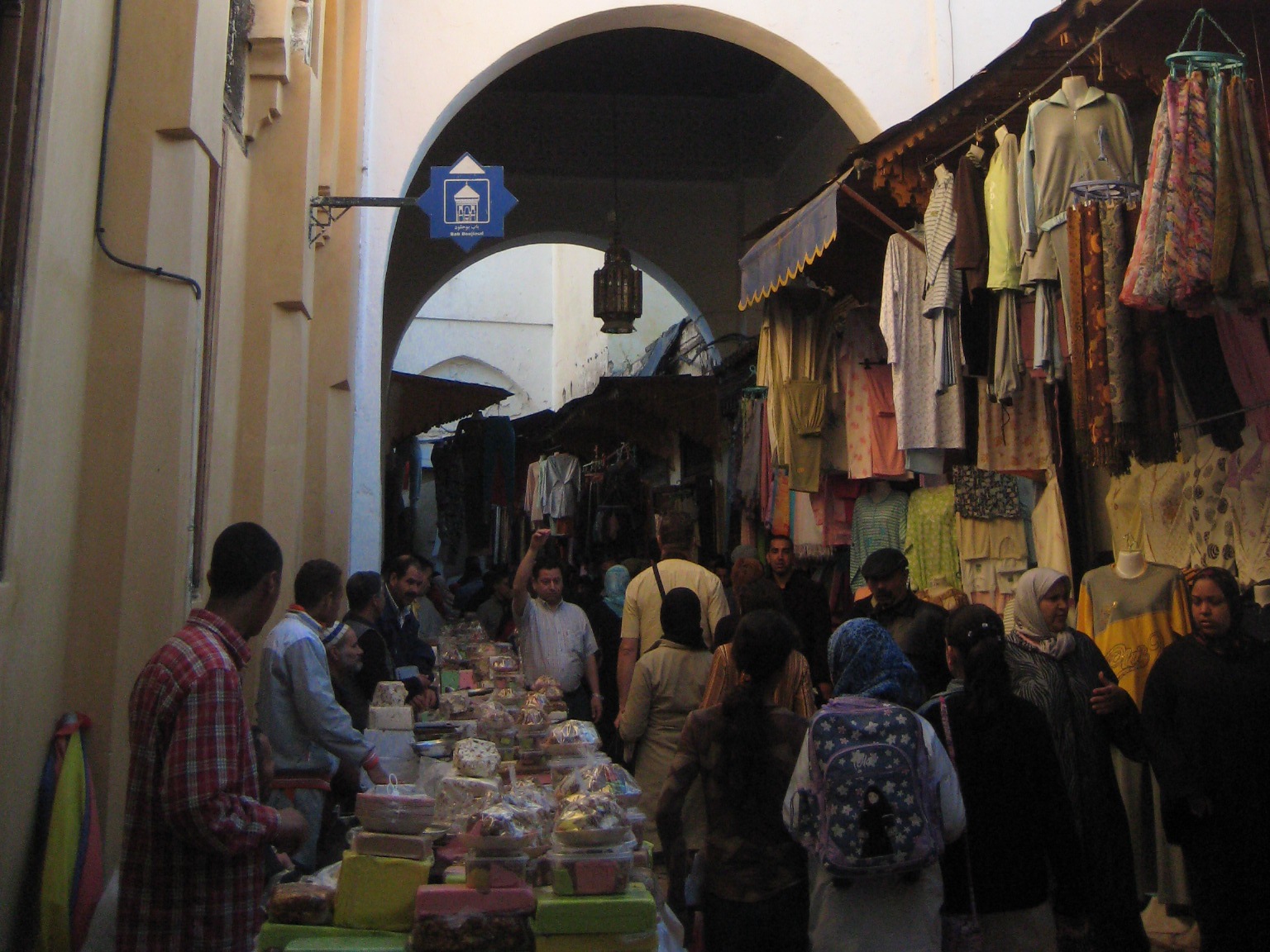
Sweetmeat sellers in the street alongside Qarawiyyin Mosque, Fes, Morocco. The brightly coloured sweets you see here are the sort I imagine (though don’t know, not being up to speed on thirteenth century candy-making….) composing the wall in the story- if so, they were pretty tought to tear down, as these things are quite a task to eat!

Smashing Your Idols and Forgetting Your Prayers

These short texts are excerpts from two medieval Sufi texts, one by the important formative-period Sufi author and biographer al-Sulami; the other by an early-thirteenth century, and rather less known, Sufi writer named al-Ardabili. The poetry by al-Shibli is from al-Sulami’s biography (in his Tabaqat al-Sufiyya) of that early Sufi master; the second is from a brief work of al-Ardabili’s titled Kitab al-Futuwwa, the Book of Futuwwa (virtuous youngmanliness is one possible translation of this rather amorphous complex of values and practices). The second text especially struck me as an illuminating and succinct example of early Sufi ‘allegorical’ (or perhaps more aptly, ‘typological’) use of scripture.

*

Today I forget my prayers because of my impassioned love-
I do not know my morning from my evening-
Remembrance of You, my Lord, is my food, my drink,
And Your face, if I see, is the cure of my disease.

– al-Shibli

*

Ja’afar bin Nasīr al-Khladi said: The virtuous young man (al-fatā) is he who slays the enemy of the Beloved, for the sake of the Beloved, and on account of this He spoke of Ibrahim- upon him be peace- when he turned the idols into tiny pieces (ja’ala al-asnām jadhādhan) and broke them. They said: ‘We heard a young man (fatā) called Ibrahim mention them.’ (Q. 21.60) And the idol of every one is his nafs [the lower, passionate ‘self’] and his passions, and when he smashes his nafs and is at enmity with his passions, he is worthy of the name of futuwwa.

Al-Hārith al-Muhāsbī said: Futuwwa is that one acts justly yet does not demand justice [for himself], and expends freely yet does not take.

– al-Ardabili

It Is Written

Where and how scripture shows up- literally, on what surfaces, in what media- is something that interests me as much as the question of how it is being used in ways we recognize more readily as ‘textual.’ These are some textual/architectural/public uses of scripture I’ve come across; their application of the scriptural voice is at once similar to and different from more ‘conventional’ employments of scripture, whether in sermon, commentary, theology, liturgy, etc. These sorts of public, ‘architectural’ inscriptions operate on different levels, speaking on different registers, depending on their surroundings while also penetrating their surroundings and forming them (much as sacred scriptures both shape the reader/exegete even as she shapes them). Where these texts appear works hand in hand with the texts’ significance within the wider tradition, as this sampling hopefully shows. As usual, I am very much thinking out loud here, and have only given this topic the briefest of thought, though it deserves a lot more.

*

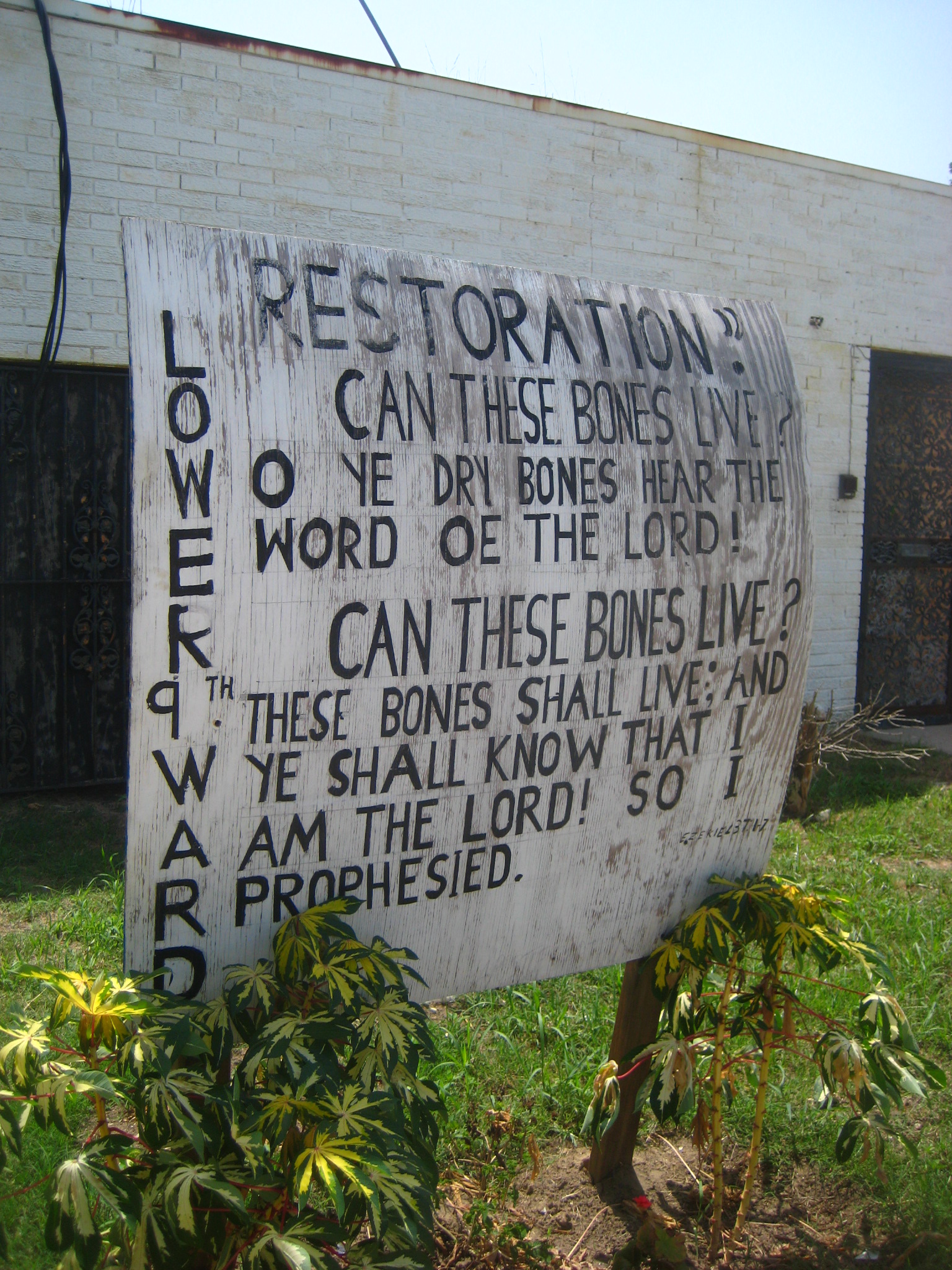
Lower Ninth Ward, New Orleans, Summer 2008: The scene: big swathes of empty green, where there used to be a neighborhood. There are hardly even bones here now, or if there are they lie beneath the switchgrass and caney reeds and brush. The air is thick, heavy, silent, except for a thudding hammer from one of the few centers of human habitation left here. The text is also crying out, even if its voice looks a little muffled, the vicious heat and humidity of the Deep South no friend to plywood and ink. No matter. The emotional power of the original passage is amplified here in this space of dry (or wet and humid perhaps) bones; it fits the place and fits the place to it.

Sihrij Madrasa, Fes, Spring 2009: This is a somewhat neglected Marinid madrasa (these madrasas being rather more like dorm complexes for the educational activities that took place in the neighboring mosques); but the calligraphy is still bright and compelling. It of course fits the space: besides the continual pre-eminence of the Qur’anic text in Islamic societies, the institutional setting makes the choice of Qur’anic text (operating both as edificational/educational material and edifying decoration) all the more apt. As the students- whose study would consist primarily of Qur’an and hadith- come in and out of the space of the madrasa, the selected texts of the Qur’an (which unfortunately cannot here identify- if anyone in Fes who might happen to read this would like to go by and transcribe, that would be truly wonderful) would become part of the architecture of the student’s daily life, daily perception, daily thought, action. Written on the wall, written on the heart…

Lower Ninth again. The text resilient, always speaking, in the midst of storm, decay. The flowers of the field may fade…

Moulay Idriss Shrine, Fes: This is one is rather different from the madrasa. The calligraphy is somewhat sparser, and the setting is not an enclosed, institutional- particular- space, but is on an external wall. Albeit still within the sacred precinct of the shrine, this now worse-for-the-wear (yet still holding on, like the battered scripture text of the Lower Ninth) slice of scripture shows itself to the passing crowds. It helps mark out the sacred space around and especially within it, and create it, and reflect it. Even to those passing by who are unable to literally read the text, it is readable as a particular thing, a sacralizing thing.  It is recognizable as being part of the sacred, even to those who do not know its literal, strictly textual meaning. It still works. This is, I think, one of the important parts of public scripture, of scripture made stone or wood or whatever and placed on display, grafted into signs and walls and amulets and so on. It blurs the line between literate and non-literate reception and what comes in between- all have some reception of this text, some access to its power, to its meanings, and themselves help construct the meaning.

Milk, Blood, Human Anatomy… and Qur’an Exegesis?

Last term I worked through a fairly prodigious stack of Qur’an commentaries (tafsir) dealing with vv. 66-69 of Surah al-Nahl (Q. 16):

66 And verily, you have a sign in the cattle: We give you to drink from what is in their bellies, from between stomach-refuse (farth) and blood, milk pure, palatable for the drinkers. 67 And from the fruits of the palm and the grape you take an intoxicant and wholesome sustenance; verily, in that is a sign for people who think. 68 And your Lord revealed to the bee: take from among the mountains houses, and from among the trees and from what [people] erect as trellises, 69 then eat from all the fruits, then travel on the easily treadable paths of your Lord. One takes from their bellies a drink, variegated of colour; in it is a medicine for the people. Verily, in that is a sign for people who understand.

I wrote some about my project here and here; I’m now working on a couple of new projects, one dealing with constructions and uses of the ideology/doctrine of futuwwa– literally, ‘youngmanliness,’ sometimes translated as ‘Islamic chivalry,’ a probably inapt term from what I know so far of futuwwa. My other project deals with mostly tenth and eleventh century Sufi approaches and embodiments of the doctrine/practice of tawakkul– also a difficult term to translate into English! It literally means ‘trust,’ but it conveys a very absolute trust in God, which can entail a sort of quietism and almost Dao or Zen-like avoidance of doing and being, in some ways.

Anyway, I realized that I have a great deal of translated material left over from last term, and some of it is really fun stuff (though, granted, I’ve an odd idea of fun I suppose). Some of it is in a more polished, presentable form than other passages. The one below, by Fakhr al-Din al-Razi (b. 543/1149, d. 606/1210) on part of the first verse in this passage, is definitely one of the more accessible for those not accustomed to the rather esoteric genre of tafsir, and was much easier to translate into a comprehensible form in English. Plus, al-Razi’s idea of how to do scripture exegesis is pretty entertaining- he pulls in material from all over the place, including, for this passage, long discussions of human and animal anatomy, which draw upon the conventions of good Galenic, Hellenistic medical theory and description. Al-Razi was obviously conversant in the science of his day, and draws upon in explicating the Qur’an- a process which also ties science into the Islamic scriptures, legitimizing both in a fashion. In so doing, he does come into conflict with previous exegetes- their description of the relation of the stomach-contents, blood, and milk in the stomach does not stand up to the test of science, so it has to be replaced something than does not contradict investigative observation (by which al-Razi likely has in mind the established Galenic tradition more than anything).

Besides helping to explain the verse- which task, one might argue, could have been done with rather less ink spilled!- al-Razi also induces in the reader a Qur’anically-keyed but scientifically developed appreciation for the wonders of God’s creative power and providence. Plus, I suspect, al-Razi enjoys these things and enjoys showing off his knowledge of them- a small vice, perhaps, but if so, one I and probably most of you, dear readers, are guilty of… Al-Razi concludes the passage with an interesting analogy between God’s creative transformation of food into blood into milk, and His creative transformation of the dead on the Day of Resurrection. This question of how the dead are raised is of course a very old question, going all the way back to St. Paul and his querying Corinthians. It becomes all the more pertinent for Muslims- and Christians and Jews- with the reception and valorization of Greek philosophy, especially Aristotle, which tended to cause difficulties for the doctrine of bodily resurrection. Al-Razi is aware of these problems, having been educated in philosophy and kalam (dialectical theology is one way to translate this term); his linking of scientific description and philosophical problems with bodily resurrection is, I think, quite clever. All in all, I found this a charming passage, and very revealing of how a well-educated, albeit pretty exceptional, thirteenth century Muslim could imagine both the physical world of creation and its intersection with the textual world of the Qur’an.

*

… [W]e say: The commentators say: the intention of His words: from between stomach-contents (farth) and blood: is that these three are produced in one place, the stomach-contents at the bottom of the stomach, the blood in the top, and the milk in the middle; we have indicated about that saying in regards to the difference of perception and investigative trial, because the blood, if it were produced in the top of the stomach (and in the ruminating-stomach [as well]) then it is necessary that whenever one vomits one would vomit blood- and that is certainly false! As for us, we say: The intended meaning in this verse is that milk is produced from a portion of the blood, and the blood is produced from a portion of the subtle stuff in the stomach-contents, which is the eaten stuff operative in the ruminating-stomach, and this milk is begotten from the portions which are produced in what is between the stomach-contents first, then produced from what is between the blood second, and God has clarified these thick, fatty portions, and created in them the attributes which are in view of becoming milk, beneficial for the body of the child, and this is what we have brought about on this matter, and God knows best.

The fourth issue: Know that the happening of milk in the breast and its attribution with attributes which are, in consideration of it, befitting for the nourishment of the child, consisting of wondrous wisdom and marvelous secrets, the soundness of the intellect seeing that it does not occur except by the direction of the Wise Doer, the Merciful Director, and He makes it clear in certain aspects:

First: that God created in the bottom of the stomach a ‘deliverer’ [so the literal meaning- I suppose this is some valve that I ought to recall from my undergraduate freshman year anatomy class but don’t…] from which departs the heavy stuff of food. When the person takes food or thin drink which is suitable to that ‘deliverer’ there does not depart from it a thing from that food and drink, so that its digestion is completed in the stomach, and it attracts what is made limpid in it to the liver, and the heavy stuff remains here. Then that ‘deliverer’ opens and expels the heavy stuff, and this is among the wonders which are not possible except by the direction of the Wise Doer, because whenever there is need of the retention of food in the stomach there is an occurrence which suits that ‘deliverer,’ and when the need to eject that matter from the body arises, it opens, and the happening of the application is one time, and the voiding another, by the reckoning of need, and the regulation of the ‘deliverer,’ from what does not arise except by the direction of the Wise Doer.

The second: That God placed in the liver a power [qūwat] which attracts the subtle portions occurring in that food or drink, and which does not attract the condensed portions, and He created in the bowel a power which attracts those condensed portions which are heavy, and which absolutely never attracts the subtle portions. And if the occasion on the contrary was for the differentiating of the wellbeing of the body then the order of the arrangement would be corrupt.

The third: that God placed in the liver a digestive power, so that these subtle portions would digest in the liver and turn into blood, then He placed in the gallbladder an attractive power towards yellow bile, and in the spleen an attractive power towards black bile, and in the kidney an attractive power for the increase of water, so that the blood remains limpid, befitting for the nourishment of the body. And He specified each one from among these members with that power and special quality, impossible but for the direction (tadbīr) of the Wise, the Knowing.

The fourth: that in the time in which the fetus is in the womb of the mother, there is directed from that blood a plentiful portion to [the womb], until raw matter becomes through growth members of that child and he increases in size, and when the fetus separates from the womb of the mother that portion is directed to the flank of the breast for the production of milk from it which is nourishment for the child. And when the child grows larger that portion is no longer directed to either the womb or to the breast; on the contrary, it is directed generally into the body of nourishment, and that blood flows, at all times, into other members beneficently for wellbeing- and the wisdom [of this] is not attributable except to the direction of the Free, the Wise Doer.

And the fifth: That at the production of milk in the teat, God has caused to occur in the nipple of the teat a slight keenness and a narrow pore, and for what is this pore is very narrow? For when there does not exit from it except what has the goal of purity and subtlety, and as for the condensed portions, it is not possible that they exit from this narrow regulator, so they remain inside, and the purpose in the occurrence of this slight keenness, and the narrow regulator in the head of the nipple of the breast is that, like [in the operation of] the strainer, everything that is subtle leaves, and everything that is thick remains inside and does not exit, and by this means the milk becomes pure, befitting for the body of the child, ‘palatable for the drinkers.’

The sixth: that God inspired the child to suckle; then verily the mother, whenever she feeds, bit by bit, the nipple of the breast in the mouth of the child, that child is in the state he takes in suckling, and if the Merciful, Free Doer did not inspire that small child that special state, then the sating of thirst would not occur by the production of that milk in the breast.

The seventh: we have made clear that God, however, created the milk from the remnant of the blood, and He created blood from the nourishment which the animal receives. The sheep, when it takes herbage and water, God creates blood from the subtle stuff of those portions, then He creates milk from some of the portions of that blood, then verily milk occurs in three states regarding differing natures: what is in it of oil is hot and wet, and what is in it of water is cold and wet, and what is in it of cheesiness is cold and dry, and these natures are what are potential in the herbage which the sheep eats. It is evident from this that these bodies do not cease transforming from attribute to attribute, from state to state, with some of them being incongruous with others, and some of them not resembling others, and in this you see that these states occur through the direction of a wise, merciful Doer who regulates the state of the world with regard to the suitable beneficence of the servants. So glory to Him who witnesses all of the minute particles of the world high and low in the perfection of His power and the ends of His wisdom and mercy, to Him is creating and command, God, the Blessed, Lord of the worlds!

Fakhr al-Dīn al-Rāzī, Mafatih al-Ghayb (al-Tafsir al-Kabir)

Bees, the Power of Music, and Other Wonders

I decided- yesterday, in fact- to add to my term paper on Qur’an tafsir material from Fakhr al-Din al-Razi’s (543/1149- 606/1210) massive Qur’an commentary, Mafatih al-Ghayb– Key to the Unknown, also known as al-Tafsir al-Kabir, the Great Tafsir. The later appellate is especially apt- al-Razi’s commentary is not only huge, stretching to some thirty printed volumes in one edition, but is also both wide and deep in subject matter. For the limited little bit that I am covering for my paper- verses 66-69 of Surah al-Nahl– al-Razi has a regular field day talking about the wonders of animal physiognomy and the marvels of bees. While he touches on grammatical issues, the bulk of his commentary is taken up with descriptions of digestion, blood and milk production and transportation within the body, the details of beehive construction, and where honey comes from (which, for al-Razi, is an odd mix of traditional Aristotelian speculation on ‘honeydew’ and the, as it has turned out, more accurate Qur’anic idea of honey as bee secretion). Among the wonders of the bees that al-Razi includes is one ‘wonder’ that no other commentator I have examined includes, and is a practice I have in fact never encountered anywhere else. Here is the relevant passage, first in Arabic, then in my translation:

والرابع: أنها إذا نفرت من وكرها ذهبت مع الجمعية إلى موضع آخر، فإذا أرادوا عودها إلى وكرها ضربوا الطنبور والملاهي وآلات الموسيقى وبواسطة تلك الألحان يقدرون على ردها إلى وكرها، وهذا أيضاً حالة عجيبة

‘And the fourth [wonder]: That whenever they flee from their nest and go as a group to another place, and they [the beekeepers] desire their return to their nest, they play the tanbur, music-makers, and [other] instruments of music, and in the midst of these tunes [the beekeepers] are able to return them to their nest- and this also is a wonderful case!’

Well. What appears to be going on here is a dislocated swarm, and beekeepers who wish to return the errant swarm to their nest. Such a situation in itself is not unusual, but the means our Khurisani (presumably) beekeepers employ is one I am not familiar with. It would seem that the music al-Razi describes is meant to make the bees sedate and thus manageable, similar to the use of smoke to calm bees. But beyond this brief passage, I have so far been unable to find any other examples of music being used in bee-management (I suppose that’s the right word), in any part of the world.

If you, dear reader, happen to have knowledge of a similar case, either in ‘folklore’ or Classical science or mythology or whatever, or in actual practice, please share. Besides the fact that this is a fascinating little anecdote, I am interested in uncovering al-Razi’s sources for his tafsir– is this something he has himself observed or otherwise heard about, or is it something one might find in a written source, perhaps even a translation from the Hellenistic world? God knows best…

* N.B.: My use of al-Razi, whose commentary is not available in my university’s library, has been made possible by the truly wonderful website Altafsir.com, which has a massive collection of classical tafsir online, free and easily accesible. Most are in Arabic, but there are also a few English translations. For the struggling graduate student, this is a particularly welcome resource- tafsir are usually expensive and bulky; though, nothing awes vistors to your office like an enormous Arabic tome opened on your desk…